


On 7 October 2026, I joined a licensed humpback whale watching tour from Los Órganos, on Peru’s far north coast, to see for myself what has become one of the country’s most distinctive seasonal wildlife experiences. This was peak migration season, with humpbacks gathering off Piura and Tumbes between mid July and the end of October, and the small fishing town of Los Órganos was buzzing long before sunrise.
Tour Basics: Date, Operator, Price and Logistics
I booked a shared morning tour with North Perú, a well known operator that sells whale watching departures from the Los Órganos pier through national ticketing platforms and local agencies. My trip date was Tuesday 7 October 2026, within the core humpback season that local tourism authorities list as mid July to 31 October. The advertised tour duration was around three hours on the water, with a scheduled check in at 6:00 a.m. and departure at 6:45 a.m. from the municipal pier at Los Órganos, also known locally as the Muelle de Los Órganos.
The ticket price for this particular departure was 130 soles per adult, with a discounted rate of 106 soles for travelers registered under Peru’s CONADIS system. That fare covered the boat trip, life jackets, guiding in Spanish and basic snacks on board. It did not include my transport from Máncora to Los Órganos, nor any post trip photos, which are sometimes offered by crew or freelance photographers at additional cost. At the current exchange rate in October 2026, the full fare worked out to roughly 34 US dollars for a foreign visitor paying the standard price.
I was staying in central Máncora, about 13 kilometers north of Los Órganos along the Panamericana. Because check in is shortly after dawn, arranging reliable transport is essential. My hotel front desk suggested two options: a colectivo van from the highway, costing about 3 to 5 soles per person, or a direct mototaxi for around 10 to 15 soles, depending on bargaining and the time of day. With camera gear and an early start, I opted for a prearranged mototaxi at 15 soles door to pier, which felt reasonable for the 20 minute ride in the dark.
On arrival at the pier around 5:55 a.m., I paid the separate pier access fee in cash. On recent mornings, this has been a small charge per person, typically under 10 soles, collected by municipal staff at the entrance. It is worth bringing small notes and coins for this, as neither the pier nor the mototaxis around it reliably accept cards. After check in with the operator’s team at a simple stand near the pier gates, each passenger received a colored wristband and was asked to sign a basic liability form before boarding.
Boat, Crew, Passenger Numbers and Sea Conditions
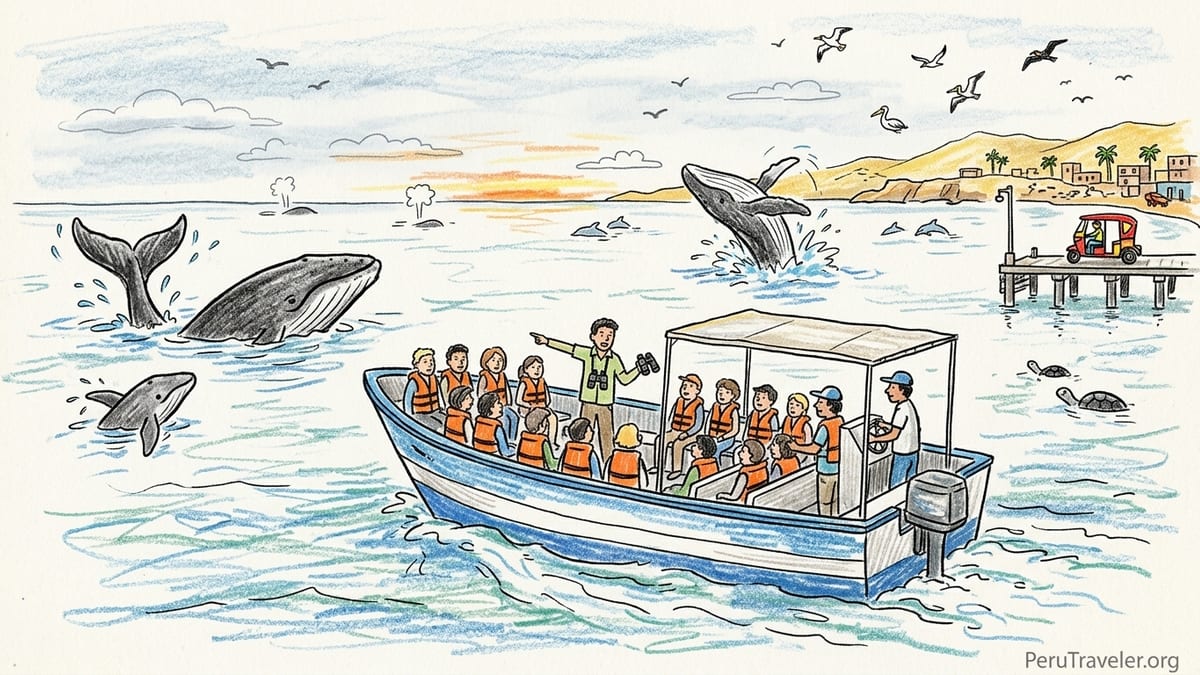
Our boat was a mid sized fiberglass launch of around 10 meters, powered by twin outboard engines and adapted for wildlife viewing with open sides and benches facing outward. On this October morning there were 18 paying passengers on board plus three crew: the captain, a deckhand and a naturalist guide. The operator caps these shared trips at around 20 to 22 people to keep weight and crowding manageable. Every seat had a foam life jacket waiting, and the crew asked each of us to try it on properly before leaving the dock.
The guide working our departure introduced herself as a marine biologist who had been collaborating with north coast whale research and tourism projects for several seasons. She explained key safety procedures, including how to stay seated while the boat was running, what to do in case of nausea and how to keep cameras and phones secure when the hull hit larger swells. Her introduction also covered basic humpback biology and a reminder that sightings could never be guaranteed, even in the heart of the season.
Weather conditions at departure were typical for early October on this stretch of the Peruvian coast. Sunrise painted a thin orange strip on the horizon while the rest of the sky stayed overcast in a soft marine layer. Wind at the pier was light, with a gentle southwest swell rolling in at about one to one and a half meters. Once we left the shelter of the bay, chop increased slightly, but the sea remained moderate. The air temperature felt cool enough before sunrise that most passengers kept a light jacket or long sleeved shirt on for the first hour, even though the day would become hot later.
The captain steered us slowly out past the end of the pier and then brought the bow around toward the open Pacific. The engines settled into a steady hum as we followed an approximate southwesterly course, leaving the shoreline behind and heading several kilometers offshore, where the seasonal humpback activity is concentrated. The guide moved along the benches, checking that everyone was comfortable and reminding those prone to seasickness to fix their gaze on the horizon and avoid reading or staring at phone screens.
The Search and the First Whale Encounters
From the moment we cleared the pier, the crew encouraged all of us to scan the water for distant blows, which look like vertical puffs of white mist rising briefly over the surface. For the first 20 minutes, we saw only seabirds and the waking coastline, which shrank into a low strip of yellow and green behind us. Around the half hour mark, the captain reduced speed, and the guide lifted binoculars to sweep the horizon. She pointed out small fishing boats in the distance, many of whose crews had also been reporting whale activity over the previous weeks.
Our first confirmed sighting came about 35 to 40 minutes after leaving the pier. Someone at the bow shouted, and all eyes followed the guide’s outstretched arm to port, where a white burst of spray rose a few meters above the water and hung briefly in the calm air. Moments later, a dark curved back broke the surface, revealing the distinctive hump in front of the dorsal fin that gives the humpback its common name. The captain eased back the throttles and allowed the boat to drift, keeping what the guide described as a legally recommended minimum distance, well over one hundred meters.
Over the next several minutes, we watched the whale exhale, arch its back and make shallow dives, appearing three or four times in loose patterns. Eventually, before a deeper dive, the animal’s tail flukes lifted cleanly into view, sending a strip of seawater cascading off the white underside before disappearing below the surface. The guide explained that the pigment patterns on these tail flukes are unique to each individual and that researchers working off northern Peru use photographs of them to build identification catalogs and track returning animals from year to year.
We stayed with this single adult humpback for roughly 20 minutes, keeping our engines at idle and quietly adjusting position as the whale surfaced again at a respectful distance. There were no spectacular breaches in this sequence, only calm breathing, slow arches and tail flukes before deeper dives. Still, the sense of sharing space with such a large, unconfined animal, hearing the soft boom of each exhalation drift over the water, was powerful and needed no theatrics.
Calves, Breaches and What We Actually Saw
After the adult whale disappeared on a longer dive, the captain conferred with the guide and decided to explore a little farther offshore, following reports from other boats by radio. We motored another ten to fifteen minutes into slightly deeper water, where the wind had picked up gently and the swell felt longer, rolling under the hull in slow, even lifts. It was in this area that we had our closest encounter with a mother and calf pair, one of the highlights of the morning.
The first sign was another blow, this time followed quickly by a second, smaller puff iust to one side. As we approached to what the guide considered a respectful stand off distance, the mother surfaced with a pronounced arch of her back, her much smaller calf close alongside. The captain kept our bow angled away, engines in neutral, so that the whales always had an easy path to move off if they chose. For about 25 minutes we watched the pair make a lazy, looping circuit, resting and surfacing in predictable rhythms without clear signs of disturbance.
The calf showed far more surface activity than the adult. Several times it rolled partway onto its side, one small pectoral fin lifting clear in a tentative slap, as if practicing movements that older whales use with much greater force. Once it half breached, launching its upper body nearly out of the water before sliding back with an energetic splash. The guide suggested that this kind of playful behavior is common in calves in their first season along breeding grounds, where they build strength and coordination before later migrations.
In terms of dramatic leaps, we saw only one full, clear breach that morning, and it was not from the mother or calf we had been watching. On the ride back toward the coast, perhaps an hour and a half after departure, another adult whale erupted almost entirely out of the water several hundred meters ahead of us, landing on its side with a heavy crash and sheet of spray. It happened so quickly that virtually no one captured it on camera. The guide explained that breaching is likely linked to communication, parasite removal or playful energy, but even during peak season there is never any way to predict when or where the behavior will occur.
Photography Challenges and the Need for Patience
Anyone expecting magazine style photographs from a half day tour needs to calibrate their hopes. Photographing whales in northern Peru is genuinely difficult, even when animals are abundant. The boat rarely stops moving entirely, the swells lift and drop the horizon, and the whales surface unpredictably. On my trip, most passengers relied on phone cameras, which struggled with both distance and motion. Only two travelers carried telephoto lenses, and even they deleted plenty of blurred or partial frames.
In practice, the most successful images came from anticipating rather than reacting. After the guide pointed out a pattern in the whales’ breathing and diving cycles, it became easier to guess roughly where and when a back or tail would next appear. Shooting continuous bursts as the whale surfaced helped too, as it increased the chance of catching a clean silhouette or the moment when a tail fluke cleared the water. Wide shots that included the boat’s rail or other passengers in the foreground also did a better job of conveying scale and setting than tight crops on distant animals.
Patience proved essential. There were long minutes when nothing happened: only open water, seabirds and the steady thrum of the engines. Some travelers seemed restless at first, but the guide used these pauses to share more about humpback migration routes, breeding behavior and the research projects that local operators occasionally support. When animals did appear, they often surfaced several times in a pattern, making the overall experience more about quiet observation than a constant stream of action.
Importantly, the crew avoided chasing animals solely for better photographs. When our boat and two other vessels happened to be within sight of the same whales, the captains kept clear lateral separation and rotated which side held the best viewing angle, a small but noticeable gesture of cooperation that reduced pressure on the animals and gave everyone a fair chance at decent views.
Responsible Operators, Routes and Safety on Board
Whale watching has grown quickly in Los Órganos, Máncora and neighboring towns, and not all operators work with the same standards. In Máncora itself, guesthouses advertise a mix of trips, some departing directly from the local beach on small open launches. Others, like North Perú and Pacífico Adventures, focus their departures on the Los Órganos pier, combining whale watching with seabird or turtle viewing and emphasizing responsible guidelines that mirror broader international whale watching codes.
On my October departure, the route followed a roughly similar pattern to other formal tours in the area: an early morning start, a steady run several kilometers offshore in search of blows, and a flexible loop that adjusted based on radio reports from other boats. Travel distances can reach up to 8 or so kilometers from shore on calm days, although captains hold closer if conditions deteriorate. The return leg usually tracks back along a slightly different line to increase the chance of independent encounters rather than repeatedly circling the same animals.
Safety equipment on our boat included life jackets for every passenger, spare vests for children, a basic first aid kit and marine radios. The guide also pointed out the location of a life ring and the emergency fuel shut off switch. While the boat did not have a full cabin, a canvas roof covered most of the seating area, providing some shade. Passengers were reminded to keep aisles clear and to avoid moving around without holding onto rails, particularly when the captain adjusted speed.
Choosing a reputable operator in Los Órganos comes down to a few practical checks. Look for teams that provide clear departure times, maximum passenger numbers, details of what is included in the price and a named guide, ideally with naturalist or marine biology experience. Ask how they manage minimum viewing distances and what they do when multiple boats converge on the same whale. You can also ask whether they adjust or cancel trips if the sea state becomes unsafe rather than pressing ahead at all costs, which is especially important for families or those sensitive to motion sickness.
Viewing Distances, Mothers and Calves and the Limits of Guarantees
Even in a region with reliable seasonal whale presence, responsible operators in northern Peru avoid promising specific behaviors or fixed numbers of animals. They may describe the overall likelihood of sightings in July, August, September or October, but they stop short of guarantees. The whales off Los Órganos and Máncora are free ranging wild animals, not captive performers, and daily conditions such as wind, currents and prey availability influence where they travel and how visible they become.
During my tour, the captain kept a consistent buffer between our boat and the whales. The guide referenced Peruvian and international whale watching recommendations that encourage operators to stay at least one hundred meters from animals, approaching only from the side and never head on or from directly behind. When whales selected their own distance by surfacing closer to the boat, the captain left the engines in neutral and waited rather than pursuing them. In one instance, the mother and calf we had been observing surfaced unexpectedly off our bow at what felt like less than this guideline distance, and the captain allowed them to pass calmly ahead before slowly turning away.
Extra care around mothers and calves was evident throughout the morning. The guide asked passengers to keep voices low and avoid sudden movements when the pair were close, explaining that noise and erratic boat behavior can increase stress for nursing or resting whales. Our captain declined to follow the pair when another boat moved in from a different angle, choosing instead to shift along the periphery and maintain a respectful triangle of space. That small decision meant shorter viewing time but aligned with the operator’s stated commitment to low impact watching.
These practices illustrate an important point for visitors. If your captain refuses to get as close as you might wish or decides to move on from a crowded sighting, it is usually a sign of professionalism rather than lack of effort. Likewise, if strong winds build or the swell steepens and the operator postpones or cancels departures altogether, that conservatism reflects genuine safety concerns on a coast where conditions can change quickly after mid morning.
Dolphins, Turtles and Other Wildlife Along the Way
The waters off Los Órganos support a broader cast of marine life, and some operators market their whale trips with images of dolphins riding bow waves or swimmers snorkeling with sea turtles at nearby coves. On my particular departure, dolphin encounters were limited and distant. At one point we saw a small group of what the guide identified as common dolphins several hundred meters away, moving in a tight arc across our path. They surfaced briefly two or three times before turning away, never close enough to create the classic bow riding scene many people hope for.
Sea turtles were more reliably visible closer to shore. As we approached the coast on our return, the captain slowed near an area where fishermen often report green turtles resting or feeding at the surface. Within a few minutes, we spotted two individuals lifting their heads above water for quick gulps of air before slipping back below. The guide reminded us that separate tours in the area focus specifically on snorkeling with turtles from nearby El Ñuro, but that on whale watching departures the animals are observed only from the boat, with no one entering the water.
Birdlife filled in many of the quiet gaps between cetacean sightings. Peruvian boobies, pelicans and frigatebirds tracked the surface, sometimes wheeling suddenly above areas where fish had gathered. While not the focus of the trip, these birds added to the sense of moving through a productive ocean environment. The guide occasionally paused to identify species and explain their own links to the cold Humboldt Current and seasonal upwelling that also concentrate humpbacks in these waters.
Crucially, none of these secondary encounters felt staged or automatic. There were no handouts to entice dolphins, no bait in the water for birds and no attempt to divert our tour into in water turtle activities. The crew presented whatever we happened to see as a bonus rather than a guaranteed checklist, emphasizing the variability that is inherent in wild ocean outings.
Comfort on Board: Seasickness, Sun, Facilities and Kids
Comfort levels on a whale tour from Los Órganos depend on both sea conditions and personal tolerance. Several passengers on our boat took motion sickness tablets before departure, and the guide recommend sitting closer to the stern, where movement is gentler. A couple of travelers felt queasy when the boat drifted beam on to the swell, but none became seriously ill that morning, largely thanks to the moderate sea state and relatively short time offshore.
Sun exposure, on the other hand, was a real concern. Although we left under a gray marine layer, the cloud thinned by mid morning, and reflections off the water intensified. There was partial shade under the boat’s canvas roof, but anyone leaning out for photos or standing at the rail was quickly under full sun. Sunscreen, a hat with a strap and sunglasses were not optional. By the time we returned to the pier shortly after 9:30 a.m., more than one traveler had acquired a noticeable stripe of sun on the side of their face or neck that had faced the water most often.
Bathroom arrangements were basic. Our vessel had a small, enclosed marine toilet near the stern, adequate for emergencies but far from comfortable. The guide suggested that passengers use the facilities at their hotel or at the pier before boarding. Those traveling with children in particular should be prepared for limited on board options and a trip length that may stretch to three hours with no chance to disembark.
As for suitability for children, North Perú and several other operators in Los Órganos set a minimum age of around five or six years for standard departures, and sometimes higher for rougher conditions. The reasons are practical as much as regulatory: life jackets must fit securely, young children need to stay seated and calm, and the open ocean environment can be frightening if waves rise or whales surface unexpectedly close. Well prepared older kids who are comfortable on boats and understand the need for patience can find the trip unforgettable, but families with toddlers are usually better off waiting a few years or choosing shore based wildlife experiences instead.
The Takeaway
By the time we stepped back onto the pier in Los Órganos, the fishing boats had returned from their own early runs, and the sun was high over the low line of houses and palm trees along the waterfront. My total out of pocket cost for the morning included the 130 soles tour ticket, 15 soles each way for the mototaxi between Máncora and Los Órganos and a handful of coins for the pier fee, adding up to a little over 160 soles, or in the range of 43 to 45 US dollars at prevailing exchange rates.
In exchange, I had watched a solitary adult humpback breathe and dive in calm arcs, spent more than twenty unhurried minutes observing a mother and calf pair at sea, and witnessed a single, exhilarating full breach in the middle distance that came and went in seconds. I also saw a small group of distant dolphins, two surface resting sea turtles and a shifting theater of seabirds. There were no choreographed feeding frenzies, no whales circling directly under our hull and no constant surface action. The experience felt real, seasonal and governed as much by the whales’ choices as by ours.
Compared with my expectations, the trip was both subtler and more satisfying. I had secretly hoped for multiple breaches close to the boat and a constant presence of whales on the horizon. Instead, I came away with long stretches of quiet, scattered moments of genuine wildlife intimacy and a deeper appreciation for how much patience and luck whale watching requires. The presence of a knowledgeable guide made a clear difference, turning gaps between sightings into opportunities to understand what we were seeing and why this stretch of the Peruvian coast has become a seasonal nursery.
Was the price justified? For me, yes. The cost felt fair in light of the fuel required to run offshore, the small group size, the crew’s training and the limited window of the humpback season. If I were advising other travelers on timing, I would suggest aiming for the heart of the migration between mid August and late September, when local reports often mention higher daily sighting rates and more frequent surface activity. That said, my early October morning off Los Órganos delivered exactly what responsible whale watching should offer: an honest chance to share the ocean with wild animals, framed by respect for their space and a clear understanding that the whales, not the tourists, dictate the script.
FAQ
Q1. When is the best time of year to see humpback whales in Los Órganos?
The main season on Peru’s north coast runs from mid July to the end of October, with August and September often considered the most reliable months for frequent sightings.
Q2. How much does a whale watching tour from Los Órganos typically cost?
In October 2026, shared boat tours from the Los Órganos pier were commonly priced in the range of 80 to 130 soles per adult, depending on operator, inclusions and demand.
Q3. How do I get from Máncora to the Los Órganos pier for an early departure?
Most travelers either take a colectivo or combi along the Panamericana for about 3 to 5 soles per person or arrange a mototaxi or taxi for roughly 10 to 20 soles, leaving at least 20 to 30 minutes before check in.
Q4. Are whale sightings guaranteed on these tours?
No operator can legitimately guarantee sightings, because humpbacks are wild animals that move with changing currents, prey and weather, even during the heart of the season.
Q5. Is whale watching from Los Órganos suitable for young children?
Many operators set a minimum age of around five or six years, and only recommend the trip for children who can wear a life jacket properly, stay seated and handle up to three hours at sea.
Q6. What should I bring on board for comfort and safety?
Essential items include sunscreen, a hat, sunglasses, a light jacket, any personal seasickness medication, water and a secure way to protect your phone or camera from spray.
Q7. How close do the boats get to the whales?
Responsible operators aim to keep at least about one hundred meters away, approaching from the side, and only allow whales to come closer on their own terms, especially mothers with calves.
Q8. Will we also see dolphins or turtles on a whale watching trip?
You might, but these encounters are not automatic. Dolphins and sea turtles appear irregularly, and reputable tours treat them as bonuses rather than guaranteed inclusions.
Q9. Do the boats have bathrooms on board?
Most mid sized whale watching boats operating from Los Órganos have a basic marine toilet, but it is simple and small, so it is best to use shore facilities before departure.
Q10. How important is it to choose a tour with a naturalist or marine biologist guide?
Having an experienced naturalist or marine biologist on board greatly enriches the trip by interpreting whale behavior, explaining conservation issues and filling quiet moments with meaningful context rather than just chasing sightings.