


On Peru’s central coast, three hours north of Lima, a dusty desert terrace above the Supe Valley holds something older than Machu Picchu, older even than most Egyptian pyramids. The Sacred City of Caral-Supe is around 5,000 years old and widely regarded as the oldest known urban center in the Americas. Visiting Caral from Lima is a very different experience from the polished Inca citadels or the intricate adobe cities of the Moche. It is starker, quieter and more demanding, but for many travelers it becomes the most thought-provoking day trip of their time in Peru.
Why Caral Matters: A Different Ancient Peru
Caral sits in a dry valley about 180 kilometers north of Lima and dates to roughly 2600–2000 BCE, placing it in the same broad era as the early pyramids of Egypt. Archaeologists see it as the best-preserved center of the Caral or Norte Chico civilization, a complex of more than 20 sites along several coastal valleys. Unlike the Inca, Caral’s people built without pottery and metal, relying on stone, earth and woven shicra bags filled with rocks. Yet they planned a true city, with monumental architecture, ceremonial spaces and residential sectors that reshaped the landscape around shared ritual life.
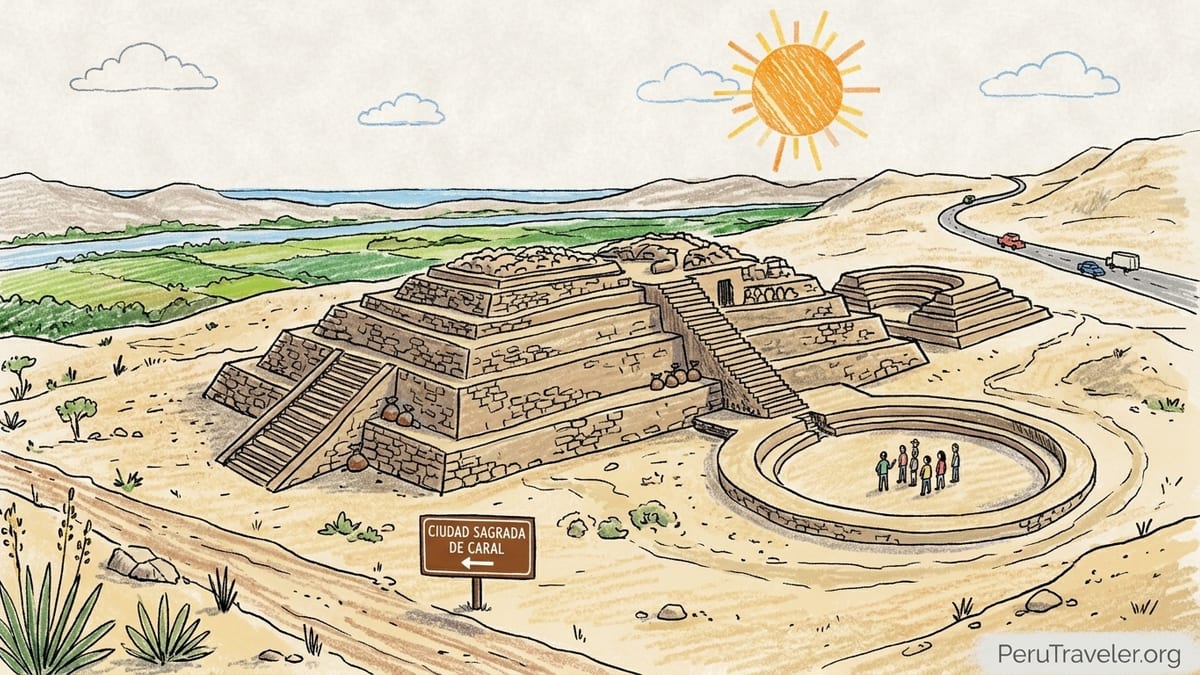
The Sacred City of Caral-Supe covers about 66 hectares and is carefully laid out on a natural terrace above the river. Visitors see six large pyramidal platform mounds, several smaller ones, two sunken circular courts and the remains of residential areas. The layout appears to respond to astronomical and landscape markers, with some structures aligned to solstices and surrounding hills. This sense of deliberate urban planning is what makes Caral critical to understanding how large, organized societies emerged in the Americas long before ceramics or formal writing.
Caral also challenges assumptions about what drives early urbanism. Archaeologists have found no evidence of defensive walls or large-scale warfare at the site. Instead, the city seems built around ceremonial life and long-distance trade in cotton, fish, exotic stones and possibly psychoactive plants. Flutes made from bird bones, decorated gourds and evidence of large-scale feasting hint that ritual and music were central to how this society held itself together. For a traveler used to the narrative of conquering empires and warrior kings, Caral offers an older story of cities organized around shared belief rather than armies.
This very different atmosphere carries through the visit itself. There are no high terraces packed with tour groups or long lines of vendors. Most days, especially on weekdays, foreign visitors find themselves among small Peruvian family groups, university outings and a few archaeological enthusiasts. The wind, the light and the sound of the Supe River below do as much to shape the visit as the stones. It feels less like checking off a famous attraction and more like stepping into the early chapters of Andean history.
Getting from Lima to Caral: Road, Time and Conditions
Reaching Caral from Lima is straightforward in terms of roads but long in terms of hours. The first stage follows the Pan-American Highway north out of Lima, passing the industrial belt of Puente Piedra and the agricultural valleys of Huacho and Pativilca. Under light traffic, tour operators quote around three hours each way, but recent travelers and tour companies now warn that four hours is possible in one direction, especially when returning into Lima in the late afternoon or on long weekends. A full day commonly runs 12 to 14 hours from hotel pickup to drop-off.
From the Pan-American, a signed turnoff near the town of Supe leads inland toward the Supe Valley. The paved highway gives way to a combination of decent asphalt and then a well-graded dirt road for the last stretch to the archaeological zone. This final section adds roughly 40 minutes to an hour, depending on conditions. In the dry season, the track is dusty but manageable in a standard car. Between December and March, rains in the highlands can affect river crossings and cause temporary detours, which is one reason experienced operators recommend avoiding very tight onward connections on the evening of your Caral visit.
The driving itself is not technically difficult. The Pan-American here is a major coastal highway with two lanes in each direction for long sections, good visibility and regular fuel stations. The challenges are more practical: long stretches without shade, strong coastal sun, and drivers unused to Peruvian highway habits such as frequent lane changes, buses stopping on shoulders and occasional livestock near village access points. After the turn into the valley, overtaking slow trucks and mototaxis requires patience. For many visitors, the main fatigue comes simply from the number of hours spent sitting in traffic or on the highway.
Road signage improves markedly after the turnoff to the Supe Valley, where brown tourist signs direct you toward the “Ciudad Sagrada de Caral.” Nonetheless, relying solely on signs is not advisable. Drivers should use an up-to-date offline map on a phone and verify the route with accommodation or tour staff in Lima before departure. There are few opportunities to stop in shade along the valley road, so most independent travelers plan their first bathroom and snack break at service stations near Huacho or Barranca, then continue directly to the site.
Admission, Opening Hours and Required Interpretation
Caral is managed by the Zona Arqueológica Caral of Peru’s Ministry of Culture, and visits follow a clearly defined process. As of late 2026, the published entry fee for foreign and Peruvian adults is 11 soles, with reduced prices for university students and a symbolic fee for children. The same 11-sol general tariff also applies to the related sites of Áspero and Vichama along the coast. These rates are set nationally in the ministry’s annual tariff schedule, so short-term fluctuations are unlikely, although travelers should still verify shortly before their trip.
The Sacred City of Caral-Supe is currently open every day, including Mondays, from 9:00 a.m. to 5:00 p.m., with last entry in the mid-afternoon to allow time for the guided circuit. These hours line up with the realities of the long drive from Lima. Most dedicated tours aim to reach the gate around 11:00 a.m. or shortly after, which allows a slow two-hour visit and a lunch stop on the way back. Independent visitors coming from nearby Barranca often choose to arrive right at opening time to avoid mid-day heat and any day-tour groups.
A key rule shapes how you experience the site: all visitors must be accompanied by an authorized cultural interpreter. You cannot simply wander the pyramids on your own. On arrival, staff at the entrance assign you to a small group with a local interpreter employed or accredited by the Zona Arqueológica Caral. Guides lead the marked loop through the site and manage group size, which is usually kept relatively small to minimize impact on the fragile architecture. For Spanish speakers, this system is straightforward. English-language interpretation depends on which interpreters are on duty and on tour demand that day.
Travelers who need English guiding have three main options. The safest is to book a Lima-based tour company that explicitly includes English interpretation throughout the day and coordinates with the site staff. A second approach is to arrange a private interpreter through agencies in Barranca or Lima and pay the regular Caral entry at the gate, which gives you commentary in your language while still following the official circuit. Finally, some independent travelers simply join the Spanish-speaking group on site and rely on bilingual fellow visitors or a driver who can summarize key points. For anyone interested in Caral’s history in depth, a clearly confirmed English-speaking guide is worth the extra planning.
What You Actually See at the Sacred City
The visitor route at Caral is a loop path that skirts and occasionally climbs low slopes around the monumental core. Much of the trail is exposed, with only a few shade structures near viewpoints. From the first mirador, the scale becomes clear: at the center rises the Great Pyramid, a stepped platform with a broad staircase and adjacent plazas. To one side lies a large sunken circular court, while other pyramids and platforms stretch along the terrace in a rough U-shape around an open central space. The river and green fields form a contrasting band of color below, emphasizing how the city controlled its agricultural environment from above.
The interpreters stop at several designated points to explain specific structures. At the Great Pyramid, you typically hear about the use of shicra bags, woven from plant fiber and filled with stones, which allowed builders to stabilize large volumes of fill. Another stop looks down on the Amphitheater Pyramid and the main sunken circular court, where evidence of burnt offerings, musical instruments and feasting suggests ritual performances. At residential sectors such as the so-called “Upper Half” of the city, you see smaller rooms and terraces where elites may have lived and carried out administrative tasks.
One important aspect of the visit is distinguishing what is original from what has been conserved or partially rebuilt. Caral’s team emphasizes conservation over imaginative reconstruction. Most visible architecture consists of cleaned and stabilized original stonework, with only minimal capping or low retaining walls added in modern times to protect fragile edges. Where walls have been rebuilt higher to suggest original forms, the new work is usually clearly marked or built with slightly different stonework so that archaeologists and visitors can recognize the intervention. There are no complete “new” pyramids or speculative temples meant to impress tourists.
Because of this restrained approach, Caral can feel visually subtle compared with the towering terraces at Machu Picchu or the sculpted adobe of Chan Chan. Surfaces are comparatively low, and many details remain half-buried to preserve them. What you gain instead is a more honest sense of an ongoing research site. Excavation squares remain open in places, and signage highlights not only monuments but also soil layers and ancient trash pits. On some days, you may see archaeologists and workers consolidating walls or sifting sediments. It reinforces that Caral is not a finished exhibit, but a long-term project gradually rewriting what we know about early Andean societies.
Independent Visits vs Tours: Car, Driver or Full Package
Travelers have three realistic ways to do Caral as a day trip from Lima. The first is renting a car, collected from major agencies in Miraflores or at the airport. International-brand rentals in Lima often start around 45 to 60 US dollars per day for a small manual sedan, before insurance and fuel. Factoring collision damage waivers and a full tank there and back, a couple might spend 90 to 120 dollars on the day’s driving costs. This option gives maximum flexibility but requires comfort with Lima’s early-morning traffic, long highway stretches and ambiguous local driving norms. It is not ideal for those unused to dense Latin American cities.
The second option is hiring a private driver with a car for the full day. Several Lima-based agencies and independent drivers offer flat rates for Caral that include pickup at your hotel, waiting time at the site and return. Recent examples discussed by travelers and regional agencies suggest prices in the region of 130 to 170 US dollars for two people for a 12 to 14-hour day, not including your site entry or lunch. This often ends up comparable to mid-range group tours on a per-person basis, while giving you control over departure time, stops and pace. English may not be guaranteed with the driver, so history-focused visitors might still want to arrange an additional interpreter at Caral or rely on the official guides in Spanish.
The third option is booking a dedicated archaeological tour from Lima. These full-day packages typically include early-morning hotel pickup in areas such as Miraflores, Barranco, San Isidro and the historic center, private or shared transport, Caral entry fees and guiding at the site. As of late 2026, reputable shared tours aimed at international visitors are commonly priced between 120 and 140 US dollars per person for two people traveling together, with per-person costs dropping slightly for three or four in a group. Premium small-group or private tours that promise additional stops or meals can reach 180 to 230 dollars per person in a two-person booking.
In practice, the on-site experience at Caral is similar whether you arrive in your own rental car or on a premium bus. Everyone must follow the same official circuit and rules. The main differences come before and after: how early you leave Lima, whether you must navigate the highway yourself and how flexible you can be about lunch and additional stops in the Supe Valley. A couple with limited time and a strong interest in context might find the cost of a well-reviewed, English-speaking tour justified by the lack of logistical friction. Confident drivers who enjoy independent exploration often prefer the freedom of a rental car or private driver, especially if they plan to continue north along the coast afterward.
Comfort on Site: Shade, Facilities and Interpretation Quality
Caral remains an active archaeological zone in a desert environment, so comfort is basic but improving. Around the entrance there is a small visitor area with ticket office, simple bathrooms and a few shaded spaces where groups gather before and after the circuit. Vendors sometimes sell bottled water or packaged snacks near the parking area, but you should not count on a full café. Most Lima-based tours include a proper lunch stop outside the site, often near Barranca or at a countryside restaurant in the Supe Valley, rather than at Caral itself.
On the trail, shade is scarce. The sun can be intense even in winter, and wind can kick up dust along exposed sections of the path. Sturdy shoes, a hat, sunscreen and at least a liter of water per person are essentials. The loop is not technically difficult, but it does involve some modest inclines and walking on uneven surfaces for roughly 90 minutes to two hours. For travelers sensitive to heat, aiming to start the circuit before mid-day makes a noticeable difference. Small children and older visitors often find the visit manageable as long as the group takes regular pauses at interpretation stops.
Bathrooms are located at the entrance rather than along the route. Guides usually remind visitors to use facilities before starting the circuit. This is another reason many operators schedule their arrival so that groups are not rushing straight from the bus to the trail. For those traveling independently, a short pause at the gate to prepare water, sun protection and cameras makes the experience more comfortable. There are no facilities in the monumental core itself, which also helps preserve the sense of isolation and integrity around the ancient structures.
The quality of on-site interpretation is generally strong, especially in Spanish. Many interpreters have worked with the project for years and are proud of Caral’s role in global archaeology. They explain not just dates and names but also the logic of the city’s layout, the meaning of sunken circular courts and the experimental techniques used to date and stabilize structures. English explanations vary more, depending on both language skills and how groups are organized on a given day. Some visitors report detailed, engaging English commentary, while others receive shorter summaries after longer Spanish explanations. If deep understanding is important, pre-arranging an English-speaking guide through a tour or agency reduces uncertainty.
Extending Your Trip: Áspero, Vichama and the Norte Chico
Caral is only one of several key sites from the same civilization. Two others, Áspero and Vichama, lie closer to the coast and offer complementary perspectives. Áspero sits near the modern fishing town of Puerto Supe, around 25 kilometers from Caral as the crow flies, and represents a maritime center with several platform mounds, including the Huaca Alta and Huaca de los Ídolos. Excavations there have revealed elite burials and evidence of intensive fishing, underlining how coastal resources helped support inland centers like Caral.
Vichama lies further south near the town of Végueta, on the right bank of the Huaura River. It is particularly noted for its high-relief friezes on adobe walls, depicting human figures, plants and possibly mythological scenes related to drought or agricultural cycles. Like Caral and Áspero, Vichama is administered by the Zona Arqueológica Caral and shares the same basic 11-sol entry fee and requirement to visit with an interpreter. For travelers who have mostly seen stone Inca sites, the expressive adobe imagery at Vichama offers a very different visual experience of early Andean ritual architecture.
While all three sites are theoretically reachable in a long day from Lima, attempting to combine Caral, Áspero and Vichama into a single outing from the capital is not realistic for most visitors. Doing so would involve more than eight hours of road time plus three separate guided circuits, leaving little space for meals, rest or absorbing what you are seeing. A day that begins with a 5:00 a.m. departure and ends with a 9:00 or 10:00 p.m. return will also collide with Lima’s heavy evening traffic, increasing fatigue for drivers and passengers alike.
A more balanced approach is to treat Caral as the main focus of a long day trip from Lima, perhaps with a brief coastal stop or a visit to Áspero or Vichama only if you are staying overnight in the region. Travelers with two or three days to spare can base themselves in Barranca or Puerto Supe and plan a relaxed loop: one day at Caral, another at Áspero and nearby beaches, and a third including Vichama and historic sites in Huacho or Huaura. This slower rhythm aligns better with the reflective nature of the sites and reduces the risk of archaeological fatigue.
Staying in Barranca or Puerto Supe vs a Lima Day Trip
Most international visitors see Caral as a very long day trip from Lima, but spending at least one night in the coastal towns of Barranca or Puerto Supe can change the character of the visit. Barranca, about 190 kilometers from Lima on the Pan-American, has a growing range of mid-range hotels and seaside restaurants. It offers easier access to both the Supe Valley and other local attractions, such as the colonial town of Pativilca or the beaches of Caleta Vidal and La Isla. Puerto Supe is smaller but closer to Áspero and has a simpler, more local feel.
From Barranca, the drive to Caral is shorter and less stressful, often around 60 to 75 minutes each way. This allows travelers to visit the site early in the morning or late in the afternoon, when light is softer and temperatures are slightly lower. It also makes it more feasible to add Áspero or Vichama on separate half-days without rushing. You can break up long drives with leisurely seafood lunches, sunset walks along the coast and unhurried evenings rather than arriving back in Lima after dark exhausted from 12 to 14 hours on the road.
Cost-wise, a night in Barranca for two people at a clean mid-range hotel might run in the region of 35 to 70 US dollars, depending on season and standard. Meals in local cevicherías and chifa restaurants are generally cheaper than comparable options in Miraflores, with hearty plates of fish or chicken often between 5 and 12 dollars. Because fuel and highway tolls do not change whether you turn back to Lima or sleep in Barranca, the extra expense primarily lies in lodging and any additional local transport. For travelers with flexible itineraries, the added comfort and ability to see more of the region often justify that cost.
On the other hand, some visitors prefer to keep Lima as a base and accept the long day. Those with tight schedules, same-city flights or fixed hotel bookings might not want to rearrange their plans to spend a single night in a smaller coastal town. In that scenario, a well-organized tour that handles all navigation and keeps to a sensible schedule is the most convenient option. The decision comes down to whether you see Caral and the Norte Chico as a brief but intense history lesson or as a small region worth two or three slower days of exploration.
Realistic Two-Person Cost Breakdown
Putting numbers to the experience helps in planning. Consider a couple in Lima in late 2026 who want to visit Caral on a single long day. If they book a solid mid-range shared tour from a reputable operator, they might pay around 130 US dollars per person, for a total of 260 dollars. This price typically includes round-trip transport from central districts, Caral entry fee and guiding at the site. It may or may not include lunch. If not, they can expect to pay roughly 10 to 20 dollars per person at a roadside or seaside restaurant on the way back, bringing the total direct cost to about 280 to 300 dollars for the pair.
The same couple renting a small car for the day might face a different breakdown. A one-day rental at 55 dollars, plus roughly 35 to 45 dollars in fuel for about 400 kilometers of driving and 10 to 15 dollars in highway tolls, could sum to about 100 to 115 dollars in transport costs. Added to that are two adult entries to Caral at around 3 dollars each equivalent, for about 6 dollars total, plus a tip for the on-site interpreter, perhaps 6 to 10 dollars. With a shared lunch bill similar to the tour example, their total might be around 140 to 165 dollars for two. This approach saves money but shifts responsibility for early-morning driving, navigation and time management entirely onto them.
A private driver with a car might quote roughly 150 dollars for the day for two passengers, inclusive of waiting time and return to Lima. Adding entry fees, a reasonable interpreter tip and a shared lunch, the total could land in the 190 to 220 dollar range. This sits between self-drive and a structured shared tour, combining door-to-door convenience with the freedom to linger at viewpoints or stop for photos as desired. The trade-off is that historical explanation on the road depends on the driver’s interests and language skills; in some cases, conversation may be limited to Spanish small talk.
Spreading the visit over two days with a night in Barranca changes the arithmetic but not dramatically. Using the rental car scenario, adding an overnight stay of around 50 dollars for a mid-range hotel and an extra dinner at perhaps 25 to 30 dollars for two might push the total for the two-day excursion into the 220 to 250 dollar bracket. For history-focused travelers who then add Áspero or Vichama on the second day, the extra value gained from seeing multiple related sites often outweighs the modest increase in cost.
The Takeaway
Caral is not the easiest day trip from Lima, nor the most instantly spectacular, but it is one of the most intellectually rewarding. The long drive through the coastal desert delivers you to a quiet terrace where some of the earliest urban experiments in the Americas took shape. Pyramidal platforms, sunken circular courts and a carefully planned city grid tell a story of people organizing themselves around ceremony, exchange and shared belief thousands of years before the Inca.
For travelers with only a day to spare on the central coast, Caral deserves priority over more convenient but less distinctive outings. A well-run guided tour from Lima, especially one that guarantees clear English interpretation on site, is worth its premium if you value understanding what you are seeing rather than simply walking past ancient stones. Independent drivers or rental-car travelers can save money and gain flexibility, but they will still depend on the official interpreters at the gate for the core of their visit.
If your interest in ancient civilizations runs deep, consider dedicating at least two days to the region. Combine Caral with Áspero’s maritime mounds and Vichama’s expressive reliefs, using Barranca or Puerto Supe as a base. This slower rhythm allows you to connect the inland city with its coastal satellites and to appreciate how early Andean societies wove together rivers, oceans and desert terraces into one cultural landscape.
Ultimately, how much time you give Caral and its sister sites is a question of priorities. Those who come mainly for scenery or cuisine may find a single long day enough. Travelers drawn to the deep history of cities, belief systems and human adaptation to harsh environments will find that a night or two on Peru’s central coast opens a window onto a chapter of the past that even many Peruvians have not yet seen.
FAQ
Q1. How long does it really take to visit Caral from Lima in one day?
Most travelers should expect 12 to 14 hours door to door, with 3 to 4 hours of driving each way depending on traffic and road conditions, plus about two hours on site and time for a meal stop.
Q2. Do I need to book a tour to visit Caral, or can I go independently?
You can visit independently by rental car or private driver, but you must join an on-site group with an authorized interpreter; organized tours simply bundle transport, entry and guiding into one product.
Q3. Is there guaranteed English-language guiding at Caral?
English is not guaranteed for walk-up visitors; for reliable English explanations you should either book a Lima-based tour that promises service in English or arrange a private interpreter through an agency.
Q4. How much is the entrance fee to Caral, Áspero and Vichama?
As of late 2026, the published general entry fee for adults at each of these Ministry of Culture sites is 11 soles, with lower prices for students and children according to national tariff rules.
Q5. Are the pyramids at Caral original or reconstructed?
Most visible structures are original stonework that has been cleaned and stabilized; modern interventions are generally low protective walls or capping, and large-scale speculative reconstructions are avoided.
Q6. Is it realistic to visit Caral, Áspero and Vichama all in one day from Lima?
For most visitors it is not; combining all three would require more than eight hours of driving plus three guided circuits, leaving little time for rest or reflection and making for an exhausting, rushed day.
Q7. What are road conditions like and is it safe to drive from Lima?
The Pan-American Highway segment is generally in good condition, with typical Peruvian highway traffic; the final valley road includes some dirt but is passable, so the main concerns are fatigue and unfamiliar driving styles rather than technical hazards.
Q8. Are there restaurants and bathrooms at or near the site?
There are basic bathrooms and a small visitor area at the Caral entrance but no full restaurant; most travelers eat at roadside or seaside restaurants near Barranca or Supe and should bring water and snacks.
Q9. Is a private guide or private tour worth paying extra for?
For visitors who value in-depth context, flexible pacing and guaranteed English, a private guide or small-group tour often justifies the higher cost compared with doing the trip alone with minimal interpretation.
Q10. How much time should a history-focused traveler devote to the Caral region?
Someone particularly interested in early civilizations should plan at least one full day for Caral itself and, ideally, an additional day based around Barranca or Puerto Supe to visit Áspero, Vichama or other nearby sites without rushing.