


From Trujillo, most travelers look south toward Huaca de la Luna or west to the adobe sprawl of Chan Chan. On a clear coastal morning, I went north instead, following the Chicama Valley to the El Brujo Archaeological Complex and the Museo Cao. I expected a smaller, quieter version of the better-known Moche sites. What I found, especially in front of the funerary bundle of the Señora de Cao, changed how I understood power, gender and religion on Peru’s north coast.
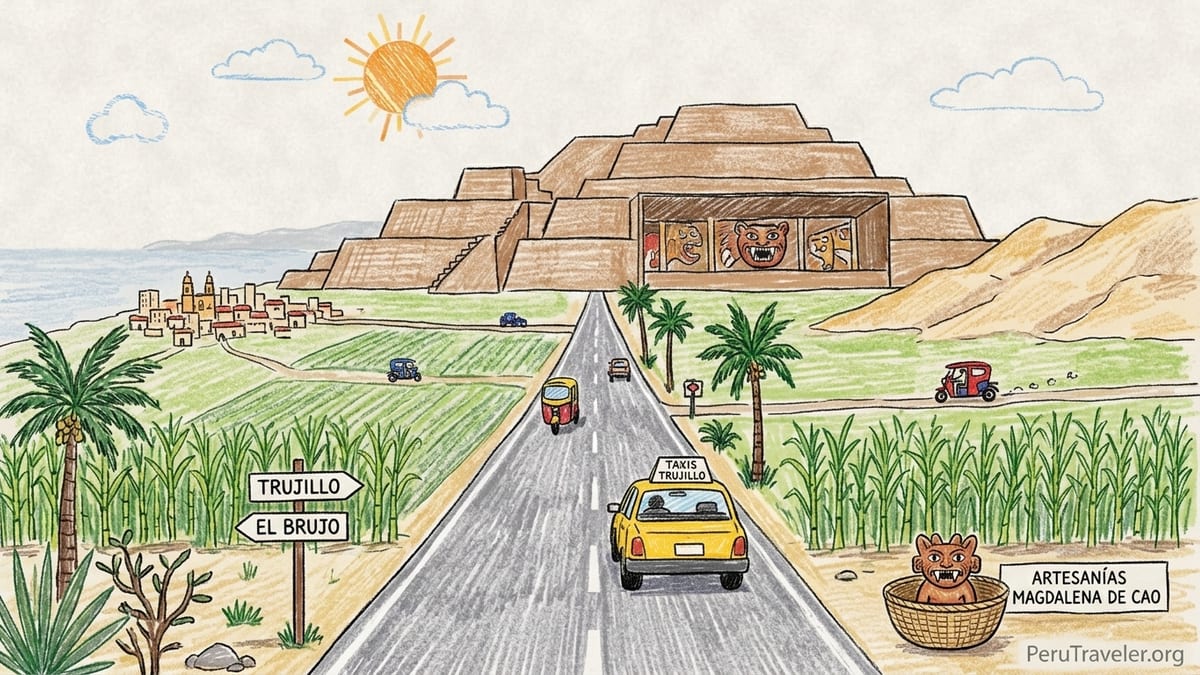
Getting to El Brujo from Trujillo: A Straight Road Into the Chicama Valley
I based myself in the historic center of Trujillo, close to the Plaza de Armas where most tour agencies cluster. El Brujo lies about 60 kilometers north, in the district of Magdalena de Cao, in the fertile Chicama Valley. Current driving time is around 1 hour to 1 hour 15 minutes each way by paved highway, depending on traffic leaving Trujillo and sugarcane trucks along the route.
Independent travelers essentially have two realistic options. The simplest is to hire a taxi or private driver in Trujillo. In October 2026, several local drivers were quoting between 220 and 260 soles for a half-day round trip for up to four passengers, including waiting time at the site. After some comparison, I settled on a licensed taxi arranged through my hotel for 230 soles. The driver collected me at 9:00 a.m., drove directly to El Brujo via the Panamericana Norte and the turnoff near Chiclín, and waited in the parking lot while I explored.
Budget-conscious travelers can piece together public transport, but it adds time and complexity. Minibuses and colectivos toward Chicama and Ascope leave from northern Trujillo; from there, a local connection toward Magdalena de Cao and a mototaxi for the final stretch are required. On the ground, people I spoke with who had tried this route described it as at least 2 to 2.5 hours each way, with total costs around 20 to 30 soles per person but lots of waiting and no direct schedule information posted at terminals. For a focused archaeological visit on a tight schedule, the savings did not justify the additional uncertainty for me.
The drive itself is part of the experience. Once past the urban sprawl, the highway cuts across broad fields of sugarcane, with the Pacific haze on one side and low, sandy hills on the other. The flat valley floor and grid of irrigation canals make it easy to imagine why the Moche built here: abundant water, productive soils and commanding views of both sea and hinterland. As the asphalt ends and a short, dusty access road climbs a low rise, the outline of the adobe pyramids of El Brujo emerges ahead, isolated against the pale sky.
First Impressions of El Brujo: Adobe Pyramids on the Edge of the Desert
The El Brujo Archaeological Complex is not a single pyramid but a cluster of massive adobe platforms built by the Moche between roughly the 3rd and 7th centuries AD. The principal structures that visitors can see are Huaca Prieta, Huaca Cao Viejo and Huaca Cortada. From the parking lot and visitor center, Huaca Cao Viejo dominates the view: a truncated pyramid of sun-dried adobe bricks rising above the plain, its eroded flanks streaked with faint vertical lines where centuries of rainfall have carved channels through the mud.
Unlike Chan Chan, with its sprawling plazas and labyrinthine corridors, El Brujo feels compact and legible. A marked path leads you up toward Cao Viejo, with low railings to keep you off the most fragile surfaces. Under large protective roofs, the excavated ceremonial walls appear almost suddenly: bands of painted reliefs preserved in surprising color. The first surprise is how close you can get. In several sectors, the walkway brings you within a couple of meters of the polychrome friezes, close enough to see individual adobe blocks and the brushstrokes of red, yellow, white and black mineral pigments.
There is an important difference between what you can see in photographs and what stands in front of you. Many images of El Brujo show broad, reconstructed panels. On site, the access focuses on original sections left in situ. Some are narrow horizontal bands of marching prisoners with ropes around their necks, others are repeating supernatural beings with fanged mouths and octopus-like limbs. The conservation team has stabilized these reliefs but left them clearly ancient: edges are jagged, some figures are only half preserved, and you can read the passage of time in every crack.
Architecturally, Huaca Cao Viejo is a textbook Moche stepped pyramid built by superimposing successive platforms over older ones. The excavated ceremonial facade visitors see today formed the front of one of those building phases. As I climbed the gentle ramps and narrow stairways, I could feel how the architecture was designed to choreograph movement: rising in stages toward restricted spaces at the summit, where rituals of sacrifice, bloodletting and political display once took place. From the upper platforms, the view opens onto the Pacific and the agricultural patchwork of the valley, reinforcing the huaca’s elevated authority over land and sea.
Meeting the Señora de Cao: What the Archaeology Actually Shows
The reason most travelers make the journey is inside the Museo Cao rather than on the pyramid itself. The Señora de Cao, or Lady of Cao, was discovered in 2005 in a richly furnished tomb near the summit of Huaca Cao Viejo. Osteological analysis and associated grave goods identify the individual as a woman, probably in her twenties, wrapped in a large funerary bundle and buried in a context that archaeologists associate with high political and ritual power.
Archaeological publications and museum interpretation highlight several key aspects of her burial. First, her tomb is located in a privileged space on the upper platform of the pyramid, close to ceremonial areas, which is typically where Moche elites and ritual specialists were interred. Second, the funerary assemblage combines objects that previous scholarship associated primarily with male warrior-rulers with items tied to female identities. The bundle included war clubs, spear throwers and multiple metal headdresses and nose ornaments, along with fine textiles, long female tunics, weaving tools and personal adornments. This mix suggests that the Lady of Cao embodied roles that crossed gendered categories of power rather than fitting neatly into earlier models of “male warrior” and “female weaver.”
The museum avoids speculative narratives about her life story but is explicit about how the discovery disrupted older interpretations of Moche society. Before 2005, most high-status burials with elaborate regalia, such as the famous Lord of Sipán, were assumed to belong to men, and depictions of rulers in Moche art were interpreted as male by default. The clearly female skeleton of the Señora de Cao, combined with the regalia of a high-ranking ritual and possibly political figure, provided direct evidence that women could occupy positions of significant authority in at least some Moche communities.
One detail that stayed with me is the emphasis on her body decoration and skin. The museum draws on forensic and conservation reports to show that large portions of her skin remained preserved, revealing complex tattoos on her arms and hands, including images of snakes, crabs and feline-like figures. Rather than treating these tattoos as mere ornament, the interpretive panels link them to broader Moche iconography, where similar creatures appear in scenes of sacrifice, fertility and transformation. The takeaway is not a romanticized “warrior queen” image, but a carefully framed argument: the Lady of Cao occupied an extraordinary place in her community, and the archaeological evidence forces researchers to rethink women’s potential roles in leadership and ritual across the Moche world.
Inside Museo Cao: Conservation, Displays and the Visitor Experience
Museo Cao is a modern, climate-controlled building a short walk from the huaca, surrounded by planted gardens and with a broad view back toward the pyramids and over the Pacific. Standard admission to the El Brujo complex, which includes both the museum and the archaeological site, is currently 10 soles for adults, 5 soles for university students and seniors, and 1 sol for children. The first Sunday of each month, entry is free for the general public. Tickets are purchased at the main entrance, and a short internal path leads first to the museum and then onward to the huaca.
Inside, the museum is organized as a progression from broader cultural context to the specifics of the Lady of Cao’s burial. Early rooms cover the natural environment of the Chicama Valley, Moche ceramics and metalwork, and the history of excavation at El Brujo. Artifacts are displayed in dimly lit cases, with explanatory panels in Spanish and generally good English translations. Climate control and low light indicate a serious approach to conservation; the galleries feel more like a small national museum than a provincial outpost.
The final galleries, where the funerary bundle and body of the Lady of Cao are exhibited, are the emotional and interpretive core. A reconstruction of the burial chamber and bundle arrangement helps visitors understand how the tomb was organized, using physical models and photographs from the excavation rather than imaginative paintings. Adjacent cases show selected original objects from her grave: metal nose ornaments, headdress fragments, textile samples, beads and ritual implements. The actual mummified body is displayed in a temperature-stable glass enclosure, with lighting calibrated to avoid damaging the preserved skin and pigments while still allowing visitors to discern tattoos and facial features.
Photography rules are clearly posted. Non-flash photography was permitted in most galleries during my visit, but staff asked visitors not to photograph the uncovered body of the Lady of Cao directly, both for conservation and out of respect. Elsewhere, guards gently reminded tourists to switch off flash. The quality of interpretation felt strong overall: labels reference current debates about gender and power in Moche society and mention that scholars continue to discuss whether the Señora de Cao was a ruler, a high priestess, or held some hybrid role that does not map neatly onto modern categories. For visitors with some background in Andean archaeology, this intellectual honesty is refreshing.
Walking the Site: Moche Reliefs, Sun Exposure and Family Practicalities
From the museum, a gently sloping path leads to Huaca Cao Viejo. Walking difficulty is moderate. The route is mostly compacted earth and concrete, with some ramps and a few flights of steps up to the viewing platforms. There are handrails at the steeper sections, but this is not a fully barrier-free site. Visitors with limited mobility may need assistance on certain stairways, and strollers are only practical up to the base of the huaca.
Once on the pyramid, the main challenge is the sun. The north coast of Peru is famous for its “eternal spring” climate, but at El Brujo the exposure feels harsher than in Trujillo. The adobe surfaces reflect light, and there is very little natural shade. Roof structures protect key mural sectors, and these provide some relief, but much of the walk between viewing areas is in full sun with the coastal wind offering only psychological cooling. A wide-brimmed hat, high-factor sunscreen and water are essential, especially for children. On my October visit, temperatures felt like the high twenties Celsius by midday, and several visitors sought out the limited shade formed by the museum building during the hottest hours.
Facilities are basic but adequate. Clean bathrooms are available near the entrance and in the museum, with running water and toilet paper included in the entry fee. I did not find additional restrooms out by the huaca, so it is worth stopping before or after your site walk. There is a small on-site café area offering bottled drinks and simple snacks, but no full restaurant service during my time there. Families should plan to bring water and perhaps small snacks, especially if traveling with young children.
For children and non-specialists, the most engaging elements are the visible reliefs and the museum’s reconstructions. Museum staff told me that school groups often spend more time in the early galleries with ceramic vessels shaped like animals and people before moving to the more somber mummy display. Parents I spoke with appreciated that the most graphic elements of Moche sacrificial iconography are not emphasized for general audiences; interpretation focuses instead on ritual meaning, status and symbolism. With shade breaks in the museum and careful timing to avoid the absolute peak of midday sun, El Brujo can work well as a family outing.
Independent Visit vs Trujillo Tours: Costs, Context and Value
Most visitors I met at El Brujo had come on organized excursions from Trujillo. Group tours marketed in the city center and online currently advertise prices around 80 soles per person for a five to six hour outing, including transport and a Spanish-speaking guide but not entrance fees. Some agencies offer bilingual or English-only departures at slightly higher prices or with a minimum number of participants. The usual format is a mid-morning pick-up in Trujillo, direct drive to El Brujo, a guided visit to the museum and huaca, then a short stop in Magdalena de Cao before returning to the city.
On paper, independent travel by taxi looks more expensive for solo travelers but competitive for couples or small groups. My own private taxi arrangement cost 230 soles for transport door to door, plus the 10-sol entrance ticket and about 25 soles for food and drinks, for a total of 265 soles. A two-person group on a shared tour paying 80 soles each would spend 160 soles on transport and guiding, plus the same 10 soles each for entry and similar food costs, ending around 360 soles total. For three or four people traveling together, the private taxi becomes noticeably cheaper per person, provided you are comfortable self-guiding.
The real question is whether specialist guiding at El Brujo adds enough context to justify the group tour. I joined part of a Spanish-language guided group for about twenty minutes around Huaca Cao Viejo with the permission of the guide, in exchange for contributing informally to his tip basket. His explanations covered the construction sequence of the pyramid, pointed out specific details in the reliefs that I might have missed and summarized the main interpretations of the Lady of Cao’s role based on current research. Some of this information overlaps with museum panels, but hearing it delivered in situ, with hand gestures toward the landscape and architecture, created a more vivid sense of how processions and rituals might have unfolded.
For travelers with limited Spanish or without prior exposure to Moche archaeology, an English-speaking guide can make an even bigger difference. Agencies in Trujillo that specialize in archaeology-focused tourism partner with licensed guides who keep up with new discoveries and can relate El Brujo to Huaca de la Luna, Chan Chan and sites farther north like Sipán and San José de Moro. Conversations with such guides during my time in Trujillo, including on a separate visit to Huaca de la Luna, substantially deepened my understanding of patterns in Moche iconography and elite burial practices. If your budget comfortably allows, a guided tour from Trujillo or hiring a certified guide on site is money well spent. If you are traveling on a tighter budget but speak Spanish and are willing to read the panels carefully, a self-guided visit remains rewarding.
Magdalena de Cao: Crafts, Lunch and Everyday Coastal Life
Most tours include a short stop in Magdalena de Cao, the small town closest to the site. From the complex, it is about a 15-minute drive by vehicle, or a mototaxi ride if you have come by public transport and want to see local life. Rather than relying on brochure promises, I limited my exploration to places I could actually visit during my half-day.
Near the main square, a modest craft house showcases textiles and gourd carvings produced by local artisans. Inside, women were working on embroidered cloths with coastal motifs and stylized Moche imagery. Prices were moderate; small pieces like embroidered bookmarks and coin purses started under 20 soles, while larger textiles hung on the walls with price tags closer to 150 soles. The atmosphere was low-pressure, with artisans answering questions about techniques and dyes without pushing for sales. Purchases here feel like a direct way to support a town that has tied its identity increasingly to the Lady of Cao.
For lunch, I chose a simple family-run restaurant one block from the plaza, recommended by my driver. The menu offered north-coast standards: ceviche, arroz con mariscos and pescado frito, with mains priced between 18 and 30 soles. I ordered a plate of fried fish with yuca and a cold bottle of soda, which came to 26 soles including a small tip. The food was fresh rather than refined: plastic chairs, tiled floor, a television in the corner showing a midday news program. Given the limited options at El Brujo itself, stopping in town for a proper meal on the way back to Trujillo made sense and extended the day beyond a quick in-and-out of the archaeological zone.
Beyond crafts and lunch, there are occasional cultural activities and local events, but none were happening during my visit. Some tour descriptions mention folkloric demonstrations or traditional healing rituals connected loosely to the site’s “brujo” (sorcerer) reputation. Without being present for a specific event, I cannot evaluate these, and the museum’s own interpretation remains firmly rooted in archaeology rather than mysticism. For my purposes, Magdalena de Cao served primarily as a pleasant, low-key stop that anchored the ruins in a living community.
El Brujo Compared With Huaca de la Luna and Chan Chan
In the days before and after my El Brujo visit, I also toured Huaca de la Luna and Chan Chan, the two major archaeological draws around Trujillo. Experiencing all three in short succession clarified where El Brujo fits in a north-coast itinerary and why it still receives far fewer international visitors than its counterparts.
Huaca de la Luna, to the southeast of Trujillo, offers the most immediately dramatic Moche murals: vast, multicolored facades packed with rows of deities, warriors and bound prisoners. The site museum is excellent, and the guided route reveals layer upon layer of architectural phases. Chan Chan, spread across the coastal plain west of the city, impresses through scale and urban planning. You walk through restored palace compounds, past long corridors and plazas with repeating reliefs of fish and seabirds. Both sites attract bus tours, school groups and day-trippers. Even in low season, I shared them with dozens of visitors.
El Brujo, in contrast, feels more remote and self-contained. Its reliefs are more fragmentary than those at Huaca de la Luna, and the architectural remains are less extensive than the palatial labyrinths of Chan Chan. Yet the combination of pyramid, Pacific horizon and a single, exceptionally well-interpreted burial gives it an intimacy the others lack. Instead of wandering through a whole ancient city, you are invited to focus on one elite complex and one woman’s tomb in detail.
From a practical standpoint, Huaca de la Luna is slightly easier to reach and more developed for tourism, with more frequent group departures and clear signage. Chan Chan, located close to Trujillo and Huanchaco, can be slotted into a half day with minimal planning. El Brujo requires a longer round trip and a conscious decision to devote at least half a day to a single site. Whether it deserves that time depends on your interest in pre-Inca archaeology. For anyone already planning to see both Chan Chan and Huaca de la Luna, I found that adding El Brujo completed a kind of triangle: city, ritual pyramid and remote coastal huaca, each offering a different angle on how ancient societies claimed and expressed power.
The Takeaway
What surprised me most at El Brujo was not simply the existence of a powerful woman in Moche society, but how carefully the museum presented the Lady of Cao without pushing her into an easy narrative. Instead of proclaiming her definitively as a queen or high priestess, the interpretation returns again and again to the evidence: the location of her tomb on the upper platform, the unusual mix of regalia, the preserved tattoos that match motifs in Moche art, the overlap and tension between male-coded and female-coded grave goods. Standing in front of her funerary bundle, then turning to the case with her exposed face and tattooed arms, it is difficult not to reconsider earlier assumptions about who could wield authority in the ancient Andes.
From a traveler’s perspective, the journey from Trujillo is straightforward enough to tackle independently but rich enough to benefit from a knowledgeable guide. My total spending for the half day, including private taxi (230 soles), site entrance (10 soles) and lunch in Magdalena de Cao (26 soles), came to 266 soles, or roughly the cost of a mid-range dinner for two in Lima. A group tour would have cost slightly less per person for solo travelers, slightly more for small groups, but with the bonus of structured guiding from start to finish. In either case, the outlay feels reasonable for access to a world-class site and museum that, for now, remains refreshingly uncrowded.
Not everything is perfect. On-site services are minimal, interpretation at the huaca itself is solid but thinner than inside the museum, and the intense sun makes the outdoor portions of the visit physically demanding, especially for older visitors or families with small children. Some travelers will miss the dramatic reconstructions and larger-scale architecture found at Huaca de la Luna and Chan Chan. The Lady of Cao exhibit, while powerful, may feel emotionally heavy for those unprepared to view human remains at close range.
Despite these limitations, I left convinced that El Brujo deserves a dedicated half day from Trujillo for anyone interested in Andean history. It is not an “extra” after Chan Chan and Huaca de la Luna but a complementary third pillar. The museum alone justifies the journey, both for the quality of its conservation and for the clarity with which it explains why this one tomb matters. By the time my taxi rolled back into Trujillo’s late-afternoon traffic, the Chicama Valley had shifted in my imagination from a line on a map to a landscape shaped by farmers, artisans and, at least once, a tattooed woman whose power was written into her pyramid.
FAQ
Q1. How long does it take to visit El Brujo from Trujillo?
Most travelers should plan about a half day. The drive each way takes roughly 1 to 1.25 hours, and two to three hours on site allows time for the museum, the walk to Huaca Cao Viejo and a brief stop in Magdalena de Cao.
Q2. How much does it cost to enter the El Brujo complex and Museo Cao?
Current entry is 10 soles for adults, 5 soles for university students and seniors, and 1 sol for children. The ticket covers both the archaeological site and the museum, and the first Sunday of each month entry is free.
Q3. Is it better to visit El Brujo independently or on a guided tour from Trujillo?
For solo travelers, a shared tour around 80 soles per person often works out cheaper and includes a guide. For two to four people, hiring a private taxi from Trujillo can be cost-effective and more flexible, especially if you are comfortable reading museum panels and exploring at your own pace.
Q4. Are there good explanations in English at Museo Cao?
Yes. The main exhibition rooms and the Lady of Cao galleries provide bilingual Spanish and English panels with clear summaries of the archaeology, burial context and current interpretations of her role in Moche society.
Q5. Can visitors take photos of the Lady of Cao and the murals?
Non-flash photography is typically allowed around the huaca and in most museum galleries. However, staff may restrict or discourage direct photography of the exposed body of the Lady of Cao for conservation and ethical reasons, so it is important to follow posted rules and staff instructions.
Q6. Is El Brujo suitable for children and older travelers?
Yes, with some planning. The museum is fully accessible and shaded, but the walk to Huaca Cao Viejo involves ramps, stairs and strong sun. Families and older visitors should bring hats, sunscreen and water, take their time on the steps and use the museum as a cool, shaded break.
Q7. What should I wear and bring for a visit to El Brujo?
Light, breathable clothing, a wide-brimmed hat, sunglasses and sturdy shoes are recommended. The sun is intense, so high-factor sunscreen and a refillable water bottle are essential, and a light layer or scarf can help with the coastal wind.
Q8. Are there places to eat near El Brujo?
On site there is usually a small café area with drinks and snacks, but not a full restaurant. For a sit-down meal, it is better to stop in Magdalena de Cao, where simple local restaurants serve fish and seafood dishes at moderate prices.
Q9. Do I need to book a tour to El Brujo in advance?
For group tours from Trujillo, reserving at least a day ahead is advisable, especially in high season or if you require an English-speaking guide. Independent travelers hiring a taxi can often arrange transport the day before or even the same morning through their hotel.
Q10. Is El Brujo worth adding if I have already seen Chan Chan and Huaca de la Luna?
If you enjoy archaeology and history, yes. El Brujo offers a quieter setting, a strong site museum and the unique experience of seeing the Lady of Cao, whose burial has reshaped interpretations of women’s roles in Moche society, making it a valuable complement to the other major sites around Trujillo.