


When you only have a few days in and around Lima, choosing between the Palomino Islands in Callao and the Ballestas Islands off Paracas can feel like a high-stakes wildlife gamble. Both boat trips promise Pacific sea lions, ocean air and dramatic rock formations. Both can be booked online in minutes. Yet they differ radically in departure logistics, conservation rules, boat style, and even whether you are allowed to get into the water. I did both tours in 2026, paid for my own tickets, and kept careful notes to decide which experience actually felt worth the money.
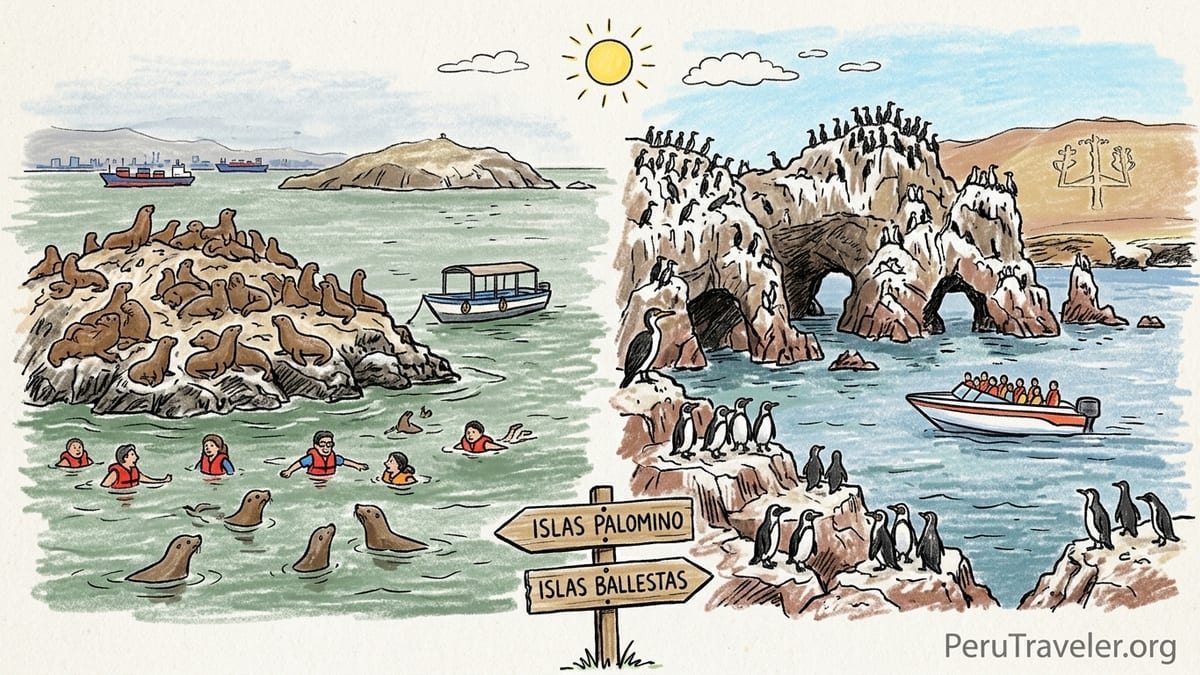
Two Very Different Marine Worlds off the Peruvian Coast
On paper, the Palomino Islands and the Ballestas Islands look similar. Each is a cluster of rocky islets off Peru’s central coast, bathed by the cold Humboldt Current and rich in marine life. Each is marketed with photos of sea lions draped over rocks and birds swirling above white-streaked cliffs. In reality, they feel like two different products entirely: one an urban half-day adventure out of Lima’s port, the other a classic protected-area excursion from the small resort town of Paracas.
The Palomino Islands sit just off Callao, Lima’s historic port district, only a short drive from Miraflores or Barranco. Most operators offer hotel pick-up or ask you to meet them in La Punta, a quiet, traditional neighborhood that feels a world away from Lima’s traffic once you step onto the pier. Ballestas, by contrast, is about 260 kilometers south of Lima, reached after roughly 3.5 to 4 hours by highway to Paracas and then a further boat trip out into the bay.
That geographic difference shapes everything else. Palomino is feasible as a compact half-day outing slotted into a city stay. Ballestas requires a longer travel commitment and, for many travelers, at least one night away from Lima or a very long full-day tour. Both are rewarding, but they answer very different questions: “What wild ocean life can I see without leaving Lima?” versus “Is it worth a multi-hour journey for Peru’s so-called mini-Galápagos?”
Because marketing materials often gloss over these distinctions, I insisted on doing both tours myself before drawing any conclusions. What follows is not a theoretical comparison but a detailed look at how each day unfolded: the boats, the guides, the wildlife, the sea conditions and the true cost for two adults and for a family.
My Palomino Islands Tour: From Lima Traffic to Sea Lion Colony
For the Palomino Islands, I joined a mid-morning tour operated from La Punta, Callao. Like many agencies, the operator offered optional hotel pick-up from Miraflores and Barranco for an extra fee, but I opted to take a taxi to La Punta to keep costs down and avoid sitting in rush-hour traffic. The ride took a little over 40 minutes from central Miraflores, cutting across busy expressways before the streets narrowed into the more residential, calmer peninsula of La Punta.
At the small marina, dozens of lifejackets in bright oranges and yellows were stacked near the pier, and staff checked our names against a printed manifest before issuing a numbered vest. Our boat was a rigid-hull vessel with covered seating and clear plastic side panels that could be rolled down if the wind picked up. There were roughly 18 passengers on board that morning: a mix of Peruvian families, a couple of backpackers, and several foreign visitors who had booked through large online platforms advertising “Swim with Sea Lions from Lima” for the equivalent of about 65 to 90 US dollars per person, depending on inclusions like transport from hotels and snacks.
Once we left the marina, the boat traced the familiar route used by Callao operators. We motored past San Lorenzo Island, the largest island off the Peruvian coast, its hilly profile rising dry and ocher above the gray-green Pacific. Our guide alternated Spanish and English commentary, touching on the island’s role as a naval base and bird nesting site. Nearby lay El Frontón, a smaller island known locally for its now-closed prison and its troubled history. Cavinzas, a guano-covered cluster of rocks busy with seabirds, came next. The boat slowed here so we could spot cormorants, Peruvian pelicans and the occasional Humboldt penguin tucked in a shaded crevice.
The vibe on this part of the route was relaxed and almost chatty. People moved along the sides of the boat to take photographs of the cliffs and flocks, and the guide pointed out passing fishing boats and navigation markers. Sea swell was moderate that day, and while some passengers donned their waterproof jackets, nobody looked particularly uncomfortable. We were about 60 to 75 minutes into the trip before the first barks of sea lions carried across the water and the brown shapes on distant rocks resolved into a full colony.
Close to the Sea Lions: Swimming, Cold Water and Caution
When we reached the Palomino Islands colony, the sound hit first: an overlapping chorus of bellows and yelps, layered over the slap of waves against the rocks. Several hundred South American sea lions crowded the boulders and ledges, with dozens more bobbing in the water or porpoising along the edge of the rookery. The boat idled a respectful distance off the main haul-out, close enough for zoom lenses to capture whiskers and scars, but far enough away to avoid obvious disturbance.
Our guide used this pause to outline the swimming option, which had been heavily promoted in the tour description. Swimming is not mandatory and not everyone on board chose to enter the water. Those who did, including me, received thicker neoprene wetsuits, a second, more buoyant life vest and simple pool noodles for extra flotation. The crew ran through a safety briefing that covered staying close to the boat, entering in small groups, and avoiding direct approaches to any individual animal. They specifically asked us not to touch, chase or feed the sea lions under any circumstances.
Even with a wetsuit, the Humboldt Current made its presence felt the moment I slipped in from the side ladder. Water temperatures in this part of the Peruvian coast often hover around 15 to 18 degrees Celsius, and you feel it quickly in your face, hands and feet. Within seconds, several curious juveniles began circling our group. They darted closer, blowing bubbles, then veered away again, sometimes passing within a meter or two but never quite brushing against us. It was exhilarating and slightly overwhelming, not least because the water was choppy and the swell occasionally lifted us higher than expected.
Sharing the ocean with large wild mammals is not without risk. Adult sea lions can weigh several hundred kilos, and even playful youngsters can cause unintentional harm with a sudden lunge or nip. From a conservation and animal-welfare perspective, swimming very close to a colony can increase stress at key times like breeding or molting. While the agency I used enforced basic rules and kept us a short distance from the main rookery, it was clear that the product is marketed heavily around close-contact photographs, both above and below the surface. You do not feed the animals, but you are quite literally entering their space for your own experience, and that raises legitimate questions about cumulative impact when many boats repeat this every day.
Ballestas Islands from Paracas: Candelabro, Cliffs and a Protected Reserve
My Ballestas Islands visit began very differently. Instead of a taxi across Lima, I took an early morning bus from the capital to Paracas, a small coastal town that exists largely for tourism around the Paracas National Reserve and the islands. The trip took just under four hours, and I had booked a Ballestas tour for the standard 8:00 a.m. departure window that most local agencies work with. In Paracas, dozens of kiosks near the El Chaco pier sell essentially the same two-hour boat trip, with prices in late 2026 commonly around 40 to 55 soles per adult for the tour itself, plus separate port and protected-area fees.
Before boarding, our group queued to pay the official charges. The national protected areas authority has set a Ballestas Islands entrance fee that is just over 10 soles for adults, with a reduced rate for children, plus an embarkation tax charged at the pier. Combined, these added roughly another 15 to 20 soles per person on the day of my visit. Boats here are fiberglass speedboats with open sides and a partial roof, seating 30 or more passengers in rows. They feel more like organized excursions than the semi-adventure vibe in Callao, and you share them with a mix of Peruvian weekenders on coastal getaways and international travelers using Paracas as a base.
As with nearly every Ballestas trip, our first waypoint was the Candelabro, a giant geoglyph etched into a sandy hillside on the Paracas Peninsula. The boat stopped a short distance offshore while the guide explained competing theories about its origin, from pre-Inca navigation marker to ritual symbol. The design, which vaguely resembles a three-pronged candelabrum, is carved into the slope so that it remains visible even as wind reshapes the surrounding sand. Cameras and phones came out en masse here, but after ten minutes we were on our way, the bow angled toward the low silhouette of the islands appearing on the horizon.
The approach to the Ballestas felt noticeably wilder than Callao. Once we left the partial shelter of the bay, the Pacific chop became more insistent, and a few passengers tightened their lifejackets and gripped the seatbacks. It took around 25 to 30 minutes from the Candelabro to reach the first island, a jagged outcrop pocked with sea caves and natural arches. There was no question that we were entering a protected wildlife sanctuary: signs and briefings made clear that no one would disembark and that boats must follow set routes at regulated distances from the rocks.
Wildlife on Ballestas: Penguins, Sea Lions and Seabird Highways
Once among the islands, the density of life was astonishing. Long ledges of the lower rocks were packed with South American sea lions, many sprawled in heaps that looked lazy until you noticed the occasional joust or head toss. Higher up, guanay cormorants and Peruvian boobies formed tight ranks, black and white bands against the guano-stained stone. We saw multiple clusters of Humboldt penguins, their smaller shapes and upright stance immediately distinguishable as they preened on mid-level shelves or hopped awkwardly over uneven ground.
The guide narrated almost constantly, pointing out different bird species that filled the air above us in shifting rivers: pelicans gliding almost level with the sea surface, Inca terns flashing red beaks, and clouds of terns and gulls turning tight circles near richer feeding patches. At certain points the smell of guano became intense, a reminder of why these islands were historically so economically important and why their protection now matters for the entire coastal ecosystem.
Unlike at Palomino, there was never any suggestion of entering the water. Swimming is not offered and not permitted as part of standard Ballestas visits. The emphasis is firmly on observing, not interacting. Boats maintained a consistent buffer from key rookeries, moving slowly but steadily along the perimeter so that people on either side of the boat had fair viewing opportunities. The total time circling the islands was about one hour, with minimal engine-off lingering in any one spot to avoid crowding or stressing the animals.
In terms of genuine wildlife sightings, Ballestas delivered everything it promised in brochures and more. I saw several distinct sea lion colonies, numerous groups of penguins and hundreds, if not thousands, of seabirds in active motion. A pair of dolphins surfaced briefly near the bow on our return leg, eliciting collective gasps, though the guide framed this as a lucky bonus rather than something to expect on every trip.
Boat Experience, Sea Conditions and Photography Compared
From a pure boat-experience perspective, the two tours felt quite different. The Palomino vessel was smaller, more intimate and more responsive to passenger movement. That made it easier to change sides for better angles, but it also meant that any shift in weight affected stability slightly. The partially enclosed design kept spray down, and the mood was informal, with the captain occasionally sharing jokes with the guide. Travel time from La Punta to the sea lion colony and back was around 2.5 to 3 hours in total, including wildlife stops and the swimming session, so you are on the water a substantial amount of time for a half-day excursion.
Ballestas boats are larger and more standardized. The ride from Paracas pier to the Candelabro and then to the islands, plus the circuit and return, took almost exactly two hours dock to dock. Sea conditions felt rougher here, partly because the route covers a longer exposed stretch with more open-ocean chop. The bigger hull soaked up some of the motion, but spray was more frequent, especially for those in the forward rows or on windy days. For anyone prone to seasickness, the shorter overall duration but more consistent movement at Ballestas versus the sometimes gentler but longer Palomino ride is worth considering.
Photography is strong on both tours but favors different styles. At Palomino, the combination of smaller boats and the option to enter the water caters to those seeking dynamic, close-up images. Wide lenses capture swimmers surrounded by curious juveniles, while telephoto shots from the boat compress the crowded colony into dense patterns of fur and rock. Light can be a challenge on hazy Lima mornings, but the urban backdrop and passing freighters add context for documentary-style work.
At Ballestas, you stay entirely on the boat, so your images will all be from above water and from a regulated distance. The payoff is scale and density: sweeping frames of arches carpeted with birds, lines of penguins with crashing surf below, and crowded sea lion haul-outs set against dramatic guano cliffs. Fast shutter speeds and longer lenses help for birds in flight, and the combination of strong contrast between dark rock and white droppings gives photos a rugged, almost monochrome feel, especially on overcast days common along this coast.
Guiding, Group Size and Conservation Practices
Both tours offered bilingual commentary, but the tone and emphasis differed. On my Palomino outing, the guide mixed history, light humor and basic natural history, with particular focus on the islands’ past use for guano extraction and the biographies of San Lorenzo and El Frontón. Environmental messaging was present but relatively brief, mostly concentrated in the pre-swim briefing and a few reminders not to feed or startle the animals.
On Ballestas, the script leaned far more heavily on conservation. Guides talked about the protected status of the islands, the role of the national reserve authority, and seasonal closure rules for certain bird nesting areas. There was repeated emphasis that we would not land anywhere, that routes and distances from colonies were regulated, and that agencies could lose their permits if they failed to respect those rules. Group sizes were larger, but the structure felt tighter, perhaps because every operator knows they are working under scrutiny inside a nationally important ecosystem.
In practice, I saw stronger on-the-water protections at Ballestas. Boats kept reasonably spaced from one another, and when a cluster began to form near a particularly photogenic arch or penguin group, captains nudged their vessels forward instead of idling too long in one place. Noise was still significant, given the number of engines, but there was a sense of choreography to avoid boxing in animals. At Palomino, boat spacing felt more casual and differed by operator. Some vessels hovered very close to the rookery edge, and while mine maintained a middle distance, it was clear that competitive pressure for “the best photo” shapes behavior.
For travelers who care deeply about minimizing disturbance, this matters. Swimming with sea lions at Palomino is thrilling, but it inherently increases the level of interaction with a sensitive population. By contrast, the Ballestas product is intentionally distant and observational. You leave having fantastic views and photos, but you also leave the animals with far less direct impact, confined largely to sound and presence.
Cost and Logistics: Half-Day from Lima vs Long Haul to Paracas
The most practical difference for many visitors is not just the wildlife or the boat, but the price and time commitment. From Lima, a Palomino Islands tour marketed with optional swimming typically costs in the region of 65 to 90 US dollars per adult when booked through major international platforms, including hotel pick-up, boat trip, wetsuit and lifejacket. Booking directly with local operators from La Punta can bring that down somewhat, especially if you arrange your own taxi, with some agencies in 2026 quoting in the range of 220 to 260 soles per person for the boat and gear. For two adults, that places the outing at roughly 130 to 180 US dollars total, including rideshare or taxi both ways within Lima.
For a family of four, assuming two adults and two children, you might pay the equivalent of 260 to 320 US dollars for Palomino once transport, tour fees and optional snacks are counted. There is no separate protected-area fee comparable to Paracas, since these islands are not part of the same national reserve structure, though agencies sometimes add small harbor charges into their pricing. The entire experience, from hotel pick-up to drop-off, fits comfortably into a half-day, often around five hours door-to-door if traffic is reasonable.
Reaching the Ballestas Islands from Lima requires more planning. Independent travelers typically buy bus tickets from Lima to Paracas with reputable companies, with recent price checks placing one-way fares from about 60 soles per person, depending on schedule and seat class. A return trip for two adults therefore runs around 240 soles, to which you add the Ballestas boat tour, commonly 40 to 55 soles per person, plus roughly 15 to 20 soles in combined port and protected-area fees per adult. For two adults, that means approximately 300 to 350 soles in tour and fee costs, plus the 240 soles for buses, landing you in a total range that converts to around 150 to 180 US dollars.
For a family of four traveling independently, those numbers climb quickly. Four return bus tickets, four tour seats and four sets of official fees can easily move the budget into the 300 to 400 US dollar band, especially once you include food in Paracas and any additional local taxis. Many visitors therefore choose a packaged day trip from Lima that bundles transport, the Ballestas boat and often an afternoon in the desert oasis of Huacachina. Prominent operators in 2026 advertise one-day Paracas and Huacachina itineraries starting at about 120 to 130 US dollars per person, with some occasional discounts bringing prices a bit below that. For two adults, this can mean spending 240 to 260 US dollars for a packed 18-hour day that starts before dawn and ends close to midnight.
The logistical trade-off is clear. Palomino is cheaper and faster in terms of transport time, especially for those already staying in Lima and not interested in extending to the desert. Ballestas demands a longer journey and usually either a very long one-day tour or at least one overnight stay in Paracas or nearby Ica, but it also offers access to a nationally significant marine reserve and the chance to combine wildlife with coastal desert scenery.
Risk, Safety and the Ethics of “Swimming with” Sea Lions
The most sensitive difference between these tours concerns risk and ethics. Swimming near a colony of large, wild sea lions looks magical in marketing photos. Operators showcase images of grinning travelers surrounded by sleek, curious animals, often taken at arm’s length. It is easy to forget that these are not trained performers but powerful predators, capable of serious injury if provoked or startled.
On my Palomino trip, the crew behaved responsibly within the constraints of the activity they were selling. They required lifejackets along with wetsuits, briefed us on staying together, and kept a support person in the water with a flotation device. They explicitly banned touching and feeding. Nevertheless, by entering the water in small groups very close to the colony, we increased both our own exposure to unpredictable animal behavior and the animals’ exposure to repeated human incursions. Even if no one in my group acted inappropriately, it is easy to imagine scenarios where excited swimmers kick clumsily toward a pup or crowd a nervous adult.
From a health standpoint, cold water and rough surface chop add additional risk. The 15 to 18 degree Celsius temperatures can be shocking for anyone not used to cold-water immersion, especially children. Even with flotation, weak swimmers may feel out of their depth, and sea conditions can change quickly along this coast. In other parts of the world, marine authorities stress that close proximity to wild pinnipeds carries a small but real risk of bites, disease transmission and sudden panicked movements, which is why many strictly limit in-water encounters.
Ballestas presents a stark contrast. There is no swimming, and in fact no disembarkation at all. Tourists remain on deck, and the entire experience is designed around viewing from a distance. For visitors who want thrilling proximity, this might initially feel less exciting. Yet from a conservation perspective, it represents a more cautious, long-term-friendly approach. Wildlife keeps more agency over the interaction, and human presence is moderated by strict rules rather than the desire for ever-closer photographs.
As I reflected afterward, I realized that most Palomino marketing I had seen before booking focused overwhelmingly on the images: underwater silhouettes of swimmers framed by sea lions and close-up selfies with animals in the background. There was far less mention of the potential stress on colonies or of long-term management plans for visitor numbers. Completing both tours left me convinced that travelers should be much more aware of these issues when choosing where and how to spend their money.
Which Tour Delivered: Expectations, Value and What I Would Repeat
Both experiences had strong points. Palomino gave me an unforgettable, visceral sense of sharing the water with wild sea lions very close to Lima. The half-day format slotted easily into an otherwise urban itinerary, and the cost felt reasonable given transport, equipment and time on the water. Wildlife-viewing time was generous, and the route past San Lorenzo, El Frontón and the Cavinzas provided added interest. The sea lion encounter was undeniably the highlight, but it also came with the concerns described above about cumulative stress and the ethics of encroaching so tightly on a rookery.
Ballestas delivered precisely what it advertised, and arguably more. The animals showcased in brochures sea lions, Humboldt penguins, massive seabird colonies and the mysterious Candelabro geoglyph were all present and easy to see. The guiding placed more emphasis on ecology and conservation, and the tour’s integration into the wider protected-area framework inspired more confidence that the islands are being managed for long-term health rather than short-term spectacle. The greater travel time from Lima and the early wake-up were downsides, and for independent travelers, total costs can creep up once buses, accommodation and meals are factored in. Even so, the combination of rich wildlife and a clearer conservation ethic made it feel like money well spent.
When I stack the two side by side on value, Ballestas edges ahead. For a similar overall budget range for two adults, I received a more comprehensive natural-history experience, greater species diversity and a stronger sense that my visit was aligned with protecting, rather than pressuring, the ecosystem. If I had to repeat only one tour using my own money, it would be Ballestas, ideally as part of an overnight stay in Paracas that allowed for a relaxed schedule and time to explore the coastal desert. That said, if I had just one free morning in Lima and no possibility of traveling south, I would still consider Palomino, sticking strictly to boat-based viewing and declining the swim to minimize impact.
Ultimately, the better choice depends on your time, budget and ethics. Palomino is about intensity and convenience, Ballestas about breadth and stewardship. Having now done both, I would encourage travelers to think beyond the marketing images and consider not only what they hope to see, but how they want to be part of these animals’ story along Peru’s coast.
The Takeaway
For travelers with only one free day in Lima and a strong desire to see wild sea lions, a Palomino Islands boat tour from La Punta is the most practical choice. It keeps you close to the city, trims transport costs and still offers substantial wildlife-viewing time. If you choose this option, I recommend focusing on observation from the boat, especially for families with children or anyone uncomfortable in cold, choppy water. The sea lion colony is impressive even without getting wet, and stepping back from the in-water experience helps reduce pressure on a population that already faces intense daily visitation.
For photographers and committed wildlife enthusiasts who can spare at least one long day or, better, a night or two away from Lima, the Ballestas Islands off Paracas offer a more satisfying overall package. You see larger and more diverse colonies of seabirds, regular groups of Humboldt penguins, and thriving sea lion haul-outs within a clearly defined protected-area framework. While you will not swim, you will return with memory cards full of dramatic rock formations, busy cliff faces and broad scenes that convey the scale of this Pacific nursery. The longer journey and layered costs are real, but so is the sense of having visited one of Peru’s flagship marine environments.
Families weighing the two should think in terms of stamina and risk tolerance. A Palomino half-day avoids the pre-dawn bus and late-night return, but the optional swim is best reserved for strong, cold-tolerant swimmers who understand they are entering a wild animal’s space. Ballestas demands more sitting time on buses and boats, yet the controlled, stay-on-board format may feel safer and more predictable, especially for younger children or older relatives. For many, pairing Ballestas with a gentle afternoon in Paracas or Ica can turn it into a relaxed coastal mini-break that balances wildlife with beach time and desert views.
Whatever you decide, the key is informed choice. Peru’s Pacific coast offers extraordinary wildlife within reach of its capital, but each tour frames that wildlife in a different relationship between humans and nature. By understanding the routes, rules, costs and implications before you book, you give yourself the best chance of coming home not only with memorable photographs, but also with the satisfaction of having spent your time and money in line with your values.
FAQ
Q1. Can you really swim with sea lions at the Palomino Islands?
Yes, several Callao-based operators include an optional in-water segment near the Palomino sea lion colony. Participants wear wetsuits and flotation gear, and crew members usually brief guests on safety and on keeping a respectful distance. However, swimming is not mandatory, and some travelers choose to stay on the boat to reduce their impact and avoid cold-water exposure.
Q2. Is swimming allowed at the Ballestas Islands near Paracas?
No. Standard Ballestas Islands tours are strictly boat-based. You do not disembark anywhere on the islands, and swimming is not part of the experience. This is linked to the protected status of the area and regulations designed to limit disturbance to sea lions, penguins and nesting seabirds.
Q3. How long does each tour take from departure to return?
The Palomino Islands boat portion usually lasts about 2.5 to 3 hours, with many Lima-based packages running around five hours door-to-door including hotel pick-up. Ballestas trips from Paracas take approximately two hours on the water, but if you travel from Lima for the day, expect a very early departure and a late return, often totaling 16 to 18 hours for a full-day package that may also include Huacachina.
Q4. What wildlife can I expect to see on each tour?
At Palomino, the main highlight is a large colony of South American sea lions, along with seabirds such as pelicans and cormorants and occasional Humboldt penguins on nearby rocks. At Ballestas, you typically see multiple sea lion colonies, regular groups of Humboldt penguins, vast numbers of guanay cormorants, Peruvian boobies, pelicans and terns, and sometimes dolphins on the way to or from the islands.
Q5. Which tour is better for families with young children?
Families who want to avoid very long travel days may prefer the Palomino half-day from Lima, especially if they plan to stay on the boat and skip the cold-water swim. However, for those comfortable with an early start and a long return, Ballestas offers a more structured, stay-on-board wildlife experience within a protected area, which some parents find easier to manage and safer for younger kids.
Q6. How much should I budget for two adults on each tour?
For Palomino, two adults booking a standard swimming tour with basic transport within Lima can expect to spend in the ballpark of 130 to 180 US dollars total, depending on operator and inclusions. For Ballestas, two adults traveling independently by bus to Paracas and booking a local tour with official fees might spend a similar overall amount, while one-day Lima packages that also add Huacachina often cost around 240 to 260 US dollars for two.
Q7. I get seasick easily. Which tour is more comfortable?
Neither tour is completely flat, but Palomino generally involves a slightly more sheltered route from La Punta, though you are on the water for longer. Ballestas has a more exposed section between the Candelabro and the islands, with choppier seas but a shorter overall boat time. If you are prone to motion sickness, bringing appropriate medication and sitting toward the center of the boat is important on both.
Q8. Do I need to book in advance, or can I arrange these tours last-minute?
In high season, advance booking is wise for both, especially if you want specific departure times or hotel pick-up. Palomino operators based in Callao often take reservations up to the day before, while in Paracas many agencies sell Ballestas seats on the same morning, subject to availability. Full-day Lima packages to Paracas and Huacachina almost always require prior booking to coordinate transport.
Q9. Which tour offers better opportunities for photography?
Palomino favors close-up, intimate shots of sea lions and, for swimmers, dramatic in-water images, though weather and urban haze can affect light. Ballestas excels for broader scenes and wildlife density: arches thick with birds, lines of penguins on ledges and expansive colonies set against guano-whitened cliffs. Serious photographers with time for only one are likely to come home with a more varied portfolio from Ballestas.
Q10. If I have only one free day in Lima, which tour should I choose?
If you cannot leave the city overnight and want a manageable, wildlife-focused outing, the Palomino Islands half-day from La Punta makes more sense logistically. You avoid the long pre-dawn bus ride to Paracas and still enjoy close views of sea lions and coastal birdlife. If, however, you can stretch that day into an overnight or accept a very long excursion south, allocating your limited time to the Ballestas Islands and the Paracas coast will provide a richer, more conservation-centered encounter with Peru’s Pacific wildlife.