


On paper, Chicama in northern Peru sounds like surfing fantasy: a desert point with the world’s longest left, mechanical lines wrapping for more than two kilometers and boats ready to zip you back to the takeoff. In reality, scoring Chicama is far more about timing, logistics and your expectations than simply showing up with a board bag. I spent four nights in Puerto Malabrigo, surfed the wave in different tides and winds, tried both a high-end surf resort and a budget surf house, and used boat-assisted returns as well as the traditional paddle and walk. Here is what Chicama was really like, and who this wave is genuinely worth the trip for.
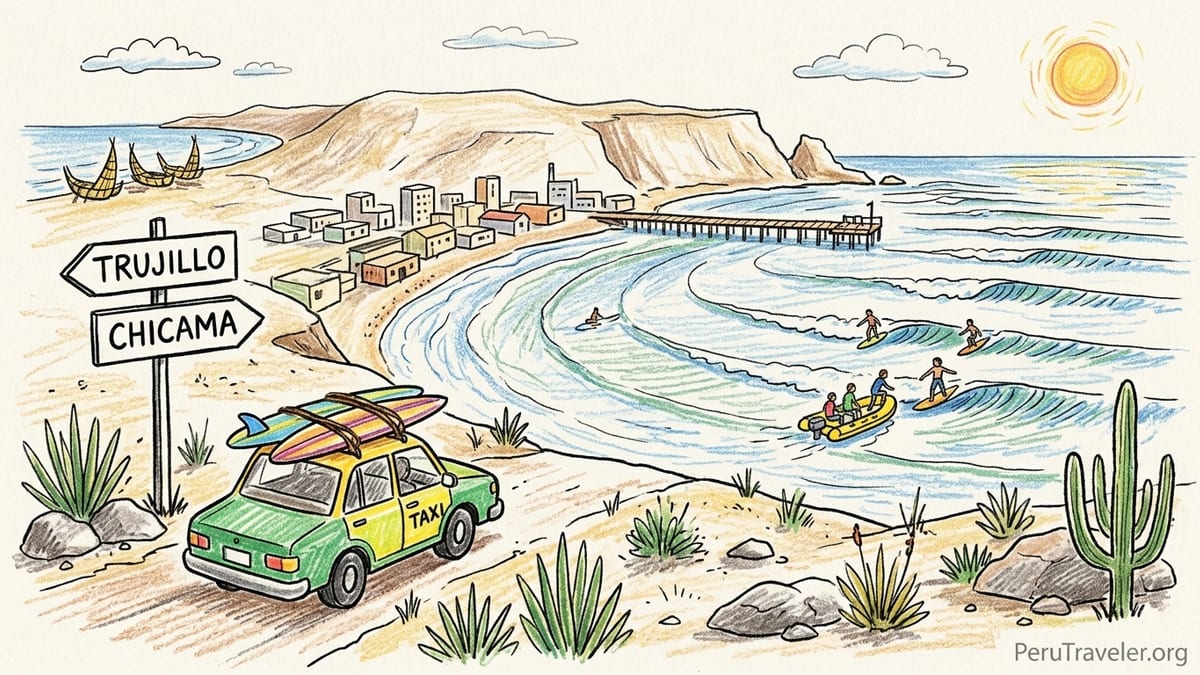
Getting to Chicama from Trujillo and First Impressions
My Chicama trip began in Trujillo, the usual jumping-off point for surfers landing from Lima. Puerto Malabrigo, often called Puerto Chicama, sits roughly 70 kilometres north of the city, connected by the Panamericana Norte and a short coastal spur road. Recent transport data suggests the drive takes a little over an hour in a private car, with taxi companies quoting the equivalent of about 25 to 30 US dollars one way for the full 70 kilometre trip when booked directly in Trujillo. Budget travellers can stitch it together by taking a bus toward Paiján or San Pedro de Lloc for a few dollars and then a local taxi or colectivo for the last 15 kilometres, but the combined time climbs toward two and a half hours and involves some haggling with drivers over boards and bags.
I opted for a pre-arranged private taxi transfer from Trujillo to Puerto Malabrigo, coordinated a few days ahead by WhatsApp. The driver met me at my central Trujillo guesthouse, strapped two surfboards to the roof on soft racks and charged roughly 30 US dollars for the one-hour trip, which aligned with current online estimates for Trujillo to Malabrigo taxis. It felt like money well spent after a long overnight flight and allowed me to check the surf forecast en route, rather than puzzle over bus terminals and colectivos.
Arriving in Puerto Malabrigo, the first impression is not a postcard surf town but a working port. The desert cliffs, pier and fishing activity give the bay a slightly industrial edge. The wave itself, however, immediately dominates the scene: long, ruler-straight lines wrapping from the distant outside point toward the pier. Even on a medium swell, you can trace section after section marching down the bay and begin to understand why this place has become a global pilgrimage for goofy-footers.
Reading the Chicama Forecast and Choosing When to Go
Before committing to several nights in Chicama, I spent weeks watching the charts. The wave is notoriously fickle. Local and international surf guides agree that you need a solid long-period south or southwest swell with a healthy amount of west in the direction to properly light up the full point. Forecasts calling for deepwater swell around the six-foot mark or larger, with long periods, are what usually translate into set waves that can link multiple sections from the top of the point.
For my mid-year trip, the forecast window showed three key days: a rising swell on arrival with deepwater energy around four feet at 16 seconds, a peak day in the five to six foot range, and then a slow fade back to three feet. Wind patterns in the region are relatively consistent, with frequent offshore or cross-offshore conditions thanks to the coastal desert and Humboldt Current, but afternoons can see more cross-shore breezes. I booked four nights to cover a full swell cycle, expecting at least two solid days and one smaller day to test how the wave feels when it is not performing at headline level.
This level of planning matters. Talking with other guests at both of my accommodations and with boat drivers, a recurring theme was surfers who travelled long distances, arrived on a weak or poorly angled swell, and spent days surfing only the “inside” sections with shoulder-high waves, short rides and plenty of current. The long, two-kilometre rides you see in videos usually require those rarer, larger and more west-angled swells. Anything less and you are surfing a very fun, very long left point, but not a kilometre-plus conveyor belt.
Where I Stayed: Chicama Boutique Hotel vs Surf House Chicama
For a clear sense of value, I split my stay between two contrasting options. The first two nights I checked into Chicama Boutique Hotel, a polished surf resort built directly above the middle of the point, with an infinity pool, spa, restaurant and on-site tow-back boat services. Recent rate information on the hotel’s own booking engine put double or triple ocean view rooms in the ballpark of 160 US dollars per night and garden view rooms from around 150 US dollars, including breakfast, with premium rooms higher again. The hotel offers secure board storage, on-site guides, yoga classes and organized transfers from Trujillo or the airport, which suits travellers who want a streamlined, full-service experience.
The second half of my trip was at Surf House Chicama, a more casual, surfer-run guesthouse set just in front of the main wave. Current prices published by the surf house list rooms from 120 Peruvian soles per night for a single, around 180 soles for two people and 230 soles for three, including breakfast, private bathroom, shared kitchen access, common areas, hammocks, outdoor showers for wetsuits and a dedicated surfboard storage area. At recent exchange rates, that puts a solo surfer at roughly 30 to 35 US dollars per night. Surf House Chicama also arranges equipment rental and connects guests with independent boat drivers, surf instructors and local taxis, although those services are usually paid directly in cash to the provider.
From a surfer’s standpoint, both places are well set up. Chicama Boutique Hotel has the edge on comfort and convenience, with everything under one roof, landscaped grounds and a full restaurant and bar. Board storage is in a secure room near the entrance, and it feels very much like a dedicated surf resort. Surf House Chicama is more intimate and communal, with a shared kitchen where guests cook together, relaxed garden hangouts, and equipment racks dotted around the property. The surf house is better suited to budget-conscious travellers or solo surfers who want to meet others, while the boutique hotel will appeal to couples, families and those who value a higher level of service and amenities.
Boat-Assisted Surfing, Prices and How Much Water Time It Adds
One of the most distinctive features of surfing Chicama is the boat-assisted return. The wave peels from south to north along the bay, and a strong northward current often makes paddling back to the top section slow and punishing. Chicama Boutique Hotel operates its own zodiac tow-back service. Recent guest reports in 2026 mention prices around 25 US dollars per surf session or about 40 dollars for two sessions in a day, with pre-booking recommended during strong swells. The boat collects surfers in deeper water beyond the impact zone after they kick out near the end of a ride, then shuttles them back toward the top takeoff area.
For one morning session on the peak swell day, I pre-booked two boat shuttles through Chicama Boutique Hotel. The staff organized a short safety briefing covering where to wait after a wave, rules about not approaching the boat from the inside near the breaking waves, and the importance of keeping leashes and limbs clear of the ladder. Pickup was simple: after riding a wave as far as practical, I paddled out through the channel to deeper water, raised my arm, and within a minute or two the zodiac swung by, idled down-swell, and I climbed aboard with my board under my arm.
In a three-hour session, I was able to ride roughly twice as many quality waves as I would have managed by walking or paddling back from the inside. Instead of spending 20 to 25 minutes per lap between paddling, walking up the beach and re-entering at the point, the boat reduced each reset to five minutes or less. I surfed ten legitimate set waves that morning, several of them connecting multiple sections, compared with the four or five I might have managed without assistance. On another day, staying at Surf House Chicama, I joined a shared boat organized by a local captain for a group of four surfers. The rate was 200 soles for a two-hour block, about 55 to 60 US dollars total, split between the group. The arrangement was more informal but followed similar safety practices.
What the Wave Was Actually Like: Sections, Current and Real Rides
Across four days, I surfed Chicama in a range of conditions, from chest-high runners to overhead sets on the best day of the swell. Water temperatures sat around the cold side of temperate, a typical figure for this part of Peru, so a 3/2 or 4/3 steamer with booties felt about right, especially with the wind factor. The wind was largely offshore or cross-offshore in the mornings, grooming the lines, then clocking a little more cross-shore by mid-afternoon but rarely going fully onshore.
The wave itself breaks in distinct sections rather than as one continuous wall. The outside “Point” is the most famous and offers the longest rides when the swell is big and well angled. On my best session there, I paddled out from the rocks just below the resort, waited inside a pack of about 15 surfers, and managed to pick off a handful of shoulder- to head-high walls. The longest of these started at the Point, raced down through a fast middle section and re-formed into a more playful wall closer to the pier. Measured against landmarks on the cliff, that ride felt around 700 to 800 metres long, with enough speed and wall to link plenty of turns but with small flat spots between pulses of energy.
However, not every wave joined the dots. Many sets would break beautifully at the Point, wall for a few hundred metres, then either run off too quickly to make the section or go flat through a deeper part of the bank before reforming further down. On the medium days, the longest consistent rides came from positioning a little wider and accepting slightly smaller waves that held their shape through more of the bay. One afternoon, I focused on this mid-bay section and tallied about six waves in a two-hour boat-assisted session, each in the 400 to 500 metre range. They lacked the drama of the biggest Point sets but allowed more relaxed, flowing turns.
The current deserves serious respect. A strong northward sweep pulls you toward the pier with every ride and even while you sit in the lineup. Without a boat, most surfers end up alternating between paddling diagonally up-current and walking along the sand after their waves. On my first, non-assisted session, I surfed three waves from the mid-point almost to the pier, spent ten minutes walking back up the beach each time, and then another ten minutes paddling out along the rocks. After two hours, my shoulders were exhausted and I had racked up far fewer waves than expected. Chicama may be a point break, but it is not a lazy conveyor belt unless you have boat support and enough swell.
Skill Levels, Sections and Why Not Everyone Surfs for Kilometres
Despite its fame as an endlessly peeling left, Chicama is not automatically user-friendly for all surfers or all conditions. The takeoff at the Point on a solid swell is relatively steep and can be crowded with experienced locals and travelling surfers who know how to sit deep, backdoor sections and handle the brisk down-the-line speed. Late drops and quick adjustments are common. Intermediate surfers who are not comfortable with fast point waves may be better served sitting wider on the shoulder or shifting to inside sections during peak sessions.
This is where understanding the different sections of the bay becomes vital. The outside Point offers the longest potential rides but also the most intense crowds and critical drops. A little further down, softer “middles” still reel down the line but with more manageable speed and room to trim and turn. Closer again to the pier, especially on medium swells, re-formed waves offer gentler shoulders, shorter rides and a bit less current, making them better for intermediates who want practice without being flung down a high-speed racetrack.
For beginners, Chicama can be the wrong choice entirely during large swells. Surf instructors in town that I spoke with were clear that on big days the main point is not suitable for first-time surfers or those who have not mastered basic takeoffs and trimming. Whitewater reform sections near shore can sometimes work for lessons when the swell is smaller, but generally, beginner lessons are held during mellow conditions or even in alternative spots closer to Trujillo, such as the more forgiving waves in Huanchaco. Treating a large Chicama swell as a learner’s playground would be a serious mistake. The combination of strong currents, length of ride and cold water can turn enthusiasm into a safety issue very quickly.
This also explains why the dream of surfing multi-kilometre rides is not achieved by most visitors. To link from the Point all the way to the pier on a single wave, you need a rare, big, well-angled swell and the fitness to pump constantly across fast sections, read the flatter bits without stalling out and stay ahead of the foam. On my best waves, I still blew one or two critical sections and stepped off after 700 or 800 metres simply because my legs and lungs were done. The wave offers the possibility of enormous rides, but you still have to earn every metre.
Life in Puerto Malabrigo Beyond Surfing
Outside the water, Puerto Malabrigo remains a fishing town first and a surf destination second. The long pier, small harbour and fleets of boats set the tone. Early mornings smell of diesel and fish as crews head out, and there is a constant background rhythm of trucks and activity related to the port. If you are expecting the bohemian surf-cafe culture of some other global surf towns, you may find the town quiet and limited.
There are, however, enough simple pleasures to fill time between tides. The coastal authorities have invested in a modest boardwalk along the cliff in front of the bay, providing a scenic place to stroll and watch the endless lines wrap into shore. Beach walks at low tide are atmospheric, with the desert backdrop meeting the ocean and fishermen working near the waterline. Chicama Boutique Hotel and a couple of other lodgings provide comfortable pools and terraces for reading or stretching. Local operators can also arrange short fishing outings with experienced fishermen from the town, adding another layer to the coastal experience and giving a glimpse into the community’s traditional livelihoods.
In terms of food, options cluster around small, family-run restaurants serving ceviche, fried fish and basic Peruvian staples alongside the more refined menus at the surf resort and a handful of newer guesthouses. Prices for a simple fish lunch hover around the equivalent of 5 to 10 US dollars depending on the restaurant and portion size, while dining at the resort can easily reach mid-range international levels, particularly if you add cocktails or wine. Practical services are minimal. There are small shops for snacks and water, a couple of basic pharmacies and ATMs within driving distance, but you will not find major supermarkets or a wide range of nightlife. After dark, life in Puerto Malabrigo slows to a very sleepy pace, which can be blissful if your priority is dawn patrol, but dull if you like lively evenings.
When the Swell Disappoints and How Chicama Compares to Huanchaco
One of the most important questions for a surf trip built around a single wave is what happens when the swell does not cooperate. During my stay, the first and last days of the forecast window underperformed. The direction shifted slightly, the period dropped and the sets at the main point never rose much beyond shoulder-high, with long lulls and sections that stopped and re-formed in frustrating ways. The wave was still rideable and fun, but the mythic kilometers did not materialize. Conversations with other travellers echoed what many online trip reports warn about: it is entirely possible to come a long way and spend much of your time chasing shorter, slower waves broken up by flat spots.
This is where Huanchaco enters the conversation. Huanchaco, closer to Trujillo, is a more developed beach town with a long left-hand point-style wave over cobblestones, a visible surf culture and the iconic reed fishing boats known as caballitos de totora. It offers a greater variety of accommodations from budget hostels to mid-range hotels, a broader restaurant scene, surf schools and more consistent, though generally smaller, waves. Several surfers I met in Chicama had structured their trips around a combination of both places, staying in Huanchaco before or after their Chicama window to surf more forgiving waves and have a livelier town base.
In terms of cost, a four-night Chicama stay at the boutique surf resort, including transfers, boat sessions, food and extras, can easily run well over 1000 US dollars for a solo traveller. Two nights at roughly 160 dollars per night, return taxi transfers from Trujillo around 60 dollars, several boat-assisted sessions at about 25 to 40 dollars each, on-site restaurant meals, spa treatments and incidentals add up quickly. At Surf House Chicama, four nights including breakfast, shared kitchen dinners, a couple of group boat charters and local meals might land closer to a few hundred dollars, but still revolves around a single break and a quiet town.
A comparable four-night stay in Huanchaco can be significantly cheaper and more flexible. Mid-range hotel rooms in the town often come in under 60 to 80 dollars per night, surfboard rentals and lessons are widely available at modest prices, and restaurants cover everything from bargain menus to more polished cevicherias. Transport from Trujillo is simple and inexpensive, and there is enough variety in both waves and town life to keep non-surfing days enjoyable. If your budget is tight, your surfing is in the beginner to early-intermediate range, or you want nightlife, Huanchaco offers better value. Chicama, by contrast, shines for surfers who are willing to invest both money and planning into chasing a specific, occasionally world-class experience.
The Takeaway: Was Chicama Worth It and Who Should Go
Going into this trip, I expected Chicama to deliver at least one or two legitimately marathon rides, the kind of waves that sear themselves into your memory and justify years of daydreaming. I also expected a slick, almost resort-like operation given the international reputation. What I actually experienced was a more nuanced picture. The longest waves I surfed were extraordinary by any normal standard, pushing close to a kilometre in length when measured by landmarks along the bay, yet I still never quite managed the mythical pier-to-point marathon. Currents, fatigue, crowd dynamics and slightly imperfect swell direction all conspired to shorten rides or break them into segments.
What frustrated me most was the inconsistency between days, even within a promising forecast window. On underperforming days, watching lines crumble or flatten halfway down the bay felt like a reminder that Chicama is still very much at the mercy of ocean dynamics, not a guaranteed mechanical wave pool. The town’s limited non-surf offerings also become more noticeable when you are not stoked and tired from marathon sessions. You are in a working port with a desert backdrop and a quiet nightlife, not a bustling surf hub.
Did the surf camp and resort justify their cost? For me, splitting time between the boutique hotel and Surf House Chicama made sense. The resort’s comfort, direct access to boat services and spa made the bigger days feel like a special occasion and turned recovery into part of the experience. The surf house delivered great value, a social vibe and all the practical support I needed at a fraction of the price. If I were returning on my own dime, I would probably base myself at the surf house or similar mid-range option, then selectively spend on boat sessions and perhaps one splurge night at the resort if a particularly promising swell appeared on the charts.
Who, then, should choose Chicama over another Peruvian surf destination? Advanced and solid intermediate goofy-footers with good fitness, who enjoy long point waves and are prepared to study forecasts, will find Chicama unique and potentially trip-defining, especially if they can stay flexible with dates to chase the right swells. Surfers who prioritise variety, town life, beginner-friendly waves or tight budgets are better served basing themselves in Huanchaco or exploring the many other breaks along the Peruvian coast and treating Chicama as a side mission only if the swell lines up. Chicama is absolutely worth visiting in the right conditions and with realistic expectations. It is not a guarantee of kilometre-long rides for every visitor, but when the stars align, it offers a kind of prolonged glide that is very hard to find anywhere else.
FAQ
Q1. How long does it take to get from Trujillo to Chicama and what does it cost?
Most surfers travel from Trujillo to Puerto Malabrigo in about one to one and a half hours by private taxi, with current fares typically in the range of 25 to 30 US dollars each way, depending on negotiation, vehicle size and whether surfboards need roof racks. Cheaper combinations of regional buses and local taxis can reduce the direct fare but take closer to two and a half hours door to door.
Q2. How much should I budget per night for accommodation in Chicama?
Chicama Boutique Hotel, the main high-end surf resort, generally charges from around 150 to 180 US dollars per night for double or triple rooms with breakfast, while Surf House Chicama lists rooms from about 120 Peruvian soles for a single, roughly 30 to 35 US dollars, including breakfast and shared kitchen access. Other small hotels and guesthouses in town fall somewhere between these two price points.
Q3. What does boat-assisted surfing cost in Chicama?
Boat-assisted tow-back services organized by Chicama Boutique Hotel are commonly priced around 25 US dollars per surf session or about 40 dollars for two sessions in a day, while independent local boats shared between several surfers often charge in the region of 200 soles for a two-hour block, which comes out to roughly 55 to 60 US dollars in total, usually paid in cash and split among the group.
Q4. Can beginners learn to surf at Chicama?
Absolute beginners are generally better off learning in milder conditions or at alternative breaks such as Huanchaco, because large Chicama swells combine long rides with strong currents and chilly water, which can be overwhelming and potentially unsafe for first-time surfers. On smaller days, instructors might use inside reform sections for lessons, but Chicama is not considered a classic beginner beach.
Q5. What water temperature and wetsuit should I expect in Chicama?
The coastline around Chicama is influenced by the cold Humboldt Current, so water temperatures are cool for the tropics, and most visiting surfers are comfortable in 3/2 or 4/3 full wetsuits, sometimes with booties for warmth and protection along the rocky point, especially during longer sessions in windy conditions.
Q6. How many waves can I realistically catch in a session at Chicama?
Without boat assistance, many surfers manage only three to six substantial waves in a two to three hour session because of the long paddles and frequent walks back up the point, while using a boat shuttle can roughly double that number by cutting reset times down to a few minutes between rides, provided you are fit enough to keep paddling and the swell is delivering consistent sets.
Q7. Is it realistic to surf a single wave all the way from the Point to the pier?
Riding from the top Point all the way to the pier, often quoted as around two kilometres, is possible but rare and typically requires a large, long-period swell with an optimal direction, combined with excellent wave selection, fitness and positioning, so most visitors instead experience a series of very long but slightly shorter rides in the 400 to 800 metre range.
Q8. How does a Chicama trip compare in cost and value to Huanchaco?
A four-night stay in Chicama, especially at a high-end surf resort with multiple boat sessions and private transfers, can easily surpass 1000 US dollars for a solo surfer, while an equivalent stay in Huanchaco with mid-range lodging, local transport, board rental and meals typically costs significantly less and offers more variety in both waves and town life, though without Chicama’s extreme ride length potential.
Q9. What is there to do in Puerto Malabrigo when the surf is small?
When the waves do not deliver, visitors can walk the beach or cliff-top boardwalk, watch the fishing activity around the pier, book short fishing trips with local crews, relax by hotel pools, explore nearby archaeological sites arranged through hotels or agencies, and enjoy slow, simple coastal life, but should not expect extensive shopping, nightlife or entertainment options.
Q10. What type of surfer is Chicama best suited for?
Chicama is best suited to fit intermediate and advanced goofy-footers who love long, fast left points, are comfortable in currents and cooler water, and are willing to time their visit around favourable swell forecasts, whereas beginners, very occasional surfers or travellers seeking nightlife and multiple beach options will usually be happier basing themselves in Huanchaco or other more versatile Peruvian surf towns.