


Few places in Peru feel as otherworldly as the Paracas National Reserve, where ochre desert cliffs drop straight into a cold, steel-blue Pacific. For many travelers it is the most memorable coastal landscape of their trip, and a key reason to stop between Lima and Arequipa. This guide focuses on the official mainland circuit inside the reserve, especially the 26 kilometer northern loop around Playa Roja, La Catedral, Mirador del Istmo, Yumaque, La Mina, Raspón and other viewpoints, with practical detail for 2026 on entrance fees, tour options, driving conditions and realistic timings.
Understanding Paracas National Reserve in 2026
Paracas National Reserve protects a large stretch of Peru’s south coast desert and adjacent marine environment near the town of Paracas in the Ica region, roughly 250 kilometers south of Lima. It is one of the country’s most distinctive “desert meets ocean” landscapes, with high cliffs, fossil-rich plateaus and calm sandy bays all within a short drive. The reserve is also one of the easiest protected areas in Peru to visit independently, which makes it a high-intent destination for tours, private drivers, bike rentals and quad excursions.
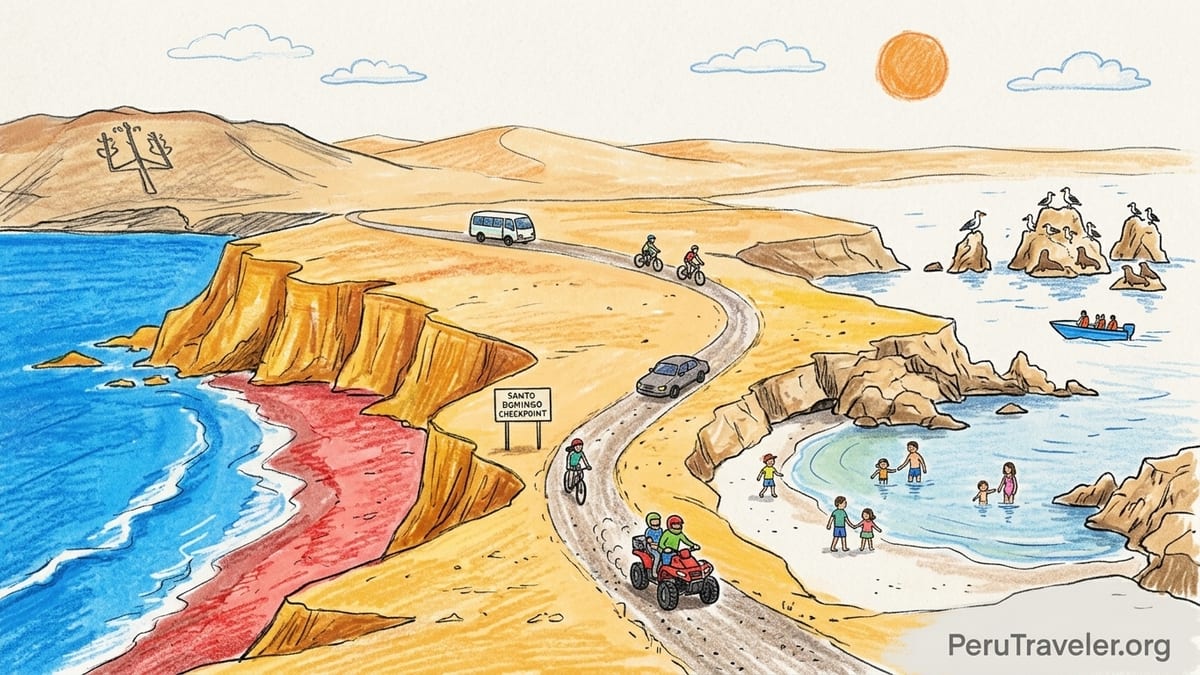
In 2026, visitor access to the main coastal zone is organized around a signposted road circuit that starts at the Santo Domingo checkpoint. The northern circuit, which this article focuses on, is an approximately 26 kilometer loop that takes in the most famous viewpoints and beaches such as Mirador del Istmo, La Catedral, Playa Roja, Yumaque, La Mina and Raspón. The official information from Peru’s protected areas authority puts the standard visit at around four to six hours depending on how many stops and swims you include, which matches what most agencies in Paracas town advertise for half-day reserve tours.
It is essential to distinguish this mainland circuit from the popular Islas Ballestas boat tours. Ballestas is a separate offshore wildlife excursion in the Pacific that departs from El Chaco pier in Paracas town, while the reserve circuit is a land route inside the peninsula. Many agencies sell combined packages, but they are two different visits, each with its own logistics, conditions and in some cases separate tickets. Understanding that difference will help you plan a realistic day that does not feel rushed.
Access to the reserve is controlled and visitors must stay on authorized routes. You either enter in a tour vehicle, a private car, by bicycle, in an authorized ATV convoy or, less commonly, on foot. The landscape might look like an open desert where you can drive anywhere, but in practice the main loop and the spurs to beaches and viewpoints are the only legal options for tourists, and rangers do monitor traffic, especially in peak seasons such as Easter and July–August.
Entrance Fees, Tickets and What They Cover
For 2026, the basic entrance ticket to Paracas National Reserve costs approximately 11 soles per adult, regardless of nationality, with a reduced fee around 3 soles for children between 5 and 16 and a social rate close to 5 soles for local residents who show their ID. Children under five enter free. The ticket is valid for one day on the mainland reserve circuit. Separate tariff categories exist for multi-day and special-use access, but most travelers only need the standard day ticket.
Tickets are sold at the Santo Domingo checkpoint on the access road to the reserve. Although SERNANP, the national parks authority, has been expanding online and card payment, in practice card machines are not always reliable, so you should bring cash in Peruvian soles. Agencies that advertise “all included” often mean transportation and Spanish-speaking guide, not necessarily the entrance ticket, so confirm in writing whether your tour price covers the reserve fee. A common pattern in 2026 is for cheaper group tours priced around 60 to 90 soles per person to exclude the park entrance and ask passengers to pay it directly at the gate.
The Ballestas Islands boat trip has its own separate costs. Shared speedboat tours from El Chaco typically start around 40 to 60 soles for the boat service in 2026, to which you must add a small dock or conservation fee collected at the pier. Some agencies bundle the boat, pier taxes and a later reserve minibus tour into a single package that might total between 110 and 180 soles depending on group size, language options and added extras such as hotel pickup. Always ask which portions of the day use your Paracas reserve entrance ticket and which are purely maritime services.
The entrance ticket for the reserve does not include bike rental, ATV use, food, bathrooms or sunshades, all of which are paid on site where available. At beaches such as La Mina or Lagunillas you can expect to pay modest amounts in soles for basic bathrooms, simple seafood lunches and bottled water. If you travel on a budget, it is entirely acceptable to bring your own picnic, but pack out all trash because bins can overflow on busy days.
The Northern Circuit: Distances, Road Conditions and Key Stops
The classic northern circuit inside Paracas National Reserve is an approximately 26 kilometer loop that starts and ends near the Santo Domingo checkpoint. From central Paracas town to the checkpoint is roughly 10 to 15 minutes by vehicle along a paved road. Once you pass the gate, the circuit combines stretches of asphalt with compacted sand and gravel roads, all generally manageable for a regular rental car in dry weather if you drive slowly and stay on signed routes.
The first key stop is the Mirador del Istmo, a viewpoint over the narrow neck of the peninsula where you can see water on both sides that separates Paracas Bay from the open Pacific. It is primarily a scenic stop, with parking near the road and no beach access. On a clear morning, the light over the water and desert ridges is excellent for panoramic photos. Strong winds are common, so secure hats and loose items before stepping to the railings.
Continuing along the circuit, you reach the area around La Catedral. Before an earthquake damaged its natural rock arch, this was one of the most iconic silhouettes of the reserve; today the viewpoint still offers dramatic views of cliffs and pounding surf. Like the Istmo, La Catedral is a scenic viewpoint only. There is no safe beach access and swimming is not permitted here because of the steep drop-offs, strong currents and falling rock risk. Short walking paths along the cliff edge allow you to vary angles for photography, but you should respect barriers and marked limits.
From La Catedral, the circuit descends toward Playa Roja, perhaps the reserve’s most photographed beach. Here red-hued sands meet yellow cliffs and deep blue water in a broad bay that is visible from an overlook above. The main experience at Playa Roja is visual. While some visitors walk down to the shoreline, swimming is not generally recommended due to powerful waves and currents that can change quickly with the swell. For most travelers, Playa Roja is a 20 to 40 minute stop spent walking along the bluff path, taking photos of the color contrasts and feeling the force of the wind that shapes the dunes.
Beaches for Swimming: Yumaque, La Mina and Raspón
After the scenic stretch of Playa Roja, the northern circuit continues to a series of more sheltered bays that many agencies market as potential swimming stops. The main ones on the loop are Yumaque, La Mina and Raspón, along with the small fishing cove and services area at Lagunillas a short detour away. These beaches sit inside the protected area, so activities are subject to park rules and seasonal conditions.
Playa Yumaque is a wide, pale-sand bay that you reach via a graded dirt spur off the main loop. The beach feels open and exposed and can experience significant surf. Although some visitors paddle at the edge on calmer days, Yumaque is better treated as a scenic beach for walking and photography rather than a dedicated swimming stop, particularly if you are traveling with children. There are no permanent restaurants here and bathroom options may be basic or absent, so it is important to bring water and accept that shade is scarce.
Playa La Mina, reached by another spur road a few minutes further along, is the reserve’s most popular family beach. Tucked between rocky arms that shelter it from the strongest Pacific swell, La Mina often has noticeably calmer water than Yumaque or Playa Roja and, in settled conditions, park staff consider it one of the better places in the reserve for a swim. Even here, you must check the conditions as you arrive. If there are red warning flags, heavy surf or ranger advice against entering the water, stay on the sand. On busy weekends and holidays, local families arrive early to claim space and there may be informal rental of sun umbrellas. Basic food stands and toilets are usually available during high season, but shoulder seasons can feel more rustic.
Raspón is a smaller and quieter bay further along the coastal segment. Road access is on sand and can feel slightly rougher, although still within the range of a normal compact car driven with care. The water can be invitingly clear on good days, but as with La Mina, swimming is always at your own risk and contingent on the day’s wave and wind conditions. Many travelers who self-drive use Raspón as a peaceful alternative when La Mina feels crowded, opting to at least wade or sit near the water if waves look manageable.
Mainland Circuit vs Islas Ballestas Boat Tours
One of the most common confusions in Paracas is between the land-based reserve excursion and the Islas Ballestas boat trip. Both are marketed in town as “Paracas tours” and are often sold together, but they are very different experiences. The mainland circuit described above focuses on desert landscapes, cliffs and beaches, with occasional sightings of flamingos or other birds in the distance. It takes place entirely on the peninsula and uses roads inside the national reserve.
The Islas Ballestas excursion, by contrast, is a two hour shared speedboat tour to a cluster of small offshore islands and sea stacks inhabited by large colonies of seabirds and marine mammals. Boats depart from the El Chaco tourist pier in Paracas town at set times in the morning, commonly around 8:00 and 10:00, and follow a fixed route that includes a view of the giant Candelabro geoglyph etched into the coastal hillside before circling the islands. You remain on the boat at all times; there is no landing on the islands. The appeal is the wildlife and the sensation of being out on the Pacific, not a beach day.
Prices and rules reflect this difference. The Ballestas ticket you buy from a boat operator or agency covers the maritime service and guiding, plus mandatory life jackets. Park or conservation fees linked specifically to Ballestas are usually added separately at the pier. If you also enter the mainland reserve later that day, you will need to pay the land entrance at the Santo Domingo gate unless you purchase a combined ticket that explicitly covers both. When comparing packages that include “Ballestas plus Reserve,” ask to see a breakdown of what each component covers, and whether you will be with the same group for both or change vehicles and guides between the morning and afternoon portions.
In practical terms, many visitors staying one or two nights in Paracas choose to do Ballestas in the morning and the northern circuit in the afternoon of the same day, or to spread them across two mornings to avoid heat and wind. If you are especially interested in photography or in a relaxed time at La Mina beach, it can be worth devoting a separate half-day simply to the reserve circuit, rather than compressing everything into a single rushed itinerary.
How to Visit: Minibus Tours, Private Drivers, ATVs and Bikes
The simplest way to explore the northern circuit is on a shared minibus or van tour booked through an agency in Paracas town or your accommodation. In 2026, these tours typically last around four hours, leave either mid-morning or early afternoon, and include transport, Spanish or bilingual guiding and structured stops at Mirador del Istmo, La Catedral, Playa Roja and at least one of the main beaches such as La Mina. Per person prices for group tours often start in the 60 to 100 soles range without the park ticket. Advantages include clear logistics, limited walking and explanations of geology and wildlife. The main drawback is that you are committed to group timings, which can feel hurried at popular stops.
Hiring a private driver or car with driver for a half-day or full-day circuit offers more flexibility. Local operators and hotels in Paracas can usually arrange this, with half-day rates that might start around the equivalent of several shared tour tickets combined, often between 250 and 400 soles for a vehicle that seats three or four passengers, depending on season and language of the driver. You still pay the reserve entrance separately at the gate, but once inside you can decide how long to linger at each viewpoint, whether to swim and how to sequence your stops to avoid crowds. This format appeals strongly to couples, families with young children and photographers who want to wait for specific light.
ATV or quad excursions have become a popular way to experience the desert environment around Paracas. Some tours take place in concession areas adjacent to the reserve, while others follow authorized routes on the peninsula, usually along the main approach to viewpoints such as the Istmo and Playa Roja. These outings emphasize the ride and the sense of adventure, but they still must respect park rules and stay on designated tracks. Quads are normally guided in convoy, not for free independent roaming. They are unsuitable for very young children and can be tiring for those with back issues, particularly on corrugated or soft stretches of sand.
Cycling is possible and several agencies in Paracas rent standard bicycles by the hour or day. From town to the Santo Domingo checkpoint is a modest fifteen to twenty minute ride on sealed road, but once inside the reserve cyclists must contend with undulating terrain, loose sand in places, intense sun and almost constant wind. Doing the full 26 kilometer northern loop by bicycle is significantly more demanding than riding along a seaside promenade. Even reasonably fit travelers can underestimate how draining the combination of heat, radiation and headwinds can be, especially in the early afternoon. For safety and comfort, those who decide to cycle often limit themselves to a shorter out and back to early viewpoints, or arrange for a support vehicle to carry extra water and provide an exit option.
Weather, Road Surfaces, Facilities and Safety
Paracas has a desert climate with minimal rainfall, strong sunlight and regular winds that pick up by late morning or early afternoon, especially in the austral spring and summer. From roughly October to April, daytime highs can feel very hot in the reserve even if the air temperature is only in the mid-20s Celsius because of reflected radiation from pale sand and cliffs. From June to September mornings can be cooler and sometimes hazy with coastal mist, but the UV index still climbs rapidly when the sun breaks through. For both seasons, travelers should think in terms of desert sun management rather than “beach vacation” conditions.
The northern circuit roads combine asphalt segments with firm sandy or gravel stretches, including the spur roads down to beaches like Yumaque, La Mina and Raspón. Ordinary rental cars are generally permitted on the main loop if you stay on marked routes and drive cautiously. The main risks are sliding or bogging down if you stray into loose sand off the graded track, and damage from hidden stones if you drive too fast. Ground clearance on compact sedans is usually adequate for careful drivers. Four wheel drive is not mandatory in dry conditions, but you should avoid visiting immediately after rare heavy coastal rains, when some dirt sections can become rutted.
Bathrooms and food options inside the reserve are limited. The simplest rule is to assume that reliable toilets and sit-down meals exist only around the small port area of Lagunillas and, in high season, near La Mina. Even there, facilities are basic, sometimes charging a small fee in cash for use. Many other stops on the loop, including Mirador del Istmo, La Catedral and Playa Roja viewpoints, have no services beyond informal vendors on busy days. Carry at least one and a half to two liters of drinking water per person for a half-day circuit, along with high-factor sunscreen, a brimmed hat and a light long-sleeved layer to reduce exposure.
Swimming anywhere in the reserve should always be treated as conditional on the day’s weather and sea state. Cold Humboldt Current waters, rip currents and surf can be hazardous even when the beach looks benign from the parking area. Pay attention to flags, ranger advice and the behavior of local bathers. At La Mina and occasionally Raspón, where swimming is usually considered more reasonable, moderate your expectations: many visitors simply wade or float near shore for a short time rather than attempt long swims across the bay.
Suggested Itineraries: Half-Day, Long Beach Day and Combined Visit
For travelers with limited time, a focused half-day highlights circuit is often the best introduction to Paracas National Reserve. This can be either a morning or an afternoon. A typical route with a shared minibus might leave Paracas town around 9:00, reach the Santo Domingo checkpoint by 9:20 and then follow the loop with short stops at Mirador del Istmo, La Catedral, Playa Roja and a longer pause at La Mina for either a quick swim or a walk on the beach. Including the drive back, you would likely return to town between 13:00 and 13:30, which fits neatly with a relaxed lunch on the waterfront.
If your priority is extended time on the sand, you might opt for a longer beach-focused visit spread over five to six hours. A private driver or rented vehicle helps with this format. You could leave town after an early breakfast, enter the reserve soon after opening, make brief scenic stops for photos at the Istmo and La Catedral, and then anchor the rest of the day at La Mina and Raspón, with a possible detour to Lagunillas for a seafood lunch. This slower approach allows you to adjust to weather: if the wind is calmer in the morning, swim earlier and keep your afternoon for more sheltered exploration or simply enjoy the emptier feel as group tours move on.
Many travelers plan a combined itinerary that includes Ballestas in the morning and the northern circuit in the afternoon of the same day. A realistic version might involve a 8:00 boat departure, returning around 10:00, followed by a short break in town and then a 11:30 or 12:00 departure into the reserve, arriving back in Paracas by late afternoon. In busy periods, agencies sometimes compress this sequence, leaving little time between the pier and minibus departure, so it is worth insisting on at least thirty to forty minutes buffer for snacks, bathroom breaks and a quick rest. If you are traveling with young children or older relatives, consider splitting the two experiences over separate days instead, which also provides more flexibility to pick the best weather window for your boat trip.
An emerging option for those keen on golden-hour photography is a guided sunset visit to selected viewpoints rather than a full circuit. Agencies that offer this kind of experience often time their departure so that guests reach Playa Roja or a nearby cliff overlook in the late afternoon, staying until the sun drops behind the horizon, and then drive back to town in the dusk. While not all beaches are suitable for after-dark stays, this format can deliver striking colors over the desert and sea while avoiding the midday heat.
Choosing the Best Excursion Format for Different Travelers
The ideal way to experience Paracas National Reserve depends strongly on who you are traveling with and what you value most. Couples looking for a balance of comfort and flexibility often gravitate toward hiring a private driver or joining a small-group tour with a capped number of participants. Having the ability to linger at La Catedral until tour buses leave, or to time your arrival at La Mina when it is less crowded, can transform the day, and the extra cost per person is modest when shared between two.
Families with children typically benefit from the predictability and safety of either a private car or a well-reviewed minibus tour. Kids may tire quickly in the sun and wind, so being able to retreat to an air-conditioned vehicle between stops is important. Structured tours also reduce the mental load on parents because someone else manages timings and navigation. At the beaches, parents should err on the side of caution and treat even calm-looking water as potentially cold and energetic; short supervised paddles near the shore at La Mina, combined with sand play and shell collecting, are often more enjoyable than pushing for serious swimming.
Photographers and landscape enthusiasts are likely to get the most from a private arrangement that allows early or late light. The ochre cliffs around Playa Roja and the shapes of the Istmo and La Catedral look very different at midday compared with low-angle sun. Some visitors arrange for an early reserve entry coordinated directly with park administration or specialist guides, which may be possible with prior notice for small groups, although standard tourist hours center on the 9:00 to 16:00 band. Even within typical hours, choosing the first or last tour slot of the day improves light for images.
Budget-conscious travelers often select shared minibus tours or, if reasonably fit and experienced in hot environments, a partial visit by bicycle combined with public or informal transport. Savings on transport should not extend to skimping on water or sun protection, however. If money is tight, one practical strategy is to book a straightforward reserve group tour that clearly excludes extras, buy your own snacks in Paracas supermarkets, and pay reserve entrance and any additional services directly in soles.
Visitors staying at least one night in Paracas are in the best position to tailor their experience. An overnight allows you to choose the calmer morning for either Ballestas or the reserve circuit, then fill the remaining half-day with a more relaxed activity such as walking the El Chaco waterfront, visiting a small local museum or simply watching pelicans and fishing boats in the bay. Those with two nights might dedicate one full day solely to the mainland reserve, exploring not just the headline beaches but also quieter corners, and then reserve the other morning for the boat trip offshore.
The Takeaway
Paracas National Reserve in 2026 remains one of Peru’s most accessible and striking protected coastal areas, particularly along its 26 kilometer northern circuit of viewpoints and beaches. Understanding the difference between scenic stops such as Mirador del Istmo, La Catedral and Playa Roja, and potential swimming bays like La Mina and Raspón, will help you set realistic expectations and pack what you need for sun, wind and basic facilities.
While it is entirely possible to self-drive or cycle the reserve, the combination of strong desert sun, wind exposure and sandy road surfaces means that casual visitors often find a shared minibus tour or private driver to be the most comfortable way to experience the landscape. ATVs and quads deliver additional adrenaline but remain tied to authorized tracks and guided convoys. Ordinary rental cars can access the main route in dry conditions as long as drivers respect speed limits and avoid soft sand.
Layering the reserve circuit with an Islas Ballestas boat excursion requires thoughtful planning around timings, especially if you aim to do both in a single day. Many visitors find that pairing a morning boat with an afternoon desert loop works well, while others prefer to stretch the two experiences over separate days and focus on one environment at a time. Either way, having at least one night in Paracas town significantly improves your flexibility and reduces the sense of rushing through one of Peru’s most unusual seascapes.
Whichever format you choose, the essentials remain the same: stay on authorized routes, respect wildlife, carry enough water, shield yourself from the sun and take time to simply stand in the wind at an overlook, watching the Pacific crash into raw desert cliffs. For many travelers, that moment of vastness and color is what makes Paracas feel like nowhere else on the Peruvian coast.
FAQ
Q1. Do I need to book a Paracas National Reserve tour in advance for 2026?
For most of the year you can usually book shared minibus reserve tours a day in advance or even on the same morning in Paracas town, especially outside peak holidays such as Easter, late July and New Year. Private drivers, English-speaking guides and sunset-focused excursions are in higher demand and are best reserved several days ahead, particularly if you have a fixed travel window or are visiting in the July to September high season.
Q2. Is it safe to drive my own rental car on the northern circuit?
In dry weather most compact rental cars can complete the official 26 kilometer northern circuit if you stay strictly on signposted roads, drive slowly on sandy stretches and avoid parking in soft dunes. You should check that your rental contract allows travel on unpaved roads, carry enough fuel, water and a charged phone, and avoid visiting immediately after rare heavy rains when ruts can deepen. If you feel uncomfortable with loose surfaces or have limited driving experience, a guided tour is the safer choice.
Q3. Which beaches in the reserve are best for swimming?
La Mina is generally considered the most suitable beach in the northern circuit for swimming when conditions are calm, thanks to its sheltered shape and relatively gentle waves. Raspón can also offer pleasant water on good days, while broad Yumaque is usually better treated as a walking and photography beach due to stronger surf. In every case, you should check the sea state, look for warning flags and follow any advice from rangers or local authorities before entering the water.
Q4. How difficult is it to cycle the Paracas northern circuit?
Cycling the full northern loop is noticeably more challenging than a casual ride along a flat seafront promenade. Riders face rolling terrain, loose sand patches, no shade, strong sun and regular headwinds or crosswinds, which can be very tiring over 26 kilometers. Experienced cyclists who are comfortable in hot, exposed conditions may enjoy the sense of isolation, but many visitors find a partial ride combined with transport support more realistic.
Q5. Can I combine Islas Ballestas and the reserve in a single day?
Yes, many visitors successfully combine an early morning two hour boat tour to Islas Ballestas with a four to six hour land excursion around the northern circuit in the same day. A common pattern is an 8:00 boat departure, return to Paracas around 10:00, and a reserve tour leaving late morning or early afternoon. You should allow some buffer time between the two for snacks and rest, and be aware that this combination can feel full and tiring for young children or older travelers.
Q6. Are there restaurants and bathrooms inside the reserve?
Services inside the reserve are limited. The small port area at Lagunillas usually has simple seafood restaurants and basic bathrooms, and La Mina often has seasonal food stands and toilet facilities during busy periods. Scenic viewpoints like Mirador del Istmo, La Catedral and Playa Roja typically have no fixed services, so you should carry sufficient water, snacks and be prepared for basic or absent toilets away from Lagunillas.
Q7. What time of day is best to visit the northern circuit?
Morning visits generally offer softer light, slightly cooler air and calmer winds compared with mid-afternoon, which makes them ideal for photography and walking. Late afternoon can also be beautiful, especially around Playa Roja and the cliffs near La Catedral, but you need to respect official visiting hours and allow enough time to exit before the reserve closes. Midday tends to be the hottest and most exposed period, which can be uncomfortable for cyclists and those highly sensitive to sun.
Q8. Do reserve tours usually include the entrance fee in the price?
Policies vary by operator. Some higher-priced private tours include the reserve entrance and handle payment at the gate on your behalf, while many budget-friendly shared minibus options advertise a lower headline rate and then ask each traveler to pay the standard entrance fee in cash at the Santo Domingo checkpoint. To avoid surprises, ask your agency explicitly whether the park ticket is included or paid separately.
Q9. Are children allowed on ATV or quad excursions in Paracas?
Age and height rules differ by company, but in general ATVs and quads are recommended for adults and older teenagers, not for small children. Many operators require drivers to hold a valid license and may only permit younger participants to ride as passengers with a parent or guide. Because the terrain can be bumpy and the wind strong, families with very young kids usually find minibus or private car tours more comfortable and appropriate.
Q10. How long should I stay in Paracas town to see both Ballestas and the reserve?
Staying at least one night in Paracas allows you to comfortably visit either the reserve or Islas Ballestas without rushing. Two nights provide more flexibility to schedule the boat trip and the northern circuit on separate mornings or to add a relaxed beach-focused day and a sunset viewpoint. Travelers passing through on a tight Lima to Arequipa itinerary often select a single overnight stay and commit to a combined day of Ballestas and the reserve, while those with more time appreciate an extra night for a slower pace.