


On Huanchaco’s waterfront, the first thing I heard was not the crash of the waves but the rasp of reeds being dragged across sand. Long bundles of totora, taller than the men hauling them, slid toward the high-tide line where half-finished caballitos de totora waited. Before I ever touched a surfboard here, I watched the original surf craft of this coast take shape in the hands of fishermen whose families have worked this shore for generations.
Arriving From Trujillo and Checking In by the Waves
Reaching Huanchaco from Trujillo is refreshingly straightforward. From the city’s Avenida España ring road, blue-and-white combis marked “Huanchaco” shuttle back and forth all day. In August 2026, I paid 3 soles for the 30 to 40 minute ride, sharing the minibus with office workers heading home and teenagers balancing bodyboards on their knees. A taxi from central Trujillo or the main Terrapuerto bus terminal cost between 20 and 30 soles, depending on traffic and bargaining, and took around 20 minutes. Even from Trujillo’s small airport, drivers were quoting similar prices for the short hop directly to the malecón.
I stepped out of the combi at Huanchaco’s main plaza just after noon and walked three minutes downhill to the seafront. The town stretches in a slim band along the bay: one side lined with low hotels, hostels and cevicherías, the other with the Pacific rolling in at a slight diagonal. I checked into a midrange guesthouse opposite the pier, paying the equivalent of about 120 soles for a private room with ocean view, hot shower and decent Wi-Fi. Cheaper dorm beds and basic rooms without sea views were available along the same strip for roughly half that.
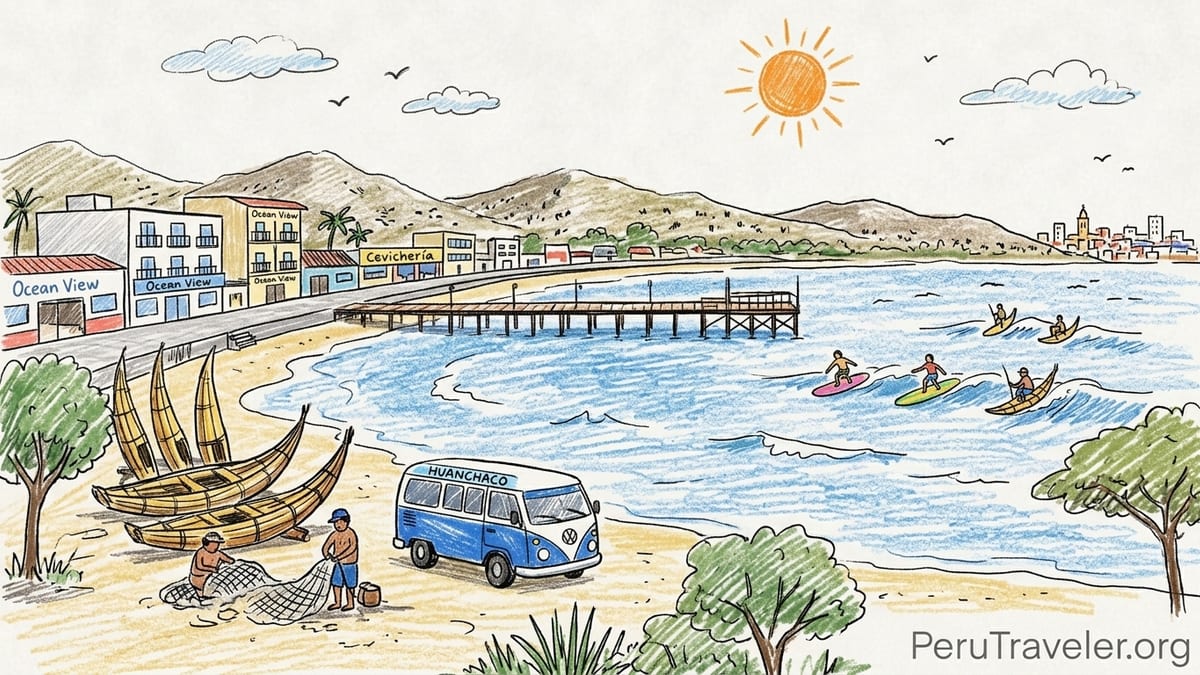
From my balcony I could see the beach running north past the pier and south toward the wetlands, chopped by small, manageable waves. A few early-afternoon surfers bobbed near the pier, waiting for sets. Closer to shore, what really stood out were the caballitos de totora lined up like spears stuck in the sand, their pointed prows tilted toward the sky. This would be my base for the next 24 hours: footsteps from both the modern surf break and the much older reed-boat tradition that made this coastline famous long before neoprene and fiberglass arrived.
Meeting the Makers of Caballitos de Totora
Huanchaco’s caballitos are not museum pieces. Around 2:30 p.m., I headed to the southern end of the main beach, where fishermen still work on their reed boats in the open. The scene was low-key but busy. Two men were binding a fresh caballito with nylon rope, totora fibers squeaking as they compressed the bundle. Another was trimming ends with a simple knife, his feet braced in the sand. They barely glanced up as a few tourists snapped quick photos from a distance.
I waited until a natural pause, then approached one of the fishermen, an older man who introduced himself simply as Juan. He agreed to chat as long as I did not interrupt his work. He explained that most of the reeds come from the nearby Pantanos de Huanchaco, shallow wetlands just inland from the coast that the community manages as a living resource. He called them “totorales” and described them as rectangular ponds, carved into the sandy ground and fed by groundwater. Families plant rhizome fragments of Schoenoplectus californicus, the totora reed, and tend them for several years until the stems reach the height needed for boats. For each caballito, he said, they cut and dry piles of reeds for around two weeks, then sort them by thickness.
Watching Juan assemble a boat clarified the process. First, he created two long bundles that would form the sides, tapering them sharply toward the front. These were lashed together at both ends, then more reeds were added on top to give the boat volume. The bottom was packed tight to increase buoyancy; the upper layers gave the prow its almost vertical curve. Juan said a working caballito lasts roughly four to six weeks before it becomes waterlogged and heavy, sometimes less if used daily. After that, the reeds are too saturated and the boat must be replaced. A single boat, he estimated, requires enough reeds from several square meters of wetland beds, one reason the community remains protective of the totorales.
Nearby, another fisherman loaded his completed caballito with nets and a small plastic crate. When I asked why they still use such simple boats instead of fiberglass skiffs, Juan shrugged. The reed craft is lighter to pull across the sand, he said, and handles the beach’s consistent shorebreak better for nearshore fishing. But the deeper reason is identity. Huanchaco has long promoted the caballito as part of its heritage, and local fishermen see themselves as guardians of that tradition. Some now also earn a little extra money by offering short rides or posing for photos, but as Juan emphasized, the core purpose remains fishing. “Sin pesca, no hay caballito,” he said: without fishing, there is no reason for the boat.
From Ancient Craft to Surf Culture on the Same Shore
Late in the afternoon, I watched as a small group of fishermen carried their caballitos to the water’s edge. Instead of launching straight through the whitewater, they waited for a lull, timed the sets with a quick glance outside and pushed forward in unison. Once afloat, they straddled the reed bundles like oversized sit-on-top kayaks, kneeling or sitting astride them, paddling with small wooden blades. As the incoming waves steepened, they rode over the backs or, when perfectly positioned, let the swell lift the caballito and carry it shoreward. The similarity to surfing was striking, even though the men were working, not playing.
Standing by the pier, I could see modern surfers sitting just beyond the fishermen, further out where the waves wrapped more cleanly around the bay. Soft-top learner boards bobbed among more performance-oriented shortboards and a few longboards. The idea that Huanchaco might be one of the birthplaces of surfing is not entirely romantic marketing. Archaeological evidence from Moche and Chimú cultures depicts reed boats riding waves, and modern organizations that work here describe caballitos as one of the earliest surf crafts still in use. Today, the same breaking waves support two intertwined cultures: one based on harvesting fish, the other on harvesting rides.
Locals I spoke with acknowledged a tension between spectacle and subsistence. Some visitors treat the fishermen as photo props, ignoring the fact that these are working boats heading out to set nets. At the same time, surf schools and hostels collaborate with fishing families in wetland conservation initiatives, recognizing that the health of the totorales and the coastline affects everyone. A surf school owner I later met described community meetings that bring together reed-boat makers, environmental groups and surfers to discuss erosion and wetland management. Modern surf tourism and ancient caballito traditions may have different aims, but in Huanchaco they share the same narrow fringe of sand and the same swells.
Booking a Real Surf Lesson and Facing the Conditions
After watching the fishermen, I walked north along the malecón and stopped at a small surf school kiosk across from the pier. Several schools line this stretch, and their boards, stacked nose-up against walls, serve as informal signboards. At one school, a chalkboard advertised group beginner lessons for 90 soles and private instruction for 120 soles, each lasting around 90 minutes with board and wetsuit included. I asked specifically about that day’s conditions for a first-timer. The instructor glanced out at the line-up, checked his phone for the swell forecast and shook his head. A long-period swell had pushed chest- to head-high sets into the bay, with a noticeable current running north. He recommended that complete beginners either wait for the following morning, when the tide and swell would be friendlier, or stick to a very close-to-shore session focused mostly on paddling and popping up.
The next morning, just after 8 a.m., I returned. The wind was light, waves around waist-high and more forgiving. I signed up for a group class at 9 a.m., paying 90 soles in cash. We were four students with one instructor and an assistant in the water, a reasonable ratio that meant each of us got hands-on guidance. The school kitted us out with full-length 3/2 mm wetsuits, which were necessary given the Humboldt Current’s cool water, and large soft-top boards designed for stability. A separate rental board and wetsuit package would have cost 25 to 30 soles for two hours, and several schools offered multi-lesson deals, such as three lessons for about 240 soles or five sessions for 350 to 400 soles, aimed at travelers staying several days.
Our instructor, a local surfer who had grown up in Huanchaco, started with a fifteen-minute beach briefing: safety zones relative to the pier, where the current usually ran, how to fall flat and protect the head. He emphasized that Huanchaco is not a guaranteed beginner paradise. On smaller days, the inside reform waves are ideal for learning, but when a bigger swell arrives, whitewater becomes heavy and currents strengthen. He told us that the school cancels or reschedules beginner classes on some winter afternoons when conditions become too challenging.
First Contact With the Cold Pacific
Stepping into the water, I understood his caution. Even in a full wetsuit, the first waist-deep immersion delivered a chill that tightened my chest. The water temperature felt somewhere in the mid-teens Celsius, cold enough to bite but not to cause numbness if you kept moving. We began in the shallows, practicing paddling and the “pop up” motion on broken, knee-high waves. The sand underfoot was fine and slightly uneven near small shore channels carved by the retreating tide.
Once we were comfortable, the instructor led us a little farther out, to where waist- to chest-deep whitewater rolled in consistently. The current had a subtle sideways pull, nudging us north toward the pier if we were not paying attention. Our instructor reminded us to use landmarks onshore to gauge drift. Paddling a large foam board in these conditions proved more tiring than it looked from the beach. For each attempted ride, there was the slow, methodical paddle back to position, ducking under or climbing over incoming foam.
On my first few waves, I barely made it to my knees before wobbling sideways into the water. The instructor stood behind, giving each board a push as the wave approached and shouting timing cues. Around the fourth or fifth attempt, my feet found the right placement and I managed a shaky, three-second ride before tumbling off. It was enough to understand why many visitors come to Huanchaco specifically to learn: the waves, when manageable, offer clean, predictable practice. Yet I also saw how a slight increase in size or a shift in wind could transform this same beach into a much more serious proposition for a novice. The lesson finished after just over an hour in the water and about 20 minutes of breaks and on-sand coaching, which matched the promised 90-minute session.
Beachfront Food, Ceviche and Contrasting Atmospheres
Surfing sharpened my appetite. Around 1 p.m., the malecón had shifted into lunchtime mode. I chose a simple seafood restaurant overlooking the pier, drawn by a hand-written “ceviche de pescado” sign. A generous plate of fresh white-fish ceviche with sweet potato, cancha corn and red onion cost 28 soles. I added a bowl of classic leche de tigre for 10 soles and a bottle of mineral water for 4 soles. Other nearby menus listed mixed seafood ceviche for 32 to 38 soles, arroz con mariscos in the low 30s and daily menus with soup and main for around 20 to 25 soles. Portions tended to be large, easily shared between two light eaters.
In the afternoon, Huanchaco felt busy but not frantic. Locals strolled the promenade; families rented plastic chairs and umbrellas; vendors passed selling ice cream, churros and bags of cancha. Speakers from a few beachfront bars spilled cumbia and rock classics into the salt air. The line-up near the pier filled with intermediate surfers taking advantage of the still-organized swell. Along the southern stretch, fishermen returned with their caballitos, hauling nets ashore. The atmosphere combined work and leisure, with wetsuits hanging from hostel balconies and freshly caught fish carried in crates toward side-street markets.
At sunrise the next day, the tone was completely different. I walked the beach at 6:30 a.m. The malecón was almost silent, save for the rattle of a delivery truck and the soft hiss of small waves folding over themselves. A few dedicated surfers were already out, sitting almost motionless in the pastel light. On the sand, caballitos rested nose-up in tidy clusters, their reed surfaces still damp from previous outings. Without the crowds and day-trip noise, Huanchaco looked more like the fishing village it has been for centuries. If you want to see fishermen preparing their boats or heading out without a ring of cameras around them, early morning is by far the most respectful and revealing time.
Water Quality, Swimming and the Reality of the Beach
Before recommending Huanchaco as a place for casual ocean swimming, it is important to talk about water quality honestly. This coast sits close to a growing city, and like many urban beaches in Peru, it has faced concerns about sewage and runoff in the past. Recent local reports in 2026 have noted improvements, including better monitoring and some infrastructure upgrades, but also point out that water quality can fluctuate after heavy rain or during certain discharge events. Official data are not always easy for short-term visitors to interpret in real time.
During my stay, the water looked clear enough from shore, with no visible debris near the main swimming area. I saw local children and adults wading and playing in the shallows, and surf schools operated lessons as usual. That said, I did not see prominently displayed daily water-quality notices on the beach itself. Given the mixed history of coastal pollution along parts of Peru’s northern shoreline, the most prudent approach for travelers is to ask up-to-date advice from local surf schools, hostels or residents on arrival, especially if you or your companions are prone to ear or skin issues.
As a practical guideline, I would treat Huanchaco primarily as a surf and cultural beach, not a classic, carefree swimming resort. Conditions include a steady shorebreak, shifting currents and cool water that makes wetsuits advisable for longer sessions. Stronger swimmers confident in surf may enjoy bodysurfing or swimming inside the main break on calmer days, but families with small children will likely prefer supervised paddling close to shore. For those looking mainly to sunbathe and watch, the promenade and low concrete wall that lines the malecón offer excellent views with far less sand in your shoes.
The Takeaway
After a full day and night tracing both surf lines and reed-boat tracks across Huanchaco’s sand, what stayed with me was not a single perfect wave but the layered way this shoreline is used. Watching fishermen like Juan build and launch caballitos de totora at sunrise, then taking a beginner surf lesson under the same modest pier a few hours later, made it clear that modern surf culture here grew on top of a much older maritime knowledge. The totorales behind town feed the boats that still bring in fish, while today’s surf schools and hostels sell a different kind of harvest: experiences and stories that visitors carry away.
As a pure surf destination, Huanchaco is appealing if you value consistency over spectacle and do not mind cool water and brownish sand. It will not compete with Peru’s more famous point breaks for advanced riders, but for learners and intermediate surfers, the combination of affordable lessons, board rental and a relaxed town vibe works well. Just remember that the beach does not offer gentle, beginner-friendly conditions every single day. Larger swells and currents can make sessions challenging, and good schools will frankly reschedule or shorten lessons when needed.
As a cultural excursion, Huanchaco shines even brighter. The visible, daily presence of caballitos de totora, the proximity of the wetlands and the straightforward access from Trujillo mean you can, in a single day, move from watching reeds being harvested and boats being built to tasting ceviche likely made with fish brought in on those same craft. That said, certain aspects may disappoint some visitors. The waterfront has its share of simple concrete buildings and patchy infrastructure rather than postcard-perfect charm, and concerns over water quality mean it is not the carefree swimming beach some day-trippers expect.
Would I stay overnight again? Yes, and I would recommend that others do the same. Huanchaco reveals different faces over a full cycle of day and night: fishermen working at dawn, surf schools and cevicherías humming through the afternoon, a calmer, almost reflective promenade after dark. Giving the town at least one night allows you to step beyond the quick-photo stop and notice how reed boats and surfboards share the same tide. If you come willing to listen to both the fishermen and the waves, Huanchaco offers something richer than a simple surf check-off: a living conversation between past and present, written in reed, water and wax.
FAQ
Q1. How do I get from Trujillo to Huanchaco without a tour?
From Trujillo, you can take a local combi or bus marked “Huanchaco” from Avenida España for about 2 to 3 soles, taking roughly 30 to 45 minutes depending on traffic, or hire a taxi from the city center, Terrapuerto or airport for around 20 to 30 soles for a 20 minute ride.
Q2. Are Huanchaco’s surf conditions suitable for complete beginners?
Huanchaco often offers beginner-friendly waves on small to moderate swell days, especially in the morning, but larger swells and currents can make conditions challenging. Good schools may reschedule or shorten lessons when waves become too powerful, so you should not assume it is safe or ideal for novices every day.
Q3. How much does a surf lesson cost in Huanchaco?
In 2026, group beginner lessons typically cost around 90 soles for about 90 minutes, including board and wetsuit, while private lessons run closer to 120 soles. Several schools offer packages such as three lessons for roughly 240 soles or five for 350 to 400 soles for travelers staying several days.
Q4. Is it possible to rent surfboards and wetsuits without taking a lesson?
Yes. Most surf schools and some hostels rent soft-top and fiberglass boards plus full wetsuits. Expect to pay roughly 25 to 30 soles for a couple of hours of board and wetsuit rental, with daily rates available if you plan multiple sessions.
Q5. What is the water temperature like, and do I really need a wetsuit?
The Humboldt Current keeps Huanchaco’s water cool for most of the year, often in the mid-teens Celsius. While hardy locals sometimes surf in shorties during warmer months, most visitors are more comfortable in a full 3/2 mm wetsuit, especially for longer sessions or during the cooler season.
Q6. Can I safely swim at Huanchaco beach?
Many people paddle and play in the shallows at Huanchaco, but currents, shorebreak and variable water quality mean it is better considered a surf and cultural beach than a classic swimming resort. Always ask locals or surf schools about current conditions, keep non-swimmers close to shore and consider other options if you are mainly seeking calm swimming waters.
Q7. What are caballitos de totora, and can visitors ride them?
Caballitos de totora are traditional reed boats made from totora grown in nearby wetlands, used by Huanchaco fishermen for thousands of years. Some fishermen and tour operators offer short demonstration rides for visitors, usually for a small fee agreed on the spot, but their primary use remains fishing, so it is important to approach respectfully and understand that not every fisherman is interested in giving rides.
Q8. How much should I budget for food along the Huanchaco waterfront?
On the malecón in 2026, a plate of fish ceviche typically costs between 25 and 35 soles, mixed seafood dishes in the low 30s and simple set menus with soup and a main around 20 to 25 soles. Street snacks, such as churros or ice cream, usually range from 3 to 8 soles, making it easy to eat well without overspending.
Q9. Is Huanchaco better as a day trip or an overnight stay?
While a day trip from Trujillo is possible, staying at least one night lets you experience dawn caballito launches, quieter early surf sessions and the contrast between the busy afternoon and calm evening promenade. If you are interested in both surfing and the reed-boat tradition, an overnight stay provides a much richer experience.
Q10. Are there any cultural or environmental considerations I should keep in mind?
Yes. Ask permission before photographing individual fishermen up close, avoid climbing on resting caballitos and treat the wetlands behind town as living workspaces rather than theme-park attractions. Supporting locally run surf schools, eating at family-owned cevicherías and following local advice about tides and water quality all help keep Huanchaco’s combined fishing and surf culture healthy.