


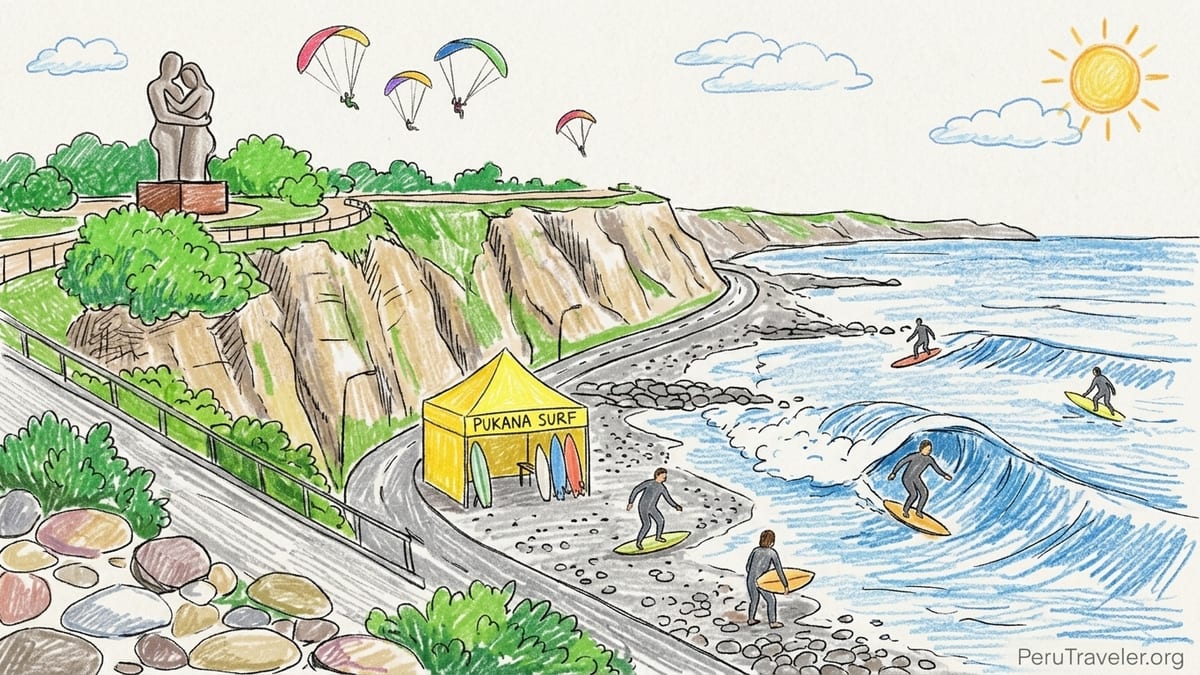
From the clifftop parks of Miraflores, Lima’s Pacific coastline looks spectacular: paragliders drifting over the ocean, surfers dotted in the waves, sunsets burning orange over the horizon. Many visitors, myself included, arrive expecting a classic warm-water resort scene. What you actually find on the pebbly Costa Verde and along the southern highway down to Punta Hermosa is far more complicated, and it raises a real question for travelers: are Lima’s beaches worth planning into your trip, or are they better as a backdrop while you explore the city?
What I Expected From Lima’s Pacific Coast
Before I set foot on Costa Verde, my mental image of Lima’s beaches mixed Pacific drama with a touch of tropical ease. I pictured walking from my Miraflores hotel down to a sandy cove, renting a sun lounger, maybe swimming for an hour, and wrapping up the day with ceviche overlooking the water. Friends who had posted photos from Parque del Amor and the Miraflores malecón reinforced that impression: endless ocean views, rugged cliffs and a ribbon of beach that looked inviting from above.
I knew the Humboldt Current keeps Peru’s water cool year-round, but assumed summer in Lima would feel similar to the Pacific coast of Mexico or Southern California on a warm day. I did not yet appreciate how much the steep cliffs, strong consistent swell and urban setting shape the way Limeños actually use their beaches. Surfing is central. Casual swimming is more limited than the postcards suggest.
I also expected to pick one or two convenient city beaches instead of trekking far down the Panamericana Sur. On the map, Miraflores to Punta Hermosa looks like a short coastal hop. Only after sitting in traffic did I understand why local surfers talk in terms of “missions” to the southern breaks, even though the distance is roughly 45 to 60 minutes on paper.
With those expectations in mind, I set out to walk, ride and surf my way through several of Lima’s most accessible beaches: Miraflores’s pebbly Costa Verde at Makaha, Waikiki and Redondo, the family-focused sands of Agua Dulce in Chorrillos, and the more dedicated surf and beach towns of Punta Hermosa and San Bartolo to the south.
Getting Down to Miraflores: Makaha, Waikiki and Redondo
Miraflores is where most visitors first encounter the ocean. From Parque Kennedy, I followed the malecón past Parque del Amor to one of the main Costa Verde access points. The descent is striking. You leave manicured clifftop parks, cross a bridge over the multi-lane coastal highway, then follow a steep paved ramp or stairway down to sea level. Official tourism information notes that the walk from central Miraflores to Playa Makaha is a little over one kilometre and takes around 15 to 20 minutes, which matched my own experience once I included photo stops.
At the bottom, the postcard illusion cracks. Playa Makaha and neighboring Waikiki are mostly grey pebbles with patches of coarse sand near the waterline. The constant hiss and clatter of stones rolling in the surf is beautiful to listen to but tough on bare feet. Many locals and surf students wear neoprene booties not just for the chilly water but also for the rocky entry. The water itself, influenced by the Humboldt Current, felt cold even in high summer. Surf forecasts and local surf guides routinely describe Lima’s water in the mid-teens Celsius for much of the year, cool enough that almost everyone I saw wore full wetsuits.
Surf schools dominate Makaha. Branded tents from local schools such as Pukana Surf, Mahalo Surf School and others line the upper part of the beach, offering beginner lessons in small groups. Recent price lists from Miraflores surf schools show group beginner lessons advertised around 80 to 120 soles for roughly 90 minutes, including board and wetsuit, with discounted packages for multiple sessions. That matched the handwritten boards I saw on the day. In peak summer, instructors were busy rotating tourists through quick land drills and then pushing them into the whitewater just inside the rockier outside break.
Just north, Waikiki has a similar profile: pebble and coarse sand, long consistent waves and a mix of learners and more experienced surfers sharing the lineup. Farther along at Redondo, the curve of the bay creates a more sheltered feel but the water remains cold and the bottom uneven. Redondo’s break attracted a denser pack of local surfers, most in hoodless full suits. None of these Miraflores beaches felt like places to spread out a towel for a soft, all-day laze, but they worked well as accessible spots for a surf session or a quick walk by the water before heading back up the cliff.
Swimming, Safety and DIGESA’s Changing Beach Ratings
Standing on the rocks at Makaha, I quickly realised that simply “going for a swim” is not straightforward on much of Lima’s urban coastline. The surf is energetic even on calm days. Sets roll through with enough force that strong swimmers need to pay attention, and the uneven rocky bottom means unexpected drops and currents. Local surf reports regularly describe Makaha and nearby breaks as having near-constant swell. That is good news for surfers but mixed news for casual bathers.
Officially, beach safety and cleanliness in Peru are monitored by DIGESA, the environmental health arm of the Ministry of Health. DIGESA’s system, updated through directives issued in recent years, evaluates beaches on three broad criteria: microbiological water quality, availability of basic hygiene services such as toilets, and the cleanliness of the sand itself. The agency posts results regularly through its “Verano Saludable” tools, especially in summer, and classifies beaches using colored flags or categories that are updated week by week rather than fixed for the season.
Media reports during the 2026 summer season highlighted that fewer than half of the monitored beaches in Lima were classified as fully “healthy” at any given time. That figure fluctuated as conditions and municipal cleaning efforts changed, and specific beaches moved on and off the recommended list over the course of the summer. Some Costa Verde beaches in Miraflores and Barranco received clean ratings on certain weeks, while others in Chorrillos, including Agua Dulce at times, were flagged for concerns about cleanliness or facilities. In short, there is no single permanent verdict on any given beach’s water quality.
For visitors, the practical implication is simple. Before entering the water, you should look for flagpoles or municipal notice boards near the beach entrance indicating the current health classification, or ask lifeguards and local authorities on site. DIGESA also encourages the public to check its online platforms in real time. Because the ratings are dynamic, any printed guide that claims a specific Costa Verde or southern beach is “always clean” or “always polluted” is out of date by definition.
Agua Dulce and the Family Beach Reality in Chorrillos
To see a different side of Lima’s waterfront, I continued south by taxi to Chorrillos, home to Playa Agua Dulce. Here the cliffs open out and the scene feels less international and more classically Peruvian. The beach is much sandier than Miraflores, with a broad intertidal zone dotted with plastic chairs, beach umbrellas and coolers. On a warm weekend afternoon in January, families had taken over almost every square metre of shade.
The “family atmosphere” many guides reference is very real. Children kicked footballs near the waterline, food vendors drifted between groups selling ceviche in plastic cups, bags of cancha and bottles of Inca Kola, and older relatives sat under hired parasols to chat. The soundtrack is loud: overlapping reggaeton from portable speakers, vendors calling out their products, squeals from kids testing the chilly waves. It felt safe and communal but not remotely tranquil.
Facilities here are more developed than on most Miraflores beaches. I found paid public toilets near the main entrance and simple changing rooms operated by local concessionaires, with small fees requested in cash. Folding plastic beach chairs and big sun umbrellas were available for daily hire along the upper part of the sand. However, the same popularity that brings services also brings litter. Even in mid-afternoon, I saw piles of plastic cups and food containers at the back of the beach and a constant battle by municipal cleaners to keep up.
It is important to stress that Agua Dulce’s health classification has not been consistently positive. Seasonal DIGESA bulletins and coverage by local media in recent summers have noted periods when Agua Dulce and nearby beaches were rated unhealthy due to sand cleanliness or service issues, even when microbiological water quality remained acceptable. On the day I visited, families were happily in the water and a flag near the entrance indicated the beach was open for bathing, but this status can change quickly. From a visitor point of view, Agua Dulce works as a cultural experience and a chance to see how many Limeños actually use the sea, less as a pristine escape.
South to Punta Hermosa and San Bartolo: Real Beach Towns
To compare Lima’s urban coastline with a dedicated beach day, I joined the stream of cars heading down the Panamericana Sur to Punta Hermosa and San Bartolo, two resort and surf towns that feature heavily in national tourism promotion. Official tourism sources describe this stretch, roughly 45 minutes to an hour from Lima in light traffic, as one of the country’s main surf corridors, with renowned breaks like Punta Rocas and Señoritas near Punta Hermosa and friendlier swimming options at San Bartolo.
The reality of the journey is longer on many days. Leaving Miraflores late on a summer morning, my ride-hailing app initially estimated 55 minutes to central Punta Hermosa. In practice, traffic bottlenecks at key junctions pushed the trip closer to one hour and twenty minutes. Fare estimates for that distance in 2026 tend to fall somewhere in the region of 80 to 120 soles each way from Miraflores, depending on demand, with higher surge pricing at peak weekend hours. Shared buses and combis along the highway are significantly cheaper but less comfortable and more time-consuming for visitors unfamiliar with local routes.
Punta Hermosa itself feels like a different world from the Costa Verde. Low-rise holiday houses line a series of coves, each with its own character. Some beaches here and in adjacent Punta Negra are rocky or dominated by powerful reef breaks reserved for advanced surfers. Punta Rocas, for example, is famed in surf media and has hosted international competitions, but from the sand it reads as a serious wave with powerful, well-defined sets. On the day I visited there were experienced locals in the lineup and a clear understanding among spectators that this was a place to watch rather than casually swim.
By contrast, sections of Punta Hermosa’s main town beach felt more accessible. There was more sand underfoot, though still with pebbly patches, and a sheltered corner where children played in shallower water under adult supervision. Even here, however, the water temperature reminded me that I was still in Peru, not the Caribbean. Most people who stayed in more than briefly wore at least a short wetsuit. Simple beach infrastructure included small restaurants offering menus of the day, some basic toilets for customers, and informal parking on sandy side streets managed by attendants charging small cash fees.
Continuing a little farther south to San Bartolo brought one of the most balanced swimming experiences of my Lima-area circuit. The main cove is well protected, with more consistently sandy entry points and a calmer inside area used by families and casual swimmers. Outside the protected zone, long, rideable waves rolled in for surfers. On a bright afternoon the amphitheatre of white houses facing the sea, the bobbing fishing boats and the humanscale scale of the cove all came together to create the closest thing to a classic beach-day setting I found near Lima.
Surf Lessons: Miraflores Convenience vs Southern Coast Conditions
Given how prominent surf culture is along this coast, I tried beginner-friendly lessons both at Makaha in Miraflores and in the southern zone near Punta Hermosa. The contrast is worth understanding if you are deciding where to learn. In Miraflores, I joined a group lesson advertised for visitors with no experience. Surf school websites based at Makaha quote prices for individual classes and packages, and boards at the beach offered a typical group rate under 120 soles including equipment. My session lasted around ninety minutes, with about twenty-five minutes on shore and just over an hour in the water.
The main advantage of Miraflores is straightforward convenience. From many hotels, you can walk down to Makaha in under half an hour, take a lesson, then be back at a café on the malecón before lunch. The surf schools are accustomed to complete beginners and international visitors, many instructors speak basic English, and the long, predictable whitewater offers repetition. The downsides are crowding and a somewhat chaotic lineup. At busy times there were dozens of learners in a relatively small zone, and I spent as much energy navigating soft-top boards and stray leashes as I did focusing on technique.
Farther south, I arranged a lesson through a small local outfit that meets students in Punta Hermosa town and shuttles them to the most suitable nearby break on the day. Prices there were closer to those I saw in Miraflores, though some instructors charged a premium for private sessions. The key distinction was in wave shape and crowd density. On the day of my class, a mellow shoulder-high wave broke along a sand and rock mix that felt more forgiving than Makaha’s inside section, and there were far fewer people competing for each wave.
Conditions in the southern zone are more variable and can be far more powerful in winter, but when the swell is moderate, many visiting surfers I spoke with preferred learning outside the city. They cited cleaner water when rated healthy by DIGESA, a more relaxed atmosphere, and the feeling of dedicating a full day to being in the ocean instead of squeezing a lesson between city sightseeing stops. For travelers, the tradeoff is the longer ride and higher transport cost for that day.
Costs, Logistics and the Hidden Price of Lima Traffic
One of the most practical questions I wanted to answer was whether a Lima beach day makes sense from a budget standpoint. For an independent afternoon at Costa Verde from Miraflores, the numbers remained relatively contained. Walking down to Makaha or Waikiki is free, and public access to the beach is open. A group surf lesson with board and wetsuit rental might run under 120 soles. If you skip the lesson and only rent a board and suit from one of the beachside kiosks, recent posted prices suggested something closer to 40 to 60 soles for a couple of hours, depending on the quality of equipment and negotiation.
On top of this, you might add small purchases such as bottled water, snacks from vendors, or a simple lunch from a nearby cevichería once you have climbed back up to the clifftop. Outside peak season, the total outlay for a solo traveler for a half-day urban beach visit, including a lesson, can plausibly stay in the low hundreds of soles, with most of that tied to the surf experience rather than the beach itself. If you arrive and leave by taxi instead of walking, short rides within Miraflores and Barranco typically cost a relatively modest amount compared with the longer southern excursions.
For a full-day trip to Punta Hermosa or San Bartolo, transport changes the equation. Even using ride-hailing at off-peak times, each leg can cost several dozen soles, and heavy traffic near Lima’s southern exits during summer weekends pushes fares upward as journey times grow. Add a surf lesson, lunch in a seafront restaurant, and perhaps chair and umbrella rental where available, and a realistic total for an independent day out can rise into the mid hundreds of soles for one person, more for groups who opt for private instruction or more upscale dining.
The hidden cost is time. A route that mapping apps optimistically label as under an hour can stretch much longer when everyone in the city had the same idea. On my return journey from San Bartolo, a late afternoon departure coincided with holiday traffic and slowed the busier junctions such that the ride took almost two hours back to Miraflores. For visitors with only a few days in Lima, that is a significant slice of the schedule to trade for beach time that still involves cold water and no guarantee of perfect sanitary ratings.
Cold Currents, Crowds and Expectations: Is Lima a Beach Destination?
After several days along this coastline, the biggest adjustment was mental. Lima’s seafront is visually stunning, but it is not a tropical resort strip. The Humboldt Current keeps the water cool even on bright summer days. Scattered fog and garúa, especially outside the peak summer months, can mute the colours of sea and sky. City beaches on Costa Verde are wedged between a busy highway and tall cliffs, and while there are patches of sand, pebbles and rough rock dominate much of the shore.
Summer crowds add another layer. On weekends in January and February, both Agua Dulce and the more accessible stretches of Costa Verde can feel extremely busy, with families claiming space early and music competing along the sand. Litter remains a real problem despite municipal cleaning campaigns and public education from DIGESA urging bathers to treat beach cleanliness as a shared responsibility. The very popularity that makes these spaces lively also tests the limits of infrastructure, especially toilets and rubbish collection.
Yet it would be unfair to write Lima off as an unattractive coastal destination. For surfers, the city is a gift: a capital where consistent swell runs almost year-round, with a range of breaks suitable for different levels and a surf school ecosystem ready to kit out beginners within walking distance of tourist hotels. For photographers and urban walkers, the juxtaposition of clifftop parks, paragliders, surf lines and dramatic Pacific sunsets is one of Lima’s defining visuals.
The key is to separate the pleasure of Lima’s coastal landscape from the assumption that it will deliver a soft-sand, warm-water, resort-style experience. Travelers who arrive wanting the latter are more likely to be disappointed. Those who treat the coast as a place to surf, stroll, watch waves, eat with a view and occasionally swim when conditions and health ratings align tend to come away more satisfied.
The Takeaway: What Worked, What Did Not, and Who Should Go Where
Looking back, my expectations evolved from dreaming of effortless tropical beach days to respecting Lima’s coast for what it actually offers. I started in Miraflores convinced I could combine city sightseeing with spontaneous swimming. After walking the steep ramps to Makaha, feeling the pebbles shift underfoot and registering how cold the water felt even on a hot day, I reframed Miraflores’s beaches in my mind as places for surfing and sea air rather than long, lazy swims.
Across the beaches I visited, swimming worked best in the more sheltered parts of Agua Dulce, on calmer days when flags showed the beach open and families clustered near the shore, and at San Bartolo’s protected cove, where the combination of sandier entry and gentler inside water created a more relaxed setting. In contrast, the rockier, more energetic waves off Makaha, Waikiki and Redondo always felt like environments where you wanted either a board or strong local knowledge before venturing far out.
There were disappointments. The amount of litter behind the main crowds at Agua Dulce was hard to ignore. The traffic to and from the southern beaches ate into the easy-day-trip illusion and made me reconsider whether a full-day mission was worth it compared with flying onward to warmer coastal regions elsewhere in Peru. And the sense of grit that comes from spending hours next to a busy highway on Costa Verde reminded me that Lima’s shore is still very much urban space.
On the positive side, my best surf experience was divided between a structured beginner lesson at Makaha, which gave me repetition and a sense of achievement in a short window, and a quieter, more flowing session near Punta Hermosa, where fewer people in the water and a mellow wave let me focus more on reading the ocean than dodging boards. In both places, the combination of local instructors, consistent swell and relatively affordable lesson prices confirmed why Lima has become a learning ground for many new surfers.
Would I plan another Lima beach day? Yes, but with clear goals. For surf, absolutely: a morning lesson in Miraflores or a full-day outing to the southern breaks makes sense within a broader Lima itinerary. For swimming and sunbathing alone, I would likely allocate my dedicated beach days to warmer, more conventionally beach-focused destinations in Peru and treat Lima’s coastline as a scenic and cultural asset rather than the core of a seaside holiday.
For families, Agua Dulce on a weekday when the beach is rated healthy can deliver a lively, local experience, while San Bartolo offers a calmer alternative if you are willing to travel. Surfers, from beginners to advanced, will find Miraflores convenient for first lessons and the Punta Hermosa corridor richer in wave quality when conditions line up. Photographers will be happiest on the Miraflores and Barranco clifftops at sunset, framing paragliders, surfers and the curve of Costa Verde below. Couples looking for romance may prefer an evening stroll and dinner with an ocean view to a hot afternoon on the pebbles. First-time visitors to Lima should absolutely walk the malecón, look down on the waves and maybe book a surf lesson, while keeping their pure beach expectations for elsewhere on their Peru route.
FAQ
Q1. Are Lima’s beaches warm enough for comfortable swimming?
The Pacific off Lima remains relatively cold year-round due to the Humboldt Current, so most people find the water brisk and prefer short dips or wetsuits, even in summer.
Q2. Which Lima beach is best for a first surf lesson?
Makaha in Miraflores is the most convenient option for visitors, with multiple surf schools offering beginner lessons that include board and wetsuit within walking distance of major hotels.
Q3. Is Agua Dulce in Chorrillos safe and clean for families?
Agua Dulce has a strong family atmosphere and services, but its health classification changes, so you should always check current flags or official DIGESA information before swimming.
Q4. How long does it really take to reach Punta Hermosa from Miraflores?
In light traffic the drive can be under an hour, but during summer weekends or peak times it often stretches to around ninety minutes each way because of congestion on the Panamericana Sur.
Q5. Do Lima’s urban beaches have soft sand?
Many Costa Verde beaches in Miraflores and Barranco are dominated by pebbles and rocks, with only limited sandy areas, so walking and sunbathing can feel quite different from classic sandy resorts.
Q6. How much does a surf lesson cost in Miraflores?
Recent price boards show beginner group lessons at Makaha generally under 120 soles for about ninety minutes, including board and wetsuit, with discounts for multi-lesson packages.
Q7. Are there lifeguards on Lima’s beaches?
During the main summer season many popular beaches, including parts of Costa Verde and Agua Dulce, have lifeguards on duty, but coverage varies and you should always confirm on arrival.
Q8. Is a day trip to San Bartolo worth it from Lima?
San Bartolo offers a more traditional cove, calmer swimming area and relaxed feel, making it worthwhile if you have time and accept the longer drive and higher transport cost.
Q9. Can I rely on one guidebook’s assessment of beach cleanliness?
No, because DIGESA’s sanitary ratings change week by week, so any fixed description can be outdated; you need to verify the current status through flags or official channels.
Q10. Should first-time Lima visitors plan multiple full beach days?
Most first-time visitors are better off planning one coastal experience such as a surf lesson or southern day trip and focusing the rest of their time on Lima’s food, culture and neighbourhoods.