


After years of hearing Peruvians argue over whether Máncora or Punta Sal is the country’s best beach escape, I finally blocked a week, flew north and did what any indecisive traveler should do: I stayed in both. Across the same late winter season, I spent three nights based on the sand in central Máncora with an extra night in quieter Las Pocitas, then three nights in Punta Sal at a resort-style property on the main beach. What follows is not a postcard fantasy but a ground-level comparison that looks at accommodation, prices, transfers, nightlife and, above all, what it is actually like to swim and walk these two very different stretches of coast.
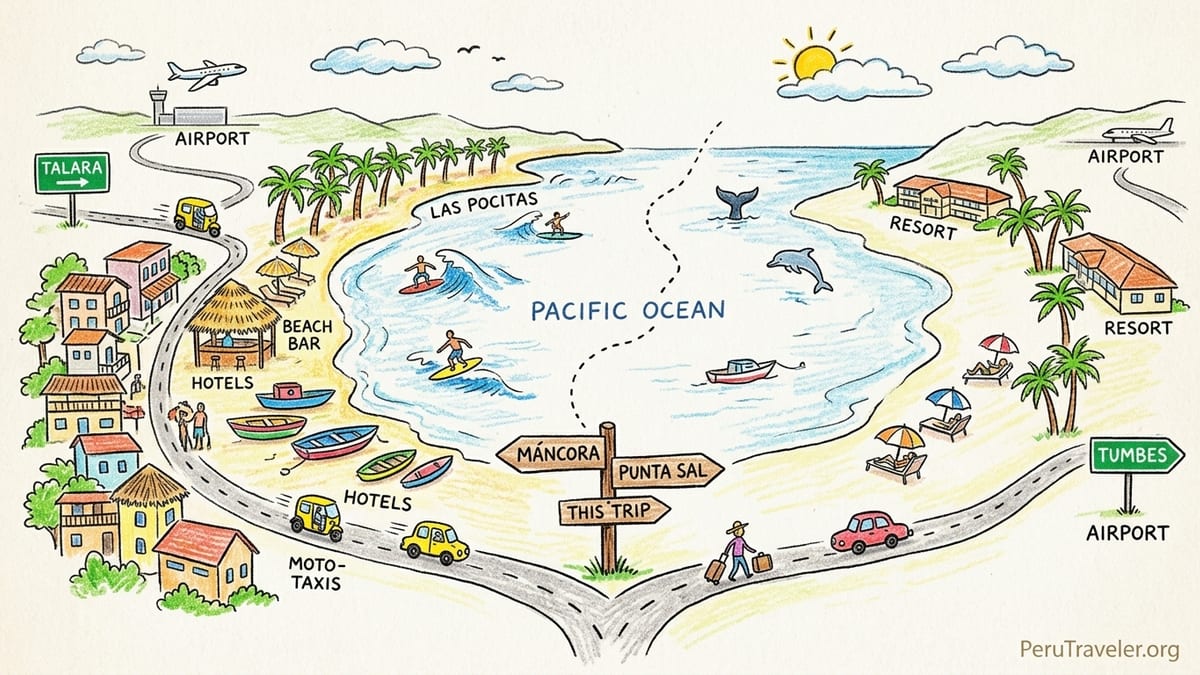
Máncora vs Punta Sal: How I Structured the Trip
I wanted a fair comparison, so I visited Máncora and Punta Sal in the same shoulder season, when crowds and prices sit between the packed Christmas and Easter holidays and the quieter months. I flew from Lima to Talara’s Capitán FAP Víctor Montes Arias airport, roughly 56 kilometers from Máncora, then continued north overland. Later in the week I used Tumbes airport as my exit point, which serves Punta Sal and the beaches of Tumbes. By keeping both stays to three nights, staying right on the beach in each destination and avoiding major Peruvian holiday weekends, I could compare like with like.
In Máncora I split my time between a mid-range beachfront hotel near the town center and a quieter boutique-style property along Las Pocitas, the more relaxed strip a few kilometers south. In Punta Sal, I chose a resort with direct beach access, pool and on-site restaurant right on the main 6.5 kilometer stretch of sand, staying within walking distance of a small cluster of independent eateries instead of disappearing into an all-inclusive bubble. All transfers were done without a rental car, relying on prebooked taxis, moto-taxis and short inter-town rides so I could honestly judge how each place works for travelers who do not want to drive.
Across both destinations, I tracked real prices during 2026 for rooms, breakfast, restaurant meals, taxis and popular excursions like surf lessons and whale watching. Where prices were only available in soles, I use a rough conversion of 3.8 soles to 1 US dollar, understanding that exchange rates move. Rather than promising fixed deals, I highlight the ranges you can realistically expect today, and where costs can climb quickly if you lean into resort comforts or private trips.
Getting There Without a Car: Transfers, Time and Hassle
The first practical question for both Máncora and Punta Sal is the same: which airport, and how hard is it without your own wheels. For Máncora, Talara airport proved the simplest starting point. From the terminal, several local agencies and independent drivers quote private transfers to Máncora in the region of 150 to 180 soles for a standard car, which matched what I saw on recent rate sheets from regional operators and taxi portals that specialize in Talara to Máncora runs. The drive took a little over an hour along the Panamericana Norte, with the last stretch dropping down toward the sea and the town.
Flying out via Tumbes after my Punta Sal stay gave me a good comparison. Punta Sal lies roughly 80 kilometers from Tumbes airport, and resorts regularly quote private transfer prices between about 100 and 180 soles for two passengers, with some higher-end properties including this in package rates. I pre-booked a fixed-fare taxi for 160 soles, which was in line with online tariff tables that showed similar figures for Canoas de Punta Sal. In practice, the drive took around an hour and a half in light traffic. Traveling between Máncora and Punta Sal themselves is straightforward: shared vans and highway buses stop on the Panamericana, while private taxis quoted me 80 to 100 soles for the roughly one-hour run, depending on whether pick-up was at a resort driveway or the roadside.
For travelers determined to save money, there are also buses and combis from both airports heading south or north along the highway, with fares from around 15 to 30 soles, but these generally require some Spanish and a willingness to walk or tuk-tuk from the roadside stop to your hotel. Overall, I found Máncora marginally easier without a car because there is always a taxi or moto-taxi within minutes and most hotels are clustered. Punta Sal felt more dependent on pre-arranged resort transport. Once you are there, though, both destinations are effectively linear beach towns pinned to the same highway, so hopping between them or to nearby Los Órganos and Vichayito is very doable with a combination of colectivos and short taxi rides.
Staying on the Sand in Máncora and Las Pocitas
Máncora’s town beach has two very different personalities: the central strip backing onto the main avenue with its hostels, bars and cevicherías, and the more spaced-out hotel fronts as you walk south toward Las Pocitas and Vichayito. In the town center I stayed in a compact beachfront hotel where a mid-range double room, with breakfast and a small pool, cost around 260 soles per night, roughly 70 US dollars. This rate sat comfortably within recent mid-range guidance for Máncora, where sources suggest 120 to 300 soles per night for a comfortable private room in a hotel directly on the sand.
Beachfront in the center is about convenience rather than serenity. From my balcony I could see surf schools dragging soft-top boards onto the sand, kids playing soccer by the tide line and a constant promenade of jewelry sellers, ice cream vendors and massage offers. At night, the soundscape shifted to the thump from beach bars and passing moto-taxis racing along the parallel street. Light sleepers would struggle here, especially at weekends. After two nights, I moved to Las Pocitas, booking a small boutique hotel right on the rocky-fringed but beautiful beach, paying close to 450 soles per night including breakfast, a more premium rate that broadly matched what higher-end properties in this area charge, as highlighted in recent hotel round-ups that list double rooms well above 300 US dollars at the most luxurious options.
Las Pocitas was a different world. Hotels stretch along a narrower road with the beach often just steps from your room. Nights here were quiet, limited mostly to the hum of the ocean and distant music on Saturday evening. The trade-off is that there is far less within walking distance. My hotel had an excellent seafood-focused restaurant and small bar, but if I wanted alternative options, I had to walk 30 to 40 minutes along the sand into town or pay 8 to 12 soles for a moto-taxi. For couples or families who want the Máncora sun and water without the full party atmosphere, this compromise worked very well.
Life in Town: Surf, Nightlife and Day-to-Day Spending in Máncora
In central Máncora, daily life orbits the strip that runs parallel to the beach. Surf schools cluster on the main sandy section, with beginner lessons quoted at roughly 80 to 120 soles, board rental extra. In my case, a 90-minute group lesson including wetsuit and board cost 100 soles. The warm water and forgiving beach break make this one of the few spots in Peru where inexperienced surfers can learn without full neoprene, although more advanced surfers will often say the waves are inconsistent compared with classic breaks farther south. That matched my own experience: some mornings were clean and playful, others almost flat.
Food and nightlife in Máncora are diverse, if not always polished. Along the main avenue, simple menu-of-the-day spots offered fish, rice and a drink for 20 to 25 soles at lunch, while better-known seafood restaurants and fusion places charged closer to 45 to 70 soles per main dish, with cocktails at 25 to 35 soles. For two adults eating well but not extravagantly, my daily restaurant spending averaged roughly 220 to 260 soles, including a beachfront lunch, coffee and a casual dinner. Nightlife kicks in from Thursday to Saturday when hostels and beach bars host DJs or live bands. On those nights, traffic increased sharply, music spilled onto the sand and the commercial feel was impossible to ignore. For some travelers, this energy is the reason to come. For others, it is a reason to base themselves in Las Pocitas and only dip into town.
Vendors are part of the Máncora story too. On the main beach, sellers of sunglasses, ceviche, empanadas and handicrafts pass every few minutes in high season. I never found the atmosphere aggressive, but it was persistent, especially compared with Punta Sal. The upside is that you can spend all day on a sun lounger and never move for snacks or drinks. The downside is that it rarely feels like an untouched, tranquil shore. Traffic on the parallel road, with moto-taxis weaving around potholes and cars jostling to park, adds to this slightly chaotic impression. Cleanliness also fluctuated; some mornings crews cleaned sections of the sand, other days there was noticeable plastic and cigarette waste washed up or left from the night before.
Punta Sal: Beachfront Resort Life and What Lies Beyond the Gates
Where Máncora is compact and busy, Punta Sal is stretched and more controlled. The beach itself runs for roughly 6.5 kilometers and is usually divided into Punta Sal Chica and Punta Sal Grande, with long, shallow sections of whitish sand and rarely any cliffs or rocks intruding into the swimming area. I based myself at a mid-range resort-style hotel directly on the sand of Punta Sal Grande. A standard double room with breakfast and access to pools and loungers cost around 520 soles per night when booked a few months ahead. Looking across current tariff sheets for Punta Sal resorts, that price sits at the lower end of established beach resorts but above the basic guesthouses in the small town center.
Life in Punta Sal is built around the properties themselves. My resort had multiple pools, a restaurant, a beach bar and its own activity team offering kayaks, stand-up paddleboards and boat trips. That translated into comfort and ease. A typical breakfast buffet of tropical fruit, eggs and pastries was included, and lunch dishes such as causa, grilled fish or burgers ran from 40 to 70 soles. A beer cost about 15 soles, mixed drinks 30 to 38 soles. By the time you factor in poolside snacks and an afternoon dessert, it is very easy for a couple to spend 280 to 320 soles per day on food and drinks without ever leaving the property.
The trade-off is isolation. The small village behind Punta Sal’s resorts has a few independent restaurants and basic shops, but nothing like Máncora’s dense strip of bars and eateries. I tried one family-run cevichería back from the sand where a generous ceviche and soft drink came to 40 soles, and another grill where a fish main was 45 soles. Tasty, but getting there required a 10-minute walk along the highway verge or an informal moto-taxi pick-up arranged through the resort staff for 10 soles each way. For visitors who want to explore widely or eat somewhere different every evening, the limited independent scene will feel constraining unless they plan on frequent taxi rides to Cancas, Zorritos or even back to Máncora for a night out.
Beach and Swimming: Sand, Water and How Reality Matches the Photos
For a beach holiday, the physical experience of sand and sea matters more than almost anything else. In both Máncora and Punta Sal, the water is significantly warmer than central and southern Peru’s colder currents, which is why these two areas appear again and again in discussions of the country’s best swimming beaches. On my trip, water in late winter was comfortably swimmable in both places, sitting somewhere in the low to mid twenties Celsius according to local tourism literature, and far from the bracing chill of Lima. I swam daily without a wetsuit, staying in for 20 to 30 minutes without feeling cold.
In central Máncora, the beach is fairly wide at low tide with a medium-grain sand that is pleasant but far from white. The photos many hotels use are honest about this, showing golden-brown sand and a busy foreground of surfers and bathers. On-site, the only gap between marketing and reality lay in the amount of people and the occasional patches of litter. Waves here are lively: enough to body surf and for beginner lessons, with a noticeable shore break on some tides. Lifeguards were present some days, absent others, and flags changed to reflect conditions. Locals repeatedly reminded me that currents and waves shift quickly along this coast. There is no permanently safe or dangerous categorization, and even seemingly calm days can hide rip currents.
Las Pocitas delivered most closely on the classic boutique-hotel photography: smaller coves, rock pools at lower tides and more space between loungers. The sand was slightly narrower but felt softer, and both the hotels I used had well-kept fronts where staff raked the beach and removed debris each morning. Swimming here was calmer than in town on my visit, though when larger swells rolled in you still felt a tug. Again, lifeguard presence was sporadic, reinforcing the point that confident self-assessment and caution are more important than assuming any one spot is always safe.
Punta Sal’s main beach, in contrast, is about broad horizons and slow shelves. The sand is paler and finer, and at lower tide you can walk long distances with just ankle-deep water. Most resort photos I had seen showed languid, nearly flat seas and wide sandy foregrounds. In person, the match was very close. There were still days with small waves, especially toward Punta Sal Chica, but the general sensation was of easier entry and exit, with fewer sudden drops or shore breaks. I spent long sessions simply floating or walking waist-deep in water with barely a ripple. That said, resort staff again stressed that the ocean is dynamic. Seasonal swells, currents and even distant storms shift things, so no traveler should treat Punta Sal as a guaranteed safe pool. For families with younger children or adults nervous in the sea, though, I found Punta Sal more comfortable overall.
Noise, Atmosphere and Practical Budgets for 3 and 7 Nights
Atmosphere is where these two destinations diverge most sharply. Central Máncora is frenetic, fun and, at times, scruffy. Traffic along the main road, constant moto-taxi horns and beach bars playing different playlists create an almost urban soundscape that never fully goes quiet, particularly on weekends and during Peruvian holiday periods when Limeños and domestic tourists surge north. The upside is that you are never bored. Within a ten-minute walk you can find surf lessons, cafes, cevicherías, sunset bars and tour kiosks selling whale watching trips between roughly July and October. Prices for shared whale-watching excursions clustered around 150 to 200 soles per person during my stay, with boats leaving from nearby Los Órganos or El Ñuro.
Punta Sal, especially inside resort complexes, felt more like a self-contained holiday bubble. After 10 pm most evenings, the loudest noise was the sea and the occasional burst of music from a wedding or special event. The beach itself rarely felt crowded; even at midday, there was always space to walk without dodging vendors or beach games. The downside is a subtle sense of isolation if you are a traveler who enjoys street life. Outside the resort gates, street lighting is weaker, pavements intermittent and services scattered. Without a car, you quickly default to eating in the hotel restaurant or arranging taxis for any change of scene.
Running real budgets under comparable conditions helps clarify the difference. For two adults in Máncora staying three nights in a mid-range beachfront hotel near town, I spent about 780 soles on accommodation, 780 soles on food and drinks across three days and evenings, and around 250 soles on taxis, moto-taxis and one shared excursion, for a total near 1,810 soles, roughly 475 US dollars at the working exchange rate. A seven-night stay on a similar pattern, adding one extra paid activity and some shopping, would rise to somewhere between 4,000 and 4,500 soles for two, or around 1,050 to 1,180 US dollars.
In Punta Sal, three nights at my resort came to roughly 1,560 soles for the room, with food and drinks easily reaching 900 to 1,050 soles over the same period because almost every meal and cocktail was taken on-site at resort prices. Local transport was lower, around 120 soles for one airport transfer and a couple of short trips into the village, and one dolphin and turtle-spotting boat excursion from a nearby jetty ran to 180 soles per person. The three-night total for two adults hovered around 3,000 soles, or just under 800 US dollars. Extrapolated to a full week, assuming one more paid boat excursion and a few spa treatments, a realistic seven-night budget for two in Punta Sal sits closer to 6,800 to 7,200 soles, roughly 1,800 to 1,900 US dollars.
Families, Couples, Surfers and First-Time Visitors: Who Fits Where
For families, especially those with younger children, Punta Sal’s wide, gently shelving beach, quieter environment and resort infrastructure are highly appealing. Larger properties offer family rooms, kids’ pools and activity clubs, and the relative absence of heavy surf and dense crowds on many days made supervising beach play less stressful for parents I spoke to. The main caution lies in cost. Feeding a family of four entirely within a resort restaurant, with soft drinks, snacks and treats, can easily push a seven-night budget above 9,000 soles once you add transfers and at least one excursion.
Máncora, by contrast, offers more flexible budgets for families willing to trade serenity and polish for energy and choice. Apartments and small hotels along Las Pocitas give direct beach access and kitchenettes at prices below big-resort rates, while a trip into town opens up economical menus, playgrounds and even small surf lessons for older kids. The downside is managing noise, traffic and occasional beach litter, especially in the central strip. For teenagers and adult children who want nightlife and surf lessons, though, the Máncora side of a family trip could be a highlight.
Couples face a nuanced decision. If your idea of a romantic beach break is quiet sunsets, long walks on a relatively empty shore and cocktails by a pool with background music rather than a DJ, then Punta Sal, or a high-end hotel in Las Pocitas, will generally suit better. If, instead, you want to mix beach time with social evenings, a choice of restaurants and perhaps a few nights of dancing, a well-located but slightly set-back hotel in central Máncora lets you do that easily. During whale-watching season between roughly July and October, both destinations make good bases for boat trips out to see humpback whales migrating along the coast, though operators tend to cluster more densely around Los Órganos, slightly closer to Máncora.
Dedicated surfers are often more critical of Máncora and Punta Sal. Both can have fun waves, especially for beginners and intermediates, but nor are considered Peru’s most consistent performance breaks. Conversations with local guides and surfers echoed what online communities say: if your whole trip is about riding world-class lefts, you will probably aim at Chicama, Pacasmayo or Lobitos instead. However, for travelers whose primary goal is a warm-water holiday with the option of a few playful sessions, Máncora stands out for its easy access to surf schools and rental boards directly on the main beach.
Expectations, Hotels, Beach Quality and Where I Would Return
Going in, my expectations were heavily shaped by reputation. Máncora, in most conversations, appeared as Peru’s party beach: backpacker hostels, nightlife and social surf. Punta Sal was framed as the calmer, more upscale choice with softer sand and quieter evenings. After my stays in 2026, those broad strokes still hold but the nuance matters. Máncora is more than just a backpacker strip; it contains calmer pockets like Las Pocitas where couples and families can enjoy a boutique experience. Punta Sal is more than an anonymous resort line; away from the biggest complexes there are local restaurants and a real, if small, community. Yet the core identities remain distinct.
In terms of the specific hotels I used, Máncora gave me more personality. My central beachfront stay was simple but social, with shared breakfasts looking over the surf and staff eager to arrange lessons or tours at short notice. The Las Pocitas boutique property had thoughtful design, small pools built almost into the sand and attentive service that felt individualized. Punta Sal’s resort, in contrast, excelled in consistency: efficient check-in, spotless pools, professionally run breakfast buffets. It felt closer to an international resort template, for better and worse. You sacrifice some spontaneity in return for predictability and comfort.
Beach quality, where I exclude cost, crowds and services, tilted in favor of Punta Sal. The finer, paler sand, wide foreshore and mostly gentle entry encouraged longer, more relaxing swims and unhurried walks. Máncora’s town beach was enjoyable and dynamic, especially if you like being amid surfers and volleyball games, but did not feel quite as clean or scenic. Las Pocitas closed the gap significantly, offering coves and rock pools that, at the right tide and light, matched any promotional photo. Yet, when I imagine a single image to represent my week, it is Punta Sal’s long, almost empty curve of shoreline that comes to mind.
There were disappointments. In Máncora, the level of traffic, the patchiness of rubbish collection on certain days and the noise bleeding into the early hours from a couple of poorly soundproofed bars near my first hotel were real downsides. In Punta Sal, I was frustrated by the limited number of independent dining options within easy walking distance and by how quickly incidental costs within the resort added up, from bottled water and coffee to activity rentals. I also noticed that some smaller budget accommodations set back from the beach had limited maintenance; peeling paint and basic bathrooms are still common if you drop below mid-range prices.
When I align these realities against actual spending, the contrast becomes clear. For similar lengths of stay and similar patterns of activity, Punta Sal cost me roughly 50 to 60 percent more than Máncora. That extra spending bought a calmer environment, a wider and, on balance, cleaner beach, and more consistent service but at the price of reduced spontaneity. If I were planning a single return trip tomorrow, without children, I would choose to base myself in Las Pocitas near Máncora, using moto-taxis to dip into town when I wanted nightlife and day-tripping once to Punta Sal to enjoy the long beach. With young children in tow, particularly at the start or end of a busy itinerary around Peru, I would be more inclined to budget for a resort week in Punta Sal, accepting the higher cost in exchange for ease and quiet.
The Takeaway
Máncora and Punta Sal sit on the same warm-water northern coast of Peru and often appear side by side in travel guides, but they deliver notably different styles of beach holiday. Máncora, with its active town beach, accessible surf lessons, broad range of restaurants and buzzing nightlife, is the better choice for travelers who want movement, choice and social energy, or who are working with tighter budgets. Staying slightly outside the loudest core, in areas like Las Pocitas, lets you balance that liveliness with quieter nights and more polished accommodation.
Punta Sal leans into serenity and resort comfort. Its long, pale, gently shelving beach, stretched along a mostly undeveloped backdrop, makes it a strong contender for Peru’s most relaxing coastal stay, especially for couples and families willing to accept higher per-day spending. The limited independent restaurant scene and dependence on organized transfers mean it rewards those who are happy to stay mostly within a single, well-chosen property and treat the outside world as an occasional diversion rather than a nightly adventure.
For first-time visitors to Peru who simply want a few warm, restorative days by the sea, either destination can work if matched to temperament. If you do not plan to rent a car, Máncora is marginally simpler for improvising nights out and meals, while Punta Sal requires a bit more pre-planning around transfers and hotel dining budgets. Whichever you choose, keep expectations grounded. The north coast remains more rustic than many Caribbean or Mexican resort areas, but with the right mindset, both Máncora and Punta Sal can provide a memorable, distinctively Peruvian end or beginning to a wider trip.
FAQ
Q1. Is Máncora or Punta Sal easier to reach from Lima without renting a car?
Talcara airport works well for Máncora, with private taxis or prebooked transfers taking a little over an hour. Punta Sal connects most naturally to Tumbes airport, and many resorts can arrange a one and a half hour transfer. Both are manageable without a car, but Máncora offers more on-the-spot taxi and moto-taxi options once you arrive.
Q2. Which destination has calmer swimming conditions most of the time?
On my visit, Punta Sal generally felt calmer, with a wide, gently shelving beach and smaller shore break. Máncora, especially near town, had livelier waves that suited beginner surfers. However, local guides were clear that swells and currents shift and neither destination can be labeled permanently safer.
Q3. How do accommodation prices compare between Máncora and Punta Sal?
Mid-range beachfront hotels in Máncora often fall in the range of roughly 120 to 300 soles per night, while resort-style properties in Punta Sal commonly start higher, with many charging the equivalent of 500 soles or more for doubles. High-end boutique hotels in Las Pocitas can match or exceed Punta Sal’s rates.
Q4. Is it realistic to stay in Punta Sal without booking an all-inclusive resort?
Yes, there are smaller hotels and guesthouses in and around the village, and a handful of independent restaurants. However, without your own transport you will probably rely heavily on your chosen hotel for meals and may need taxis for variety, so it still feels semi-resort-like.
Q5. When is whale-watching season in the Máncora and Punta Sal area?
Whale-watching tours typically operate from around July to October, when humpback whales migrate along Peru’s north coast. Boats usually depart from nearby ports like Los Órganos or El Ñuro, and you can arrange trips from both Máncora and Punta Sal through local agencies and hotels.
Q6. Which place is better for nightlife and meeting other travelers?
Máncora clearly has the edge for nightlife. Its central strip includes bars, hostels with events and late-opening restaurants that attract both Peruvians and international travelers. Punta Sal is much quieter after dark, with evenings largely centered on hotel and resort bars.
Q7. Are the beach photos used by hotels accurate for both destinations?
In my experience, Punta Sal’s resort photos matched reality closely, especially the long, pale sand and relatively calm water. Máncora’s photos were truthful about the color and width of the sand and the presence of surfers, though they rarely showed the crowds and occasional litter that appear on busy days in town.
Q8. How much should a couple budget for a week in each destination?
A couple staying seven nights in a mid-range beachfront hotel in Máncora, eating at a mix of inexpensive and mid-range restaurants and adding a couple of excursions, could expect to spend around 4,000 to 4,500 soles in total. In Punta Sal, a similar-length stay in a resort with most meals on-site and one or two boat trips can easily reach 6,800 to 7,200 soles or more.
Q9. Which destination is better for families with young children?
Punta Sal’s wide, gentle beach and quieter, resort-based environment make it particularly appealing for families with younger children, provided the higher costs are acceptable. Families seeking more affordable food options and activity variety might prefer basing themselves in Las Pocitas or a quieter part of Máncora and visiting town or other beaches by short taxi rides.
Q10. If I only have three nights, should I choose Máncora or Punta Sal?
Choose Máncora if you value variety, easy access to restaurants, surf lessons and nightlife, and are comfortable with some noise and bustle. Choose Punta Sal if your priority is relaxing on a calmer, wider beach with resort comforts and you are willing to trade off independent dining and lower prices for that quieter experience.