


On Peru’s northern coast, just outside the city of Trujillo, lies one of South America’s most overlooked archaeological heartlands. Here the adobe metropolis of Chan Chan, the painted temples of the Moche and the fishing town of Huanchaco tell a story that stretches centuries before the Incas. Choosing the right tour can mean the difference between ticking off a few ruins and truly understanding the coastal civilizations that transformed this desert into a fertile, urban landscape.
Understanding Trujillo’s Archaeological Landscape
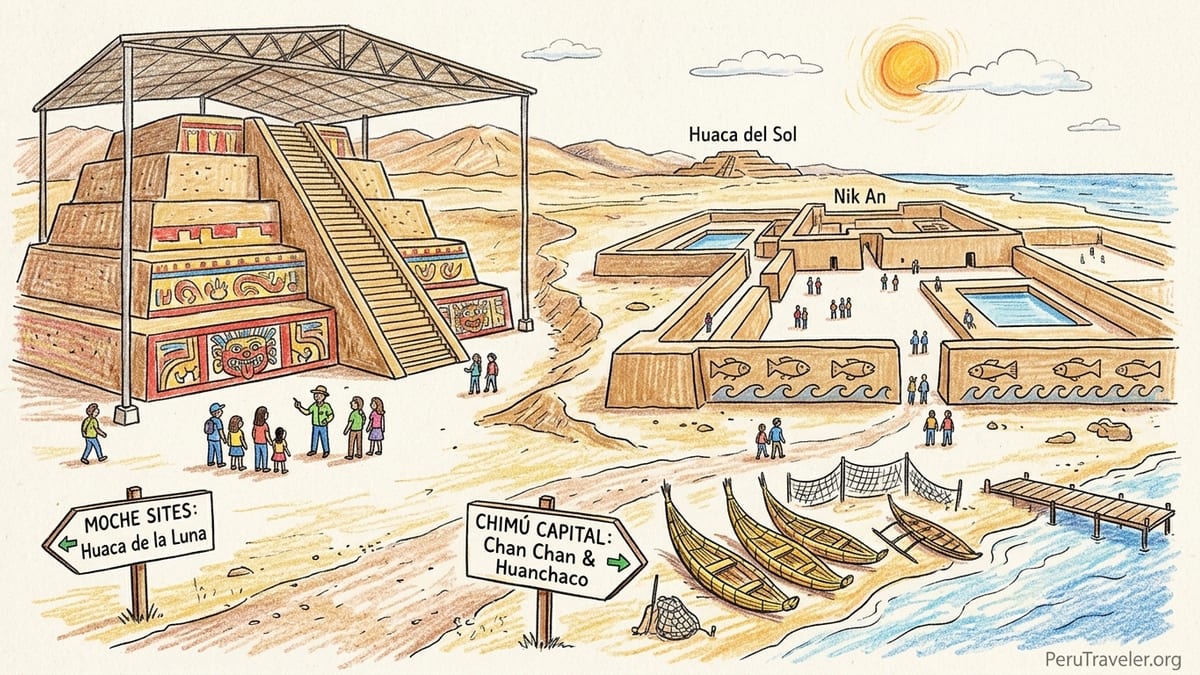
Visitors often arrive in Trujillo assuming they are seeing “Inca pyramids,” but the major sites around the city belong to different pre-Inca cultures with distinct styles and time periods. South of Trujillo, Huaca de la Luna and Huaca del Sol formed the ceremonial and political center of the Moche civilization, which flourished roughly between the first and eighth centuries. Their world revolved around ritual sacrifice, complex iconography and sophisticated irrigation that made intensive agriculture possible in an extremely dry coastal valley.
Northwest of the city, Chan Chan represents a different chapter of history. This enormous adobe capital was built by the Chimú civilization, which rose centuries after the Moche. At its peak around the 14th and 15th centuries, Chan Chan was the largest adobe city in the Americas, a planned urban center of palaces, plazas and reservoirs that relied on extended irrigation canals to support tens of thousands of inhabitants. Walking its restored palace complex of Nik An, you move through a city that predates the Spanish conquest but postdates most of the Moche temples.
Closer to the coast, smaller sites like Huaca Arco Iris, also called Huaca del Dragón, and Huaca Esmeralda help bridge these stories. Huaca Arco Iris is associated with the late Moche or early Chimú period and is decorated with bands of reliefs that include warlike figures, animals and a serpent-like motif that gave rise to its “dragon” nickname. Their location near the highway to Huanchaco makes them a useful first stop on many archaeological circuits, especially for visitors who want to understand how ceremonial platforms and palaces were scattered across the wider landscape rather than existing as isolated monuments.
Finally, Huanchaco itself, though better known as a laid-back surf town, plays an important supporting role in this archaeological network. Long before it became a beach escape, this bay was a Chimú and earlier Moche fishing port. The traditional reed boats, the caballitos de totora, that you still see pulled up on the sand recall a subsistence strategy as old as the nearby temples. Many full-day tours use Huanchaco for lunch or sunset, tying together the desert cities and the ocean that sustained them.
Huaca de la Luna, Huaca del Sol and the Huacas de Moche Museum
For most archaeology-minded travelers, Huaca de la Luna is the single most impressive site around Trujillo. Excavations have peeled back layer after layer of this stepped adobe temple, revealing polychrome friezes of warriors, prisoners and supernatural beings. The most iconic figure is the fanged deity often called the Decapitator, depicted holding a severed head and surrounded by geometric patterns. Because the Moche repeatedly built new temple levels over older ones, some of these reliefs are extraordinarily well preserved, their reds, yellows, whites and blacks still sharp in the coastal light.
Huaca del Sol, a massive truncated pyramid visible a few hundred meters away, appears on many tour itineraries but is generally not open for ordinary interior visits. Centuries of looting and erosion, including damage from colonial-era treasure hunters who diverted a river to cut through the structure, mean that most tour operators limit the experience to exterior viewpoints. When you see “Huacas del Sol y de la Luna” listed in a tour description, it usually indicates a panoramic stop to admire Huaca del Sol from outside, combined with an in-depth guided visit inside Huaca de la Luna and the associated museum.
The Santiago Uceda Castillo Museum, known locally as the Huacas de Moche museum, is a crucial part of this complex. Located at the entrance to the site, it displays ceramics, metalwork, textiles and reconstructed friezes that contextualize the imagery you see on the temple walls. As of late 2026, adult admission to Huaca de la Luna costs around 10 soles, with a separate ticket of about 5 soles for the museum, and reduced prices for students and schoolchildren. Payment is typically in cash at the museum ticket office. Guided visits on site are organized in groups and are mandatory to protect the fragile structures, so even travelers arriving independently will join an official guide at no extra cost or for a modest fee depending on demand.
Most half-day Huacas de Moche tours departing from central Trujillo include hotel pickup, round-trip transport, the guided visit at Huaca de la Luna and time in the museum. Entry tickets are often not included in the base price, so a shared group tour that costs about 60 soles per person can end up closer to 75 or 80 soles once you add admission. Typical itineraries run from about 10:00 to 13:30, which leaves time for lunch in the countryside or a relaxed afternoon back in the city for independent museum hopping.
Chan Chan’s Nik An Palace and Huaca Arco Iris
Chan Chan is vast, but visitors experience it primarily through the restored Nik An palace complex near the site museum. This palace, once one of at least nine major compounds, showcases the monumental adobe architecture that made Chan Chan famous. You enter through high walls that funnel you into open plazas, then walk past courtyards framed by reliefs of fish, birds and stylized waves that reflect the Chimú dependence on the sea. Deeper inside, a series of passageways lead to ceremonial spaces and a large reservoir that once stored water for elite residents and rituals.
The site museum at Chan Chan presents models of the city, excavated artifacts and a concise overview of Chimú history. Combined entry tickets for the Chan Chan complex and associated sites generally cost around 10 soles for adults, with concessions for students and children. Many day tours do not include the ticket price in the advertised rate, so travelers should bring sufficient small bills in local currency. On a typical group tour, expect to spend about 90 minutes in the Nik An palace and museum area, with the guide focusing on the urban layout, the role of irrigation canals that diverted water from the Moche River and the eventual conquest of the Chimú by the expanding Inca Empire.
Huaca Arco Iris, usually the first stop on dedicated Chan Chan circuits, offers a more intimate look at ceremonial architecture. Here, double walls protect a small platform decorated with superimposed bands of reliefs. The most recognizable motifs are arch-like shapes interpreted as rainbows and lines of mythical creatures that resemble dragons, which explains the local name Huaca del Dragón. Restoration has stabilized the upper levels, but visitor access typically focuses on ground-level corridors and viewing platforms to reduce wear. Many operators bundle Huaca Arco Iris with Chan Chan and Huanchaco in a four-hour “Chan Chan and Huanchaco” package, providing a compact introduction to Chimú religious and political life.
Because Chan Chan is inscribed as a UNESCO World Heritage Site and remains on the List of World Heritage in Danger, large parts of the city are deliberately closed to the public. Conservation challenges include rain events associated with El Niño, which can rapidly erode exposed adobe walls. To manage this risk, authorities prioritize protecting unexcavated sectors and limiting foot traffic in vulnerable areas. For travelers, this means that an itinerary mentioning several “palaces” in Chan Chan generally refers to panoramic explanations rather than physical access to each compound. Respect for fences, signed paths and guide instructions is not just a matter of rules, it is essential for preserving the site for future generations.
How the Tours Actually Work: Half Day, Full Day and Private Options
Most visitors experience Trujillo’s archaeology through organized tours that package transport, guiding and several sites in a single outing. Half-day tours are the most time efficient, while full-day combinations offer better value and context for travelers with a full day to spare. Private archaeological guides add flexibility and depth at a higher price point, which serious history travelers often find worthwhile.
Half-day tours typically focus either on the Huacas de Moche or on Chan Chan plus Huaca Arco Iris. A common Huaca de la Luna tour runs from about 10:00 to 13:30, including hotel pickup in central Trujillo, transport to the site, a guided temple visit and time for the Huacas de Moche museum. Shared departures with local agencies cost roughly 60 soles per person, with entry fees extra. Half-day Chan Chan circuits, often labeled “Chan Chan and Huanchaco” or “Chan Chan and Huaca Arco Iris,” last around four hours and cost between 50 and 80 soles per person depending on language and group size. These usually include hotel pickup, stops at Huaca Arco Iris, the Chan Chan museum and Nik An palace, plus a quick drive along Huanchaco’s seafront for views of the reed boats and pier.
Full-day archaeological packages combine the Moche and Chimú worlds with time at the coast. One widely offered “Trujillo Full Day Clásico” groups Huacas del Sol y de la Luna, Chan Chan and Huanchaco into a seven or eight hour excursion for about 50 soles per person in Spanish, with higher prices for other languages. According to current operator descriptions, this includes hotel pickup in the historic center, transport, a certified guide and free time in Huanchaco. Entrance tickets for Huaca de la Luna and Chan Chan, each around 10 soles, are paid separately at the sites. In practice, travelers spend roughly two hours between the Huaca de la Luna and the museum, a short viewpoint stop facing Huaca del Sol, around 90 minutes at Chan Chan and at least an hour in Huanchaco for lunch and a seaside stroll.
Private archaeological guides offer another tier of experience. Agencies based in Trujillo and Lima sell bespoke full-day tours that might combine Huaca de la Luna, Chan Chan, Huaca Arco Iris and Huanchaco with door-to-door transport from central hotels or even the airport. Prices for a full day private tour for two people often fall somewhere between 80 and 150 US dollars in 2026, depending on inclusions and language. These tours are particularly attractive for travelers who want extended time at specific sites, photography-focused visits at golden hour, or in-depth explanations of topics like irrigation technology, iconography or conservation challenges that group tours may only briefly touch on.
Practical Details: Tickets, Guides, Distances and Languages
Understanding the practicalities of site access helps you choose between tours. At Huaca de la Luna and the Huacas de Moche museum, visitors purchase separate tickets at the museum entrance. As of late 2026, adult admission is around 10 soles for the huaca and 5 soles for the museum, with student and schoolchild discounts clearly posted in the ticket office. Guided visits inside the huaca are usually included in the ticket or arranged at the entrance gate, and groups depart at set intervals, with the last group entering midafternoon. Payment is generally cash only, so carrying small denomination soles is essential.
At Chan Chan, a combined ticket for the Nik An palace and related sites like Huaca Arco Iris and the Chan Chan museum costs about 10 soles for adults, again with discounts for students and children. Some visitors choose to visit independently by taxi or public transport, then hire a local guide at the entrance. Official guides wait near the ticket office and offer services in Spanish and often English, with some also speaking French or Italian. Fees are negotiated on the spot and can be reasonable when shared among several travelers. However, on busy days independent visitors may find that most bilingual guides have been pre-booked by agencies, so anyone who prioritizes English commentary may prefer a pre-arranged tour.
Distances between sites are short but not walkable as part of a single circuit. The Huacas de Moche lie about 4 to 5 kilometers south of central Trujillo, a 15 to 20 minute drive. Chan Chan stands roughly 5 kilometers northwest of the center, and Huanchaco lies another 10 to 12 kilometers beyond that. Taxis between Trujillo and Huanchaco cost in the region of 20 to 25 soles one way and take about 20 minutes under normal traffic conditions, while local colectivos and buses cover the same route more slowly for a few soles. Most organized tours include hotel pickup within the historic center; hotels in Huanchaco or outlying neighborhoods may require meeting at a designated downtown point.
Language availability is an important differentiator between budget and midrange tours. Many of the cheapest shared excursions around Trujillo are conducted exclusively in Spanish, suitable for domestic visitors and confident Spanish speakers. Agencies that clearly advertise English guides tend to charge slightly higher rates, especially for full-day archaeological and Huanchaco combinations. Some operators can also provide French or Italian commentary on request, usually for private or semi-private groups. When booking, travelers should confirm not only the language but also whether guiding is continuous throughout the day or split between local specialists at each site.
Why Conservation Matters: Chan Chan on the World Heritage in Danger List
Chan Chan’s inclusion on UNESCO’s List of World Heritage in Danger reflects both its significance and its vulnerability. The city’s fabric is almost entirely adobe, a material highly susceptible to water damage. Periodic El Niño events bring intense rain to a region that is otherwise one of the driest on the continent. Without protective roofing and careful drainage, decorative reliefs and structural walls can dissolve in a single season. Conservation teams work to stabilize priority sectors, but the combination of climate variability, urban encroachment and limited funding means large portions of the site must remain unexcavated or off-limits.
For visitors, this conservation context shapes the experience. Unlike stone-built sites where open wandering might be possible, Chan Chan channels guests along marked routes in the Nik An palace, with raised walkways and barriers protecting floors and lower walls. Entire palace compounds visible on aerial images are left untouched, serving as a reserve for future generations and a safeguard against current climate risks. When tour descriptions mention “restricted areas” or postponed openings, it is usually because conservation specialists have decided that the risk of accelerated deterioration outweighs the benefits of additional visitor access.
Similar concerns guide management at Huaca de la Luna and Huaca del Sol. Excavated sections of Huaca de la Luna are now covered by large protective roofs that shield the painted reliefs from direct sun and occasional rain. Visitor groups stand at dedicated platforms, separated from the walls by railings that protect both the art and the public. Huaca del Sol, heavily damaged and structurally compromised, remains mostly off-limits to interior exploration. Panoramic viewpoints allow photography and appreciation of its scale without putting additional stress on the surviving architecture. Travelers should interpret the lack of interior access not as a slight, but as a deliberate choice to preserve what remains of a monument once partially destroyed by treasure hunters and river diversion.
Respecting these measures supports ongoing research and community development. Tourist revenue from entry fees and tours helps fund local employment, from site guards and guides to artisans selling replicas and textiles. By choosing operators that emphasize conservation and by following signage and guide instructions, visitors become partners in safeguarding the Moche and Chimú heritage, ensuring that the painted friezes of Huaca de la Luna and the labyrinthine corridors of Chan Chan remain visible for decades to come.
Where to Stay: Trujillo vs Huanchaco for Archaeology Lovers
Deciding whether to base yourself in central Trujillo or in Huanchaco shapes how you experience the region’s archaeology. Trujillo’s colonial center puts you closer to most tour departures, museums and restaurants. Many agencies include pickup only from hotels around the historic plaza, and early departures to Huaca de la Luna or full-day combinations are easiest if you can step into the van directly from your lobby. Several midrange hotels and guesthouses cluster within walking distance of the main square, where you can also explore the cathedral, colonial mansions and small museums dedicated to regional history.
Huanchaco, by contrast, offers a slower pace focused on the beach. Here low-rise hostels, surf lodges and boutique hotels line the malecón with views of the pier and the Pacific. From a Huanchaco base, you trade immediate access to tour offices for sea breezes and sunsets over caballitos de totora. Reaching the archaeological sites means either booking tours that explicitly include Huanchaco pickup, taking a taxi into Trujillo to join a group, or negotiating private transport for the day. For many travelers, the 20 minute taxi ride at a cost of roughly 20 to 25 soles each way is an acceptable compromise for waking up to ocean views.
For visitors whose main focus is archaeology, staying in central Trujillo for at least part of the trip often makes sense. You can dedicate one day to Huaca de la Luna and the museum, another to Chan Chan and Huaca Arco Iris, and still have evenings free to enjoy Trujillo’s plazas and restaurants. After covering the major sites, you might then move to Huanchaco for one or two nights of relaxation, combining a morning surf lesson with an afternoon return to Chan Chan or a final stroll along the bay. This split-base strategy works especially well for travelers with four to six days in the region.
Travelers who are already planning a surf-focused or beach holiday may prefer to stay in Huanchaco throughout and treat the archaeological tours as day trips inland. In that case, choosing tour operators that offer direct pickup in Huanchaco or that are flexible about meeting points is important. Some agencies advertise “Full Day Trujillo Archaeological and Huanchaco” packages that naturally pass through the town at the end of the route, making them easy to join from the coast. However, travelers should clarify whether hotel pickup in Huanchaco is included or whether they must meet the group in Trujillo at the start of the day.
Recommendations by Traveler Type
Families with school-age children often do best with a single full-day classic circuit rather than splitting the sites into multiple outings. A full-day tour that includes Huaca de la Luna, a panoramic view of Huaca del Sol, Chan Chan and Huanchaco provides a strong overview without requiring constant hotel transfers. The presence of clear murals, animal reliefs and large open plazas keeps younger travelers engaged, and the chance to finish the day on the beach or watching caballitos de totora helps balance the educational content. Families should confirm that the tour bus has seat belts and that guides are willing to adapt explanations for younger participants.
Serious history travelers may prefer to combine one full-day package with at least one additional half-day visit. A typical pattern is to start with a guided full day that ties the sites together, then return independently to either Huaca de la Luna or Chan Chan for more focused exploration and photography. Hiring a private guide for a morning at Huaca de la Luna, for example, allows time to discuss Moche iconography in detail, examine the irrigation channels visible in the surrounding valley and delve into current excavation projects. Another half-day with a private guide in Chan Chan can focus on urban planning, water storage and the political organization of the Chimú state.
Photographers benefit from thinking about light and access as much as content. Morning light tends to be soft at Huaca de la Luna, especially under the protective roofs where colors can appear muted at midday. Afternoon visits to Chan Chan often produce dramatic contrasts on the reliefs and long shadows in the corridors. Booking a private or semi-private tour that does not rush through the sites gives photographers extra minutes to work from the designated platforms without feeling pressured by group schedules. In Huanchaco, late afternoon and sunset provide opportunities for silhouettes of caballitos de totora against the waves and candid shots of fishermen tending their boats.
Cruise passengers arriving at the port of Salaverry, about 15 kilometers southeast of Trujillo, face particular time constraints. Some ships sell shore excursions that bundle Huaca de la Luna, Chan Chan and a short Huanchaco stop into a single day with guaranteed return times. These packages can appear more expensive than booking directly in Trujillo, but they remove the stress of arranging independent taxis and calculating buffer times for port formalities. For cruise travelers who value depth over breadth, it may be wiser to focus on just Huaca de la Luna and Chan Chan, even if that means skipping extended time at the beach. Given the limited hours ashore, a well-organized full-day archaeological tour usually offers better value than trying to arrange each site separately from the port.
The Takeaway
Trujillo’s archaeological circuit rewards travelers who look beyond postcard images of Machu Picchu and the Sacred Valley. Here, the painted walls of Huaca de la Luna, the massive silhouette of Huaca del Sol and the labyrinths of Chan Chan tell a coastal story shaped by water control, ritual and urban planning that long predates the Inca Empire. These are distinct civilizations rather than variations on a single theme, and the best tours help you see the contrasts as clearly as the connections.
Choosing between half-day and full-day tours comes down to time, budget and interest. Half-day outings are ideal for travelers just passing through or those combining Trujillo with other northern destinations, while full-day combinations that link Huaca de la Luna, Chan Chan and Huanchaco provide the richest sense of place. Private archaeological guides can add meaningful depth for history enthusiasts and photographers, especially when combined with flexible timing and focused questions about irrigation, iconography or conservation.
Whether you stay amid Trujillo’s colonial streets or on the sands of Huanchaco, the key is to build an itinerary that respects both the fragility of the sites and your own travel rhythm. Plan around official opening hours, carry enough soles for entry fees, clarify what each tour includes and remember that “visiting Huaca del Sol” usually means admiring it from a distance rather than walking inside. In doing so, you will not only see some of the most important pre-Inca sites on the continent, you will also help ensure that their adobe walls and painted deities endure for travelers yet to come.
FAQ
Q1. Are Huaca de la Luna and Chan Chan from the same civilization?
Huaca de la Luna belongs to the earlier Moche civilization, while Chan Chan was the capital of the later Chimú state. They are separated by several centuries of history and should not be confused as a single culture.
Q2. Can I go inside Huaca del Sol on a tour?
Most visitors only see Huaca del Sol from outside. Its interior is generally closed to ordinary tourism because of past damage and structural instability, so tours usually offer panoramic viewpoints rather than internal access.
Q3. How much should I budget for entry fees to the main sites?
As of late 2026, adults pay around 10 soles for Huaca de la Luna and about 5 soles for the Huacas de Moche museum, plus roughly 10 soles for a combined Chan Chan ticket. Reduced rates are available for students and children, and most tours do not include these fees in their base price.
Q4. Do I need a guide, or can I visit the sites on my own?
You can arrive independently by taxi or bus, but guided visits are either mandatory or strongly recommended at major sites. At Huaca de la Luna, you join official guided groups to protect the temple. At Chan Chan and Huaca Arco Iris, on-site guides add essential context to what can otherwise look like eroded adobe walls.
Q5. Is it better to take a half-day or full-day archaeological tour?
Half-day tours are efficient if you have limited time and want to focus on either Huaca de la Luna or Chan Chan. Full-day tours that combine Huaca de la Luna, a view of Huaca del Sol, Chan Chan and Huanchaco offer a more complete picture and often better value per site.
Q6. Can I stay in Huanchaco and still visit all the archaeological sites easily?
Yes. From Huanchaco you can reach Trujillo in about 20 minutes by taxi and then join tours or continue directly to the sites. Some operators pick up in Huanchaco by prior arrangement, but you should confirm this when booking and factor in extra time and cost for transfers.
Q7. Are English-language tours widely available?
English-speaking guides are available but more common on midrange and private tours than on the cheapest shared options. When booking, confirm that your tour includes an English guide and whether guiding is provided by a single person all day or by different specialists at each site.
Q8. How physically demanding are the visits?
Most visits involve gentle walking on uneven ground, climbing a few low ramps or stairs and standing for explanations in the sun. Distances within Huaca de la Luna and Chan Chan are manageable for most reasonably fit travelers, but sun protection, water and comfortable shoes are important.
Q9. Is Chan Chan safe to visit given that it is on the World Heritage in Danger list?
Yes. The “in danger” designation refers to conservation risks such as erosion and climate events, not to visitor security. Tourist circuits follow controlled routes that balance public access with site protection, and standard safety precautions for any urban-area excursion apply.
Q10. Do cruise passengers arriving at Salaverry need to book ship tours?
Ship-organized shore excursions are convenient and timed to the vessel’s schedule, which reduces the risk of delays. Confident travelers can arrange private or small-group tours that pick up at the port entrance or nearby, but should build in generous time buffers to ensure an on-time return to the ship.