


From a distance, northern Peru’s Pacific coast looks like an endless strip of desert beaches and surf breaks. That was the picture I carried in my head on the drive up from Máncora toward Tumbes, with roadside sand dunes and dry scrub rolling past the window. It was only when I arranged a boat excursion into the Manglares de Tumbes that the coastline revealed an entirely different face: a tangle of tropical mangroves, tidal mudflats and quiet channels that shelter birds, crabs and the communities that depend on them.
Getting to Tumbes and Choosing a Mangrove Base
Most travelers reach the mangroves from either beach hotels around Punta Sal and Zorritos or from the small city of Tumbes itself. I was staying near Punta Sal, roughly 90 to 100 kilometers south of the mangrove ports, so I began the day early with a pre-arranged taxi. The drive north along the Panamericana Norte took a little over two hours with light traffic, passing beach towns and dry coastal hills before turning inland toward Tumbes and then back out toward the estuary.
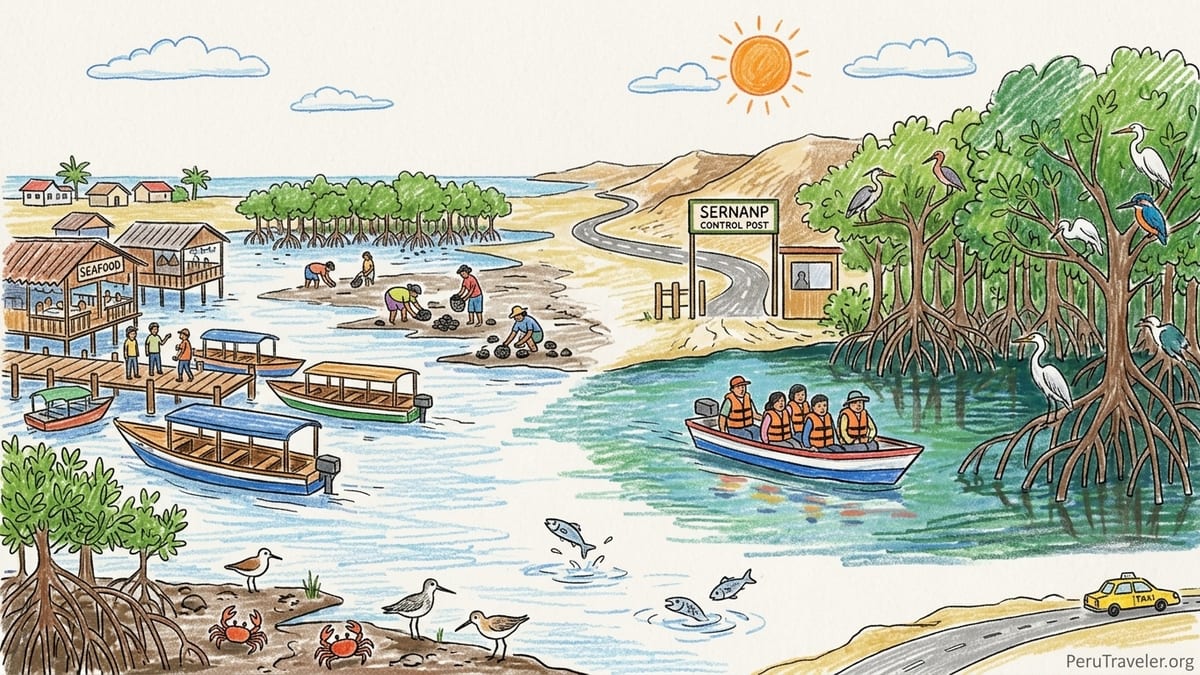
For a first visit, there are two very different mangrove products to understand. One is the classic tourist boat trip from Puerto Pizarro, a fishing village and small port about 20 to 25 minutes by road from the city of Tumbes. These excursions explore mangrove channels near the port and usually combine them with short stops at nearby islands and a crocodile breeding center. The second option is visiting the Santuario Nacional Los Manglares de Tumbes itself, a nationally protected area in Zarumilla province, closer to the Ecuador border and reached through official access points such as Puerto 25 or El Algarrobo.
Because I wanted to see the protected sanctuary and not just the village mangroves, I split my day in two. I booked an early morning shared boat from Puerto Pizarro to get a feel for the estuary and then arranged a separate authorized visit in the afternoon to the sanctuary’s Puerto 25 sector. This allowed me to compare scenery, rules and the overall experience, and it quickly became clear that they are not the same tour dressed in different marketing.
If you are short on time and staying in Tumbes city, a half-day from Puerto Pizarro can be enough to get a taste of the ecosystem. If you are already dedicating a full day away from Punta Sal or Zorritos, it is worth planning ahead so at least part of your outing reaches the actual national sanctuary sector in Zarumilla.
Arranging an Authorized Boat Excursion
In Tumbes and Puerto Pizarro, mangrove tours are mostly organized by small local operators and lancheros who work from the main pier. I chose to book in advance through a Tumbes-based agency that specializes in northern Peru itineraries, confirming that their program included entry to the Santuario Nacional Los Manglares de Tumbes via Puerto 25 in the afternoon and not just loops around Puerto Pizarro. The agency communicated that park access would be coordinated with SERNANP staff at the control post.
For the morning Puerto Pizarro outing, I joined a shared fiberglass boat with a sun canopy, outboard motor and basic bench seating. At the pier, several lancheros were offering similar trips that included mangrove channels, a stop at an island with rustic restaurants and a brief visit to the crocodile breeding station. Prices in September 2026 ranged between about 20 and 40 soles per person for a one-and-a-half to three-hour circuit in a shared boat, depending on the distance and number of stops. There was a separate small fee in local currency collected at the crocodile breeding center entrance, and that charge was not included in the boat price.
For the sanctuary visit, pricing was different and more structured. The agency charged a higher package rate that clearly listed transport from Tumbes to Puerto 25, the boat and guiding inside the protected area, and assistance with the mandatory park admission ticket. The entrance fees published by SERNANP distinguish between foreign visitors, Peruvian nationals and local residents, with day tickets for international travelers around a few dozen soles and reduced tariffs for Peruvians. In my case, the admission was not bundled into the boat price but purchased separately through the official channel before entering, so it is important to clarify with your operator whether the sanctuary fee is included in your quote or needs to be paid on top.
Both boats I used were small covered launches that seated around 10 passengers. Life jackets were stacked under the canopy. In Puerto Pizarro, the jackets were handed out only after the passengers boarded, and a few travelers chose not to fasten them until the boat left the dock. For the sanctuary excursion from Puerto 25, SERNANP’s requirement was stricter. The guide and boatman both reminded us that life jackets had to be worn properly throughout the navigation inside the protected channels, and no one argued with that rule.
From Pier to Mangrove: Checkpoints, Tides and First Impressions
The Puerto Pizarro tour started straight from the village pier, with no formal checkpoint beyond the municipal pier staff. We motored out across a broad, brownish estuarine bay that looked almost like an inland lake at mid-tide. On the horizon, low green clumps of mangroves fringed the water, contrasting with the pale sandbars and the dry hills behind the coast. Within fifteen minutes the soundscape shifted from the town’s mototaxis and pier chatter to only the hum of the motor and the slap of water on the hull.
Navigation into the narrower channels depended heavily on the tide. My morning departure had been timed for a mid-rising tide, which meant the boat could nose deeper into side channels without risk of grounding. Even so, the pilot slowed the engine in the shallowest stretches, weaving between exposed roots and sandbars. At low tide, some of these same passages dry to sticky mudflats pocked with crab holes, and boats must stick to the deeper estero routes, so departure timing is something to discuss when you book.
The afternoon sanctuary visit felt more controlled from the outset. Our driver left the city of Tumbes, followed the Panamericana toward Zarumilla and then turned off onto a smaller road toward Puerto 25, one of the official control points of the Santuario Nacional. At the entrance, there was a modest visitor area where SERNANP staff checked our tickets, took down passport or ID details and explained the main rules of the protected area. This was the only real access checkpoint of the day and it underscored the difference between simply touring mangrove habitat near a town and entering a nationally protected zone with conservation objectives.
From Puerto 25’s little dock, we boarded another small motorboat. The tide had begun to fall by mid-afternoon, and the guide warned that some side channels would already be too shallow to explore. Our navigation focused on the main estero Zarumilla, where the channels were broader but still lined with dense mangrove walls, their roots forming a dark lattice plunging into the water and mud. Here, the water level rose and fell against the trunks, leaving a visible tideline of algae and barnacles that made the tidal rhythm suddenly tangible.
Inside the Mangroves: Roots, Mudflats and Wildlife Actually Seen
Once inside the first mangrove channel near Puerto Pizarro, the landscape changed from open bay to a sheltered green corridor. Black and red mangroves rose several meters above the boat, knitted together by aerial roots that arched into the water like wooden stilts. As the channel narrowed, the air cooled slightly and smelled faintly of brine, wet wood and organic mud. Occasional gaps in the trees opened onto pale mudflats where the retreating tide had exposed a shiny, rippled surface.
Wildlife sightings here were subtle rather than spectacular. Perched on low branches ahead, a white heron fixed its gaze on the water, ignored our passing and then stepped delicately along the roots. Deeper among the roots, smaller shorebirds probed the mud, though they were hard to identify at a distance from the rocking boat. The most constant presence was crabs. At every stop, the mud seemed to move as hundreds of small crabs scuttled sideways toward burrows, some waving a single oversized claw. The guide pointed out one patch where fiddler crabs created a mosaic of colors on the mudflat, from pale beige to almost orange.
Inside the sanctuary sector in the afternoon, the atmosphere was noticeably quieter. There were no restaurants or houses in sight, just uninterrupted mangrove forest and distant outlines of islets. The guide cut the engine entirely in one of the narrower branches of the estero to let us listen. Egrets called from unseen perches, and somewhere above us a kingfisher rattled before darting low across the water. A little later, we watched a grey heron stalk the edge of a mudbank, pausing motionless and then striking at something in the shallows. Small fish periodically broke the surface, leaving rings that spread to the roots.
What I did not see, despite marketing posters in Tumbes, were wild crocodiles. Some Puerto Pizarro circuits include a visit to a crocodile breeding station where captive Tumbes crocodiles are raised behind fences, and these enclosures are often photographed and promoted as if they were part of a wild safari. My boat in the morning stopped briefly at the breeding center, but all crocodiles there were clearly within artificial ponds. In the open channels we navigated, there were no reliable crocodile sightings, and the boatmen did not promise any. Travelers should be skeptical of any tour that guarantees encounters with wild crocodiles in open water.
Still, the understated wildlife did not make the outing less valuable. Watching a line of wading birds pick their way across a tidal flat, or seeing how countless crabs, small fish and filter-feeding shellfish occupy different levels of the same bank, made the ecological complexity of the mangroves feel real in a way no brochure could convey.
The Human Dimension: Concha Negra, Crab Harvesting and Conservation Rules
One of the most interesting parts of the day was hearing local explanations of how people make a living from the mangroves without, in theory, destroying them. In Puerto Pizarro, our boatman spoke about concha negra, a dark-shelled bivalve that lives buried in the mangrove mud and is a prized ingredient in northern Peruvian seafood, especially in ceviches and mixed seafood dishes. At low tide, collectores wade into the mud with rubber boots and short tools to feel for the shells underfoot, a practice that has been passed down through generations.
Inside the national sanctuary, the framing was more formal. Our SERNANP-accredited guide explained that the protected area is classified primarily for indirect use, which means that tourism, environmental education and controlled research are emphasized over extractive activities. Certain traditional resource users have long-standing rights in specific zones, but visitors are not allowed to collect concha negra or crabs within the core tourism routes. At one point we saw a group of authorized extractors working in the distance, knee-deep in mud and bent over as they searched, but we observed only from the boat and did not approach their working area.
Later, back on dry land, a community member near Puerto 25 gave a short demonstration using empty shells and a small patch of mud beside the dock to show how concha negra is located and dug out, more as environmental interpretation than as a harvest. It was clearly separated from the sanctuary’s actual extraction zones. The message from both the park staff and the local cooperative was simple: visitors are welcome to learn about the traditional harvesting of concha negra and mangrove crabs and to enjoy them in local dishes in nearby villages, but they should not attempt to harvest anything themselves inside the protected area.
On both tours, the guides wove in basic conservation messages. They described how mangroves provide nursery grounds where juvenile fish and crustaceans can feed and hide among the roots before moving into the open sea, supporting coastal fisheries over a much wider area than the forest itself. They also emphasized the role of mangroves as a living barrier that helps buffer storms and erosion, anchoring the shoreline with their intricate root systems. Hearing this while bumping along a channel lined with what look like wooden scaffolds made those concepts easier to grasp than reading them in a report.
Comfort on the Water: Mosquitoes, Facilities and Time in the Mangroves
Practical comfort can make or break a day in the mangroves. I visited at the end of the dry season, between April and December, when skies were mostly clear and daytime temperatures in Tumbes hovered around the mid- to high-20s Celsius. Out on the water, the sun felt intense reflected off the estuary, and the boat’s simple canopy did not fully protect from sideways light. Sunblock, a hat and light long sleeves were essential, and I was glad to have brought a reusable water bottle as there were no shops once we left the port.
Mosquitoes were a concern I had expected, but the reality varied. During the mid-morning Puerto Pizarro circuit, a light breeze kept insects almost entirely away while we were moving, and I noticed bites only when we stopped near a sheltered bank to watch birds. In the late afternoon inside the sanctuary, when the boat moved more slowly along still channels, mosquitoes and no-see-ums were more noticeable, particularly close to sunset. A layer of repellent on exposed skin and thin trousers made the difference between occasionally swatting at the air and being genuinely bothered.
Boat comfort was basic on both excursions. The fiberglass launches had backless bench seating and no separate storage area, so daypacks were tucked under seats or onto laps. There were no toilets on board. In Puerto Pizarro, public bathrooms near the pier were serviceable but rustic and charged a small fee, payable in coins. At Puerto 25, there were simple restroom facilities near the control post, but once out on the water there was nowhere to stop discreetly. Anyone who needs frequent bathroom breaks should plan accordingly and speak up before boarding.
In terms of how the day divided between travel and actual time in the mangroves, my schedule felt balanced. From Tumbes city, the morning transfer to Puerto Pizarro took around 25 minutes. The boat then spent about two hours navigating different channels and islands before returning to the village. After lunch in town and the drive to Puerto 25, we spent roughly one and a half hours inside the sanctuary’s channels before the falling tide required us to head back. Door to door, it was a long day away from a beach base like Punta Sal or Zorritos, but the proportion of time spent actually in mangrove habitat, rather than in vehicles, felt worthwhile.
Comparing Puerto Pizarro Mangrove Trips with the National Sanctuary
Although they share the same broader ecosystem, the Puerto Pizarro circuits and the official sanctuary visit feel like two different experiences. Around Puerto Pizarro, the mangroves hug a human landscape. On the way out and back, you see fishing boats anchored near the village, families on small beaches and clusters of simple seafood restaurants perched on stilts above the water. The boatmen juggle tourism with daily fishing and shellfish collection, and tours are structured to suit short visitor attention spans with multiple stops, including commercial ones.
In contrast, once you pass the control point at Puerto 25 and enter the Santuario Nacional Los Manglares de Tumbes, the human footprint becomes far less visible. Aside from distant glimpses of authorized extractors and the occasional patrol boat, the journey focuses on natural scenery and birdlife. There are no floating restaurants or souvenir stalls along the route. The guide follows marked navigation lines agreed with the protected area administration, and there is more emphasis on maintaining distance from sensitive banks and roosting sites.
Regulations are also stricter inside the sanctuary. Speed is limited in certain stretches to reduce wake and disturbance, passengers are asked to maintain quiet near bird colonies, and there are clear rules around not disembarking onto muddy banks or cutting across shallow flats to take photos. In Puerto Pizarro, while individual responsible guides may encourage similar behavior, there is less formal enforcement, and I noticed some boats approaching sandbars quite closely to let passengers snap pictures of birds at shorter range.
For travelers, the decision often comes down to time, budget and expectations. If you want a quick, sociable outing that combines mangroves with a restaurant stop and a look at captive crocodiles, Puerto Pizarro delivers that in a compact package. If your goal is to understand why this is a national sanctuary and to see a more continuous mangrove landscape with fewer distractions, arranging transport to Puerto 25 or El Algarrobo and entering through the official access points is worth the extra organization and cost.
The Takeaway: Was a Day Away from the Beach Worth It?
What surprised me most about Peru’s tropical north coast was simply that this landscape exists at all. From brochures focused on Máncora’s surf, Punta Sal’s long sandy arc and Zorritos’ relaxed beach hotels, it would be easy to imagine the region as desert coast only. Floating along shaded mangrove corridors, with birds lifting off the banks and crab burrows stippling the mud, reframed my mental map of the Peruvian Pacific. It reminded me that this coastline is more than beaches and resorts; it is also a meeting point of river and sea that Peru has chosen to protect.
In terms of wildlife actually seen, my day was modest but satisfying. I counted several herons and egrets, both stark white and grey, a few glimpses of kingfishers, numerous shorebirds too distant to name, and a fascinating abundance of crabs on the mudflats and among the roots. We saw fish breaking the surface and heard about, but did not witness, larger marine life moving into the channels on higher tides. There were no wild crocodiles, and I left the captive breeding station with mixed feelings, appreciative of the conservation intent but wary of how its images are used in tour marketing.
The tours did a good job explaining the basics of the ecosystem and the cultural importance of concha negra and mangrove crabs, but there were gaps. I would have appreciated more detail on how climate patterns like El Niño affect the mangroves over time, and clearer explanations of how local communities participate in park management today, beyond simple mentions of “authorized extractors.” These are areas where guides and agencies could deepen their storytelling without making the experience more technical or less enjoyable.
Was the sanctuary worth a dedicated day away from Punta Sal or Zorritos? For me, yes. The journey required early departures and long transfers, but floating quietly between mangrove walls in the protected estero, with almost no sign of development and the occasional heron lifting off ahead of the bow, felt like a different country from the hotel-lined beaches. It offered a reminder that northern Peru’s Pacific coast includes not only sweeping desert shores but also a fragile, living forest at the ocean’s edge, one that deserves a place on travelers’ itineraries and in the national imagination.
FAQ
Q1. What is the difference between Puerto Pizarro mangrove tours and the Santuario Nacional Los Manglares de Tumbes?
Puerto Pizarro tours are local boat excursions in mangrove habitat near the fishing village, often combined with island stops and a crocodile breeding center. The Santuario Nacional Los Manglares de Tumbes is a formally protected area in Zarumilla province accessed through official control posts such as Puerto 25, with stricter conservation rules and fewer commercial stops.
Q2. How much does a mangrove boat trip cost near Tumbes?
Shared boat tours from Puerto Pizarro usually cost around 20 to 40 soles per person, depending on route length and inclusions. Visits that enter the national sanctuary through Puerto 25 are more expensive because they add overland transport and the separate sanctuary entrance fee on top of the boat and guide costs.
Q3. Are life jackets provided on mangrove boat tours?
Yes, boats from both Puerto Pizarro and Puerto 25 had life jackets on board during my visit. In Puerto Pizarro, they were offered once everyone had boarded, while inside the sanctuary the guide required every passenger to wear a fastened life jacket throughout the navigation.
Q4. How long do mangrove excursions last?
Puerto Pizarro circuits typically last between one and a half and three hours on the water, depending on how many stops are included. The sanctuary navigation from Puerto 25 generally takes around one and a half to two hours, not counting overland transport from Tumbes or nearby beach towns.
Q5. Do tours guarantee wildlife sightings such as crocodiles?
No, wildlife sightings in open mangrove channels are not guaranteed. Birds and crabs are commonly seen, but I did not encounter wild crocodiles during my excursion. Some tours visit a crocodile breeding station where the animals are kept in enclosures, which is different from a wild sighting.
Q6. When is the best time of year to visit the Manglares de Tumbes?
The most comfortable period to visit is usually between about April and December, when conditions are warm and relatively dry. There can be heavier rains early in the year, and it is wise to check local forecasts before planning a trip, especially if you intend to combine the mangroves with beach time.
Q7. How do tides affect mangrove navigation?
Tides strongly influence which channels boats can use. At higher tides, it is possible to enter narrower, more sheltered branches of the estuary, while at low tide some routes become shallow mudflats and boats must stick to deeper esteros. It is worth confirming with your operator that your departure time is suited to the type of navigation you want.
Q8. Are there many mosquitoes in the mangroves?
Mosquito levels vary with time of day, tide and wind. During my mid-morning outing, insects were minimal while the boat was moving, but late afternoon inside more sheltered channels brought noticeable mosquitoes and no-see-ums, especially near sunset. Bringing repellent and wearing light long sleeves and trousers is recommended.
Q9. Can visitors harvest concha negra or mangrove crabs during a tour?
Visitors should not collect concha negra or crabs inside the protected area or along standard tourism routes. Traditional harvesting is carried out by authorized local extractors in specific zones, and guests are encouraged instead to learn about the practice through explanations or demonstrations and to enjoy these products prepared in local restaurants.
Q10. Is it worth visiting the mangroves if I am staying in Punta Sal or Zorritos?
Reaching the mangroves from Punta Sal or Zorritos requires an early start and several hours of combined road and boat travel, but it offers a very different perspective on Peru’s north coast. If you are interested in nature and coastal ecosystems, dedicating a day to explore the Manglares de Tumbes can be a rewarding contrast to time spent on desert beaches.