


I went to Ayacucho expecting a pleasant provincial stop between better known Peruvian destinations. Instead, by staying in the historic center and spending a full day on the Wari–Quinua–Pampa de Ayacucho route, I walked into a different map of the Andes, one that begins long before the Incas and continues in clay beneath the hands of Quinua’s potters.
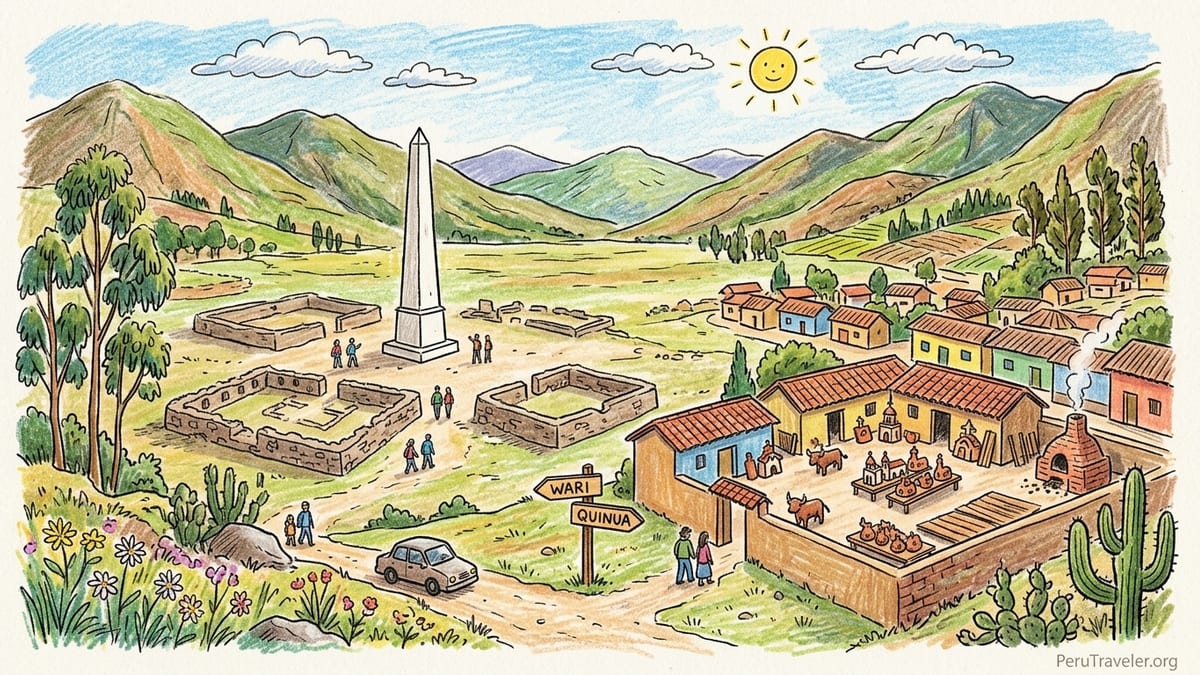
Staying in Ayacucho’s Historic Center and Planning the Route
I based myself a block from Ayacucho’s Plaza Mayor, in a small hotel inside a restored colonial house with a tiled courtyard and balconies facing the street. Rooms in this part of town typically range between 150 and 250 soles per night in 2026 for a mid-range double, including breakfast, and the advantage is clear: you can walk to the plaza before sunrise, see the carved stone portals and whitewashed churches turn pink with the first light, and still be back in time to meet transport for the Wari route.
To travel the Wari–Quinua–Pampa circuit without being rushed, I decided against the fastest half-day tour and instead arranged a private driver-guide who was willing to stretch the usual 9:30 to 15:30 circuit into a 9:00 to 17:30 day. Agencies on or near the plaza quoted me between 250 and 320 soles for a private car for two people including guiding, fuel and waiting time, significantly more than the 40 to 80 soles per person that shared excursions charge, but it bought something that mattered to me: time to walk the Wari sectors slowly and sit in an actual working pottery workshop rather than sprint from souvenir stand to souvenir stand.
We left the historic center at 9:00, negotiating Ayacucho’s morning traffic and climbing north on the paved road that links the city with Quinua. A shared colectivo from the garages on Jirón Manuel Pozo, a few minutes’ walk from the plaza, would have cost around 5 to 7 soles per person to Pacaycasa or Wari, but the flexibility of stopping wherever we wanted on the 22-kilometer drive made the private option feel justified for this particular trip.
As the city dropped away behind us, eucalyptus and patchwork fields appeared on the slopes, and my guide pointed out Pacaycasa, where some of the earliest evidence of human presence on these highlands has been found. Well before the Incas, even before Wari, people had been moving through this landscape, leaving stone tools and campfire traces in caves that now look down on the modern highway.
Walking Through Wari: A Pre‑Inca Capital Above the Clouds
The Wari Archaeological Complex sits near kilometer 23 of the Ayacucho–Quinua road, in the district of Pacaycasa, spread across a gentle hillside surrounded by farmland. At the entrance, signboards indicate the official visiting hours of 9:00 to 17:00 from Tuesday to Sunday, and the ticket office charged me 6 soles for general admission in line with the current Ministry of Culture tariff that also covers the small site museum. A guide stationed near the gate offered his services for 30 soles for a couple of hours, a rate that local agencies had already confirmed as standard for small groups.
From the parking area, stone walls emerge from the scrub in low lines, then gather themselves into higher enclosures with trapezoidal doorways. My guide was careful to point out that visitors currently walk only a fraction of the roughly 2,200 hectares that once formed this pre‑Inca city. Many sectors remain unexcavated or closed for conservation, so paths lead you through selected compounds rather than an open-plan ruin like some Inca sites.
In the first accessible sector, narrow corridors and double walls created a sense of controlled movement. The Wari masonry here is functional rather than polished: medium-sized stones set in thick mortar, surfaces once plastered and painted rather than left bare. We stopped at a doorway where my guide contrasted this with Inca architecture. Inca imperial centers like Cusco or Ollantaytambo use finely cut, tightly fitted stone blocks that stand without mortar, with slightly off-vertical walls and perfectly carved niches. Wari construction, by comparison, privileges mass and planning over showpiece finishes, evidence of an earlier urban experiment where uniformity and control mattered more than aesthetic refinement.
He explained that between about 600 and 1000 CE, Wari was the capital of a state that projected power along highland routes from Ayacucho toward the central coast and the southern Andes. Administrative centers like Pikillaqta near Cusco and sites around Huari in the north followed a similar template of orthogonal compounds, restricted access patios and storage areas. Long before the Incas, Wari engineers were already building planned cities, experimenting with state-controlled agriculture, and laying out roads that later informed sections of what we now call the Qhapaq Ñan, the Andean road network that the Incas expanded.
The Site Museum: Textiles, Ceramics and the Shape of an Empire
After walking among the walls, we retreated to the on-site Museo de Sitio Wari, a low modern building near the entrance. The same 6-soles ticket covers the museum, which follows the complex’s schedule of Tuesday to Sunday, 9:00 to 17:00. Inside, the lighting was simple but effective, with bilingual information panels in Spanish and some English that, while concise, gave enough context to piece together Wari’s story without feeling lost.
One room displayed ceramics with geometric red-and-white designs and stylized figures framed in tight black outlines. My guide pointed out that this white-on-red tradition echoes in the ceramics of Quinua today. The continuity is not a straight line, but the visual dialogue is evident: sharp stepped motifs, frontal deities, and compact, almost architectural vases that seem built as much as shaped. Nearby, shelves held stone tools, carved monoliths and fragments of large storage jars that once lined Wari storerooms.
In a glass case, fragments of textiles revealed an even more sophisticated side of the culture. Tiny camelid-fiber threads formed designs so intricate that they looked printed rather than woven, with repeated warrior and animal figures marching across the cloth. The explanatory text emphasized something that often gets lost when Peru’s history is reduced to “pre‑Inca” and “Inca.” Wari was not a footnote before Cusco. It was a regional power that developed administrative practices, iconography and spatial organization that later Andean states, including the Inca Empire, adapted and re-signified.
The museum’s interpretation quality felt on par with better-known sites, although it is compact. It took about 45 minutes to read the panels, study the pieces and talk through the displays with my guide. On a rushed half-day tour, this is often cut to ten or fifteen minutes, enough for quick photos but not for the slow process of relating the objects back to the walls outside or forward to the ceramics I would see in Quinua.
Ayacucho in the Andean Network and How Wari Differs from Inca Stonework
Standing on a lookout above the excavated sectors, Ayacucho’s position within the central-southern Andes came into focus. To the west lies the route to the coastal valleys; to the east, roads slope towards the Amazonian fringe. Wari’s location here was no accident. It allowed the state to oversee caravan routes transporting salt, coca leaves, textiles and ceramics between ecological zones, an early expression of the vertical archipelago model that Andean societies used to access diverse resources across altitudes.
Architecturally, Wari used this position to project power in ways distinct from the Incas who followed. Wari compounds around Ayacucho and beyond insist on enclosed spaces, inward-facing patios and controlled access doors. Walls were usually double, filled with earth and stone, then plastered smooth and painted. Little of this plaster survives in Wari’s open sectors today, but in protected corners you can still see faint traces of color that suggest a much more vivid built environment than the grey stones visible now.
In contrast, Inca centers like Sacsayhuamán or the great plaza of Cusco emphasize broad open spaces and finely dressed stonework that signaled imperial presence as spectacle. Walking through Wari, I had the sense of moving through a bureaucracy; walking through Inca plazas elsewhere in Peru, the feeling is of participating in ritual theater. Recognizing this difference matters because it repositions Ayacucho as more than an incidental stop between Lima and Cusco. Here, an earlier state learned to administer a scattered realm from a highland capital, and the Incas later inherited both the roads and the idea.
My guide stressed another point. The Wari world was not an isolated precursor but part of a broader Andean conversation. Textiles and ceramics from Wari contexts echo motifs found in Nazca and Tiwanaku traditions, while Wari-influenced sites near the Apurímac and in the Mantaro Valley speak to connections that run across what are now several Peruvian regions. For travelers used to thinking of Andean history as a straight climb toward Machu Picchu, Ayacucho’s Wari ruins redraw the lines into a web of intersecting roads and shared symbols.
Reaching Quinua and Finding an Active Pottery Workshop
From Wari, we rejoined the main road and continued about 15 kilometers to Quinua, a small town with adobe houses and red tile roofs that curve around a hillside. Colectivos from Ayacucho also continue this route for around 7 to 10 soles per person, dropping passengers near the plaza, but arriving with my guide meant we could stop at viewpoints where the Pampa de Ayacucho spread out below like a pale green blanket.
Quinua’s streets are lined with pottery shops, and at first glance it is hard to distinguish between active workshops and stores that mainly resell pieces. An active workshop usually reveals itself through open courtyards, stacked raw clay, and half-finished objects drying on wooden planks. In contrast, souvenir outlets closer to the plaza tend to have shelves of finished pieces, bright signage, and little sign of production on-site.
Before my trip, I had noted the address of El Canto de los Barros, a well-regarded Quinua workshop recognized in national artisan programs and located on Jirón San Martín near the center of town. When we arrived, the family had agreed to receive visitors that afternoon, and a young potter greeted us with hands still stained red from clay. The difference from a simple store was immediate. Instead of leading us directly to display shelves, he invited us into the work area where lumps of local clay, mixed with ground volcanic material for strength, rested under plastic to keep them from drying too quickly.
He began by showing how the raw clay arrives from pits near the town as heavier chunks, which are then soaked, cleaned of stones by hand and feet, and mixed with fine sand or puzolana until the texture is smooth enough to shape. This preparation can take several days, and only then do they move to coiling and modeling. Seeing this labor before even a single figurine takes form made the prices I would later see feel less like souvenirs and more like the visible tip of a long process.
Miniature Houses, Roof Ornaments and Learning to Read the Clay
On a workbench, small churches, musicians and bulls in various stages of completion formed a quiet crowd. Quinua is famous for its miniature church models and roof ornaments that crown the ridges of Andean houses. In one corner, I recognized the compact silhouette of a double-spired church similar to the Ayacucho cathedral, with the walls still unpainted and the bell towers exaggerated to look taller from street level, a detail I had read about but only appreciated fully when I saw the clay towers from up close.
The potter demonstrated how he attaches decorative elements. Using a simple wooden tool and his fingernails, he incised stepped motifs reminiscent of Wari designs into the surface of a small house, then added tiny birds and crosses to the roofline. He explained that after drying in the shade, the pieces would be fired in a wood-fed brick kiln at the back of the courtyard, where firing days still gather several neighboring artisans to share fuel and monitor temperatures. Only after this do they apply mineral-based paints in red, white and black, echoing Wari’s palette but expressing scenes that belong to Quinua’s present: wedding processions, farmers planting potatoes, bands playing during local fiestas.
Prices in this active workshop were clear and roughly aligned with those cited by regional artisan platforms. Small roof bulls started around 20 to 30 soles depending on detail, palm-sized churches at about 35 to 50 soles, and more elaborate scenes with many figures from 80 soles upward. I bought a medium-sized red-and-white rooftop church for 45 soles, and the potter wrapped it carefully in recycled cardboard and newspaper. Later, walking through Quinua’s plaza, I compared these with pieces sold in purely commercial outlets, where similar houses sometimes cost slightly less but there was no opportunity to see the process or speak with the maker.
The distinction between an active workshop and a souvenir shop is not about purity or judgment. Some family workshops also maintain small storefronts, and many commercial shops resell pieces originally made in village workshops. For a traveler interested in craft traditions, however, asking if there is a taller where you can see work in progress opens doors to courtyards where the continuity between Wari ceramics and Quinua’s living pottery becomes something more than a design resemblance.
Pampa de Ayacucho: An Open Landscape Marked by a Single Obelisk
From Quinua’s plaza, the road continues gently uphill toward the Pampa de Ayacucho Historic Sanctuary, known locally as the Pampa de la Quinua. About ten minutes later we arrived at a broad grassy expanse at roughly 3,300 meters above sea level, the site of the Battle of Ayacucho of 9 December 1824, a turning point in South America’s wars of independence. A modest entrance booth charged 5 soles per person, consistent with current references shared by Ayacucho agencies for the sanctuary.
The landscape is deceptively simple. An undulating plain, distant hills with scrub and queñual trees, and at the center a towering white obelisk that rises 44 meters into the sky. According to UNESCO documentation, this Obelisco de la Pampa de la Quinua was inaugurated in 1974 for the 150th anniversary of the battle and is the only permanent structure on the plain, intentionally isolated so that the monument and landscape read as a single memorial space.
We climbed the steps to the base of the obelisk, where reliefs and plaques commemorate the patriot leaders and armies who defeated the royalist forces here. My guide unfolded the narrative of the battle: how the combined patriot forces under Antonio José de Sucre faced the Spanish viceroy José de la Serna on this high plateau, how the engagement ended with the capitulation that effectively secured independence for Peru and sealed the fate of Spanish rule in mainland South America.
Looking across the pampa, it was easy to imagine lines of infantry advancing over the gentle slope, cavalry sweeping in from the hills of Condorcunca and Andrespata that frame the plain. The sanctuary’s open design, with only scattered interpretive panels, means that much depends on the guide you come with or the reading you do beforehand. There is talk locally of improving on-site interpretation, but even now, the combination of sky, wind and that solitary obelisk offers a stark lesson in how landscapes carry memory differently from museums or city monuments.
A Regional Lunch and the Question of Time
On the way back to Quinua, we stopped at a simple comedor on the roadside recommended by my guide rather than one of the larger tour-oriented restaurants. The menu was hand-painted on a board and limited to three options. I chose a plate of puca picante, a regional dish of potatoes and pork in a beet-colored peanut sauce, served with rice and a small salad. The portion was generous and cost 15 soles, including a mug of emoliente, a warm herbal drink. It was not a destination restaurant, but it was clearly cooking for locals first and visitors second, and the flavors felt aligned with the clay-rich, agricultural world I had been walking through all day.
By the time we rolled back into Ayacucho around 17:30, the central streets were filling with evening commuters, and Wari’s walls, Quinua’s kilns and the wide pampa had folded themselves into a single mental route. Looking at the day as a whole, I felt that stretching the usual half-day excursion into a longer circuit had changed the quality of each stop. At Wari, we had nearly two hours to move between sectors and spend real time in the museum. In a standard shared tour, groups often report spending 40 to 60 minutes at the ruins, which barely allows a walk to the main sector and a few photos of the walls.
In Quinua, our visit to an active workshop lasted over an hour, including the demonstration of clay preparation and detailed conversations about designs and firing. Most quick excursions devote roughly the same time to the entire town, encouraging participants to buy souvenirs but not necessarily helping them see how the craft connects to Wari’s legacy and Ayacucho’s identity. At the Pampa de Ayacucho, we had space to walk away from the obelisk and see the monument shrink against the horizon, a small but important shift in perspective that I might have missed on a tighter schedule.
The Takeaway
Spending a full day on the Wari–Quinua–Pampa route, anchored in a stay in Ayacucho’s historic center, quietly reoriented my understanding of Peruvian history. In Lima and Cusco, the narrative often jumps from the pre‑ceramic to the Inca Empire, with other civilizations treated as prologues. Walking Wari’s planned compounds and standing in front of its ceramics and textiles gave a different impression: that centuries before the Incas, a highland state headquartered near Ayacucho was already experimenting with the administrative tools and visual vocabulary of power.
In Quinua’s workshops, the continuity between that past and today’s pottery traditions was not a museum label but a tactile reality. The most meaningful stop for me was the hour spent watching clay being kneaded, miniature houses incised and bulls attached to tiny roofs. It was in that courtyard, with smoke from a distant kiln in the air, that Wari’s abstract red-and-white designs from the museum vitrines reappeared as living patterns shaped by contemporary artisans, many of whom balance farming and pottery just as their grandparents did.
Not everything felt untouched. Quinua’s main streets have clearly adapted to tourism, and some stores lean heavily into mass-produced pieces designed for quick sale to passing buses. The obelisk on the pampa, too, is a product of a particular commemorative moment in the 1970s, with a monumental language that can feel distant from the complex social history of the independence wars. Yet even within this commercialization, the underlying stories remain accessible if you give them adequate time.
Ayacucho, in this light, deserves several days rather than a single excursion. One day for Wari, Quinua and the Pampa of Ayacucho as described here; another to explore the city’s churches, nearby memory sites and retablo workshops; perhaps a third for surrounding valleys. For travelers who want their understanding of the Andes to reach beyond Inca stonework, basing yourself in Ayacucho and walking this pre‑Inca and artisan route offers a grounded, quietly transformative counterpoint to the more famous itineraries further south.
FAQ
Q1. How much does it cost to visit the Wari Archaeological Complex from Ayacucho?
Entry to the Wari Archaeological Complex, including the site museum, cost me 6 soles for a general ticket, in line with current Ministry of Culture tariffs. Hiring a local guide on site was an additional 30 soles for a couple of hours, and a private car with driver-guide from Ayacucho for the full Wari–Quinua–Pampa circuit ran around 250 to 320 soles for the day, compared with 40 to 80 soles per person for a standard shared half-day tour.
Q2. What are the current opening hours for Wari and its museum?
When I visited, both the Wari Archaeological Complex and the Museo de Sitio Wari operated from Tuesday to Sunday, 9:00 to 17:00. The ticket office stopped selling tickets shortly before closing time. Monday is the usual closure day, so it is wise to plan your Ayacucho stay so that the Wari visit falls between Tuesday and Sunday and to arrive by late morning if you want ample time to walk through the sectors and the museum.
Q3. Is it possible to do Wari, Quinua and the Pampa de Ayacucho as a half-day trip?
Shared excursions from Ayacucho commonly offer Wari, Quinua and the Pampa de Ayacucho as a half-day tour, typically departing around 9:30 and returning by midafternoon. It is physically possible to see all three in that timeframe, but in my experience the stops become photo opportunities rather than deep visits. Choosing a longer private or small-group excursion that returns closer to 17:00 allowed more time at the ruins, in an active pottery workshop and walking across the pampa.
Q4. How do I distinguish an active pottery workshop from a souvenir shop in Quinua?
Active workshops in Quinua usually show clear signs of production: open courtyards with raw clay, half-finished pieces drying on planks and perhaps a visible kiln. The artisan or family members are often working when you arrive. Souvenir shops closer to the plaza tend to focus on finished pieces arranged on shelves, with less evidence of materials or tools. Neither type is inherently better, but if you want to understand the process, asking to visit a taller where work is underway is the best approach.
Q5. What did you pay for pottery in Quinua, and were the prices fair?
In the workshop I visited, small roof bulls started around 20 to 30 soles, miniature churches around 35 to 50 soles, and more elaborate scenes from 80 soles upward, depending on size and detail. I paid 45 soles for a medium red-and-white rooftop church. Considering the days of clay preparation, modeling, firing and hand-painting involved, these prices felt fair and directly supported the artisan, especially compared with similar items sold at slightly lower prices in purely commercial outlets that do not show the making process.
Q6. How does Wari architecture differ from Inca sites like Cusco or Ollantaytambo?
At Wari near Ayacucho, you walk through orthogonal compounds and narrow corridors built from medium-sized stones set with mortar, walls that were originally plastered and painted. The impression is of enclosed, controlled administrative space. Inca imperial centers such as Cusco and Ollantaytambo, by contrast, showcase carefully carved stone blocks fitted without mortar and broad plazas designed for public ceremony. Understanding this difference helped me see Wari as an earlier experiment in planned urbanism and state control rather than as an unfinished version of Inca architecture.
Q7. What did you learn at the Pampa de Ayacucho Historical Sanctuary?
At the Pampa de Ayacucho, I learned how a seemingly gentle highland plain became the stage for the decisive Battle of Ayacucho on 9 December 1824, when patriot forces under Antonio José de Sucre defeated the royalist army of Viceroy José de la Serna. My guide explained troop positions on the surrounding hills and how the capitulation signed here effectively ended Spanish rule on the South American mainland. The tall white obelisk erected in 1974 for the 150th anniversary serves as a national monument, but the wide, mostly empty landscape itself carries much of the historical weight.
Q8. Is Ayacucho worth more than one day on a Peru itinerary focused on Inca sites?
After completing the Wari–Quinua–Pampa route, I would argue that Ayacucho deserves at least two or three days. One day allows you to explore Wari, Quinua and the Pampa in depth; another opens time for Ayacucho’s historic center, churches and artisan workshops such as retablo makers; a third could be dedicated to surrounding valleys or memory sites related to more recent history. For travelers interested in understanding Peruvian history beyond the Inca focus of Cusco and the Sacred Valley, Ayacucho provides an essential pre‑Inca and artisan counterpoint.
Q9. How did this route change your understanding of Peruvian history and culture?
Walking Wari’s planned compounds, listening to explanations of its political reach and then handling Quinua ceramics influenced by Wari designs made Peru’s pre‑Inca past feel central rather than preliminary. The route showed me that many visual and organizational ideas later associated with the Inca Empire had earlier expressions here in Ayacucho. It also highlighted how living traditions like pottery are not decorative sidelines but active ways communities continue to interpret and transmit that deeper history.
Q10. Would you recommend booking a tour or going independently for this experience?
For travelers who speak some Spanish and are comfortable with local transport, it is possible to reach Wari and Quinua independently using colectivos and then hire a guide at the site or arrange workshop visits upon arrival. I chose a private driver-guide from Ayacucho to ensure enough time at each stop and smoother access to an active workshop, and I found the extra cost worthwhile for the depth it added. Whichever option you choose, planning for a full day rather than a tight half-day schedule makes the difference between a checklist of sites and a genuinely connected experience.