


The turquoise terraces of Millpu near Ayacucho have become a social media star in Peru, a chain of pale blue pools suspended in a tight Andean canyon. The photographs that sell the dream are seductive: glassy water, empty walkways, and a surreal palette of blues and greens. After completing the long excursion from Ayacucho in October 2026, I discovered a more complicated reality. Millpu can be extraordinary, but the long day on the road, seasonal water color, strict conservation rules and basic facilities make it a destination that demands careful thought before you book.
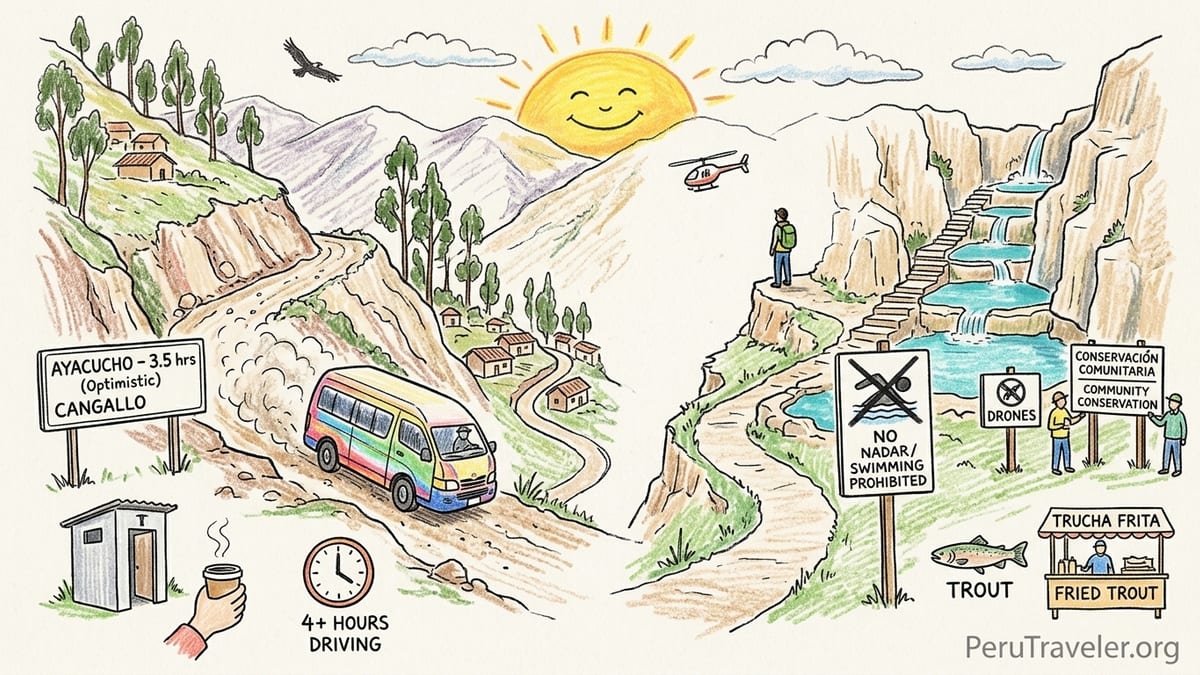
The Photos That Convinced Me to Book
I first encountered Millpu the way most travelers do: on a screen. Online galleries showed a staircase of perfectly turquoise pools backed by pale limestone, with a lone figure for scale and a caption promising an untouched paradise three and a half hours from Ayacucho. Several Ayacucho agencies promoted “Aguas Turquesas de Millpu” as the region’s must-see natural wonder, often ranking it above archaeological icons such as Wari or Vilcashuamán. The message was clear: if you skipped Millpu, you were missing the highlight of Ayacucho.
Travel sites and tour ads quoted road times of around 3.5 to 4 hours each way between Ayacucho and Millpu, along the route Ayacucho – Cangallo – Huancapi – Huancaraylla – Circamarca, with only a “short walk” at the end. Some packages promised a 20-minute stroll from the parking area to the pools and mostly showed photos taken in intense, dry-season sun, when the water is at its clearest blue-green. Several blogs mentioned that Millpu had become the “hidden queen of the Andes,” often glossing over the impact of altitude, seasonal rains and conservation rules that now shape every visit.
Before traveling I checked official and local sources. Peru’s national tourism inventory lists the access walk from the Pataqocha parking area to the pools as about 2 kilometers along a narrow mountain path at around 3,680 meters above sea level, with an indicative duration of 20 minutes in each direction for acclimatized walkers. Regional media and local information confirmed that the Circamarca community administers access and that swimming has been prohibited since late 2018 to protect water quality. A regional ordinance from April 28, 2026 raised the stakes by declaring the protection of Millpu and its surrounding landscape a matter of regional priority. In other words, the site I would visit in 2026 was not the carefree bathing spot of older blog posts, but a fragile landscape with stricter rules and higher local expectations.
The final push came from the promise that Millpu would justify a full day of my limited time in Ayacucho. I had only four days in the city. Choosing Millpu meant sacrificing an easy half-day tour to Wari and Quinua and a more relaxed exploration of Ayacucho’s plazas and churches. The gamble was simple: one very long, tiring day in exchange for the chance to see one of Peru’s most photogenic river canyons with my own eyes.
The Long Drive From Ayacucho: Timings, Vehicle and Road Conditions
I joined a shared day tour from central Ayacucho, one of several agencies that contract local operators familiar with the route. We left the historic center at 7:40 a.m. in a 15-seat minibus with seat belts in most but not all seats, reasonable suspension and functional brakes. Road times can vary by season and construction works, but on my October 2026 trip, which was late in the dry season but close to the rains, the advertised “3.5 hours each way” proved optimistic.
The first section south from Ayacucho to Cangallo followed a paved road, with the usual speed bumps near villages and market towns. The countryside shifted quickly from eucalyptus-framed slopes to open highland fields, and the driver used this good surface to make time. At Cangallo we stopped briefly at a simple roadside restaurant for bathrooms and coffee. Toilets here were basic but usable, with running water and a small fee. This was the last proper toilet before Millpu itself, and the guide strongly encouraged everyone to use it.
Beyond Huancapi the road changed character. Asphalt gave way to a compacted, graded surface with stretches of loose gravel, washboarding and dust. The views became more dramatic, but so did the feeling of isolation. Our minibus handled these sections competently, but the ride grew noticeably rougher, and anyone prone to motion sickness would have struggled without medication. In total, with the Cangallo stop and another brief photo break near Huancaraylla, the drive from Ayacucho’s Plaza Mayor to the Pataqocha community parking area took just under four hours and fifteen minutes.
The return was similar. We left the Pataqocha parking area around 3:20 p.m. and were back in central Ayacucho at 7:30 p.m., slowed this time by afternoon traffic as we re-entered the city. Counting hotel pickup, delays while collecting other passengers and the final drop-offs, the full excursion consumed roughly 12 hours door to door. Of that, close to eight hours were spent in the vehicle on sometimes bumpy, narrow roads, with only short breaks for toilets and a late lunch in the community. Those “turquoise” photos do not hint at how much of your day will unfold on the road.
Approach to the Canyon: The Walk, Viewpoints and Real Appearance of the Pools
From the Pataqocha parking area, you see neither canyon nor pools. The route begins gently enough along a dirt path past trout ponds managed by the local community. At 3,600 to 3,700 meters, even this moderate incline can leave sea-level visitors short of breath. The surface is a mix of packed earth and loose stones, uneven in places with some narrow sections above the river. There are no handrails for much of the way, so people with limited balance or vertigo need to walk carefully and may feel uncomfortable if the path is crowded.
As you follow the river upstream, the canyon begins to close in and the first small pools appear between pale rock ledges. In mid-October, after some early-season rains, the water during my visit was an opaque blue-green in the sun and more muted in the shade. It was not the electric turquoise seen in heavily edited images from the heart of the dry season, but it was beautiful in a subtler, more natural way. Where the canyon walls narrowed, reflected light deepened the color, but in cloud or late afternoon shade the same pools shifted toward grey-green.
The main viewpoints are informal terraces along the path, with a couple of wider spots where guides encourage groups to stop for photos. A higher vantage point near the top of the route offers the classic “ladder of pools” view, though in reality the staircase effect is less perfectly aligned and more broken by rock steps and small cascades than in many photos. The rock formations themselves are striking: smoothed depressions carved by water over time, some rimmed with a thin line of white mineral deposits. The canyon feels intimate rather than grand, a place where detail and color matter more than scale.
On my visit the pools contained more suspended sediment than expected, a reminder that color is not guaranteed. Local guides and the Circamarca community consistently point to four factors: season, rainfall, sunlight and upstream activity. From roughly May to August, when rains are minimal and skies more reliably clear, the water is both clearer and more intensely colored. In the shoulder months, any overnight storm can leave the river higher and cloudier, muting the turquoise effect. Travelers who arrive under overcast skies after recent rain simply do not see the tones promised in tour posters.
What I Could Not Do: Swimming, Drones and Free Roaming
Many older articles still show visitors swimming in Millpu’s pools or wading between them in bright swimsuits. Those days are definitively over. Information from the local Millpu site and regional tourism authorities confirms that a strict no-swimming rule has been in place since late 2018, underpinned and politically reinforced by the April 2026 regional ordinance that prioritized conservation of the site. During my visit, signs at the start of the path and near the first viewpoint spelled out the rules clearly: no bathing, no entering the water, no alcohol, no littering and no drones without specific authorization.
On the ground these rules were taken seriously. Community-appointed guards and guides watched the main viewpoints and reminded visitors to stay behind agreed lines when taking photos. When one member of our group put a foot into the water at the edge of a pool, a community representative intervened immediately and asked them to step back. The rationale, they explained, was practical: sunscreen, sweat, dust and detergent quickly degrade water clarity, and a few seasons of unregulated swimming had already affected the pools’ color. With Millpu now recognized as a regional conservation priority, there is little chance these prohibitions will be relaxed.
Drones were also restricted. On the day I visited, one traveler produced a small drone at the higher viewpoint and was politely, but firmly, told not to launch it due to both noise concerns and the risk of disturbing birds and livestock in the area. The rules form part of a wider effort by the Circamarca community to balance income from tourism with protection of their water source and landscape. Visitors expecting free movement across the rocks, wild swimming or unrestricted flying should understand that Millpu now operates more like a small, community-managed protected area than a recreation spot.
Even photography access is gently controlled. At popular vantage points, informal queues formed as guides coordinated groups to step onto narrow outcrops one at a time. In the busiest moments this meant waiting ten to fifteen minutes for a clear photograph. It was all good-natured and practical, but it changed the feel from spontaneous exploration to a managed photo session, very different from the solitary images that hooked me online.
Conservation Rules and the Role of the Circamarca Community
Behind the new restrictions lies a deliberate shift in how Millpu is governed. The campesino community of Circamarca administers access to the pools, collects entry fees and organizes services such as basic food stalls and local guiding. Regional reporting and community information describe Millpu as a case study in communal tourism management, highlighting self-administration, environmental management and investment of income in local infrastructure and small enterprises such as trout farming and crafts.
As of late 2026, locally published information lists entry fees of around 10 soles for Peruvian adults, 5 soles for children and 15 soles for foreigners, updated in April 2023 by community and local tourism sources and broadly consistent with Peru’s national tourism inventory, which refers to a smaller base tariff recorded in 2024. My tour price included this fee, so I did not pay at the gate, but our guide confirmed that revenue now flows through the community, which has set up a simple but structured ticketing and checkpoint system. Residents also staff the parking area and keep an eye on trail conditions.
The April 2026 regional ordinance issued by the regional government of Ayacucho formally declared the protection and conservation of Millpu and its surrounding landscape to be of regional interest and priority. While dense in technical language, this measure effectively backs the Circamarca community’s existing rules, anchoring them in regional policy and giving more weight to prohibitions on swimming, littering, disorderly conduct and off-trail access. For visitors, it translates to more visible oversight along the trail, occasional reminders through loudspeakers on busy days, and a clear expectation that you follow instructions from local custodians.
In practice the system worked well on my visit. The path was reasonably clean, with only occasional bits of rubbish collected quickly by community members. Food and drink stalls were concentrated near the parking area, reducing waste inside the canyon. Conservation messages focused not on scolding but on explaining why water clarity mattered to both ecology and tourism. It felt less like top-down regulation and more like a small community defending the natural asset that now underpins a growing share of its income.
What Disappointed Me: Crowds, Terrain, Facilities and Time at the Pools
Despite the beauty of the setting and the clear efforts at conservation, parts of the experience fell short of what the photos and tour descriptions had led me to expect. The first was the ratio of road time to pool time. From a 7:40 a.m. departure to a 7:30 p.m. return, I spent just under two hours and fifteen minutes in or near the canyon itself, of which perhaps 90 minutes were actually at or overlooking the pools. The rest of the day vanished into driving, lunch and waiting for others. For a traveler with only a few days in Ayacucho, this is a major trade-off.
Terrain was the second surprise. Marketing materials often describe the walk as a short, easy stroll suitable for “all ages.” At 3,600 to 3,700 meters this is misleading. While the path is not technically difficult, it is narrow in places with steep drop-offs to the river, uneven stones and several short but steep sections that demand care. I saw one older traveler turn back halfway due to shortness of breath and concerns about balance, and parents with very young children had to keep a tight hold on small hands near the edges. This is not a walk for pushchairs, and it would be challenging for anyone with reduced mobility or fear of heights.
Crowds also altered the atmosphere. Millpu has become popular with both domestic and international travelers, and on my weekday visit there were at least eight tour groups plus independent visitors on the trail at the same time during the late morning peak. The narrowest sections of the path turned into brief bottlenecks; at one viewpoint a line formed as groups took turns posing for the signature shot. The canyon’s intimacy, which in theory is one of its charms, also amplifies noise from conversations and guides’ explanations, making it hard to find a genuinely quiet moment with the landscape.
Facilities were mixed. At the parking area there were basic toilets with squat stalls and limited running water, usable but far from comfortable for anyone expecting modern facilities. Food options consisted of a handful of simple stands selling soups, trout dishes, boiled potatoes, instant noodles and hot drinks. Everything was cash-only. Drinking water was available in bottles or from large jugs, but there was no guarantee of treated water on the trail itself. Shade was scarce once you left the canyon’s partial cover, and there was no mobile signal from my Peruvian SIM anywhere between Huancaraylla and Millpu. While experienced rural travelers will accept these conditions as part of the journey, those arriving with the expectations set by curated online photos may find the reality surprisingly basic.
Comparing Millpu With a Shorter Cultural Excursion: Wari and Quinua
To put Millpu in context, I completed another classic Ayacucho excursion on a separate day: a half-day tour to the Wari archaeological complex and the town of Quinua with its Pampa de Ayacucho battlefield site. This circuit runs northeast of the city along a good paved road, with far less time in the vehicle and very different rewards. Wari, capital of a major Andean state between about AD 550 and 900, lies roughly 22 to 23 kilometers from Ayacucho’s center, reachable in 30 to 35 minutes by bus or minibus. Quinua is about 37 kilometers away, roughly 55 minutes by road, and is known for its ceramic traditions and the towering independence obelisk on the nearby pampa.
Several local agencies offer Wari–Quinua half-day tours priced around 40 to 80 soles per person, with a typical schedule from about 9:30 a.m. to 3:30 p.m. Entry to the Wari archaeological complex and site museum was priced at 6 soles for adults when I visited, in line with official Ministry of Culture information. The Pampa de Ayacucho historic sanctuary near Quinua charged a modest fee of around 5 soles per person. Total door-to-door time from my hotel, including traffic and a brief lunch stop in Quinua, was just under six hours. Crucially, more than half of that time was spent out of the vehicle exploring ruins, visiting workshops and walking the battlefield plateau.
Physically, the Wari–Quinua excursion was less demanding than Millpu. Although Quinua and the Pampa sit slightly higher than Ayacucho, walking surfaces were generally wider and more even, and there were no narrow cliff-side trails. For travelers worried about altitude fitness or traveling with young children or older relatives, this day felt accessible and low-stress. Toilets at both Wari and Quinua were basic but more numerous than at Millpu, and the town offered multiple options for simple lunches and snacks, along with a functioning mobile signal around much of the route.
Financially, Millpu was also more expensive when total costs were considered. My Millpu tour from Ayacucho, including transport, guide, lunch in the community and entry fee, cost the equivalent of roughly 280 to 320 soles per person based on 2026 price surveys and agency offers, while the Wari–Quinua half day came in closer to 60 to 120 soles depending on operator and group size, plus small entry fees. Exact prices continue to evolve and should be checked locally at the time of booking, but the pattern is clear: Millpu consumes more time and money than a cultural circuit that offers deeper historical context and more flexible pacing.
Who Will Appreciate Millpu, and Who Should Think Twice?
For landscape photographers willing to work with natural conditions, Millpu can be rewarding. The canyon’s curves, mineral-streaked walls and rhythm of pools offer compositional possibilities that go beyond the standard postcard shot, and the play of light between sunlit water and shaded rock can be subtle and beautiful even when the water is not at peak turquoise. Those with time in their schedule can even plan around weather, giving themselves flexibility to choose the clearest day of their Ayacucho stay.
Nature lovers who value geology, hydrology and community conservation may also find the trip worthwhile. Observing how the Circamarca community has taken ownership of the site, restricted damaging activities and integrated tourism with trout farming and local gastronomy paints a hopeful picture of rural stewardship. Walking slowly along the canyon, listening to the river and bird calls and talking with community members about the changes they have seen brings a depth that transcends the Instagram surface.
Families with small children or travelers with limited mobility, by contrast, should think carefully. The narrow, uneven trail at altitude is not suitable for strollers and will challenge anyone who struggles with balance or steep gradients. There are few secure railings, and the drops to the river can be alarming for parents. Basic toilets and long stretches without mobile signal add stress for some. In such cases, a shorter cultural excursion to Wari and Quinua or a day in Ayacucho itself, exploring its churches, museums and artisan workshops, may offer a more relaxed use of precious holiday time.
For travelers in Ayacucho for only two or three days, the question is sharper. Devoting one entire day to Millpu means sacrificing the chance to see Wari, Quinua and perhaps Vilcashuamán, or to enjoy Ayacucho’s streets in a less hurried way. Unless your heart is set on this kind of natural landscape and you are visiting between roughly May and August, when water clarity is most likely to match the famous photos, a shorter cultural excursion will often deliver more variety and context with far less physical strain.
The Takeaway
Looking back on my October 2026 excursion, Millpu’s turquoise pools were both as beautiful and more constrained than I had imagined. The canyon is intimate and photogenic, and the water, even in its cloudier shoulder-season mood, held a quiet charm. Yet the cost of seeing it in person was high in hours, soles and physical effort: roughly eight hours of driving on mountain roads, more than 12 hours away from Ayacucho in total, and only a sliver of that time spent actually close to the water. For me, the day was valuable as a lesson in community conservation and in the gap between polished online imagery and lived experience, but it was not the unmissable highlight of Ayacucho that the boldest marketing suggests.
For dedicated photographers, fit hikers and travelers who place natural landscapes above ruins or urban culture, Millpu can still be a justified centerpiece of an Ayacucho itinerary, especially between May and August in stable weather. For families with small children, visitors with mobility concerns, or those with just two or three days in the city, the balance tilts toward shorter, easier excursions such as Wari and Quinua or Vilcashuamán, where history, views and village life come packaged with smoother roads and more time off the bus. Whichever choice you make, go in with realistic expectations about color, crowds, rules and effort, and remember that in Ayacucho, some of the most rewarding moments still happen not in viral landscapes, but in quiet plazas, village workshops and conversations over a simple plate of trout and potatoes.
FAQ
Q1. How long is the day trip from Ayacucho to Millpu?
Door to door, most organized tours take around 12 hours, with roughly 3.5 to 4.5 hours of driving each way depending on stops, traffic and road conditions.
Q2. How much time will I actually spend at the pools?
On a typical day you can expect about 90 minutes to two hours on the trail and at the viewpoints near the pools, with the rest of the time taken up by driving, lunch and short breaks.
Q3. Is swimming allowed in the Millpu turquoise pools?
No. Swimming and entering the water are prohibited to protect water clarity and the ecosystem. The rule has been in place since 2018 and is now reinforced by regional conservation measures.
Q4. When is the best season to see Millpu at its most turquoise?
The dry months from roughly May to August usually offer the clearest water and strongest blue-green tones, while heavier rains from December to March often leave the river higher and cloudier.
Q5. Is the walk to the pools suitable for small children or older travelers?
The 2-kilometer path is narrow, uneven and at altitude, with some steep sections and drops to the river. It is not ideal for very young children, strollers or people with limited mobility.
Q6. What facilities are available at Millpu?
Facilities are basic: simple toilets at the parking area, small food stalls serving local dishes, bottled drinks, limited shade and no reliable mobile signal between Huancaraylla and the site.
Q7. How much does a Millpu tour from Ayacucho cost?
Recent tour offers place full-day excursions, including transport, guide, community entry and a simple lunch, in the broad range of around 280 to 320 soles per person, though prices should always be confirmed locally.
Q8. How do Millpu and Wari–Quinua compare as day trips?
Millpu involves a very long road journey and a short but demanding walk for a single natural attraction, while Wari and Quinua offer archaeology, history and village life in a shorter, less tiring half-day at a lower overall cost.
Q9. Who manages Millpu and enforces the rules?
The campesino community of Circamarca manages access, collects entry fees and oversees conservation rules, supported by an April 2026 regional ordinance that prioritizes protection of the site.
Q10. Is Millpu worth it if I have only two or three days in Ayacucho?
If you prize dramatic natural landscapes and are visiting in the clearer dry months, Millpu may be worth a full day. Otherwise, many short-stay visitors will gain more from closer cultural excursions such as Wari and Quinua or Vilcashuamán.