


High above the Apurímac Canyon, Choquequirao feels like Machu Picchu’s wilder sibling: a remote Inca city that still demands an honest, leg-burning approach on foot. For travelers who prefer switchbacks and river crossings to trains and gift shops, the Choquequirao trek from Cusco is one of the Andes’ great pilgrimages, especially in 2026 as access rules, trail maintenance and tour offerings continue to evolve.
2026 Access Rules and the Classic Approach Route
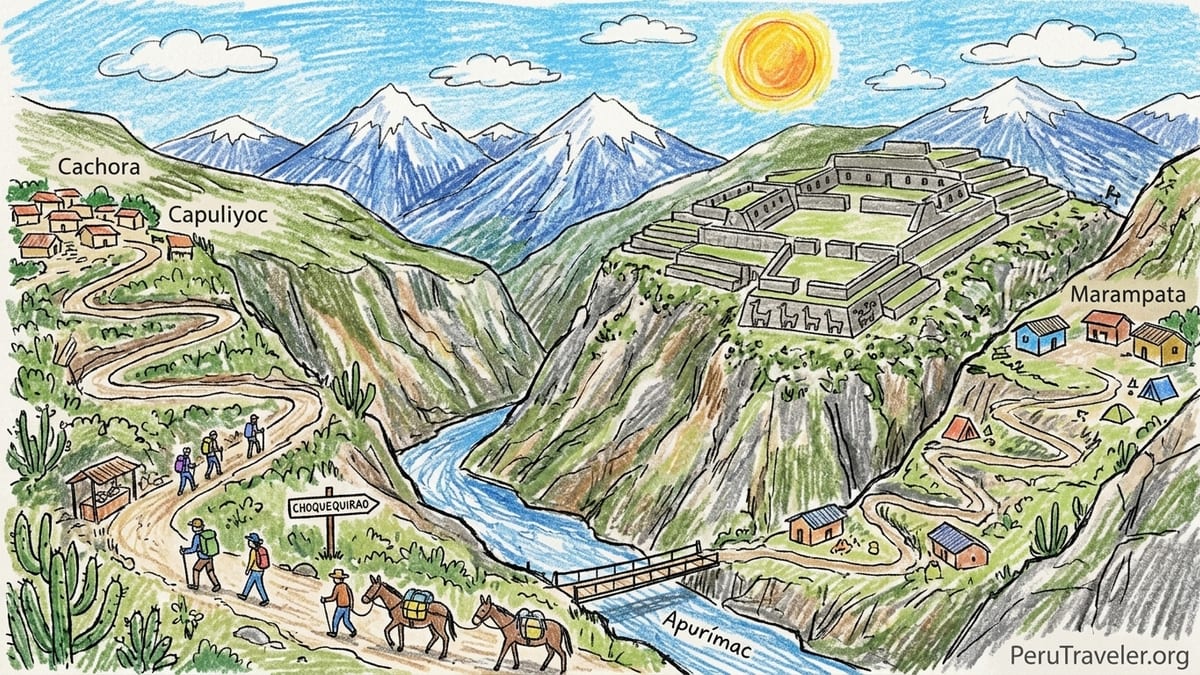
The standard way to reach Choquequirao still begins by road from Cusco to the village of Cachora and the nearby Capuliyoc trailhead, around four hours by private vehicle. From Capuliyoc you look straight into the Apurímac Canyon, with Choquequirao hidden on a shelf on the far side. The authorized “classic” trekking route follows a steep descent from Capuliyoc to the canyon floor, crosses the Apurímac River, then climbs relentlessly via Santa Rosa to the farming hamlet of Marampata and finally the archaeological park entrance.
In 2026, the key update for trekkers is that all approaches to Choquequirao were temporarily suspended from 1 February 2026 while regional authorities carried out maintenance and risk assessments after heavy rains. The main Capuliyoc to Cachora access was officially reopened from 15 April 2026 once landslides were stabilized and basic infrastructure repaired, allowing tour operators to resume the classic four and five-day itineraries on this section. Other, longer traverses that link Choquequirao with Huanipaca, Yanama or the Salkantay–Machu Picchu corridor have been subject to separate, sometimes changing approvals, so agencies have been advising clients that these extended routes require case-by-case confirmation and may not be available on short notice.
By October 2026, reputable Cusco agencies are again selling group and private treks along the Capuliyoc–Marampata–Choquequirao line, but the consistent message is to check close to departure whether any additional temporary closures have been imposed due to rockfall, bridge damage or wildfire risk. Independent hikers should do the same in person with the Dirección Desconcentrada de Cultura Cusco office or the nearest tourist information point in Cusco, and avoid assuming that online blogs from previous years reflect current conditions.
At the archaeological complex itself, visiting hours are generally aligned with other major Inca sites: roughly from early morning to late afternoon, with last entry well before sunset so that everyone can exit before dark. Tickets are controlled by Peru’s Ministry of Culture, and camping inside the core archaeological zone is not allowed. Travelers must sleep in designated campsites outside the ruins and respect park rules that prohibit climbing on walls, terraces and fragile structures, even when an area looks quiet or unguarded.
Understanding the Route: Elevation, Difficulty and Daily Stages
The attraction of Choquequirao is not only its isolation but the sheer effort that reaching it requires. From Cusco at about 3,400 meters, vehicles drop you to Capuliyoc at roughly 2,900 meters. From there, the trail tumbles more than 1,400 meters down into the Apurímac Canyon before rising again around 1,500 meters to Marampata. Because you reverse the same profile on the way back, the trek feels punishing in both directions, and many hikers consider it harder than the classic Inca Trail despite the shorter total distance.
On a typical first day, groups start hiking from Capuliyoc late morning, following a dusty path with sweeping canyon views. After a relatively gentle contour, the trail begins a long series of switchbacks dropping past small puestos where local families sell drinks and snacks. Many four and five-day itineraries spend the first night at Chiquisca campsite, perched on a sloping terrace with basic toilets and rustic dining shelters, or continue farther down to Playa Rosalina near the river if daylight and group fitness allow.
The second day is usually the most demanding. Leaving the warmth of the canyon floor near the Apurímac River, hikers face a sustained ascent to Santa Rosa and then to Marampata. This section is exposed for long stretches, with limited shade and a combination of packed dirt and rocky steps. Water can be purchased at a few homesteads, but many agencies also boil and filter water at lunch for clients to refill bottles. Late in the afternoon, as clouds build over the canyon, the path finally eases onto the Marampata plateau, where a cluster of basic guesthouses and campsites stretch along the ridge facing Choquequirao.
From Marampata it is typically two to three hours of undulating trail to the site entrance, then more walking inside the park to reach the various plazas and terraces. For a four-day itinerary, this means a long third day that includes the approach to Choquequirao, several hours of exploration and the return to Marampata or a nearby campsite, followed by a fourth day devoted entirely to retracing steps down to the river and back up to Capuliyoc. Even very fit hikers feel the cumulative strain, and many describe the final set of switchbacks up to Capuliyoc as an endurance test, especially under afternoon sun.
Four-Day vs Five-Day Itineraries from Cusco
Most agencies in Cusco now offer both four-day and five-day Choquequirao treks, often using very similar logistics but with a different pace. In a typical four-day program, day one runs from Cusco to Capuliyoc and down to Chiquisca, day two climbs from the canyon floor to Marampata, day three is dedicated to Choquequirao with a return to Chiquisca, and day four climbs back to Capuliyoc and returns by vehicle to Cusco. Daily walking times commonly fall in the seven to ten hour range, with long descents and ascents compressed into fewer days.
A five-day itinerary stretches the same profile into shorter stages and more time among the ruins. Many five-day group treks schedule day one from Cusco to Capuliyoc and on to Chiquisca, day two from Chiquisca to Marampata, day three as a full exploration day at Choquequirao with a night again in Marampata, day four descending to Chiquisca or another canyon campsite, and day five climbing back to Capuliyoc and driving to Cusco. Some premium operators even offer a second partial morning in the ruins on day four before hiking down, which can be attractive for archaeologically focused guests who want to linger in specific sectors.
In practical terms, this extra day can dramatically change the feel of the journey. On the four-day schedule, many travelers report reaching the main plaza of Choquequirao tired and acutely aware of the return hike still ahead. Photographers may rush their time at the far-flung llama terraces or upper ritual platforms to ensure they can hike back to Marampata in daylight. By contrast, a five-day schedule allows for unhurried circuits around the upper and lower plazas, time to rest quietly in the shade of the kallankas, and optional side hikes to viewpoints that look deep into the Apurímac Canyon. For anyone primarily interested in understanding Choquequirao as an archaeological site rather than simply “bagging” a tough trek, five days usually proves more satisfying.
There is also a safety aspect. Allowing five days reduces pressure on slower hikers, leaves more margin for altitude or stomach issues, and offers better odds of adjusting plans around afternoon thunderstorms that often roll up the canyon in the wet months. Guides have more flexibility to manage group energy, adjust campsites and respond to minor injuries without turning the schedule into a forced march.
Campsites, Mules, Water and On-Trail Comfort
Unlike the tightly regulated Inca Trail, the Choquequirao route remains more rustic. Most hikers sleep in tent camps run either by local families or by each tour operator’s logistics team. Common overnight points include Chiquisca, Playa Rosalina, Santa Rosa Baja or Alta and Marampata. Facilities range from simple toilets and basic cold showers to more developed family-run hostels in Marampata with roofed dining areas and a few private rooms. Some independent trekkers now choose to sleep in these rooms and keep tents as backup, though availability cannot be guaranteed in peak months.
Mule services are central to how the trail operates. Group treks from Cusco normally include pack animals that carry shared camping gear, kitchen equipment and often a 7 to 8 kilogram personal duffel per client. This allows participants to hike with a relatively light daypack containing water, extra layers, rain gear and snacks. For example, several midrange Cusco operators explicitly advertise the inclusion of mules and muleteers in their Choquequirao packages, while charging extra only if clients request a riding horse for part of the route. In Capuliyoc and Cachora, independent hikers can negotiate directly with local muleteers for transport of packs between campsites, usually on a per-day, per-animal basis paid in Peruvian soles.
Water is abundant in the canyon, but not always safe to drink untreated. Most organized tours boil and filter water at camps and lunch stops, refilling client bottles in the morning and at mid-day. Along the trail, small kiosks and farmhouses in places like Cocamasana, Chiquisca, Santa Rosa and Marampata sell bottled drinks and sometimes basic snacks, although prices rise as you get further from road access, and supplies can run out after busy groups pass through. Toilets at campsites are generally squat-style and can be rough, so carrying hand sanitizer, toilet paper and a small headlamp for night visits is essential.
Comfort on the path itself depends on sun exposure and insects. Much of the descent from Capuliyoc and the climb from the river is open to the sky, with limited tree cover. In the dry season, dust and reflected heat make sun hats, high-SPF sunscreen and a neck gaiter very useful. Mosquitoes and sandflies tend to be worst near the river and in some shaded sections; many trekkers wear light long sleeves and trousers rather than relying only on repellent. After dark, temperatures at canyon camps stay relatively mild compared with high Andean routes, but nights can still be cool and occasionally windy, so a sleeping bag rated roughly to freezing or slightly below remains advisable.
Inside Choquequirao: Open Areas, Rules and Archaeology Highlights
Choquequirao’s name is often translated as “Cradle of Gold,” and the site spreads across a broad ridge with terraces dropping steeply toward the Apurímac Canyon. Unlike Machu Picchu, which concentrates most structures in a compact saddle, Choquequirao’s ceremonial sectors, administrative buildings and agricultural terraces are scattered across several levels connected by steep staircases. For visitors, that means two things: you need time and you will keep climbing even after days of trekking to reach the park gate.
The heart of the complex is a pair of broad plazas surrounded by kallankas, storage buildings and minor enclosures. Guides often start visits here, using the main plaza to explain Choquequirao’s role in the late Inca period and its possible links with Vilcabamba and the resistance against Spanish rule. On clear days, the surrounding peaks form a dramatic amphitheater, and condors sometimes soar over the canyon below, emphasizing how strategically the Incas chose this perch.
One of Choquequirao’s most distinctive features are the famous llama terraces, a cluster of steep agricultural platforms whose stone retaining walls are inlaid with white-tone stones forming stylized llama figures. Reaching this sector involves a sustained descent from the main plaza area and then a return climb, which most visitors underestimate. As of 2026, tours report that the main sections of the plaza complex, several extensive terrace systems and the llama murals remain open to visitors, while more peripheral or unstable areas may be roped off or signed to prevent entry during ongoing conservation works. Where ropes or signs are present, walking beyond them or climbing on walls is forbidden, both for safety and to protect fragile masonry.
Official visiting hours are established by the Ministry of Culture and are typically set so that entry begins early in the morning and finishes in the mid-afternoon, with all visitors expected to exit before dusk when staff close the park. While exact times should be verified at the ticket control in Capuliyoc or with a reputable agency before departure, travelers should plan their Marampata departures to reach the gate not long after opening, which allows cooler exploration and better light for photography. Camping anywhere within the archaeological core is prohibited; instead, trekkers return to Marampata or nearby designated camping areas in the late afternoon. Eating meals on the structures, leaving trash, lighting fires or drones without explicit permission are all against regulations and can lead to fines or expulsion from the site.
Tours, Prices and What to Look For in 2026
As of late 2026, Choquequirao remains a niche product compared with the heavily marketed Inca Trail or Salkantay trek. This relative obscurity keeps group sizes moderate but also means that prices and inclusions vary widely between operators. In Cusco, you will see budget offers for four-day group treks starting around the equivalent of 260 to 320 US dollars per person for departures with a minimum number of participants, typically including transportation from Cusco to Capuliyoc and back, guide, camping gear, meals, mules and park entrance. More established or comfort-focused agencies commonly quote higher prices, often in the range of 450 to 700 dollars for four or five days depending on group size, equipment quality and level of service.
Private treks understandably cost more, but the per-person rate can fall significantly for families or small groups who fill most of the available spaces. For instance, a private five-day Choquequirao trek for a couple might run 800 to 1,000 dollars per person with a midrange Cusco operator, including roomy tents, thicker mattresses, a dedicated cook, and extra mules or horses to increase pack-animal capacity. High-end international adventure companies that market Choquequirao as part of a longer Peru itinerary often charge well above these local rates, bundling in upscale Cusco hotels, domestic flights and pre- and post-trek sightseeing.
When comparing operators, experienced trekkers emphasize looking beyond headline price and checking what is genuinely included. Key questions include whether the Choquequirao entrance fee is covered, what weight allowance is provided for personal duffels, whether sleeping bags are included or rented separately, and what meals look like in practice. Some agencies pride themselves on varied menus with fresh vegetables, hot breakfasts and daily snacks, while others provide simpler fare. It is also worth asking about first aid capabilities: competent Choquequirao guides typically carry an oxygen bottle for emergencies at higher points on the approach, a well-stocked first aid kit and radio or satellite communication for contacting support vehicles or local authorities.
Cancellation and change policies deserve attention as well, especially given the 2026 pattern of temporary trail suspensions. Some agencies offer date changes at no extra charge if closures are announced, while others retain non-refundable deposits even when conditions change. Reading the fine print or asking explicitly what happens if the trail closes again after booking can prevent disappointment. Travelers who prefer flexibility sometimes choose to arrange tours in person in Cusco a few days before departure, when short-term weather and access information is clearer, though that risks limited date choices in peak months from June to August.
Group Departures vs Private and Starting Near Cachora
Most visitors still book Choquequirao treks as round-trip packages from Cusco, where agencies bundle transport, guide services and gear. Group departures appeal to solo travelers and pairs who want to share costs and meet others, and departures generally include hotel pick-up, private minibus to Capuliyoc, mules, cook, tents and basic mattresses. Guides on these trips often work nearly back-to-back in peak season, gaining deep familiarity with trail conditions and the ruins but sometimes following a set script.
Private arrangements cater to trekkers wanting more control over pace and itinerary. A family or small group of friends might request an earlier start from Cusco to avoid heat on the descent, or ask for quieter campsites away from larger groups. Private trips also allow more tailored archaeological interpretation. For example, travelers particularly interested in Inca hydrology can request extra time exploring fountains and canals, while photographers might prioritize sunrise or late afternoon light in specific terraces or viewpoints.
There is also an emerging pattern of travelers arranging logistics closer to Cachora or Capuliyoc rather than in Cusco itself. A few local families run simple hospedajes and can connect hikers with muleteers, cooks and sometimes independent guides. This option can reduce costs for experienced Spanish-speaking trekkers who bring their own camping gear and food, but it requires more planning and flexibility, especially in 2026 when authorities have occasionally tightened controls on who can guide within the archaeological park. Anyone choosing this route should be comfortable negotiating prices in soles, checking that muleteers understand daily stage plans and confirming whether their presence satisfies any current park regulations regarding guided access.
Independent hikers who go entirely without guides remain a minority but share similar advice: travel with updated maps or GPS tracks, anticipate hot and exposed climbs, and ensure that someone in Capuliyoc or Cachora knows your route and expected return day. Even when not hiring a full package, paying local muleteers to carry part of the load not only supports the community but also reduces physical strain on the steepest sections.
The Takeaway
For travelers who care more about remote archaeology and physical challenge than polished infrastructure, the Choquequirao trek remains one of South America’s most compelling journeys. In 2026, the reopening of the Capuliyoc–Cachora approach after the February suspension has reaffirmed the classic four and five-day itineraries as the most reliable options, while longer traverses that link Choquequirao to other valleys still demand careful verification and flexible expectations. The essential character of the route, with its brutal descents and ascents bracketing a sublime ridge-top citadel, has not changed.
Choosing between a four and a five-day itinerary ultimately comes down to priorities and fitness. A four-day trek may suit strong hikers on tight schedules who are comfortable with multiple long days and are happy with a focused, shorter visit to the ruins. The five-day version fits those who want more breathing room on the trail and more time wandering through plazas, terraces and llama mosaics without watching the clock. For archaeology-focused travelers, the extra day usually feels like an investment rather than a luxury; for serious hikers, it becomes a way to savor the canyon environment instead of simply enduring it.
In terms of budget, a realistic all-in cost from Cusco for 2026 begins around the high 200s to low 300s US dollars per person for the simplest group offers sold in Spanish, climbs into the 400 to 700 dollar range for more established agencies with stronger logistics and English-speaking guides, and can reach significantly higher for custom or international packages with added hotel nights and broader itineraries. To that, travelers should add personal gear purchases or rentals, tips for guides and muleteers, meals in Cusco and any extra nights in the region before or after the trek.
The best season remains the dry months from roughly May to September, when river levels are lower, trails are more stable and skies clearer. Shoulder months such as April and October can offer greener hillsides and fewer people but carry a higher chance of afternoon showers or localized washouts, which in 2026 have already prompted temporary closures. Anyone planning a trek should monitor weather forecasts shortly before departure and reconfirm with their tour operator that the Capuliyoc–Marampata route to Choquequirao is fully open.
Whether the Choquequirao trek is right for you depends less on labels like “archaeology fan” or “serious hiker” and more on your willingness to combine both identities for several days. To appreciate Choquequirao fully you must accept the physical challenge of long climbs and descents, while those drawn mainly to the trekking aspect will find that the ruins give their effort a narrative and cultural anchor. If that blend appeals, and you are ready to adapt to evolving 2026 access rules and rustic conditions, Choquequirao offers something increasingly rare in the Andes: a major Inca site that still has to be earned, step by step.
FAQ
Q1. Is the Choquequirao trek open in 2026 after the February closure?
The Capuliyoc–Cachora access used for the classic four and five-day treks reopened from mid-April 2026 after maintenance, but longer connecting routes toward Huanipaca or the Salkantay area continue to be reviewed separately, so all hikers should reconfirm exact trail sections with a reputable operator or local authority before committing to dates.
Q2. How difficult is the Choquequirao trek compared with the Inca Trail?
Many experienced trekkers find Choquequirao harder because the trail drops more than a thousand meters into the Apurímac Canyon and then climbs a similar amount on the far side, and you repeat much of that profile on the way back, which creates steeper, longer ascents and descents than the classic Inca Trail despite the shorter duration.
Q3. Do I really need five days, or is four enough?
Four days work for fit hikers who are comfortable with long days and a relatively fast visit to the ruins, while five days spread the effort, provide extra time inside Choquequirao itself and offer more margin for weather, photography and rest, which most archaeology-focused travelers and moderate trekkers appreciate.
Q4. What are realistic prices for a Choquequirao trek from Cusco in 2026?
In Cusco, simple Spanish-language group tours for four days start at roughly the high 200s to low 300s US dollars per person including basic camping, mules and entrance, midrange operators commonly quote between about 450 and 700 dollars depending on group size and length, and private or international packages can cost more, especially when combined with hotels and other excursions.
Q5. Can I trek to Choquequirao without a guide?
Experienced hikers do occasionally walk the Capuliyoc–Marampata–Choquequirao route independently, arranging muleteers and simple lodging directly in Capuliyoc or Marampata, but they still need to respect park rules, carry appropriate gear and check in Cusco that independent access is currently permitted, since regulations and safety advisories can change.
Q6. Are mules included in tours, and can I ride a horse if I get tired?
Most organized treks include pack mules to carry camping equipment and a limited amount of personal gear, while riding horses, when available, are usually hired at extra cost for specific steep sections; independent trekkers can negotiate separate pack-animal services with local muleteers in Capuliyoc or Cachora using cash in local currency.
Q7. What facilities exist at campsites on the Choquequirao trek?
Campsites such as Chiquisca, Playa Rosalina, Santa Rosa and Marampata typically offer level tent areas, simple toilets and basic showers, sometimes with roofed dining spaces or family-run kitchens, but they remain rustic, so hikers should not expect the structured infrastructure of the Inca Trail and should bring headlamps, personal hygiene items and warm sleeping gear.
Q8. Which parts of the Choquequirao ruins are usually open to visitors?
Under current conditions, visitors can generally explore the main plazas, surrounding structures, several extensive terraces and the famous llama-figure terraces, while some peripheral or unstable sectors may be closed or roped off during conservation works, so local guides lead routes that focus on areas officially cleared for public access at the time of your visit.
Q9. When is the best time of year to hike to Choquequirao?
The ideal period is the Southern Hemisphere dry season from about May to September, when trails are more stable and skies clearer; April and October can also be rewarding but carry increased risk of showers and trail damage, so anyone trekking in shoulder months should pay extra attention to updated access information.
Q10. Is the Choquequirao trek better for archaeology lovers or serious hikers?
The trek suits both, but only if travelers are open to combining interests: archaeology enthusiasts must be prepared for steep, sustained hiking to appreciate the site, while strong hikers who choose Choquequirao over more famous routes generally do so because the remote Inca city gives their physical effort a focused historical and cultural reward.