


In 2026 I finally did what so many travelers to Huaraz talk about but rarely manage to fit into one short trip: I visited both Laguna 69 and Laguna Parón under almost identical conditions, within the same clear October weather window, using legal transport and agencies operating with current SERNANP rules. I booked real tours, paid the latest park fees, sweated through the climbs and clocked the actual minutes I spent at the water’s edge. What I discovered is that the two most famous high lakes of the Cordillera Blanca are far more different in transport, effort and experience than their equally spectacular photos suggest.
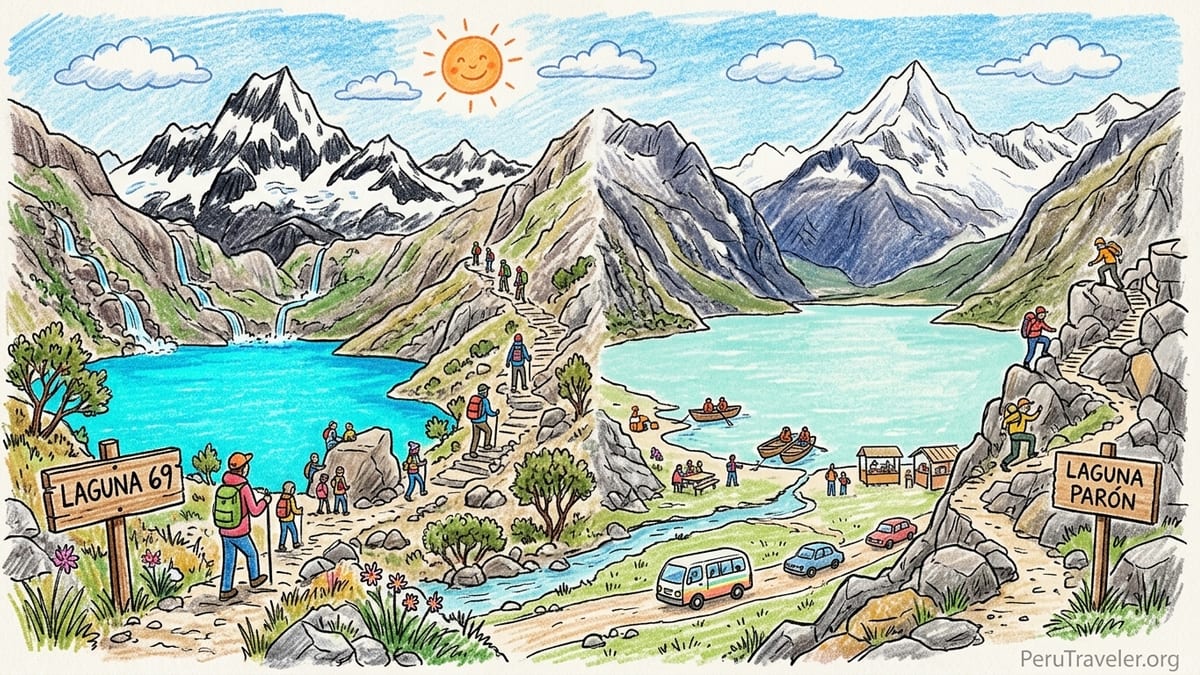
How I Booked Both Lakes and What It Really Cost in 2026
To compare Laguna 69 and Laguna Parón fairly, I started the same way most travelers do: walking into agencies around the Plaza de Armas in Huaraz and cross checking what they offered against current information from Huascarán National Park and recent travelers. In October 2026, agencies were very consistent about one key point. Laguna 69 visits must now be run through authorized tour operators that coordinate with SERNANP and the park guards at Llanganuco. Independent drivers were openly telling people to book a tour instead of trying to improvise their own transport, because rangers have intensified checks on unofficial vehicles entering this part of the park.
For Laguna 69 I chose a standard group hike with a midrange operator rather than the absolute cheapest kiosk, to make sure they were on SERNANP’s current list. The group service including transport from Huaraz, a basic guide and oxygen in the bus was quoted between 160 and 190 soles per person in town, which roughly matches online group offers around 40 to 50 US dollars without lunch. Park admission for Huascarán National Park was separate and paid in cash at the control point. In 2026 that meant 30 soles for foreign visitors and 12 soles for Peruvian nationals for a one day entry.
For Laguna Parón the picture was more mixed. A few years ago some operators had stopped running regular tours because of community disputes and road issues, and travelers on forums described the destination as complicated or “possibly illegal” to visit. By late 2026, however, Huaraz agencies were again selling daily group trips on normal tourist buses or minibuses. Full day Parón tours from Huaraz generally cost 100 to 130 soles per person, not including food or boating. Huascarán National Park fees were again charged separately at the control gate on the road, with the same day rate of about 30 soles for foreigners and a lower rate for Peruvians.
For this article I also priced private trips. A private car with driver from Huaraz to Laguna 69, waiting and return, was usually quoted at 450 to 550 soles for up to four people, plus the same park fee per person. A similar private service to Laguna Parón cost slightly less, around 380 to 450 soles, but there were warnings that drivers had to comply with local community rules on the road and park at designated areas near the dam. In both cases, guides were extra. An officially certified hiking guide for Laguna 69 added roughly 250 to 350 soles for the group, while an accredited local guide to walk around Laguna Parón’s mirador trails was offered closer to 200 soles.
Starting From Huaraz: Early Alarms and Long Roads
Laguna 69 demands an unglamorous start. The group bus collected me in Huaraz between 4:50 and 5:20 a.m. depending on the hotel order, with everyone half awake and bundled in down jackets. The drive north up the Callejón de Huaylas is impressively scenic but also long. With a brief breakfast stop near Yungay in a roadside comedor, then the slow climb on the paved road into Quebrada Llanganuco, the total one way journey took just over three hours. We reached the Cebollapampa trailhead, at around 3,900 meters, slightly after 8:30 a.m. and the guide hustled us out quickly to make sure there was enough time for the ascent and descent.
The return from Laguna 69 was even more punishing on tired legs. We left the lake at about 1:30 p.m., reached the trailhead around 3:45 p.m. and then sat through another three hour ride down the valley and back to Huaraz. Between picking up people, the breakfast break and an afternoon toilet stop, my total door to door time was around 13.5 hours. Out of that, roughly six hours were spent in a vehicle.
Laguna Parón started more gently. The group tour picked up passengers between 6:00 and 6:45 a.m., which gave me a more human wake up time and allowed for a quick hotel breakfast. The bus followed the same main valley road north, but continued further to Caraz before turning east. Agencies typically describe the road from Caraz to the lake as “carrozable” or drivable but unpaved. In October 2026 that description was accurate. It was a long, narrow dirt road with some washboard sections and exposure to drops, but our experienced driver and the local traffic rules, including mandatory passing zones, made me feel more alert than anxious.
From central Huaraz to Laguna Parón’s parking area took about 3 hours 45 minutes with one or two short photo stops. On the return it was similar, although afternoon road works and oncoming trucks from the hydroelectric facilities occasionally forced us to wait. The entire Parón day ran from shortly after 6 a.m. to around 6:15 p.m., so it was also a full 12 hour excursion, but with more lake time and marginally less intense hiking in the middle.
Laguna 69: The Ascent, Exhaustion and That First Turquoise Shock
The hike to Laguna 69 is where its reputation is earned. From Cebollapampa the official signs indicate an elevation gain of approximately 800 meters to the lake at around 4,600 meters. The guide gave the group four hours to reach the top and two and a half to descend. The first hour of the trail eased us into the day along a relatively gentle valley path beside a river, crossing grassy meadows, low bushes and scattered quenual trees. Morning shadows kept the temperature cool and the walls of the valley channeled the first views of snow on the surrounding peaks.
Soon after the valley section ended, the trail tilted uphill and our bus chatter disappeared. A long, steady climb through a series of switchbacks brought us past roaring waterfalls that plunged from hanging glaciers above. At this point we were working hard but still near the treeline, weaving between small polylepis trees and stepping over rocky water crossings. Many people, including strong young travelers, were breathing heavily and using the frequent photo pauses to recover. The guide kept a slow, steady rhythm but gently reminded those lagging far behind about the turnaround time.
The final section of the ascent is what breaks people. After a short plateau that tricks you into thinking the worst is over, the path rears up into a last steep climb across loose stones and uneven rock steps. The lake remains hidden until almost the last minute. At this stage the combination of altitude and gradient had my legs burning and my heart pounding, even though I had already spent several days acclimatizing with lower hikes like Laguna Churup. A couple of hikers from our group chose to stop at the last mirador and skip the uppermost zigzags, content with distant views and concerned about making it down safely.
When the path finally crested the final rise, the payoff felt almost unreal. Laguna 69 appeared abruptly below the wall of Chacraraju, an almost impossibly bright turquoise pool backed by gray rock and hanging ice. Small waterfalls fed the lake from the glacier above, and every gust of wind shifted the reflections on the surface. But this drama came with crowds. In peak dry season agencies send several buses a day, and even in October there were at least 70 people spread around the shore when I arrived, competing for the famous rock outcrop photo. Toilet facilities were limited to a basic block near the start of the trail at Cebollapampa, and there were no services at the lake itself.
Laguna Parón: Road Access, Rules and Real Effort on the Rocks
Historically Laguna Parón has had a more complicated relationship with access, in part because it serves both as a tourist attraction and a reservoir connected to hydroelectric infrastructure. Several years of disputes between the local community, authorities and concessionaires fueled rumors that the lake was “closed” or that visiting was illegal. By October 2026, however, SERNANP and local operators were clear that Parón was officially open for tourism, but under stricter controls. Buses and private vehicles were required to check in at a control point before the end of the road, drivers had to obey community speed limits and parking was only allowed in designated zones near the dam and refuge area.
The asphalt ends shortly after Caraz, and from then on the road into Quebrada Parón is entirely dirt. The quality in 2026 was passable in dry conditions but would be rough in heavy rain, with some exposed drops and narrow switchbacks. I was glad to be in a tour minibus whose driver ran the route most days rather than in a rental car. SERNANP staff at the control not only charged the park fee, they also reiterated that off road driving near the shore was prohibited, drones required special permission and swimming in the reservoir was discouraged for safety reasons.
Unlike Laguna 69, you reach Parón by vehicle. Stepping out of the bus, the first impression was the sheer size of the lake and the high white walls surrounding it. The water was a softer, milky turquoise compared to the electric blue of Laguna 69, reflecting the suspended glacial flour in this larger body of water. From the shore the iconic view, with Artesonraju and Pirámide Garcilaso behind the lake, was already impressive but partially obscured by the angle and foreground rocks, which is why so many visitors head for the mirador.
The mirador hike is where people underestimate Parón. The ascent is shorter than Laguna 69, but it starts immediately from 4,185 meters and climbs steeply on a rocky path right above the lake. The most photographed viewpoint sits on a pile of boulders reached by a faint trail between large rocks with exposure on one side. Our guide made it clear that this section was optional and not recommended for anyone with vertigo, children or people struggling with balance. I took my time, using hands and feet, and saw several independent visitors decide that the final scramble felt too risky and stop at a lower vantage point. Compared with the long grind of Laguna 69, the effort here was more about balance and comfort with heights than pure cardiovascular endurance.
Comparing Water Color, Scenery, Crowds and Time at the Shore
Both lakes are famous online for intense turquoise water, but in person the color and mood felt very different. Laguna 69’s water was a sharp, almost neon blue under the midday sun, with a relatively small, enclosed bowl beneath Chacraraju’s jagged face. The scale is intimate; you can walk around a good portion of the shore in 15 to 20 minutes and always feel close to the dramatic glacier above. There were frequent small avalanches across the valley, sending ice dust down the face, and the waterfalls feeding the lake were close enough to hear clearly.
Laguna Parón, in contrast, felt vast. The lake stretches along the valley, with the classic postcard composition visible only from the higher mirador. The color was a gentler, pastel turquoise with milky tones, especially visible near the shore where small stones vanished a short distance below the surface. Motorized boating had been tightly restricted, and only a few rowboats with life jackets operated under park supervision close to the shore when I visited. This kept the water relatively calm and preserved more of the high mountain stillness than I expected.
In terms of crowds, Laguna 69 still felt busier, especially at the peak midday window when almost all groups converge on the shore between about 11 a.m. and 1:30 p.m. The small beach area near the outlet stream was lined with hikers eating packed lunches, and the famous rock promontory often had a queue for photos. At Laguna Parón there were also several tour buses, but the experience diffused more. Some people stayed by the lakeside café and picnic tables, others rented boats, and those who felt strong enough set off for the mirador. Because the shore is easily accessible, families with children and older travelers were more visible here.
The biggest experiential difference was the ratio between effort and lake time. On my Laguna 69 day I spent about two hours and fifteen minutes at the lake itself, sandwiched between nearly four hours of ascent and descent hiking. At Laguna Parón I had close to three and a half hours in the vicinity of the lake, split between a leisurely hour on the shore, about 75 minutes for the mirador hike and time for a simple hot lunch near the parking area. Photographers, in particular, have more freedom at Parón to wait for shifting light or clouds without worrying about a strict turnaround time for a steep descent.
Facilities, Food, Toilets and Practical Comforts
Neither lagoon visit could be described as luxurious, but the comfort level differed noticeably. On the Laguna 69 tour, breakfast was not included. The bus stopped in a small settlement near Yungay where simple restaurants offered eggs, bread, coffee and coca tea for 15 to 25 soles. After that there were no formal food options. All hikers were expected to carry their own packed lunches, snacks and at least two liters of water. The only toilets were basic facilities near the Cebollapampa trailhead, often with a small local fee, and there was no running water or toilet at the lake itself. Trash collection depended entirely on visitors packing out what they brought.
On the Laguna Parón day, facilities were marginally better. After a short coffee stop in Carhuaz, we continued to Caraz where it was possible to buy last minute snacks and water. Near the lake itself, a small refuge and simple local stalls sold instant noodles, basic hot dishes, sweets and drinks at understandable mark ups. There were functioning toilets near the parking area, and while not modern, they were cleaner than the trailhead toilets at Cebollapampa on the day I visited. These small comforts mattered more than I expected after several hours on a rough dirt road.
On the cost side, I deliberately tracked the extras. For Laguna 69, beyond the 170 soles I paid for the tour and the 30 soles park fee, breakfast and extra water came to another 30 soles, bringing my actual day total to roughly 230 soles. For Laguna Parón, the 120 soles tour plus 30 soles park fee looked similar on paper, but with coffee, a simple lakeside lunch and a half hour rowboat rental at the shore, I spent closer to 260 soles. Private options would amplify these differences, but in both cases the headline tour price did not represent the full spend once food and lake activities were included.
It is worth noting that both lakes sit above 4,000 meters and carry real altitude and weather risks. On Laguna 69 the combination of effort and elevation made this impossible to ignore. Several hikers turned back early due to headaches, nausea or breathing difficulty. On Parón, the road access makes it feel like an easier day, but I met a couple in their sixties who reported dizziness and shortness of breath after only ten minutes on the mirador trail, despite having felt fine beside the shore. Neither destination should be treated like a low altitude picnic.
Was Laguna 69 More Rewarding or Simply More Exhausting?
Before arriving in Huaraz I half expected Laguna 69 to be the obvious “winner” for drama and achievement. Online images show that electric blue water and the wall of Chacraraju in almost unreal clarity, and many hikers talk about it as a must do rite of passage. After actually climbing it, I did feel a deep satisfaction at reaching the shore and watching the shadow of the mountain slide across the lake. The physical ordeal made the first sight of that perfect bowl of water feel earned, almost like a summit. My legs ached for two days afterwards, but the sense of accomplishment was real.
However, there were also moments when the day verged on type two fun. The final steep section was crowded, with people negotiating narrow rocky steps in both directions. A couple of groups pushed themselves to the point of stumbling heavily on the descent, which is when ankle injuries become more likely. The strict turnaround times imposed by guides, necessary for safety and park regulations, meant that those moving more slowly had less time to rest at the lake and barely ten or fifteen minutes for photos before being urged to start down again. For less acclimatized travelers, Laguna 69 risked becoming more about suffering than scenery.
Laguna Parón, in contrast, felt like a day with a wider range of possible experiences. The lake itself was accessible enough that people could enjoy postcard level views from the shore with almost no hiking, yet those wanting a challenge could climb toward the mirador and test their comfort with exposure on the rocks. For me, the scramble above the lake added just enough adrenaline without feeling reckless, especially with a guide pointing out safer lines. Because the total walking time was shorter and the steepest parts were optional, I came back tired but not destroyed.
Surprisingly, when I looked back on both days a week later, my emotional highlight was not the hardest moment on Laguna 69 but a quieter stretch above Laguna Parón, sitting on a rock between boulders watching clouds wrap and unwrap Artesonraju. That said, hikers who relish long, strenuous climbs at altitude and want a full body test will probably find Laguna 69 more satisfying. For them, the exhaustion is inseparable from the reward, and reaching that little turquoise bowl at 4,600 meters will sit high on the list of Andean achievements.
What I Expected vs What Each Journey Required
Going in, my expectation was simple. Laguna 69 would be the big, epic high altitude trek that justified two or three days of acclimatization beforehand. Laguna Parón, reached by road, would be the comparatively relaxed option for a recovery day with beautiful views and minimal physical stress. The reality was much more nuanced, and recognizing that difference is vital for anyone planning just one or two lake days around Huaraz.
Laguna 69 required significant preparation. I needed at least two prior days above 3,500 meters, good hiking boots, layers for cold wind at the lake, sunscreen, 2 to 3 liters of water, trekking poles and the psychological commitment to walk uphill for three hours at altitude. The logistics also meant accepting a very early start and late return with limited food options. In exchange, I gained an intense, focused experience dominated by hiking effort, thin air and a dramatic but compact amphitheater of rock, ice and water.
Laguna Parón demanded a different kind of readiness. There was more time sitting in a vehicle and less strict structure once at the lake. The main requirements were tolerance for bumpy dirt roads and the self awareness to decide how far up the mirador route felt safe. It also required paying attention to updated rules at the lake, from where boats could operate to which trails were open, because local and national authorities have adjusted access in recent years to balance tourism, safety and the reservoir’s functional role. Mentally, it felt less like a test and more like a flexible high mountain outing.
In hindsight, I underestimated how serious altitude remains at Parón. The ability to step off a bus at more than 4,000 meters, stroll to the shore and drink a hot chocolate can create a false sense of security. Watching several visitors, including a family with teenagers, struggle on the rocky mirador path reminded me that even “easy” options in the Cordillera Blanca are not walks in the city park. For planners, the takeaway is clear. Laguna 69 is undeniably harder, but Laguna Parón still requires respect, acclimatization and realistic expectations.
The Takeaway: Money Spent, Views Earned and Which Lake I Would Return To
When I added everything up, my Laguna 69 group day from Huaraz cost about 230 soles including transport, guide, park fee and meals I bought myself. Laguna Parón cost slightly more in total, around 260 soles, once food, park fee and a short rowboat trip were counted. A private excursion to either lake for two people would push those numbers closer to 800 or 900 soles once driver, park tickets and an optional guide were factored in, with Parón usually coming out a little cheaper. In other words, from a budget perspective, neither destination is dramatically more expensive, especially if you stick to group tours sold in town.
In terms of sheer view quality, Laguna 69 gave me the single most intense moment. Cresting the final rise and seeing that compact, neon turquoise pool beneath the knife edge of Chacraraju is something I will remember long after my legs forget the climb. Laguna Parón, on the other hand, delivered a broader, more cinematic panorama from the mirador, with Artesonraju’s pyramid framed above the pastel lake. If I were choosing purely based on one postcard angle, I might give Laguna Parón a very slight edge for composition and the feeling of scale.
The disappointments were revealing. At Laguna 69 it was the sense of being rushed and crowded at the lake after investing so much effort. I would have loved another 45 minutes just to sit quietly, but the tour model and long return drive made that unrealistic. At Laguna Parón, the main letdown was the reality of the mirador route’s exposure for less confident walkers and the slightly messy lakeshore near the parking area, where informal food stalls, parked vehicles and scattered trash undercut the wild mountain setting.
So which lake would I personally return to if I had the chance to repeat only one? From a writer’s and hiker’s perspective, I would go back to Laguna Parón. The mix of options around the lake, the opportunity to play with different vantage points over several hours and the relative gentleness on my body all contribute to that choice. Laguna 69 feels like a one time pilgrimage, a demanding and beautiful badge of honor. Laguna Parón feels like a place I could revisit in different seasons, at different times of day and perhaps even with friends or family who have varying fitness levels.
For photographers, Laguna Parón is the stronger choice overall. The wide lake, shifting clouds around multiple peaks and flexibility to move between shore, mirador and boats make it easier to experiment with compositions and wait for changing light without racing the clock. Serious landscape photographers with excellent fitness will also love Laguna 69’s sculpted bowl and the textures of its surrounding cliffs, but they should understand that tour schedules and limited lakeside space will restrict tripod time.
Families and older visitors are better served by Laguna Parón, provided everyone is acclimatized and honest about their limits on the rocky paths above the lake. Parents can enjoy shore views, short walks and possibly a supervised boat ride while fitter members of the group tackle part of the mirador route. Laguna 69’s sustained climb, lack of facilities and strict timing make it unsuitable for young children and a serious challenge for many older travelers, especially those with knee, heart or respiratory issues.
Experienced hikers looking for a demanding high altitude day will still find Laguna 69 the more rewarding target. The long ascent and descent provide a sense of progression and accomplishment that Parón cannot match from a purely athletic perspective. Those same hikers might then choose Parón as a more relaxed follow up day, enjoying scenery without another exhausting climb. For travelers who have only one full excursion day from Huaraz and are reasonably fit but not enthusiastic about suffering, my honest recommendation is Laguna Parón. It delivers enormous scenery, high mountain atmosphere and meaningful but manageable walking, while keeping altitude stress and logistic rigidity a notch lower than its famous sibling.
FAQ
Q1. Is Laguna 69 currently open and do I need to go with an authorized agency?
Laguna 69 was open during my October 2026 visit, but access was controlled through Huascarán National Park and tour operators authorized to run transport to the Cebollapampa trailhead. Independent vehicles faced more checks at the park gates and some drivers reported being turned around if they lacked proper permissions or insurance. For practical purposes, joining an authorized group or hiring a registered operator with park approval was the simplest legal way to visit.
Q2. What about Laguna Parón, has the road access issue in 2026 been resolved?
By late 2026 Laguna Parón was again being visited regularly by group tours and private drivers who complied with SERNANP and local community rules. The dirt road from Caraz remained narrow and rough in places, but it was open for tourism, with a control point where park staff collected entrance fees and reminded drivers of parking and speed restrictions. Access conditions can change, so travelers should confirm the latest situation in Huaraz before booking.
Q3. How long are the drives from Huaraz to Laguna 69 and Laguna Parón?
The group bus from Huaraz to the Laguna 69 trailhead at Cebollapampa took a little over three hours each way, including a breakfast stop and park control procedures. The trip to Laguna Parón, continuing further north before climbing the dirt road from Caraz, was slightly longer at around three and a half hours each way, depending on traffic, road works and short photo breaks. Both are full day outings with significant time spent in vehicles.
Q4. How difficult is the hike to Laguna 69 compared with the mirador at Laguna Parón?
The Laguna 69 trek is a sustained, high altitude hike with about 800 meters of ascent from roughly 3,900 to 4,600 meters, taking most groups three hours up and two and a half down. The mirador trail at Laguna Parón starts higher, around 4,185 meters, but climbs a shorter distance in a steeper, rockier burst above the lake, with some exposed sections that feel more like scrambling. Laguna 69 is more demanding in overall effort and endurance, while Parón’s challenge is concentrated in balance, footing and comfort with heights.
Q5. Can children and older travelers visit either lake safely?
Children and older visitors can enjoy Laguna Parón more safely than Laguna 69, especially if they limit themselves to the lakeshore paths and avoid the steeper mirador scramble. The altitude still requires prior acclimatization and monitoring for symptoms like headaches or dizziness. Laguna 69’s long, steep trail and strict turnaround times make it a poor choice for young kids or travelers with mobility limitations, heart conditions or respiratory issues.
Q6. What are the approximate 2026 costs for group tours to each lake?
In 2026 typical group tours sold in Huaraz cost about 160 to 190 soles per person for Laguna 69 and 100 to 130 soles per person for Laguna Parón, excluding food. In both cases, Huascarán National Park entry was an extra charge at the control point, around 30 soles for foreign visitors with lower rates for Peruvians. Meals, snacks and any boat rentals at Parón were additional out of pocket expenses.
Q7. How much time do you actually spend beside each lake?
On my Laguna 69 day I spent just over two hours at the shore between the arrival time and the guide’s turnaround deadline, which had to allow for a safe descent. On Laguna Parón, I had roughly three and a half hours in the lake area, including time at the shore, a hike to the mirador and a hot lunch near the parking area. Tour timings vary slightly, but Parón generally offers more unstructured time by the water.
Q8. Which lake is better for photography?
Laguna 69 provides a single, powerful composition of intense turquoise water tucked directly beneath the face of Chacraraju, best captured around midday when the bowl is fully lit. Laguna Parón offers greater variety for photographers, with wide angles from the shore, higher perspectives from the mirador and subtle changes in light across a larger surface. It is also easier to linger at Parón for different light conditions without being rushed by hiking schedules.
Q9. Do I need to be acclimatized before visiting these lakes?
Yes, both lakes sit above 4,000 meters and require acclimatization. Spending at least two nights in Huaraz and doing one or two lower hikes, such as viewpoints or shorter lakes around 4,000 meters, reduces the risk of altitude sickness. Even with acclimatization, travelers should hydrate, eat lightly, avoid alcohol and be prepared to turn back if symptoms worsen.
Q10. If I only have one day trip from Huaraz, which lake should I choose?
If you are an experienced hiker, already acclimatized and motivated by a hard, rewarding climb, Laguna 69 is a powerful single day objective. If you want big scenery with more flexibility, slightly more comfort and the option to scale the effort up or down, Laguna Parón is the better choice. For mixed groups, families or travelers unsure about how they handle altitude, I recommend Laguna Parón as the more forgiving and versatile one day excursion.