

When I first planned a trekking trip to the Peruvian Andes, everyone in Huaraz had an opinion. “Do Santa Cruz to warm up, then Huayhuash if you are serious,” one guide told me. So in June 2026 I did exactly that, hiking the classic 4 day / 3 night Santa Cruz Trek in the Cordillera Blanca, then the 10 day Huayhuash Circuit in the neighboring Cordillera Huayhuash with two different but comparable Huaraz operators. What follows is not a brochure pitch but a ground level, wallet aware comparison of which trek actually felt worth the money, the effort and the time away from work.
Trip Details: Dates, Routes, Operators and What I Paid
I completed the Santa Cruz Trek from June 8 to June 11, 2026, walking the standard west to east route from Cashapampa to Vaquería over Punta Unión, then taking the road back to Huaraz. One week later, from June 15 to June 24, 2026, I hiked a 10 day Huayhuash Circuit starting and ending near Llamac, moving counterclockwise with the classic camps at Carhuacocha and Jahuacocha and a series of high passes that stayed around or above 4,700 meters most days.
To keep the comparison fair, I booked both treks with mid range Huaraz agencies that advertised similar service levels: licensed UIAGM or IFMGA affiliated trekking guides, a dedicated cook, mule support, tent and kitchen gear included, and group departures capped at 8 clients. For Santa Cruz I joined a mixed group departure with a local company in Huaraz at the lower end of the international price spectrum. For Huayhuash, I joined a scheduled 10 day group circuit with another Huaraz based operator whose services and equipment quality felt broadly comparable on the ground.
For the 4 day Santa Cruz Trek I paid the equivalent of about 170 US dollars booked directly in Huaraz, in line with current offers of around 660 soles for a 4 day group trek including transport, guide, meals, tents and mules. That price did not include the Huascarán National Park entrance fee, my sleeping bag rental or trekking poles. For the 10 day Huayhuash Circuit I paid just under 900 US dollars, similar to other full service group departures that currently quote around 800 to 1,200 dollars for 10 days with guide, cook, mules, tents, meals and community fees bundled into the package.
On Santa Cruz our group size was 7 clients plus one guide, a cook and two muleteers with six donkeys. On Huayhuash we were 6 clients plus one guide, one assistant guide, a cook and three muleteers with nine donkeys. In both cases I rented a cold rated down sleeping bag and extra thick sleeping mat in Huaraz and brought my own trekking poles from home. The similar support levels and relatively small groups made differences in landscape, difficulty and total cost quite clear.
Landscape: Santa Cruz Valleys vs Huayhuash Turquoise Lakes
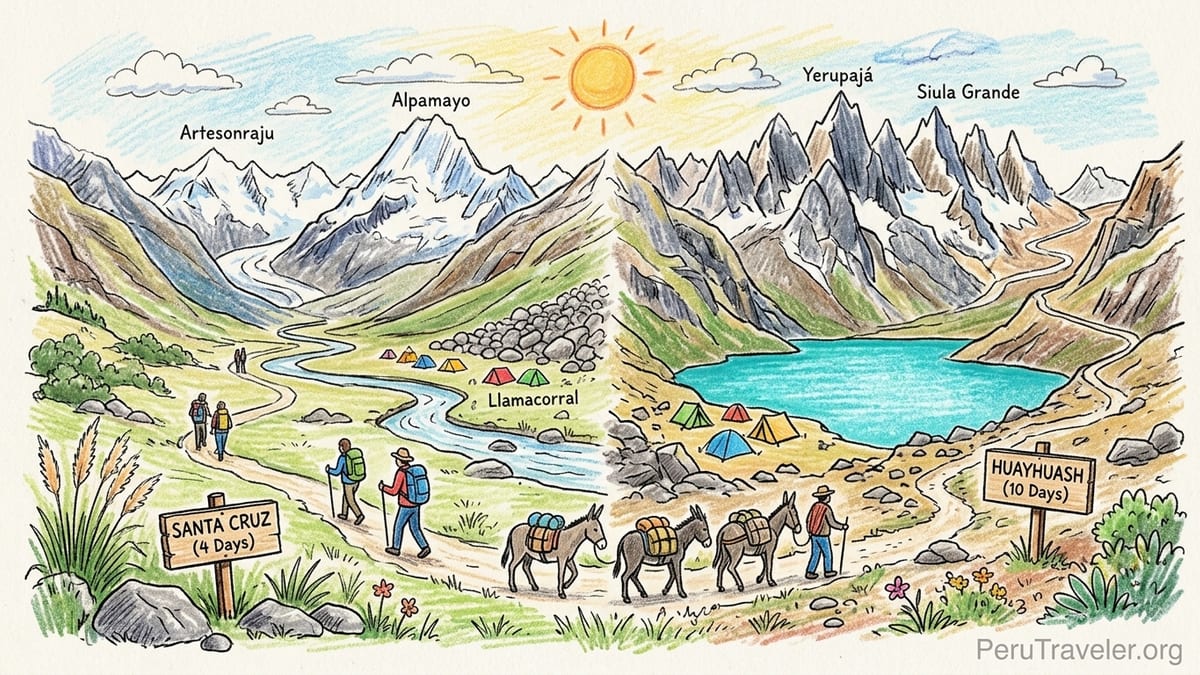
Santa Cruz is often described as a “mini Cordillera Blanca.” That is accurate in the best possible way. From the first afternoon climbing out of Cashapampa’s canyon into the broad Santa Cruz valley to the final views from Punta Unión, the landscape is clean and legible. You follow a glacial U shaped valley, camp at Llamacorral beside the river at about 3,800 meters, then move toward Taullipampa with views of peaks like Artesonraju and Alpamayo on clear days. The high point is Punta Unión Pass around 4,750 meters, a stone notch between valleys that gives classic postcard views back across turquoise Laguna Taullicocha and the line of white peaks.
Huayhuash felt very different from the moment we left the last road. The Cordillera Huayhuash is smaller in area than the Cordillera Blanca but more compact and serrated, with narrower valleys and higher average passes. Instead of one main glacial valley, the circuit circles an entire mountain chain. Our second camp at Carhuacocha, around 4,150 meters, might be the single most beautiful campsite I have used in the Andes, with the turquoise lake in the foreground and the sharp faces of Yerupajá, Siula Grande and Jirishanca rising directly from the far shore.
Santa Cruz’s drama is concentrated on one big pass day and a handful of classic viewpoints near Taullipampa and Punta Unión. Huayhuash strings those moments together almost every single day. After Carhuacocha we climbed to viewpoints above a chain of small emerald lakes, then over passes like Siula, Trapecio and Cuyoc in the 4,700 to 5,000 meter range. Each descent dropped us into a different glaciated basin or remote valley, often ringed with lakes whose exact names I learned over soup in the mess tent and forgot again by the following week.
If I tally my memory in photos rather than kilometers, Santa Cruz gave me two big showstopper days out of four, while Huayhuash delivered something close to seven truly world class mountain days out of ten. However, that density of scenery also came with more physical strain, colder nights and more time spent in a thin air headspace that not all hikers will enjoy.
Difficulty and Hardest Days: When Each Trek Really Hurt
Santa Cruz is often sold as a first serious multi day trek, and in my body that description felt fair but not generous. The first day out of Cashapampa gains around 900 meters of elevation to Llamacorral, much of it on a well graded but sustained path. We walked for about 6 hours including breaks and arrived at camp pleasantly tired but not exhausted. The second day was a more relaxed 5 to 6 hour stroll up the valley toward Taullipampa, with only modest elevation gain and long stretches of easy valley floor trail.
The hardest day on Santa Cruz, without question, was the climb from Taullipampa to Punta Unión and the long descent into the Huaripampa valley. We walked for around 8 hours, climbing from about 4,250 meters at camp to roughly 4,750 at the pass, then dropping more than 900 meters to the next campsite. The zigzag path to Punta Unión is steep but steady, and for me the main challenge was simply moving my legs and lungs at that altitude while carrying a 7 to 8 kilogram daypack. I felt some mild headache near the pass that eased on the descent, and by the time we reached camp my fatigue felt more muscular than systemic.
Huayhuash delivered its hardest day in a way that Santa Cruz never quite matched. For me this was Day 5, crossing a high pass just under 5,000 meters after several days of accumulated exertion. We left camp around 7:30 in the morning after a night where the temperature fell well below freezing, thin ice crusting inside the tent’s single wall. Over the next 4 hours we climbed steadily on a mix of packed dirt and loose scree to the day’s pass, pausing often as one member of the group fought wave after wave of nausea from the altitude. Wind cut across the saddle and we layered every piece of clothing we carried, fingers stiff in the cold as we tried to photograph the view.
The descent that afternoon was beautiful, dropping past a hanging glacier and a glassy lake, but exhaustion set in more heavily than anything I had felt on Santa Cruz. By the time we reached camp after roughly 9 walking hours, my legs felt hollow and I was slow even untying my boots. Sleep came quickly but lightly at a campsite still above 4,300 meters, and it took an easy half day hike the following morning before I felt fully myself again. That pattern of one very demanding day followed by a less intense stage repeated several times in Huayhuash, which is part of what makes it a genuine expedition rather than just a long stroll between scenic lakes.
Why Huayhuash Is Not Just a Longer Santa Cruz Trek
On paper you might be tempted to think of the Huayhuash Circuit as “Santa Cruz plus a few more days.” After all, both are camping based treks in the central Peruvian Andes, both use mule support and both reach passes above 4,700 meters. The reality on the ground felt very different. Santa Cruz took four days, covered around 45 kilometers and involved a single major high pass with most nights spent between 3,800 and 4,250 meters. The Huayhuash Circuit took ten days, covered around 120 kilometers and strung together at least six passes roughly in the 4,650 to 5,000 meter range, with every night in a tent above 4,000 meters.
Beyond distance and altitude, exit options matter. On Santa Cruz, if someone in the group had developed serious altitude sickness or a knee injury, our guide could have arranged mule or horse evacuation down either side of Punta Unión or coordinated vehicle access from the valley roads near Vaquería and Cashapampa. We were never more than a day’s walk from road access, and communication with Huaraz would have been relatively straightforward.
Huayhuash felt meaningfully more committing. Once we left the Llamac area and passed the first community checkpoints, we were in a loop that had only a few realistic exit points and no quick vehicle access for several days at a time. The valleys are narrower and steeper, and even if a road is marked on a map, it may be a rough track used almost entirely by locals and pack animals. Our guide carried a satellite communicator on Huayhuash, something I did not see on Santa Cruz, precisely because evacuations are more complex and weather windows can close passes temporarily.
This has a psychological effect. On Santa Cruz I felt I was doing a challenging but controllable hike, one where I could step off the merry go round if my body or mind began to protest. On Huayhuash I felt part of a small mobile camp that had to keep moving, day after day, to stay in rhythm with weather, food supplies and animal energy. It was never reckless or unsafe with a good operator, but it was undeniably a bigger undertaking that demanded more respect.
Logistics, Guides, Gear and Life in Camp
Both treks were fully supported, but small differences in logistics made a big difference to comfort. On Santa Cruz our guide handled navigation, safety decisions and daily briefings in both Spanish and English, while the cook and muleteers handled camp setup. We used two person dome tents that had seen a few seasons of use but remained weatherworthy, along with three centimeter foam sleeping pads. Drinking water came from streams, boiled in the kitchen tent morning and evening and served in large jugs where we could refill bottles.
On Huayhuash the guide team felt more structured. We had a lead guide who focused on route decisions and group pacing, and an assistant who often walked at the back with slower hikers. Tents were slightly roomier, with double wall construction that reduced condensation in frosty nights. Sleeping mats were thicker, a combination of foam and inflatable pads. The cook had a dedicated kitchen tent tall enough to stand in, which mattered on the windier, colder evenings when lingering over tea or a second bowl of soup was the only thing keeping us warm.
Food quality was roughly similar in variety but scaled to the longer itinerary on Huayhuash. On Santa Cruz breakfasts were usually oatmeal or quinoa porridge with bread and jam, lunches were simple hot dishes like rice with vegetables and some chicken, and dinners included soup followed by a main and a basic dessert of canned fruit or pudding. On Huayhuash those patterns repeated but with more variation and occasional treats. We had fresh avocado for two days, then switched to tinned fish and cheese once the fresh supplies were gone. One night we even had a small cake baked in a camp oven as a surprise for a group member’s birthday.
Mule support was critical on both routes. On Santa Cruz, mules carried the group gear and most personal items up to a 5 kilogram limit, with anything extra expected to go in your daypack. On Huayhuash, the personal gear allowance was closer to 8 to 10 kilograms, partly because of the extra warm layers and heavier sleeping bags required for more nights at high altitude. Both outfits treated their muleteers well from what I could observe, with clear meal portions set aside for staff, proper padded harnesses on the animals and agreed end times to the working day in camp. I paid tips at the end of each trek directly to guide and staff as recommended, which added meaningfully to their earnings.
Costs, Hidden Fees and Real Value for Money
From a pure numbers perspective, Santa Cruz was much cheaper. My 4 day package at roughly 170 dollars came out to a little over 40 dollars per person per day, not including the Huascarán National Park entrance fee of around 30 dollars for multi day access, sleeping bag and mat rental of about 6 to 8 dollars per day and a recommended tip pool of 10 to 15 dollars per trek member for staff. Adding two hotel nights in Huaraz at around 25 to 40 dollars per night for a private room and a couple of acclimatization day hikes, my total Santa Cruz related spend came to roughly 350 to 400 dollars.
Huayhuash was in another category. My 10 day circuit at just under 900 dollars translated to roughly 90 dollars per person per day, though that headline figure included the scattered community entrance fees that independent hikers pay separately at checkpoints. On top of that I paid for sleeping bag and mat rental again, at a similar daily rate to Santa Cruz, plus additional acclimatization nights in Huaraz because spending ten days above 4,000 meters without prior exposure is unwise. By the time I factored in extra hotel nights, bus transfers and tips for a larger support team, the Huayhuash section of my trip landed close to 1,300 to 1,400 dollars.
Community fees on Huayhuash deserve special mention. The circuit crosses the lands of several rural communities, and each charges a small fee collected in cash, often between 10 and 30 soles per person per section. Independent trekkers pay these at the trail checkpoints, which can add up to around 130 to 180 soles over a full 8 to 10 day circuit. Some guided packages include these fees in the advertised price while others list them separately, which is important when comparing offers that may look cheaper at first glance. In my case the operator absorbed and managed the community payments, but I still saw the collection points and receipts, which made the cost structure more transparent.
From a value perspective, Santa Cruz felt like an excellent deal for what I received. For less than the price of two nights in a mid range Lima hotel, I got four days of logistics, meals, guidance and some of the best valley scenery in the Cordillera Blanca. Huayhuash was undeniably expensive, but the cost per unit of experience was more complicated. I paid roughly four times as much total, but I also got more than twice the number of high mountain days, less crowding on the trail and a sense of being out in a real mountain wilderness that Santa Cruz, with its more established road heads and slightly busier camps, could not fully match.
Repetition, Discomfort and the Long Expedition Headgame
Multi day trekking is not just about views. It is also about how often you unzip a frosty tent at 2 a.m., how long you can ignore the stiffness in your hips and how much repetition you can tolerate in meals and daily routines. On Santa Cruz, discomfort stayed well within my tolerance. Three nights is just long enough to get used to crawling into a sleeping bag while wearing a beanie, but not so long that the novelty wears thin. Mornings were cold at Llamacorral and Taullipampa, with some frost on the grass, yet we also had sunny afternoons where laundry dried quickly on rocks.
On Huayhuash the attrition was more subtle. By night six, brushing my teeth in water so cold it bit my gums ceased to be charming. Several toilets along the route were basic wooden shelters over deep pits, clean enough but without running water. A couple of camps lacked formal facilities, which meant discreet cat holes and strict adherence to leave no trace practices under the supervision of our guide. The routine of packing and unpacking duffel bags every day, rolling a frozen tent fly and putting on boots that had not fully dried from the previous afternoon began to feel less like adventure and more like repetitive labor.
The scenery itself remained remarkable throughout, but not every additional day felt dramatically better than the last. Some valleys blended into one another and a couple of passes, while objectively impressive, did not surpass the emotional punch of the first views at Carhuacocha or the last evening at Jahuacocha. For me the extra days were still worth it, but I could imagine some travelers reaching a point of diminishing returns if their primary motivation is a handful of iconic photographs rather than the full arc of an extended expedition.
Waste management and community impact also become more visible on a longer trek. Our Huayhuash operator carried out all non organic waste, including used gas canisters and food packaging, and coordinated with communities that manage campsites to minimize the spread of informal fire pits and toilet sites. Staff spoke openly about the fees paid to local communities and the importance of fair wages and seasonal contracts for muleteers who may support families in villages with limited cash income. On Santa Cruz those dynamics were present too, but in compressed form. There simply was less time and fewer camps for the social and environmental footprint of the trek to compound.
Expectations vs Reality and Which Trek I Would Repeat
Before flying to Peru, I expected Santa Cruz to be a pretty warm up and Huayhuash to be the big show. In practice, Santa Cruz surprised me with how quickly the scenery escalated from farmland to classic Andean peaks, and how satisfying it felt to stand at Punta Unión knowing I had walked there over several days. The trek met and in some ways exceeded my expectations as a training ground for altitude and camping routines. It also reassured me that my gear choices and basic fitness were adequate before committing to something longer.
On Santa Cruz the hardest day framed the whole trek. Reaching Punta Unión in thin air and then enduring the long descent into greener valleys made the final day’s walk out feel like a celebratory lap. Cold nights, while noticeable, did not erode my energy reserves, and recovery was rapid enough that a hot shower back in Huaraz left me ready for a restaurant meal and plans for Huayhuash.
On Huayhuash the hardest day reshaped my respect for the mountains. The combination of repeated high passes, one particularly long 9 hour stage, and the accumulation of minor discomforts such as iced tents, restless sleep and mild digestive ups and downs stretched me more than I had anticipated. Yet the best landscape of the entire trip was also on Huayhuash, especially the Carhuacocha lakeside dawn when alpenglow slid down the faces of Yerupajá and Siula Grande and the circuit’s final evenings at Jahuacocha with peaks mirrored in still water.
What I disliked most was not any single hardship but the feeling, around day seven of Huayhuash, that my appreciation of exceptional scenery was dulling at the edges. There are only so many times you can crest a 4,800 meter pass and say “wow” with the same intensity. From a package perspective, Santa Cruz clearly delivered better value in terms of cost versus the level of support, safety margin and iconic views in a compact timeframe. If I had to choose which trek to repeat tomorrow with the same level of fitness, I would pick Huayhuash for its depth and wilderness feel. If I had to choose which to recommend as a purchase that more travelers will actually enjoy and feel satisfied with, Santa Cruz would win more often.
Who Should Choose Which Trek?
For first time multi day hikers, Santa Cruz is the safer and smarter investment. Four days is just enough to learn how your body handles altitude, continuous walking and camping nights without committing to a full expedition. The logistics are simpler, exit options are better and the reduced cost leaves more room in your budget for acclimatization day hikes like Laguna 69 or Laguna Churup before or after. Booking with a reputable Huaraz operator that provides solid tents, experienced guides and fair treatment of muleteers turns Santa Cruz into an accessible yet still adventurous purchase.
Experienced trekkers looking for a challenge and a sense of remoteness will find Huayhuash much more compelling. If you have already hiked routes like the Annapurna Circuit, Torres del Paine’s O circuit or the John Muir Trail and are comfortable with long days above 3,500 meters, the ten days around the Cordillera Huayhuash will feel like a meaningful progression rather than a leap into the unknown. Budget for a well reviewed operator that includes community fees, adequate staff ratios and emergency communication equipment, and treat the trek as a once in a decade type of trip rather than just another item on a long list.
Photographers face a happy dilemma. Santa Cruz packs Punta Unión, Taullipampa’s amphitheater of peaks and the reflective waters of Jatuncocha into a neat, manageable package that fits neatly into a week in Huaraz. Huayhuash, however, offers a broader portfolio of visual highlights: Carhuacocha at dawn, the multi lake vistas above it, lonely passes with glaciated walls close enough to feel, and the closing scenes at Jahuacocha. If you shoot landscape professionally or seriously as a hobby and can handle the cold early starts and high altitude, Huayhuash justifies its higher cost in terms of unique images.
Couples and friends traveling together should think carefully about tolerance for discomfort. If one partner is enthusiastic and the other is merely agreeable, Santa Cruz is kinder. It allows you to share a tent for three nights rather than ten, test how both of you handle thin air and still have time back in Huaraz for hot showers, good food and perhaps an overnight in a comfortable lodge in the Callejón de Huaylas. Huayhuash can be wonderful for couples who already know they travel and suffer well together, but its length can also magnify small differences in expectations and stamina.
Visitors with only one week in Huaraz, including acclimatization and bus travel from Lima or flights into the nearby airport, should almost always choose Santa Cruz. You can arrive, spend two or three days doing easier walks above 3,500 meters, complete the four day trek and still have a buffer day in town before returning to the coast. Trying to compress any version of Huayhuash into such a short window would either be physically risky or would rush what is best approached with time and attention.
FAQ
Q1. Is the Santa Cruz Trek enough acclimatization for Huayhuash?
For many hikers yes, especially if you add one or two day hikes above 4,000 meters beforehand. I felt significantly stronger on Huayhuash after doing Santa Cruz, but you still need to listen closely to your body and be willing to adjust the pace if symptoms of altitude sickness appear.
Q2. How much did you really spend in total on each trek?
For Santa Cruz, including the tour, park fee, gear rental, tips and several nights in Huaraz, my spend was roughly 350 to 400 US dollars. For Huayhuash, including the guided circuit, extra acclimatization nights, rentals, tips and transfers, the total approached 1,300 to 1,400 dollars.
Q3. Could a fit beginner skip Santa Cruz and go straight to Huayhuash?
It is technically possible if you acclimatize carefully in Huaraz with several day hikes, but I would not recommend it for someone who has never done a multi day trek. Santa Cruz is an ideal proving ground for your gear, your feet and your tolerance for sleeping above 3,800 meters.
Q4. How crowded were the trails and campsites on each trek?
Santa Cruz had noticeably more groups, especially near Llamacorral and Taullipampa where several tour operators share the same camps. Huayhuash felt quieter, with some days where we saw only one or two other groups and camped in wide open valleys with plenty of space between tents.
Q5. What about safety and emergency response on both routes?
On Santa Cruz our guide relied on mobile phone coverage near road heads and radio contact with the agency; evacuation options by mule or vehicle were relatively close. On Huayhuash, our lead guide carried a satellite communicator because some sections have no phone signal and evacuations are more complex, which made me more comfortable with the remoteness.
Q6. How cold did it actually get at night?
On Santa Cruz, temperatures at Llamacorral and Taullipampa dropped a few degrees below freezing, enough to frost tents but not dangerously cold with a proper sleeping bag. On Huayhuash, several nights felt significantly colder, especially at higher camps, and I woke to ice inside the tent and frozen water bottles more than once.
Q7. Did your operators handle waste and community payments responsibly?
On both treks staff carried out all non organic waste, burned only limited paper and emphasized using designated toilet areas. In Huayhuash, I saw guides pay community fees directly at checkpoints and camps, and they spoke about the importance of those payments in supporting local infrastructure and fair wages for muleteers.
Q8. What kind of training should someone do before these treks?
Consistent hill walking or stair climbing several times a week in the months before your trip, combined with general cardiovascular training like running or cycling, will help. If you can comfortably hike 15 to 20 kilometers with a light pack at home over rolling terrain, you will be better prepared for the sustained efforts at altitude.
Q9. How important is choosing the right guide company?
Crucial, especially for Huayhuash. Good operators invest in experienced guides, quality tents, adequate food, fair staff treatment and emergency plans. Cheaper offers sometimes cut costs by reducing staff, skimping on equipment or excluding community fees, which can affect both safety and overall enjoyment.
Q10. If I can afford only one trek, which delivers better overall value?
For most travelers, Santa Cruz delivers better value when cost, physical demand, safety margin and time are all considered together. Huayhuash offers deeper rewards in terms of wilderness and variety of scenery, but it requires a larger budget, more fitness and a stronger appetite for long spells of high altitude discomfort.