


The Cordillera Huayhuash has earned its reputation as one of the world’s finest long-distance treks and one of Peru’s most serious commitments for adventure travelers. Jagged 6,000-meter peaks, turquoise lakes and remote Quechua communities combine with true expedition logistics: guides, cooks, pack animals, full camping infrastructure and a string of local access fees. This guide focuses on realistic route options from three to twelve days, what you actually see on each, what they cost in 2026 and how to choose a reputable operator before you commit a major share of your Peru budget.
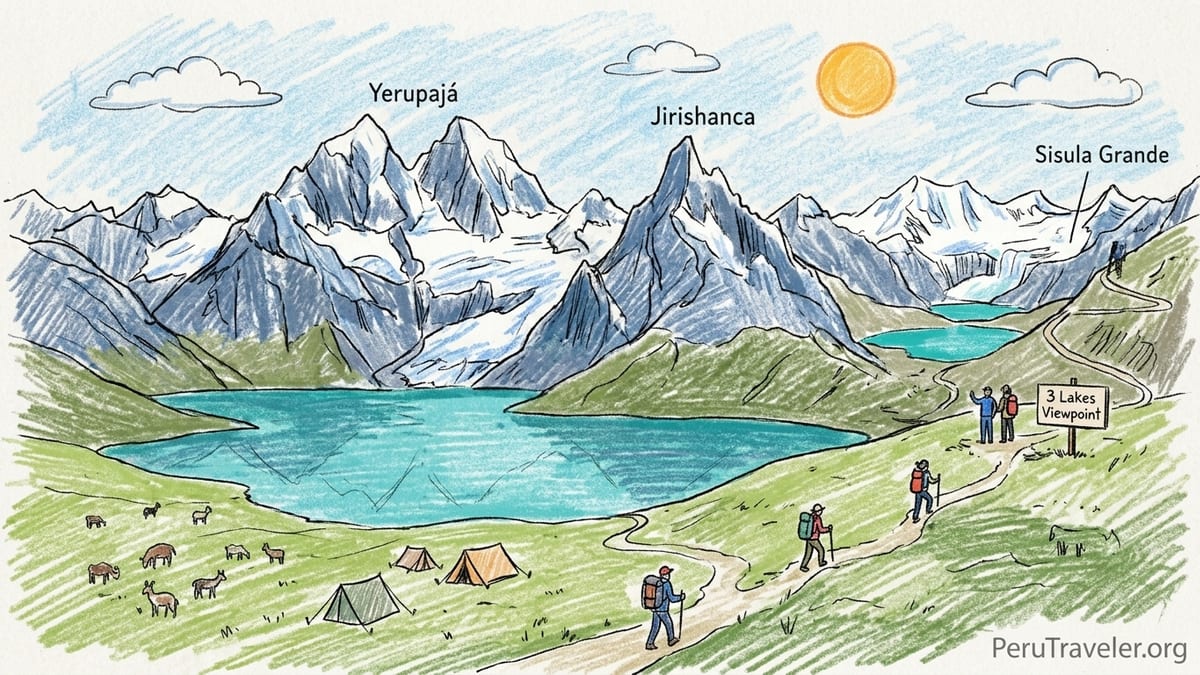
Understanding the Cordillera Huayhuash and Its Main Views
The Cordillera Huayhuash is a compact mountain range south of Huaraz, with seven major summits over 6,000 meters and some of the most dramatic relief in the Andes. Yerupajá, at about 6,635 meters, is Peru’s second-highest peak, while nearby Siula Grande became famous through Joe Simpson’s book “Touching the Void.” Most trekking routes never set foot on these summits, but they circle their base, crossing a chain of passes that often reach or exceed 4,800 to 5,000 meters in elevation.
Scenery on the standard trekking circuit follows a rhythm. Lower down, you walk through dry puna grassland and small herding hamlets. Above camp, glaciated faces, corniced ridges and hanging seracs dominate the skyline. Iconic postcard views concentrate around certain camps and passes: Mitucocha and Carhuacocha for reflections of Yerupajá and Jirishanca, the Siula Pass viewpoints for the three turquoise lakes below Siula Grande, and Jahuacocha as a final amphitheater of water, ice and rock.
It is important to distinguish normal route scenery from optional side hikes that require extra effort and acclimatization. For example, simply camping at Laguna Carhuacocha gives good morning views of the big peaks, but the most famous “three lakes” panorama comes from a higher viewpoint reached via an extra couple of hours of steep hiking toward the Siula Pass. Likewise, many itineraries sleep near Cutatambo or at Huayhuash camp, then offer an extra hike to the Gran Vista viewpoint below Siula Grande, which is not part of the shortest through-trail variants.
Because the range is relatively small, the difference between an 8, 10 and 12-day trip is not so much about crossing completely different terrain as about how many viewpoints and side valleys you have time to explore. Shorter trips link a handful of key passes and lakes, while the longest itineraries come close to a full circumnavigation, with detours for hot springs, alternative high passes and rest or contingency days.
Access from Huaraz and Core Overnight Spots
Most Huayhuash treks start and finish in the mountain city of Huaraz, reached from Lima by a roughly eight-hour overnight bus. From Huaraz, private transport to the main trailheads typically takes about four to six hours depending on the specific start point and the condition of the dirt roads. Agencies commonly drive via Conococha and Chiquián before turning onto narrower tracks toward Llamac, Pocpa or Cuartelwain / Matacancha, where the walking begins.
Matacancha, around 4,150 to 4,200 meters, is one of the classic first-night camps on 8 and 10-day circuits. Reaching it usually involves a full morning in the vehicle and only a short acclimatization walk in the afternoon. From here, many itineraries cross Cacanan or Rondoy Pass toward Laguna Mitucocha, another key early camp between roughly 4,150 and 4,250 meters, framed by the wall of Jirishanca and Rondoy. Both Matacancha and Mitucocha are within territories where local communities charge camping and access fees, so trekkers can expect to be approached by a representative in the evening or as they arrive in camp.
Carhuacocha, at about 4,150 meters, is often the third or fourth night on the standard clockwise or counter-clockwise circuit and offers one of the most celebrated sunrise views in the range. The main lake dominates the foreground while Yerupajá and Siula Grande rise behind. Further along the loop, camps such as Huayhuash (around 4,350 meters), Viconga (roughly 4,400 to 4,500 meters near hot springs), Huayllapa village (around 3,500 meters, the lowest point on most circuits) and Jahuacocha (about 4,050 meters) structure the latter half of the trek. Each of these zones is managed by a different community, which has implications for both route choice and budgeting.
Daily distances on guided itineraries are typically kept between 10 and 15 kilometers, but the combination of altitude and accumulated ascent makes them feel far longer. Between Matacancha and Mitucocha, for instance, an agency might advertise only 12 kilometers, yet the day includes a pass of around 4,700 meters and several hundred meters of descent. On the approach to Huayhuash from Carhuacocha, walking via Siula Pass can involve seven to eight hours of sustained effort above 4,500 meters, even though the horizontal distance is moderate.
3–5 Day Huayhuash Introductory Treks
Not every traveler has time or experience for a full high-altitude circuit. In response, several Huaraz-based operators now market three to five-day Huayhuash “mini-treks” that sample the most photogenic sectors without committing to the full loop. These shorter options are popular with visitors who are combining the Huayhuash with treks like the Santa Cruz or day hikes such as Laguna 69 or Pastoruri.
One common four or five-day route focuses on the eastern lakes and Siula Pass. Groups transfer from Huaraz to Matacancha or Cuartelwain on day one, sleep near Mitucocha, move to Carhuacocha on day two via a moderate pass, then spend day three crossing Siula Pass at roughly 4,800 meters to reach Huayhuash camp. Depending on whether transport can meet them on the southern road, they either exit near Huayhuash village on day four or add an extra day toward Viconga before leaving the range. Distances per day run between about 10 and 15 kilometers, but the overall elevation profile still demands careful acclimatization.
Another style of three to five-day introduction uses Jahuacocha as a base. After a long drive from Huaraz to Llamac, trekkers hike for four to five hours up to Jahuacocha at just over 4,000 meters. Day two might include a side hike up to Yaucha Pass around 4,850 meters for a skyline view of Yerupajá and the surrounding chain, while day three allows for exploration of nearby viewpoints or a relaxed descent back to Llamac and the waiting vehicle. This version is easier logistically and avoids the highest passes, making it more accessible to fit but less experienced walkers when supported by mules and a guide.
Pricing for these shorter Huayhuash tasters in 2026 typically starts around the equivalent of 350 to 600 US dollars per person in a small group if booked locally in Huaraz, depending on the exact length, group size and included services. Higher-end, pre-booked packages marketed internationally can cost more, sometimes approaching or exceeding 1,000 US dollars per person for four or five days when run privately with upgraded tents, more elaborate meals and dedicated support staff.
8-Day Circuits: Compact Loops and What You See
Eight-day Huayhuash itineraries are often sold as “short circuits” or “mini-circuits” that still include many of the classic views but cut out some remote western or southern sections. A typical 8-day schedule from Huaraz includes two long transfer days at the start and end and six days of trekking, with camps that might include Matacancha, Mitucocha, Carhuacocha, Huayhuash, Viconga and Jahuacocha.
On these routes, trekkers usually cross key passes such as Cacanan or Rondoy near 4,700 meters, Carhuac around 4,650 meters, Siula Pass near 4,800 meters and Portachuelo de Huayhuash at roughly 4,750 meters. Some versions include a high exit via Yaucha Pass above Jahuacocha at around 4,850 meters, while others take a lower route out. Daily walking times are typically between five and eight hours, comparable to the standard 10-day circuit but with fewer side detours and rest days.
An 8-day trip does not usually complete a pure geographic circumnavigation of the range. Instead, it bows through the eastern and central valleys with a cut-off that rejoins the Llamac exit without visiting Huayllapa or the western valleys like Guanacpatay. This still offers repeated views toward Yerupajá, Siula Grande and Jirishanca, as well as time at the Viconga hot springs, but skips some of the longest and most remote days. For many travelers with strong fitness and limited vacation time, this balance is attractive.
As of the 2026 season, mid-range Huaraz agencies often advertise 8-day group departures in the ballpark of 2,000 to 2,400 Peruvian soles per person in groups of eight or more, which is roughly 500 to 650 US dollars. That usually covers guides, cooks, tents, basic sleeping mats, pack animals, food on trek and private transport from and back to Huaraz. Some operators explicitly include around 290 to 300 soles in community access and camping fees in that price, while others specify that each client must carry approximately 300 soles in cash to pay communities individually along the route.
The Classic 10-Day Circuit: Nearly Full Huayhuash Loop
The standard 10-day Huayhuash circuit is what many trekkers think of as “the” Huayhuash trek. Most versions make an almost complete loop around the range, starting with a long drive from Huaraz to Cuartelwain or Matacancha, then swinging through Mitucocha, Carhuacocha, Huayhuash, Viconga, the high passes around Cuyoc or San Antonio, Huayllapa, Cashpapampa and Jahuacocha before exiting to Llamac on the final day.
Day by day, this often breaks down into one day of driving and acclimatization at Cuartelwain or Matacancha, then a sequence of pass days: Cacanan or Rondoy near 4,700 meters, Carhuac around 4,650 meters, the optional high viewpoint above the three Siula lakes near 4,900 meters, Siula Pass itself around 4,830 meters, Portachuelo de Huayhuash at roughly 4,750 meters, then either Cuyoc Pass around 5,000 meters or the even higher San Antonio variant, which some itineraries list at just over 5,000 meters. Later in the trek, Tapush Pass at around 4,800 meters and Yaucha Pass near 4,850 meters frame the link into and out of Jahuacocha.
Campsites on this classic loop sit mostly between about 4,100 and 4,500 meters, with the main exception of Huayllapa at around 3,500 meters, which gives one lower night and a chance to buy simple snacks from village shops. Daily distances are often advertised at 10 to 15 kilometers, but the passes and cumulative altitude make it essential to treat the trip as a serious high-altitude expedition, not a hiking holiday. Several operators categorize this circuit as “strenuous” or equivalent in their grading systems, recommending that clients arrive in Huaraz at least three or four days early to acclimatize on local day hikes.
For 2026, many Huaraz outfitters publish list prices for 10-day group departures that range from roughly 2,500 to 3,600 soles per person in groups of six to ten, or about 650 to 950 US dollars at recent exchange rates. Higher-end international adventure travel companies often charge from around 2,000 US dollars per person and up for similar-length itineraries, but those prices may include additional hotel nights in Lima or Huaraz and extra logistical support. When comparing, it is important to confirm whether community fees, sleeping bag rentals, airport transfers and Lima–Huaraz buses are included or not.
Extended 12-Day Expeditions and Alternative Passes
Twelve-day Huayhuash trips add time rather than fundamentally new terrain, but the extra days matter. Operators use them in several ways: adding a second night at standout locations like Carhuacocha or Jahuacocha, including alternative high passes such as Trapecio or Santa Rosa, or inserting one or two contingency days in case of heavy snow, illness or route-finding issues on remote variants.
One common 12-day strategy keeps the standard 10-day loop but builds in a rest or exploration day either at Carhuacocha, with a full-day hike to multiple Siula viewpoints, or at Cutatambo / Guanacpatay on the western side, where trekkers can climb to the Gran Vista viewpoint beneath Siula Grande. Another approach is to contour farther out onto the western side of the range via passes like Trapecio at roughly 5,000 meters and Santa Rosa above that, which provide huge panoramas but also add exposure to altitude and weather.
These extended itineraries are firmly in serious expedition territory. Several days run six to eight hours of moving time, with passes near or slightly above 5,000 meters and camps rarely below 4,200 meters. Operators often emphasize that participants should have prior multi-day trekking experience at altitude, good cardiovascular fitness and the ability to handle cold nights where temperatures at camp can fall below freezing in the dry season.
Prices reflect both the longer duration and the higher level of logistics. Local Huaraz agencies may quote around 3,600 to 4,800 soles per person for a 12-day group departure with full support in a small group. Internationally marketed private expeditions for four people can start at around 2,000 US dollars per person and rise with extra comforts such as larger dome tents, thicker sleeping mats, solar charging stations, satellite communication devices and specialist high-altitude guides.
Community Access Fees, What They Cover and Who Pays
Unlike some national parks where a single entry ticket covers the entire area, Huayhuash access is organized by individual communities. Villages such as Llamac, Pocpa, Queropalca, Uramaza, Huayllapa and Pacllón charge separate fees for passing through their land and using their camping areas around sites like Matacancha, Mitucocha, Carhuacocha, Huayhuash, Viconga, Huayllapa, Cashpapampa and Jahuacocha. Each community maintains its section of trail and often provides basic infrastructure such as pit toilets and designated tent platforms.
Community representatives usually collect these fees in cash, in soles, on the trail or at camp. Trekkers receive a simple paper receipt that can be requested again at a later checkpoint. In recent seasons, per-community fees have commonly ranged from around 20 to 50 soles per person, and a complete Huayhuash circuit involving all the main overnight areas has typically added up to roughly 290 to 300 soles per person in community charges by the time you complete the loop.
Operators differ in how they handle these payments. Some Huaraz agencies and international outfitters state clearly that all community fees, currently around 290 to 300 soles per person for a classic 8 to 10-day circuit, are included in the package price. Others keep trek prices lower on paper but expect each guest to bring roughly 300 soles in cash to pay communities directly, which can feel confusing if it is not explained up front. Before booking, it is sensible to ask for a written breakdown that specifies whether these local charges are included or will be paid by you as you go.
Because fees are set locally and can change from one season to the next, any figures you see online should be treated as approximate. For travelers comparing operators, the key point is not the exact number of soles per village, but whether the agency is transparent about current community costs, pays them on time and respects local rules about camping locations, pack-animal routes and waste disposal.
Group Departures vs Private Treks: What You Really Get
Choosing between a scheduled group departure and a private trek has a large impact on both budget and experience. Group departures from Huaraz are usually the most economical way to access a full-service Huayhuash trek. Per-person prices drop as group size increases, because the cost of guide wages, cooks, muleteers and private bus transfers is shared among more people. It is common for a solo traveler joining an 8 or 10-day group to pay less than half of what a similar itinerary would cost run as a private one-person trip.
Private treks, by contrast, give more control over itinerary, pace and side trips. Families, groups of friends or very experienced backpackers often choose this format so they can adjust daily stages, add extra nights at particular lakes or request specific passes like San Antonio or Trapecio. International adventure companies often only operate Huayhuash trips as private departures, with prices that start around 2,000 US dollars per person for a 10 to 12-day circuit for a group of four and increase for smaller groups or higher comfort levels.
Regardless of format, it is worth looking closely at the included services. Many mid-range operators provide roomy double tents rated for alpine conditions, foam or inflatable sleeping mats, a dining tent, a kitchen tent and a toilet tent. Some include sleeping bags rated to at least minus 10 degrees Celsius, while others rent them for an additional fee. Pack animals, usually donkeys and sometimes horses, carry camping gear and personal duffels, freeing clients to hike with lighter daypacks. A separate emergency horse for riders who fall ill is a key safety feature that not all budget operations provide by default.
Guide language and group size influence the experience significantly. Cheaper departures might assign a single Spanish-speaking guide to ten or more clients, relying on basic English for communication, while higher-end outfits keep groups at six to eight trekkers per guide and offer fluent English or additional assistant guides. Serious operators also carry emergency equipment such as a satellite phone or messenger, first-aid kit with high-altitude medications where legal, and a clear plan for evacuating someone to lower elevations, usually involving rapid descent on horseback to the nearest roadhead and transfer back to Huaraz.
Ethics, Food Quality, Water and Weather Flexibility
Because Huayhuash treks are labor-intensive, the treatment of porters and muleteers matters. Responsible agencies state a maximum load per animal and reasonable weight per porter, often keeping client duffels under about 12 kilograms and providing staff with adequate clothing, shelter and food. Some international companies audit their local partners on porter welfare, while smaller Huaraz outfits rely more on long-term relationships and word of mouth. As a client, you can ask how many staff will accompany your group, how long they have worked with the company and whether they receive appropriate equipment.
Food quality can vary widely between budget and premium operators. At the lower end, expect basic Peruvian staples: soups, rice, pasta, potatoes, eggs and occasional meat, often supplemented by instant drinks and simple snacks. Better-resourced cooks prepare more varied menus that may include fresh salads early in the trip, home-baked bread, desserts and thoughtful adaptations for vegetarians or those avoiding gluten. Asking to see a sample menu is a reasonable step before paying a deposit, especially for longer 10 to 12-day expeditions where mealtime variety helps morale.
Safe drinking water is another key consideration. Many agencies treat water for clients by boiling it at camp and refilling bottles morning and evening. Others additionally use chlorine drops or filters. Independent trekkers usually bring their own filtration systems or chemical treatments. Because livestock graze widely in the valleys and camps, it is unwise to drink untreated surface water. Confirm with your chosen operator whether water will be provided already treated, or whether you should bring your own filtration bottle or tablets.
Finally, itinerary flexibility during bad weather or illness matters in a range as serious as the Huayhuash. The core dry season from May through September is generally favored because it usually brings more stable conditions, with cold, clear nights and sunny mornings. However, snow can still fall on the high passes and storms can develop quickly. Better operators build small margins into their schedules, allow alternative lower routes on days like the San Antonio pass and have clear criteria for when to turn back. Asking how they handled recent weather events can give a candid picture of their decision-making culture.
Costs, Season and Budgets for 8, 10 and 12 Days
For a realistic Huayhuash budget, you should combine trek costs with acclimatization time in Huaraz, equipment rental and travel to and from Lima. In 2026, many travelers joining mid-range group treks report paying in the region of 50 to 90 US dollars per person per day for full-service camping when booked directly in Huaraz, with prices toward the lower end for larger groups on 8-day itineraries and the higher end for longer, smaller-group or more comfortable trips.
As an approximate guide, an 8-day group circuit booked locally might cost between about 400 and 700 US dollars per person, excluding transport between Lima and Huaraz but sometimes including community fees. A 10-day classic circuit could run between roughly 650 and 1,000 US dollars per person in a group of six to ten, again depending on inclusions. A fully supported 12-day expedition, especially if run privately for a small group or through an international outfitter, can cost anywhere from around 1,200 to well over 2,000 US dollars per person once all on-the-ground services are included.
On top of these trek prices, you should add community fees of roughly 290 to 300 soles per person if they are not already bundled into the package; rental costs for sleeping bags, trekking poles or down jackets if you do not bring your own; two to four hotel nights in Huaraz for pre-acclimatization and recovery; and transport costs for the Lima–Huaraz bus and airport transfers in Lima. Independent trekkers who arrange their own food and equipment but still hire local muleteers and pay community fees may spend less in total, but the savings narrow once pack-animal wages, stove fuel and rental gear are factored in.
Seasonally, May through September remains the preferred window for Huayhuash circuits because it usually lines up with the Andean dry season. Skies are often clearer, river levels are moderate and the risk of prolonged multi-day storms is lower than in the heart of the wet season. That said, conditions are never guaranteed. Early in the season you may encounter lingering snowfields on passes; later, dust and strong afternoon winds can be an issue. Shoulder months such as April and October can offer quieter trails but come with a higher chance of rain or unsettled weather.
Who Should Go: Experienced Backpackers vs First-Time High-Altitude Trekkers
The Huayhuash rewards experience. Multi-day backpackers who have already trekked at moderate altitudes in ranges like the Rockies, Alps or Himalaya often adapt best. They are familiar with pacing, layering systems, foot care and the mental demands of committing to a long trail with variable weather. For such travelers, a guided 8 or 10-day circuit can be an ideal progression, providing logistical support while still offering a genuine sense of remoteness and self-reliance.
First-time high-altitude trekkers can still enjoy the Huayhuash, but it is wise to be realistic. Shorter 3 to 5-day introductions based around Jahuacocha or an abbreviated eastern loop keep pass heights slightly lower and allow guides to monitor how people respond to altitude before committing to multiple consecutive days above 4,500 meters. Those intent on tackling the full 10 or 12-day circuit without previous experience should at least schedule several acclimatization hikes from Huaraz and consider medical advice about altitude-related risks.
Regardless of background, comfort with camping is important. Every Huayhuash circuit is a pure camping trek, and nights are cold. Even with good gear, sleeping at 4,200 meters night after night can be tiring. People who know how their body reacts in a tent at altitude and how to handle basic tasks like organizing gear in the dark will generally cope better and enjoy the scenery more than those learning it all for the first time in the field.
Physical training before departure should include both cardiovascular conditioning and strength work to handle sustained ascents and descents with a daypack. Walking or hiking for several hours on consecutive days at home is more relevant preparation than isolated gym sessions. Travelers who arrive well-trained often find that they can appreciate optional side hikes like the high Siula viewpoints or extra passes rather than merely enduring the main route.
The Takeaway
The Cordillera Huayhuash is not a casual add-on to a Peru itinerary. Whether you choose a three to five-day taste or commit to a full 8, 10 or 12-day circuit, you are signing up for a serious high-altitude expedition with logistics, costs and responsibilities to match the rewards. Understanding how different itineraries use core camps such as Matacancha, Mitucocha, Carhuacocha, Huayhuash, Viconga, Huayllapa and Jahuacocha will help you match route length to your experience, fitness and available time.
Budgeting realistically, confirming whether community fees are included, asking detailed questions about guide qualifications, group size, emergency equipment and porter treatment, and allowing ample acclimatization time in Huaraz all go a long way toward ensuring that you focus on the vivid blues of the lakes and the serrated skyline of Yerupajá and Siula Grande instead of preventable problems. In return, the Huayhuash offers some of the most impressive long-distance mountain scenery accessible to fit, committed trekkers anywhere on the continent.
For experienced backpackers already familiar with camping at altitude, a guided 8 or 10-day circuit can be a lifetime trek that still feels attainable with good training. For first-time high-altitude walkers, a shorter introductory route or a very carefully prepared classic circuit with a reputable, well-supported operator may be a safer and more enjoyable way to join the thin-air world beneath Peru’s second-highest peak.
FAQ
Q1. How long does it take to trek the Cordillera Huayhuash?
The full classic circuit usually takes 8 to 12 days of trekking, with 10-day itineraries the most common. Shorter 3 to 5-day options sample only part of the range.
Q2. What is the highest altitude on the Huayhuash trek?
Several passes reach close to or just above 5,000 meters, including Cuyoc, San Antonio, Trapecio and Santa Rosa, while most camps sit around 4,100 to 4,500 meters.
Q3. Do I need a guide for the Huayhuash circuit?
Regulations and local practice increasingly favor guided groups, and many communities and operators now expect trekkers to be accompanied by a licensed guide and muleteer team for safety and community coordination.
Q4. How much should I budget for community fees?
For a classic circuit that uses standard overnight areas, you should expect total community access and camping fees of roughly 290 to 300 soles per person, either prepaid via your operator or paid in cash along the route.
Q5. When is the best time of year to hike the Huayhuash?
Most trekkers choose the dry season from May through September, when conditions are generally more stable, though cold nights, wind and occasional snow on passes remain possible.
Q6. What fitness level is required for the Huayhuash trek?
The circuit is rated strenuous by many operators. You should be able to hike 10 to 15 kilometers for several consecutive days, with sustained climbs at high altitude while carrying a daypack.
Q7. What equipment is usually included in guided Huayhuash tours?
Typical inclusions are mountain tents, sleeping mats, a dining and kitchen tent, pack animals, meals and a guide and cook team. Sleeping bags, trekking poles and personal clothing are often rented or brought separately.
Q8. How is drinking water handled on the trek?
Most operators provide treated water, usually boiled and sometimes additionally filtered or chemically treated. Independent trekkers should bring their own filters or purification tablets because surface water is not safe to drink untreated.
Q9. Can beginners do the Huayhuash trek?
Fit beginners with no prior high-altitude experience can attempt shorter 3 to 5-day segments or a guided circuit if they allow several acclimatization days in Huaraz, train in advance and choose a cautious, reputable operator.
Q10. What should I ask an operator before paying a deposit?
Key questions include group size, guide language, whether community fees are included, what tents and sleeping gear are provided, how emergencies and evacuations are handled and how porters and muleteers are treated and equipped.