


Huaraz has become the de facto day-hiking capital of the Peruvian Andes, with turquoise lagoons, hanging glaciers and snow-capped 6,000-meter peaks all within a few hours of town. In 2026, however, choosing the right tour is no longer only about scenery. Altitude, new access rules inside Huascarán National Park, changing road conditions and big differences between group and private tours mean travelers need to plan their hikes more carefully, especially around Laguna 69, Laguna Parón, Laguna Churup, the Llanganuco Lakes and the Pastoruri glacier area.
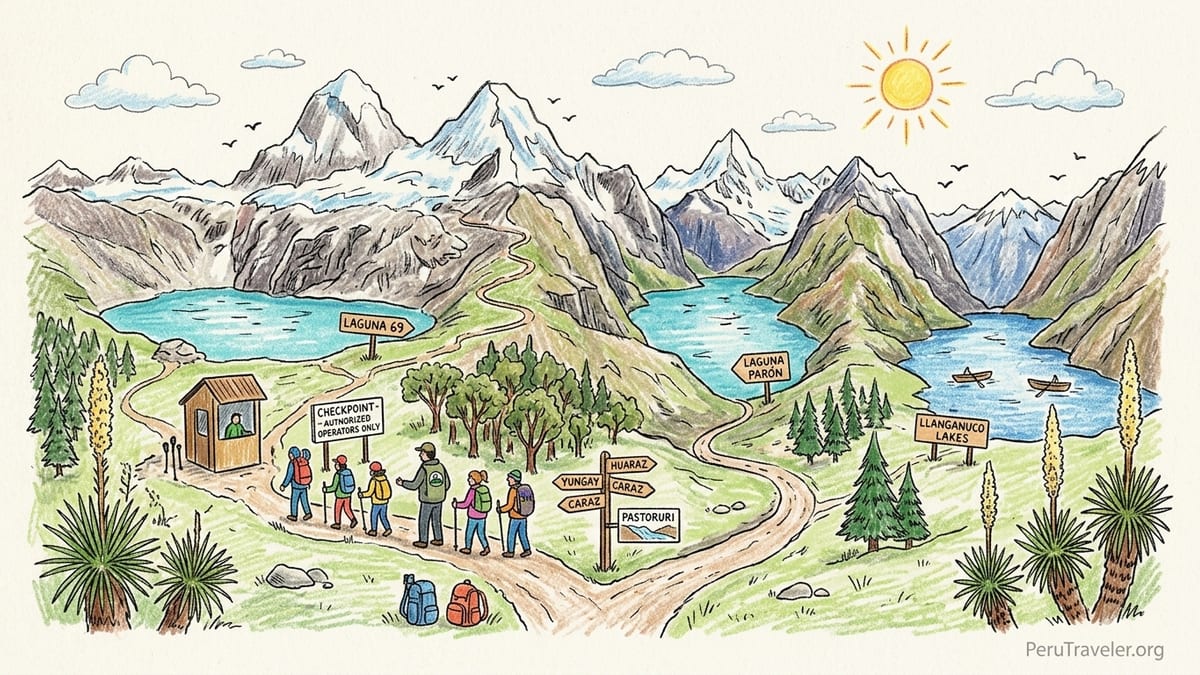
Huascarán National Park in 2026: What Has Changed
Huascarán National Park protects much of the Cordillera Blanca, including Laguna 69, Laguna Parón, Laguna Churup, the Llanganuco lakes and Pastoruri. It is one of Peru’s most visited high-mountain areas and also one of its most regulated. Across 2025 and 2026, authorities have tightened access to certain hotspots because of erosion, overcrowding and safety incidents, especially around Laguna 69 and Nevado Pisco. For independent travelers used to simply taking a colectivo and walking in, those changes are significant.
In August 2025, Peru’s tourism authority and the national protected areas service announced that visits to Laguna 69 and Nevado Pisco from the Llanganuco sector would be permitted only with tourism companies that hold a current contract with park authorities. That rule is now being enforced in 2026, and multiple tour agencies in Huaraz confirm that visitors attempting to hike Laguna 69 without being on the list of an authorized operator are usually turned back at park checkpoints or at the Cebollapampa trailhead.
Elsewhere in the park, access remains more flexible. For Laguna Parón, Laguna Churup, Llanganuco and Pastoruri, independent visits are still technically possible, although in practice almost all visitors join a tour because of the long drives, rough mountain roads and the need to coordinate national park admission. The result is that Huaraz today works best if you treat day hikes as organized excursions, while longer trekking routes such as Santa Cruz or Huayhuash remain the arena for semi-independent backpackers and expedition-style trips.
For 2026 planning, it is important to think of Huascarán National Park not as a single place but as a set of distinct valleys and access points. Laguna 69 and the Llanganuco lakes are reached via Yungay, Laguna Parón via Caraz, Laguna Churup from villages just east of Huaraz, and Pastoruri from the southern road towards Catac. Choosing where you stay and how you structure your days can save hours in buses and significantly improve how your body adapts to altitude.
Laguna 69: High-Altitude Classic with New Access Rules
Laguna 69 is the headline day hike of the Cordillera Blanca, a small glacial lake at roughly 4,600 to 4,650 meters framed by icefalls and granite walls beneath peaks like Chacraraju and Pisco. The standard tour from Huaraz starts around 5:00 in the morning, drives north through the Callejón de Huaylas, climbs the Llanganuco valley past the twin lakes of Chinancocha and Orconcocha, then continues on to Cebollapampa at about 3,850 meters. From there, most groups hike around 6 to 7 hours round trip, covering roughly 13 to 15 kilometers in total.
The hike is demanding rather than technical. The trail is well-trodden and non-exposed, but the altitude is punishing. After a gentle start through grassy valley, you climb a series of switchbacks to a shoulder, briefly descend to a basin, then tackle a final steep zigzag to the lake. Many agencies describe it as suitable for anyone with “basic fitness,” yet park staff and local guides report frequent cases of hikers turning back because of headaches, nausea or simple exhaustion. On a busy dry-season weekend, you may be walking among more than a hundred other hikers spread along the trail.
The new rule requiring authorized tourism operators has changed logistics. Tour desks around Huaraz’s Plaza de Armas still sell Laguna 69 almost every day in dry season, with 2026 shared-group prices commonly advertised around 80 to 110 soles per person for transport only. Some operators, such as Perumoche Tours or Tours Huaraz, publish online offers in that range for a full-day group excursion, usually excluding food and sometimes excluding the separate Huascarán National Park entrance fee. When comparing tours, travelers should ask three explicit questions: whether the company has a current Huascarán contract for Laguna 69, whether the park fee is included, and whether an English-speaking guide will accompany the group on the trail.
To verify authorization, responsible agencies will show you either a scanned copy of their contract with the park or a current list of authorized operators. If staff brush off the question or tell you authorization is “not important,” consider that a red flag. The safest approach in 2026 is to choose an agency that provides a written service description, confirms that your name will be on the official access list for that day and clarifies if the guide walks with the group or simply rides in the bus as a “tour conductor.” Because Laguna 69 is at 4,600 meters, carrying your own basic first-aid kit and walking poles is sensible, even if the agency rents poles for an additional fee.
Laguna Parón: Verify Road Access and Base Yourself Wisely
Laguna Parón is the largest lake in the Cordillera Blanca and one of its most photographed, with turquoise water backed by famous peaks like Huandoy and the pyramid-shaped Artesonraju. It sits at about 4,200 to 4,300 meters in a side valley above Caraz, which lies roughly 70 kilometers north of Huaraz. For years, its appeal has been that you can enjoy stunning Andean scenery without a long hike: tours typically drive directly to the lakeshore parking area, then offer optional short walks along the shore or up to a mirador on the surrounding ridge.
Access to the Parón valley road has not been entirely predictable. Local news in Caraz in May 2026 reported that the road to the lake had recently reopened following maintenance and small landslide clearance, after intermittent closures earlier in the rainy season. By mid 2026, Huaraz-based agencies were once again promoting full-day Laguna Parón tours as part of their regular schedule, though some still warned of occasional delays and time windows when road crews work on the route. Before recommending Parón as a highlight, it is therefore crucial to confirm that your chosen agency has up-to-date road information for your exact date.
Group tours from Huaraz generally depart around 6:00 in the morning and return by early evening, with about 3 to 3.5 hours of driving each way because of the narrow, winding access road above Caraz. Travelers who stay a night or two in Caraz cut that travel time significantly, sometimes to less than 2 hours one way, and can visit Parón on a shorter day with more time at the lake itself. Some Caraz-based guides also offer early-morning departures that reach the lake before the main tour buses, which is attractive for photographers who want calm reflections and softer light.
At Laguna Parón, walking distances are optional. Most visitors simply stroll along the lakeshore, enjoy a lakeside snack and perhaps rent a simple rowboat. More active hikers climb for 45 to 60 minutes up to a rocky viewpoint above the southwestern end of the lake, gaining several hundred meters and enjoying dramatic views over the water towards the surrounding peaks. Because most of the day is spent above 4,000 meters even with limited hiking, it is not a first-day excursion for travelers arriving directly from Lima. For 2026, the best practice is to schedule Parón on day three or later of your stay, or to base in Caraz after one or two acclimatization nights in Huaraz or Yungay.
Laguna Churup: Steep Acclimatization Hike Close to Huaraz
Laguna Churup is a smaller, steeper and more intimate hike than Laguna 69 or Parón, and it is often recommended as an acclimatization walk. The lake sits at around 4,450 meters on the slopes of Nevado Churup, east of Huaraz. Because the trailhead at Pitec is only about 20 kilometers from town, the total driving time is much shorter than for other classic day trips: usually 1 to 1.5 hours each way, depending on whether you travel in a tour bus, private taxi or shared van through Llupa.
The standard hike from Pitec to the lake and back takes about 3 to 5 hours for most visitors. The distance is shorter than Laguna 69, but the trail is significantly steeper, with sustained uphill sections from the start. Near the end of the route, there is a rocky stretch with simple scrambling and fixed cables or metal handholds. Local guides consider it manageable for hikers who are comfortable with some basic hands-on rock, but it may be intimidating for those with vertigo or knee problems. Some agencies offer variations that avoid the steepest cables section by taking an alternate path, at the cost of extra time.
Shared tours to Churup in 2026 are often priced slightly below Laguna 69 or Parón, reflecting the shorter drive and the possibility of running half-day departures. Agencies in Huaraz have advertised rates around 60 to 80 soles per person for group transport, again usually excluding national park entrance. Because Churup is relatively close to town, many hikers use it as their first serious outing after a quiet arrival day in Huaraz, before progressing to Laguna 69 or Parón. The route is ideal for testing how you feel above 4,000 meters with steeper gradients, without committing to a 12-hour excursion.
From a planning point of view, Churup is also a safety valve for bad weather or fatigue. On days when clouds sit low over the higher peaks, you may still enjoy moody atmosphere and partial views on this shorter ascent, and it is easier to turn back and be back in Huaraz by mid-afternoon. For travelers balancing remote work with adventure, Churup can even fit into a workday if you start early and avoid group buses that make multiple stops.
Llanganuco Lakes and Pastoruri: Easier Sightseeing and Climate-Change Routes
The Llanganuco lakes, Chinancocha and Orconcocha, lie at approximately 3,850 meters in a deep glacial valley between Huascarán and Huandoy. Many agencies in Huaraz list a classic “Callejón de Huaylas and Llanganuco” full-day tour that visits villages like Carhuaz and Yungay, then drives into Huascarán National Park to spend an hour or two at the lakes. Walking here is very light, usually limited to flat lakeshore paths, viewpoints and short dock areas where local families rent small boats. In 2026, shared tours from Huaraz often advertise prices in the region of 60 to 80 soles per person, not including park fees.
For travelers who are not ready for a long hike or who have companions with limited mobility, the Llanganuco excursion is one of the easiest ways to experience high Andean scenery. Road quality inside the valley is usually good, though subject to weather-related delays in the rainy season, and most of the day is spent below 4,000 meters. This makes it a popular choice for the first or second day in Huaraz, especially for families and older travelers who want stunning views, picnic spots and short walks without the stress of steep hills.
Pastoruri sits much higher, at around 4,900 to 5,000 meters, but the modern “climate-change route” has transformed how visitors experience it. Rather than a technical glacier climb, the Pastoruri excursion is now built around an educational trail that explains glacial retreat, polylepis forests and the giant Puya raimondii plants on the way to the glacier viewpoint. The typical tour from Huaraz leaves mid-morning, stops at villages and roadside viewpoints, then drives into the southern sector of Huascarán National Park. From the final parking lot, visitors walk on a gently ascending path and stone steps for 45 minutes to 1.5 hours to reach the glacier lookout.
Tour operators in Huaraz commonly price Pastoruri group trips in a similar band to Llanganuco or Laguna 69 transport, often between 60 and 90 soles per person depending on inclusions and seasonal demand. Because almost the entire day takes place above 4,300 meters, Pastoruri is deceptive: it feels easier than Laguna 69 because the walk is shorter and the path is more controlled, but the altitude effect can be stronger. Many guides therefore recommend doing Pastoruri only after at least two nights in Huaraz and preferably after one easier high-altitude outing, such as Llanganuco or Churup, so that your body has started to adapt.
Altitude, Acclimatization and Why Your First Hike Should Not Be Laguna 69
Flying from sea-level Lima to Huaraz, at roughly 3,050 to 3,100 meters, is a shock to the system. Symptoms of mild altitude sickness, such as headache, poor sleep and shortness of breath on stairs, are common in the first 24 to 48 hours. Attempting a 4,600-meter hike like Laguna 69 immediately after arrival is poor planning, even for people who consider themselves fit at home. Local agencies and park staff repeatedly see strong runners from low altitude turn around halfway to the lake because they underestimated the combined effect of thin air, sun exposure and a 12-hour day.
A more sensible acclimatization strategy in 2026 follows a simple progression. On day one, arrive in Huaraz, walk slowly around town, drink plenty of water, avoid heavy alcohol and rest. On day two, consider a relatively gentle excursion that does not exceed 4,000 meters for long, such as the Llanganuco lakes, a city tour or a half-day hike to a lower viewpoint near Huaraz. On day three, step up to a hike like Laguna Churup, where you will gain height more actively and test how you feel above 4,400 meters. Only from day four onwards should you book demanding full days like Laguna 69 or high, sustained exposures like Pastoruri.
Travelers with pre-existing heart or lung conditions should consult a doctor before planning high-altitude trips and may want to structure their time even more conservatively. Carrying acetazolamide (Diamox) prescribed by a physician is common among trekkers, but it is not a replacement for gradual acclimatization. Peru’s rescue infrastructure in Huascarán National Park is limited, and helicopter evacuation is not guaranteed. In concrete terms, that means it is better to arrive a day earlier and walk slower than to stack Laguna 69, Pastoruri and Parón on three consecutive days without rest.
If your time is short, it is tempting to buy packages from Huaraz agencies that advertise a different big-name destination every day for four or five days. These can be good value, but in 2026 travelers should examine the order of excursions carefully. Ask the agency to start with Llanganuco or a lower hike, schedule Laguna 69 in the middle rather than on day one, and keep Pastoruri or Parón towards the end. Many local operators are happy to rearrange days within fixed-price packages if you ask before paying.
Group Tours vs Private Guides vs Trekking Packages
Huaraz’s tourism economy is built around shared group tours, private guiding and multi-day trekking packages, all of which coexist in 2026. Shared group tours are the cheapest way to reach the classic day-hiking destinations. For Laguna 69, Churup, Llanganuco, Pastoruri and Parón, it is common to see shared-transport prices advertised between about 60 and 110 soles per person depending on distance, season and whether small extras like lunch or trekking poles are included. These tours pick up travelers from a handful of central Huaraz hotels and follow fixed itineraries and time windows.
Private guides and drivers cost more but offer flexibility. A private Laguna Parón day from Caraz or Huaraz, arranged with a local agency or directly with a certified guide, often falls in the range of the equivalent of several group-tour seats, but the exact 2026 rates vary by operator and group size. The advantage is obvious in practice: you can leave earlier to beat the crowds, spend longer at a viewpoint or adjust the plan if someone in your group feels unwell. For hikes like Churup, families with teenagers or older travelers often find that a private guide can manage pace and safety on the rocky sections more carefully than a single guide responsible for 15 or 20 people.
Longer trekking packages, such as four-day Santa Cruz or eight to ten days in the Huayhuash, sit in a different price bracket and usually include tents, cooks, donkeys for luggage and full guiding. In 2026, some agencies use day hikes like Laguna 69 as part of acclimatization before starting a multi-day trek, bundling the day tour into a larger package. When comparing these, ask exactly what is and is not included: airport or bus transfers, hotel nights in Huaraz, park permits for multiple valleys and whether the company uses licensed high-mountain guides or general trekking guides.
Across all formats, travelers should look beyond headline price boards outside agencies. Some of the lowest advertised prices in Huaraz are for transport only, leaving you to pay national park entry in cash at the gate and to bring your own food, water and gear. Others include entrance fees, a boxed lunch and trekking poles or ponchos. A useful real-world approach is to walk around the main square, request written tour descriptions from three or four agencies for the same excursion and compare line by line for inclusions such as English-speaking guide, park admissions and equipment rental.
Where to Stay: Huaraz, Caraz or Yungay
Most travelers still base themselves in Huaraz, which has the widest range of hotels, restaurants, cafés and gear-rental shops. Staying near the Plaza de Armas or along main streets such as Luzuriaga makes it easy to join early-morning tour pickups, compare agencies in person and buy last-minute items like snacks or wool hats. For people planning a sequence of different day trips in 2026, Huaraz offers the greatest flexibility to change plans if the weather or health conditions shift.
Caraz, a smaller town further north, has become an attractive base for visitors focusing on Laguna Parón and the northern valleys. Because Caraz is closer to the Parón access road, staying there can cut several hours of daily driving and allow for quieter sunrise or sunset visits to the lake with local guides. Some travelers also appreciate Caraz’s lower elevation relative to Huaraz, which can help with sleep during the first nights in the region. The trade-off is a smaller range of tour agencies and evening options, so it works best for travelers who already know they want to concentrate on Parón, Santa Cruz or nearby routes.
Yungay, rebuilt after the 1970 earthquake, sits below the Llanganuco valley and serves as a quieter base for trips towards Laguna 69 and the Llanganuco lakes. A handful of local operators in and around Yungay organize private day tours into the park, and some visitors in 2026 report finding excellent drivers and guides by arranging directly in town. Staying here reduces the morning drive times into the Llanganuco sector compared with Huaraz and allows slower starts for those who do not mind being slightly removed from the central backpacker scene.
In practice, many travelers blend these bases. One concrete itinerary might involve three nights in central Huaraz to acclimatize and complete Churup and Pastoruri, followed by two nights in Caraz to focus on Parón and perhaps a quieter valley, before returning to Huaraz for a final night. Choosing your base according to planned excursions, rather than defaulting to a whole week in one hotel, is one of the most effective ways to reduce time in buses and increase time on the trail.
Comparison Table and Suggested Hiking Sequences
The following comparison summarizes how the main day hikes and excursions around Huaraz line up in 2026. Distances and prices are approximate ranges derived from current agency offerings in town and online, and may change with demand and regulations.
Laguna 69: demanding full-day hike from Huaraz, with about 6 to 7 hours of walking over roughly 13 to 15 kilometers. Maximum elevation sits around 4,600 to 4,650 meters. Road transfer usually takes 3 to 3.5 hours each way via Yungay and the Llanganuco valley. Difficulty is high because of sustained altitude and steep final sections. Scenery includes turquoise lake under hanging glaciers and high granite walls. Typical shared group prices in 2026 range roughly from 80 to 110 soles for transport and basic guiding, with national park entrance and meals often extra. Booking must be through an authorized operator, and advance reservation of at least a day or two is wise in high season. Best suited to fit hikers who already spent several days acclimatizing.
Laguna Parón: scenic, mostly sightseeing day with optional moderate hikes. Walking may range from 30-minute lakeshore strolls to a 1 to 2 hour return hike up to a mirador. Maximum elevation is about 4,200 to 4,300 meters, with road transfers of roughly 3 to 3.5 hours each way from Huaraz, or shorter from Caraz. Difficulty is low to moderate depending on whether you take the viewpoint hike. Scenery centers on turquoise water flanked by peaks like Huandoy and Artesonraju. Shared group prices from Huaraz often appear in the 70 to 100 soles range for transport-focused tours, with lunch and boat rides extra. It is a good choice for travelers wanting big-mountain views with flexible walking demands, ideally after two or more nights at altitude.
Laguna Churup: shorter but steep hiking day, with total walking time between about 3 and 5 hours over a shorter distance than Laguna 69. Maximum elevation sits near 4,450 meters. Road transfers take about 1 to 1.5 hours each way from Huaraz. Difficulty is moderate to high due to steep gradients and a rocky section with cables. Scenery combines a compact turquoise lake, rugged cliffs and views back towards the Callejón de Huaylas. Group-tour prices typically fall in a similar range to other hikes, though sometimes at the lower end because of the closer starting point. Churup works very well as a first high-altitude hike after an easy acclimatization day.
Llanganuco lakes: primarily a sightseeing excursion with very light walking, often less than an hour total on mostly flat ground. Maximum elevation is around 3,850 meters, and road transfers from Huaraz via the Callejón de Huaylas take roughly 3 hours each way with stops in the valley. Difficulty is low. Scenery is dominated by jade-green water and steep valley walls, with views of Huascarán and Huandoy on a clear day. Shared group prices often lie around 60 to 80 soles for transport and guiding, plus national park fees and optional boat rides. This is one of the best tours for families, mixed-ability groups and anyone on their first or second day at altitude.
Pastoruri: climate-change educational route at very high elevation with a short but sustained walk. Walking time from the parking area to the glacier viewpoint and back is typically 1.5 to 3 hours total, on a path that climbs from around 4,600 meters to near 4,900 or 5,000 meters. Road transfers from Huaraz take approximately 3 to 3.5 hours each way via Catac. Difficulty is moderate because of the short distance but very high altitude. Scenery includes retreating glacier remnants, multi-colored lakes and stands of Puya raimondii. Group prices in 2026 often mirror those of Laguna 69, usually somewhere between 60 and 90 soles for transport and a guide. Pastoruri suits travelers who are already acclimatized and want to see high glaciers without committing to a full-day mountain hike.
Based on these characteristics, a sensible three-day sequence for reasonably fit travelers arriving from Lima might look like this: day one, arrive in Huaraz and rest, with a gentle city walk; day two, join a Llanganuco lakes sightseeing tour or a very easy lower hike around Huaraz; day three, hike Laguna Churup with a group or private guide, then depart or add a rest afternoon. This allows a taste of high-altitude hiking without rushing into extreme elevations too fast.
For a five-day hiking-focused visit, a more complete acclimatization-friendly plan could be: day one, arrival and rest in Huaraz; day two, Llanganuco lakes or a similar moderate-altitude excursion; day three, Laguna Churup; day four, Laguna 69 with an authorized operator; day five, Pastoruri or Laguna Parón, depending on preferences and energy levels, with a rest morning before the excursion if needed. Travelers who wish to include an overnight in Caraz or Yungay can shift Parón to the final days while staying closer to that valley, reducing driving and enjoying quieter mornings.
FAQ
Q1: Is it still possible to hike Laguna 69 independently in 2026?
In practice, no. Current regulations and enforcement mean visitors are expected to enter the Llanganuco sector and Laguna 69 trail with an authorized tourism operator, and agencies in Huaraz report that independent hikers are frequently turned back at checkpoints.
Q2: How can I check if a Huaraz agency is authorized for Laguna 69?
Ask the agency to show its current contract or authorization for Huascarán National Park and specifically for the Llanganuco sector, and request written confirmation that your name will be on the daily access list. Reputable companies will provide this without hesitation.
Q3: What should be included in a fair Laguna 69 group tour price?
A transparent Laguna 69 tour price should at least include round-trip transport, a guide who accompanies the hike and clear information about whether the Huascarán National Park fee, walking poles and meals are included or must be paid separately.
Q4: Which hike is best for my first full day in Huaraz?
Most travelers do better starting with an easier outing such as the Llanganuco lakes or a gentle lower-altitude walk near Huaraz, then progressing to Laguna Churup or a similar hike on day three once they have spent more time adapting to altitude.
Q5: How many days of acclimatization do I need before Laguna 69?
Many guides recommend at least two nights in Huaraz and one moderate-altitude excursion, such as Churup or Llanganuco, before attempting Laguna 69, especially if you are arriving from sea level.
Q6: Are private tours worth the extra cost around Huaraz?
Private tours cost more but allow earlier starts, flexible pacing, more time at viewpoints and closer attention to safety. They can be especially worthwhile for families, older travelers or anyone nervous about altitude.
Q7: Should I stay in Huaraz, Caraz or Yungay for these hikes?
Huaraz is best for variety and services, Caraz is ideal if you focus on Laguna Parón or northern valleys, and Yungay works well as a quiet base for Llanganuco and Laguna 69 access.
Q8: Do I need trekking poles for Laguna 69 and Churup?
Poles are not mandatory but many hikers find them helpful on steep, uneven sections and for reducing strain on knees during descents. If you do not own poles, several agencies rent them for a small additional fee.
Q9: Can children or older travelers visit these lagoons?
Yes, but destination choice matters. Llanganuco and, for some, Laguna Parón can be suitable with careful pacing, while Laguna 69, Churup and Pastoruri’s high altitude are better reserved for fit, well-acclimatized visitors and may not be appropriate for everyone.
Q10: When is the best season to hike around Huaraz?
The main dry season from roughly May to September usually offers the clearest skies and most reliable trail conditions, although tours operate in shoulder months too with more variable weather and a higher chance of afternoon clouds or rain.