


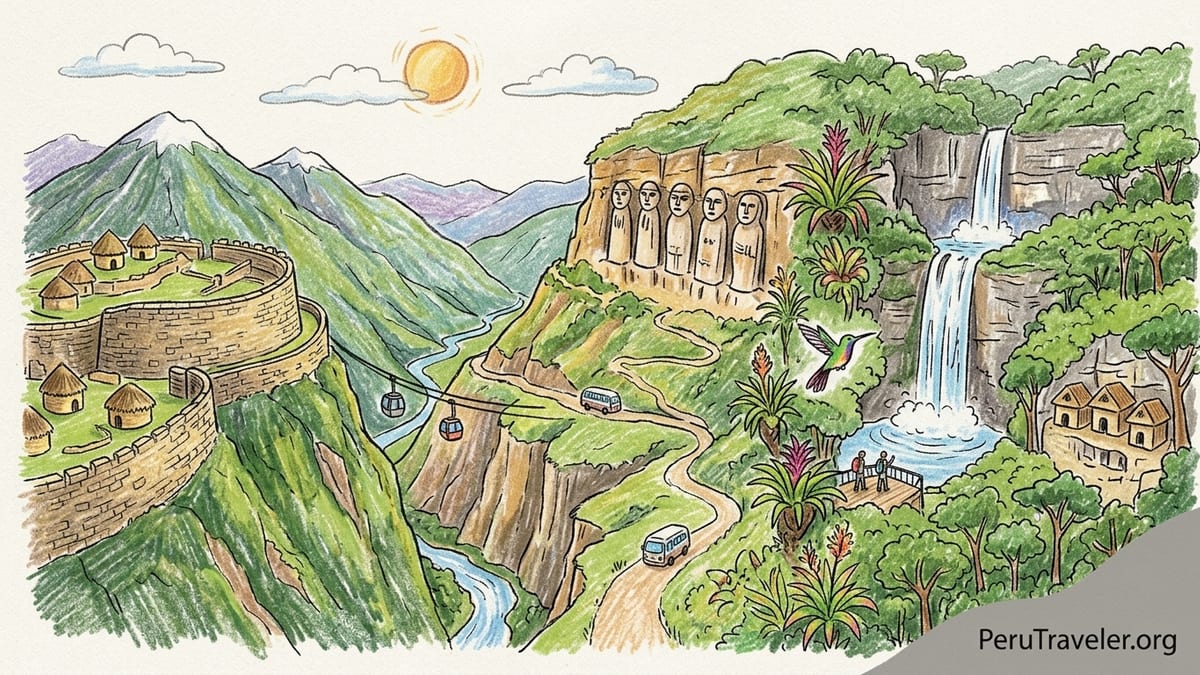
High in Peru’s northern Andes, the Chachapoyas region combines pre-Inca fortresses, cloud-forest waterfalls and quiet rural lodges in a way that few destinations can match. This guide focuses on Kuélap and Gocta Waterfall, but also on the satellite sites, birdlife and countryside accommodation that turn a quick visit into a rich cultural-and-nature trip. It reflects operational realities as of late 2026, based on the latest regional updates and on-the-ground reports.
Why Base Your Northern Andes Trip Around Chachapoyas
Chachapoyas sits around 2,300 meters above sea level in Peru’s Amazonas region, with cool days, misty evenings and a distinct small-town feel. The historic center is compact, with low colonial-era houses and a walkable plaza. From here, day trips reach Kuélap’s mountaintop fortress, the Gocta Waterfall amphitheater, cliffside tombs at Karajía and Revash, and museums housing mummies from highland lakes. The region suits travelers who prefer a slower pace, local guesthouses and hiking over high-volume tourism.
Unlike Cusco or Huaraz, Chachapoyas remains relatively under the radar internationally. That brings trade-offs. There is less crowding at major sites, and many hotels are family-run. On the other hand, direct flights are limited or seasonal, and infrastructure on rural roads can be basic. Planning around realistic travel times, current site rules and the latest conservation measures at Kuélap is essential, especially in 2026 as restored areas reopen with new visitor circuits.
Chachapoyas is best thought of as a hub for several distinct experiences. Kuélap is a dense archaeological complex that rewards unhurried exploration and interpretation. Gocta is a long hike into cloud forest to reach one of the tallest waterfalls in the Andes. Karajía and Revash preserve unusual funerary architecture on sheer cliffs. Leymebamba Museum connects the dots with hundreds of recovered mummies and fine textiles. Add in nearby birding lodges between Chachapoyas and Tarapoto, and you have a northern circuit that can easily fill five days or more.
Logistically, this means dedicating individual days to Kuélap and Gocta rather than trying to rush both. Drives along the Utcubamba valley, cable-car schedules, walking times and weather delays in the cloud forest can all eat into your day. Treating Chachapoyas as a base for three to five nights allows you to adjust for rain, add a museum day if you feel tired, and slot in birdwatching or an extra waterfall without feeling pressed.
Reimagined Kuélap in 2026: Circuits, Access and Tickets
Kuélap, often compared to Machu Picchu for its scale and setting, has undergone significant conservation and stabilization in recent years. After partial closures following wall collapses, the Ministry of Culture progressively reopened sections, and in 2026 the complex operates with expanded and clearly marked visitor circuits. Travelers now generally choose between a complete route, which can take three to four hours at an easy pace, and shorter loops that focus on restored sectors and main viewpoints. These shorter options are important for families, older visitors and anyone adjusting to altitude.
The complete circuit typically follows the outer defensive wall, passes one of the narrow, funnel-like entrances and winds through clusters of circular stone dwellings, some with reconstructed walls and thatched roofs. New viewing areas emphasize restored segments where the iconic friezes and multi-tiered constructions can be seen from different angles. Shorter circuits tend to loop through the most restored residential compounds and main temples, with lookout points over the Utcubamba valley. Rangers and signage explain which sectors remain off-limits for continued stabilization work, and routes may be adjusted during heavy rain to protect both visitors and structures.
Access to Kuélap combines several separate services, which can be confusing if you arrive without a tour. First, there is the cable car system Telecabinas Kuélap, based in Nuevo Tingo about 38 kilometers from Chachapoyas. The concession includes a short shuttle-bus ride from the embarkation station to the cable-car platform and then an approximately 20-minute journey by gondola over a deep valley to La Malca, the upper station near Kuélap. Official information in 2026 notes operating hours from 8:00 to 16:30, Tuesday to Sunday and holidays, with the last same-day ticket sales around mid-afternoon and occasional scheduled closures for maintenance.
Second, there is the archaeological site admission managed by the Ministry of Culture, paid separately at or before La Malca. Recent tariff tables indicate adult tickets in the range of several tens of soles rather than the low historical prices that still circulate in some older guidebooks, so check the latest rate the week you travel or ask your tour operator to confirm. Children, students and seniors usually pay reduced rates. Third, from La Malca you walk roughly 30 to 40 minutes uphill to reach the fortress entrance. This path is free of charge but can be muddy in the rainy season, and horses are sometimes offered locally for those who prefer not to walk. Finally, guided interpretation may be included if you join an agency tour from Chachapoyas, or you can hire licensed guides at the site or via agencies in town.
Telecabinas Kuélap from Nuevo Tingo: How the Journey Works
Travelers visiting independently usually leave Chachapoyas by shared taxi or agency minivan around 7:00 or 8:00 in the morning, reaching Nuevo Tingo after about 1 to 1.5 hours along a paved but winding road down the Utcubamba valley. At the Telecabinas station, you line up at the ticket office, where each person must show their ID or passport. According to recent user guidelines, up to 20 tickets can be purchased per person for future dates, although in peak Peruvian holiday periods the limit may be reduced. Same-day ticket sales typically stop around 15:45, and demand can spike during Semana Santa and Fiestas Patrias.
Once ticketed, you board a shuttle bus for the short climb to the cable-car and then wait for your gondola. The entire transport sequence from base station to La Malca usually takes about 25 to 30 minutes. A practical example from a mid-2026 traveler report describes leaving accommodation in Nuevo Tingo at 8:40 with tickets for a 10:00 slot, reaching the fortress around 10:10 and returning to the village by 14:30 with time for lunch. From La Malca the walking path undulates gently at first and then climbs more steeply toward the massive outer wall of Kuélap, with simple rest shelters along the way.
Return timings matter because weather in this cloud-forest zone can change quickly. In the dry season, between roughly June and September, you may enjoy clear views on the cable car in the morning but see clouds roll in by mid-afternoon. In the rainy season, from about November to April, you should carry a waterproof jacket and protect camera gear. The Telecabinas operate year-round except on scheduled maintenance days or during severe weather. Because Kuélap’s circuits now emphasize both restored and restricted areas, guards may hold visitors at certain points during brief storms to reduce the risk of slips on stone steps.
In Nuevo Tingo, several simple restaurants line the main street near the Telecabinas facility and serve set menus featuring local dishes such as juanes, grilled trout and caldo de gallina. Some travelers choose to overnight here rather than in Chachapoyas so they can take one of the first cable-car departures. That can be a smart strategy if you want quieter conditions inside Kuélap, are traveling with children, or wish to photograph the fortress before larger groups arrive from town. However, evening options in Nuevo Tingo are limited compared with Chachapoyas, and most visitors still prefer to base in the regional capital.
Gocta Waterfall: Cocachimba vs San Pablo Trailheads
Gocta is a multi-drop waterfall over 700 meters high in the cloud forest above the Cocahuayco valley. Visits typically start from one of two communities, Cocachimba or San Pablo, which manage their own trail access and community fees. Hikes are moderately demanding due to distance, mud and humidity, and most travelers dedicate a full day to Gocta alone.
From Cocachimba, the standard trail follows a well-trodden path along the valley before climbing toward the base of the lower drop. Rough distance estimates place the round-trip at approximately 10 to 12 kilometers from the community center, with several steep sections and a mix of packed earth, stone steps and wooden bridges. The trail passes multiple viewpoints where you see both upper and lower sections of Gocta framed by cloud forest and terraced fields. Community information boards at the trailhead indicate an entrance fee, which in 2026 is reported locally as having risen compared with older guidebooks. As prices have changed several times in recent years, travelers should confirm the current rate with their accommodation or agency shortly before hiking rather than relying on pre-2020 figures.
From San Pablo, the trail starts higher and generally offers more direct views of the upper section first, before some itineraries descend to a mid-level lookout over the full waterfall. The total walking distance is similar or slightly shorter than from Cocachimba, but the path can feel tougher on the way back because of the altitude and steeper climbs. Terrain is likewise a mix of muddy earth and stone, with horse hire possible from local residents. Photographically, San Pablo can be rewarding on clear mornings when the upper drop emerges from thin mist, whereas Cocachimba’s classic viewpoint frames the entire cascade with greener foregrounds. During the drier months, water volume is reduced, which can make the falls look more slender but helps keep the trails less boggy; in the wettest weeks, the waterfall is far more powerful but you and your camera may be soaked by spray at the base.
Both communities have local guide associations, and in practice most visitors either hire a guide on arrival or arrange one through their accommodation. Typical arrangements in 2025 and 2026 involve a set community entrance fee plus a separate guide fee based on group size, sometimes with the option of Spanish-only or bilingual guiding. Because these figures are negotiated locally and have shifted with inflation, they cannot be quoted precisely here, but agencies in Chachapoyas and lodges in Cocachimba regularly update their information and can give current numbers in soles or US dollars. For families or occasional hikers, a guide who knows when to propose breaks, where trails are slippery and how to pace the ascent often makes the difference between a strenuous but enjoyable day and an exhausting one.
Horses are a common add-on for those who prefer not to walk the entire distance. In Cocachimba, for example, horses are often used for the first, more gradual segment, with riders walking the final steeper descent to the base. Fees are usually per horse per segment and paid directly to the animal’s owner. Given the steep return climbs from both Cocachimba and San Pablo, especially in midday heat, it is wise to carry more water than you think you will need, wear trail shoes rather than basic sneakers, and plan a flexible return time instead of committing to a tightly scheduled onward bus the same evening.
Karajía, Revash and the Leymebamba Museum
Beyond Kuélap and Gocta, three sites round out the cultural side of a Chachapoyas itinerary: the cliffside sarcophagi at Karajía, the Revash mausoleums and the Museo Leymebamba. All three illustrate how the Chachapoya people used inaccessible rock faces and remote valleys for their burials, and all require some combination of road travel and walking.
Karajía lies north of Chachapoyas and is famous for its individual anthropomorphic sarcophagi, perched on a narrow ledge high on a yellowish cliff. Access typically involves a drive of about two hours and then a hike of around 30 to 40 minutes from the parking area down into a valley and up the other side. Local communities maintain a trail and lookout platforms and charge a modest entrance fee collected at a control point. In recent seasons, travelers have reported that some agencies combine Karajía with the Quiocta Cave or local viewpoints in a long day trip, while others run Karajía-focused excursions that start later to avoid the earliest crowds.
Revash, south of Chachapoyas in the Santo Tomás district, features house-shaped collective tombs built into a limestone cliff at roughly 2,800 meters above sea level. Reaching the viewpoint above the valley involves a road journey toward the village of San Bartolo and then a walk of about 45 minutes to 1.5 hours, depending on the starting point and your pace. Several recent guides describe combined Revash and Leymebamba tours from Chachapoyas with an early departure and a full day of driving and walking. Community or site entrance fees for Revash have historically been small but are not consistently published online, and on-the-ground reports note they have risen since pre-pandemic years. As at Karajía, visitors pay on site, usually in cash, and should carry small bills.
Museo Leymebamba sits near the town of Leymebamba, south of Revash along the Utcubamba valley. It protects more than 200 mummies and associated artifacts recovered from the remote Laguna de los Cóndores. The museum building itself uses local materials like adobe, stone and timber, and displays ceramics, textiles, quipus and metalwork as well as the famous funerary bundles. Official data from Peru’s museum network lists opening hours from 10:00 to 16:30 daily. The same official listing notes tickets sold at the museum, with recent tariffs in the region of 30 soles for adults, around half that for university students and seniors, and a small fee for schoolchildren. Because some online sources still show the previous 15-sol adult rate, travelers should follow the latest information provided on official channels or at the Chachapoyas tourism office.
Given distances, many visitors choose between two patterns: a dedicated Revash and Leymebamba day, leaving Chachapoyas by 7:00 and returning in the early evening, or an overnight in or near Leymebamba to reduce backtracking. The overnight option appeals in particular to birdwatchers, since elevations around Leymebamba and the route toward Abra Barro Negro support a mix of high-Andean and cloud-forest birds, including hummingbirds that frequent lodge gardens and local feeding stations.
Birdwatching and Rural Lodges in the Chachapoyas Corridor
Birdwatchers have quietly been visiting the northern Andes between Chachapoyas and Tarapoto for years, drawn to sites like Abra Patricia, Huembo and the highland lakes around Pomacochas. International tour reports from specialized operators highlight species such as Marvelous Spatuletail hummingbirds at Huembo’s feeders, mixed tanager flocks along the Abra Patricia ridge forests, and various Andean owls and antpittas in cloud-forest ravines. Even for non-specialists, staying at a rural lodge in this corridor can add dawn and dusk birdlife to a cultural itinerary, from hummingbirds buzzing around flowering hedges to tanagers in roadside trees.
Lodges around Huembo and Abra Patricia sit lower or higher than Chachapoyas itself and therefore have different climates. Cloud-forest sites often mean misty mornings and occasional rain even in the “dry” season, as well as cooler nights. Many lodges include guided walks on forest trails as part of their room rates or offer birding packages that bundle accommodation, meals and expert guiding for two or three days. Compared with staying only in central Chachapoyas, these rural bases involve longer transfers to Kuélap or Gocta but may place you closer to Leymebamba, Pomacochas or specific birding hotspots featured in field-guide itineraries.
For travelers whose primary interest is culture but who are curious about birds, a realistic compromise is to spend two or three nights in Chachapoyas town for Kuélap and Gocta, plus one or two nights in a rural lodge between Chachapoyas and Tarapoto. Another option is to base in a quiet rural lodge closer to Cocachimba, where early morning balcony views often capture Andean motmots, toucanets and mixed flocks passing across the Gocta amphitheater. Certain lodges publish naturalist-led “soft birding” walks that focus on easy trails and general wildlife rather than serious species lists, which can work well for families.
Because many birding lodges have few rooms and cater to small-group tours during peak months, advance booking is important, especially from June to August and around Easter. Specialist birding packages usually need even more lead time, as they require coordinating guides, drivers and permit windows. For independent travelers, writing directly to lodges and asking about current road conditions, access to nearby reserves and the latest bird activity is more reliable than relying on generic booking-platform descriptions.
Where to Stay: Chachapoyas Town, Cocachimba and the Countryside
Accommodation in and around Chachapoyas falls into three broad zones: central Chachapoyas, the Gocta valley (especially Cocachimba) and rural lodges scattered along the routes toward Tarapoto and Leymebamba. Your priorities for restaurants, early tour departures, scenery and quiet should determine where you spend the bulk of your nights.
Central Chachapoyas offers the most services. Around the plaza and surrounding blocks, you find small hotels and guesthouses ranging from budget inns to mid-range boutique properties in remodeled colonial houses. Many agencies that run Kuélap, Gocta, Karajía and Revash tours maintain offices here, and shared taxis and regional buses depart from or near town. If you prefer walking out in the evening for varied restaurant choices, coffee shops and small supermarkets, basing here for at least the first nights is practical. Mototaxis are inexpensive for short hops between bus terminals and hotels, with recent local surveys confirming prices of only a few soles per ride.
Cocachimba, on the other hand, is all about the Gocta view. Several lodges and guesthouses face the amphitheater so that you wake up to the waterfall framed between green slopes. Nights are generally quieter than in Chachapoyas, and you can start the Gocta hike directly from your doorstep or with a short mototaxi ride to the San Pablo side. Downsides include more limited restaurant choice and less convenient departure points for Kuélap or the southern archaeological sites. Some travelers split time, starting in Chachapoyas for Kuélap and Karajía, then moving to Cocachimba for one or two slower days focused on hiking and relaxation.
Rural lodges along the Utcubamba and toward Tarapoto tend to focus on nature, birding and tranquility. Properties near Pomacochas Lake or Huembo, for example, combine simple but comfortable rooms with surrounding gardens, forest patches and, often, hummingbird feeders. These lodges are typically reached by prearranged transfer or intercity bus drop-offs plus a short taxi ride. They work especially well in four- or five-day itineraries where you want to avoid rushing directly back to a larger hub after Kuélap and Gocta. Because Google and online mapping apps sometimes underestimate travel times on these curving mountain roads, ask your lodge or agency for realistic estimates when planning onward connections.
Getting To and Around Chachapoyas in 2026
Access to Chachapoyas has evolved over the past decade, but as of 2026 it is still shaped more by road than by frequent scheduled flights. The regional airport outside Chachapoyas has seen intermittent commercial service in the past, and new interregional routes are periodically announced, but travelers should verify any flight option shortly before booking, as timetables can change or be suspended. For many visitors, the most reliable approach is to combine an internal flight to another northern city with a bus or shared taxi to Chachapoyas.
From Lima, one common route is to fly to Chiclayo on the north coast and then continue by night bus to Chachapoyas, a journey of around nine hours with reclining seats offered by major Peruvian bus companies. Another increasingly popular route is via Jaén, which has an airport linked to Lima and acts as a gateway to the Utcubamba valley. From Jaén, road distance to Chachapoyas is roughly 180 kilometers, taking about four hours by bus or shared taxi. To the east, Tarapoto in San Martín region functions as a rainforest gateway; from there, shared cars and minibuses travel across the Andes to Chachapoyas in about eight hours on a paved highway.
Within the region, transport mixes formal and informal options. Mototaxis dominate short trips in Chachapoyas itself. For day tours, most visitors book through agencies that provide minibuses or 4x4s and handle local access arrangements at communities. Independent travelers can sometimes piece together routes with a combination of intercity buses, shared cars known as colectivos and hired taxis, especially to reach Nuevo Tingo, Cocachimba or Leymebamba. However, departure times for colectivos are often approximate and based on filling seats, so planning tight same-day connections to flights is risky.
Road conditions vary widely. Main routes along the Utcubamba and to Jaén or Tarapoto are paved, but sections may be narrowed by landslides in the rainy season, leading to delays while machinery clears debris. Secondary roads to villages like San Bartolo near Revash can be rough or muddy. Checking recent news or asking local operators for updates is sensible, particularly if traveling between November and April when heavy rains are more frequent in this part of the Andes and cloud forest.
Why Kuélap and Gocta Deserve Separate Days
On a map, Kuélap and Gocta do not look especially far apart, and some older itineraries advertise combined day trips that attempt to visit both. In practice, treating them as separate full days is almost always the better choice. Each site involves at least three distinct time blocks: the road approach, access logistics and the on-site experience. Compressing both into one outing can mean spending most of your time in vehicles and hurrying through the very places you came to see.
For Kuélap, a reasonable independent timetable from Chachapoyas might look like this: departure around 7:30, arrival at Nuevo Tingo by 9:00, cable-car and walk to reach the fortress entrance by 10:00, and then three hours on the upper circuits before descending for a late lunch and a mid-afternoon drive back to town. That already fills eight to nine hours. Any delays in buying Telecabinas tickets, weather pauses or a desire to explore the longer circuit can push your return later, especially if you linger at viewpoints or in the small onsite interpretation areas.
Gocta requires a different kind of time commitment. Even fit hikers rarely complete the Cocachimba trail to the lower waterfall and back in under five hours, and many take six or more with photo stops and breaks. If you add time to arrange a guide, pay community fees, wait for a horse or share lunch in Cocachimba afterwards, the day easily extends from 8:00 to 16:00 or beyond. Trail sections can become slippery by afternoon, which slows your pace on the return climb. Trying to squeeze Kuélap into the same day would either necessitate a very rushed walk through the fortress circuits or a very late return by mountain roads after dark.
Splitting Kuélap and Gocta over two days also hedges against weather. In a cloud-forest environment, visibility at one site may be poor while the other remains perfectly enjoyable. If your first scheduled Kuélap day dawns foggy, you might swap it with Gocta, where mist can add atmosphere on the trail even if the top of the falls is partly hidden. Conversely, if heavy rain turns the Gocta path into deep mud, you might prefer the more solid walkways and stone paths of Kuélap that day. Keeping some flexibility and generous margins between major excursions increases the odds that your photos and memories match the region’s potential.
Sample 3-, 4- and 5-Day Chachapoyas Itineraries
While every trip is different, the following sample itineraries show how to arrange Kuélap, Gocta and the surrounding sites without rushing. They assume you arrive in Chachapoyas the evening before Day 1 and depart the morning after the final day.
Over three days, a focused cultural-nature itinerary might dedicate Day 1 to Kuélap via Telecabinas from Nuevo Tingo, with an early start and unhurried three-hour circuit. Day 2 would then center on Gocta from Cocachimba, with an overnight there to enjoy the waterfall view and a quieter evening. Day 3 could combine a morning stroll or shorter hike in Cocachimba with a transfer back to Chachapoyas for your onward bus or flight connection. This pattern suits travelers short on time, though it leaves no room for Karajía, Revash or Leymebamba.
With four days, you gain flexibility. One realistic plan is to base in Chachapoyas for three nights and Cocachimba for one. Day 1 covers Kuélap. Day 2 tackles Karajía, possibly with a secondary stop such as a nearby cave or village viewpoint arranged by your agency. Day 3 moves you to Cocachimba with a half-day Gocta hike or simply balcony time if you prefer to rest. Day 4 then offers either a fuller Gocta route or a return to Chachapoyas with a short town walk and museum visit before your departure the next morning. Alternatively, a four-day schedule could swap Karajía for a Revash and Leymebamba loop if you are particularly interested in mummies and funerary architecture.
Five days open space for a rural lodge stay or deeper birdwatching. One option is to spend two nights in Chachapoyas, one in Cocachimba and two at a nature lodge near Huembo or Pomacochas en route toward Tarapoto. In that case, Days 1 and 2 might focus on Kuélap and Karajía, Day 3 on Gocta and the move to Cocachimba, and Days 4 and 5 on birding and lakeside walks before continuing east. Another configuration for history enthusiasts would be three nights in Chachapoyas and two in or near Leymebamba, allowing a full Revash and Leymebamba day without rushing and a spare day for local walks or birding above the town.
Throughout these itineraries, you can mix independent hotel bookings with pre-arranged excursions or package stays. Chachapoyas town hotels often work with multiple agencies, so you can shop around for Kuélap or Gocta day tours on arrival. In contrast, rural lodges and some Gocta-view properties commonly offer packages that include breakfast, dinner and guided activities. These can simplify logistics and ensure guide availability but require firmer advance commitments. If you travel in high season or with a family group, reserving at least Kuélap and Gocta days, plus any specialist birding, before you arrive is sensible.
Independent Bookings vs Lodge and Tour Packages
Deciding whether to book everything piecemeal or rely on packages depends partly on your travel style and partly on the season. In the Chachapoyas region, independent travelers can often secure town accommodation and day tours after arrival, especially outside major Peruvian holidays. However, Kuélap’s Telecabinas schedule, community trail quotas and guide availability for Gocta, as well as limited room counts at rural lodges, mean that some elements benefit from early planning.
Independent booking typically involves reserving hotels in Chachapoyas and Cocachimba online, then hiring agencies or guides in town for Kuélap, Karajía and Revash, and arranging Gocta guides directly through your Cocachimba or San Pablo lodging. This approach gives you freedom to adjust plans based on weather or energy levels. It also lets you compare agency prices and group sizes in person. On the other hand, you assume responsibility for piecing together transport between each leg, for example making sure your Kuélap day tour returns in time for a night bus or that your Gocta hike finishes before an onward transfer to Jaén.
Package arrangements fall into two broad categories. First, there are agency-based “Chachapoyas circuits” that include town accommodation, airport or bus-station transfers and fixed excursions to Kuélap, Gocta and one or two additional sites over three or four days. Second, some countryside lodges, particularly those focused on birding or wellness, offer multi-night stays with included activities and transfers from Chachapoyas, Jaén or Tarapoto. In both cases, you gain simplicity and the security of having one point of contact, at the cost of less day-by-day flexibility and sometimes higher per-night rates than booking each element yourself.
As of 2026, inflation and fuel costs have pushed tour prices upward across Peru, including Amazonas region. Reputable operators in Chachapoyas are transparent about what their Kuélap or Gocta packages include: Telecabinas tickets, archaeological entrance fees, community fees, guides, lunch and hotel pick-up. When comparing offers, pay close attention to group size limits, whether English-speaking guides are guaranteed or “subject to availability,” and cancellation terms in case road closures or severe weather force rescheduling.
The Takeaway: Who Chachapoyas Suits and What to Book Ahead
For history enthusiasts, Chachapoyas offers a rare chance to see a pre-Inca highland culture in context. Kuélap’s expanded 2026 circuits, with restored sectors and new viewpoints, reward slow exploration with a knowledgeable guide who can explain defensive architecture, ritual spaces and everyday domestic life. Combining the fortress with Karajía’s cliffside sarcophagi, Revash’s house-shaped tombs and Leymebamba’s mummy collections creates a multi-day narrative that complements, rather than duplicates, a classic southern Peru itinerary around Cusco and Machu Picchu.
Photographers will find strong opportunities at both Kuélap and Gocta, as well as in the rural landscapes between them. Early cable-car departures and late-afternoon returns offer side light on the fortress walls and surrounding ridges, while Gocta’s amphitheater, especially seen from Cocachimba or San Pablo in variable cloud and sun, changes character hourly. Village scenes, local markets in Chachapoyas and misty mornings around Leymebamba add quieter frames. To maximize results, it is worth planning Kuélap and Gocta days separately, carrying rain protection for gear and choosing lodges with open views rather than inner courtyards alone.
Birdwatchers and nature lovers can treat Chachapoyas as the cultural anchor of a broader northern Andes loop. A balanced plan might pair Kuélap and Gocta with at least two nights at a birding lodge near Huembo or Abra Patricia, or a countryside inn with gardens and forested slopes. Specialist birding outfits already run regular itineraries through this corridor, citing reliable encounters with Andean and cloud-forest species. Independent travelers interested in birds, but not necessarily in hardcore listing, can choose accommodations that advertise feeders and short trails and then ask on arrival about local guides or recommended dawn walks.
Families and couples seeking a quieter northern Peru experience will appreciate that Chachapoyas remains less crowded and commercial than some other highland hubs. For families, it is crucial to allow acclimatization, choose the shorter Kuélap circuits and consider using horses for parts of the Gocta trail. Stays in Cocachimba or a rural lodge with gardens can provide downtime between big excursion days. Couples, meanwhile, often gravitate to Gocta-view rooms in Cocachimba, combining a Kuélap day trip with slower mornings and evenings watching clouds drift across the waterfall amphitheater.
In terms of advance booking, three elements stand out for 2026. First, secure accommodation with good cancellation terms in Chachapoyas and any rural lodges or Cocachimba hotels you particularly like, especially for June to August, Easter and national holidays. Second, pre-arrange at least your Kuélap and Gocta excursions, whether through agencies or directly with lodges, confirming what tickets and community fees are included and how long you will have on site. Third, if you want a specialist birdwatching guide or a custom itinerary that combines Revash, Leymebamba and remote reserves, start inquiries several months before travel. With those core pieces in place and an extra buffer day where possible, Chachapoyas can deliver one of Peru’s most rewarding blends of archaeology, waterfalls, birds and countryside hospitality.
FAQ
Q1. Is Kuélap fully open in 2026, and what has changed with the new circuits?
As of late 2026 Kuélap has reopened substantial areas with defined visitor circuits, including a complete route of about three to four hours and shorter loops focusing on stabilized, restored sectors. Some zones remain closed for ongoing conservation, but the new layout offers more structured paths, additional viewpoints over restored walls and clearer separation between groups to protect fragile structures.
Q2. How long should I plan for a visit to Kuélap from Chachapoyas?
From Chachapoyas, a realistic Kuélap day takes eight to nine hours door to door. That includes roughly 1 to 1.5 hours by road each way to Nuevo Tingo, time to buy Telecabinas tickets, around 25 to 30 minutes by shuttle and cable car, a 30- to 40-minute walk from La Malca to the fortress entrance and two to three hours exploring the circuits, plus a lunch stop.
Q3. Can I visit Kuélap and Gocta Waterfall in a single day?
While certain agencies advertise compressed itineraries, it is generally not advisable to combine Kuélap and Gocta in one day. Doing so means very early departures, long hours in vehicles and shortened time at both sites. Most travelers are happier dedicating one full day to Kuélap and another to Gocta to allow for weather, walking pace and photo stops.
Q4. What are the main differences between the Cocachimba and San Pablo trails to Gocta?
The Cocachimba trail is the most popular and leads primarily to the base of the lower waterfall, with a round-trip walk of around 10 to 12 kilometers through valley and forest. The San Pablo side starts higher and emphasizes views of the upper section first, with steeper climbs on the return. Both involve mud and uneven terrain, but Cocachimba is generally considered slightly more gradual, while San Pablo offers some distinct photographic angles of the upper drop.
Q5. How much do community fees and guides cost at Gocta and the archaeological sites?
Community entrance fees and guide rates at Gocta, Karajía and Revash are set locally and have increased in recent years with inflation. Rather than quoting outdated figures, it is best to ask your Chachapoyas agency or lodge a week or two before arrival for current amounts in soles. Many agencies now include these fees in their day-tour prices and can explain exactly what is covered.
Q6. Is Chachapoyas suitable for children and older travelers?
Yes, with thoughtful planning. Selecting shorter Kuélap circuits, considering horse assistance on steeper segments of the Gocta trail, allowing extra days for rest and choosing accommodations with easy access and on-site dining all help. Families often base part of their stay in Cocachimba or a rural lodge where there is space to play and relax between excursions, while older travelers may prefer to focus on Kuélap, Karajía and Leymebamba with more limited hiking.
Q7. Do I need to book Telecabinas Kuélap tickets in advance?
For most days you can buy Telecabinas tickets at the Nuevo Tingo station on the morning of your visit, but during Easter, Fiestas Patrias and peak Peruvian vacation weeks advance coordination is important. Many Chachapoyas agencies secure slots for their groups, and independent travelers should arrive early or visit the station the day before if staying in Nuevo Tingo. Always check the latest operating calendar to avoid maintenance closures.
Q8. What is the best season to visit Chachapoyas, Kuélap and Gocta?
The drier months from about June to September tend to offer more stable weather, firmer trails and clearer views, although clouds are common year-round in this region. The rainy season from roughly November to April brings heavier downpours, muddier paths and higher water volume at Gocta. Shoulder months like May and October can provide a good balance of green landscapes and manageable rain, but flexibility in your daily plans remains important in all seasons.
Q9. Are there ATMs and card payment options in the region?
Chachapoyas town has several ATMs and larger hotels and restaurants increasingly accept card payments. However, Telecabinas tickets, community fees at trailheads and small village purchases are typically cash-only. Visitors should carry enough soles in small denominations before heading to Nuevo Tingo, Cocachimba, Karajía, Revash or Leymebamba, as card readers and ATMs are scarce in rural communities.
Q10. How many days do I really need in Chachapoyas if I want both culture and nature?
A minimum of three full days allows for Kuélap and Gocta with one additional excursion or a lighter buffer day. Four days let you add Karajía or a Revash and Leymebamba loop without rushing, while five days or more create space for a stay in a rural birding lodge or extra hikes in the Gocta valley. Travelers interested in both archaeology and wildlife tend to find four to five days the most satisfying balance.