


The Tambopata region of southern Peru offers one of the world’s most accessible chances to watch wild macaws gathering in the hundreds at natural clay banks. From Puerto Maldonado you can reach famous macaw clay licks such as Chuncho and Colorado, stay at research lodges deep inside Tambopata National Reserve, or base yourself at smaller lodges closer to town that visit more modest parrot licks. Choosing between a brutally early departure, an upriver lodge stay and a full multi-day macaw program has a direct impact on what you will actually see through your binoculars and camera viewfinder. This guide explains the practical differences and helps you match the right Tambopata macaw experience to your time, budget and photographic ambitions.
Understanding the Tambopata Macaw Clay Licks
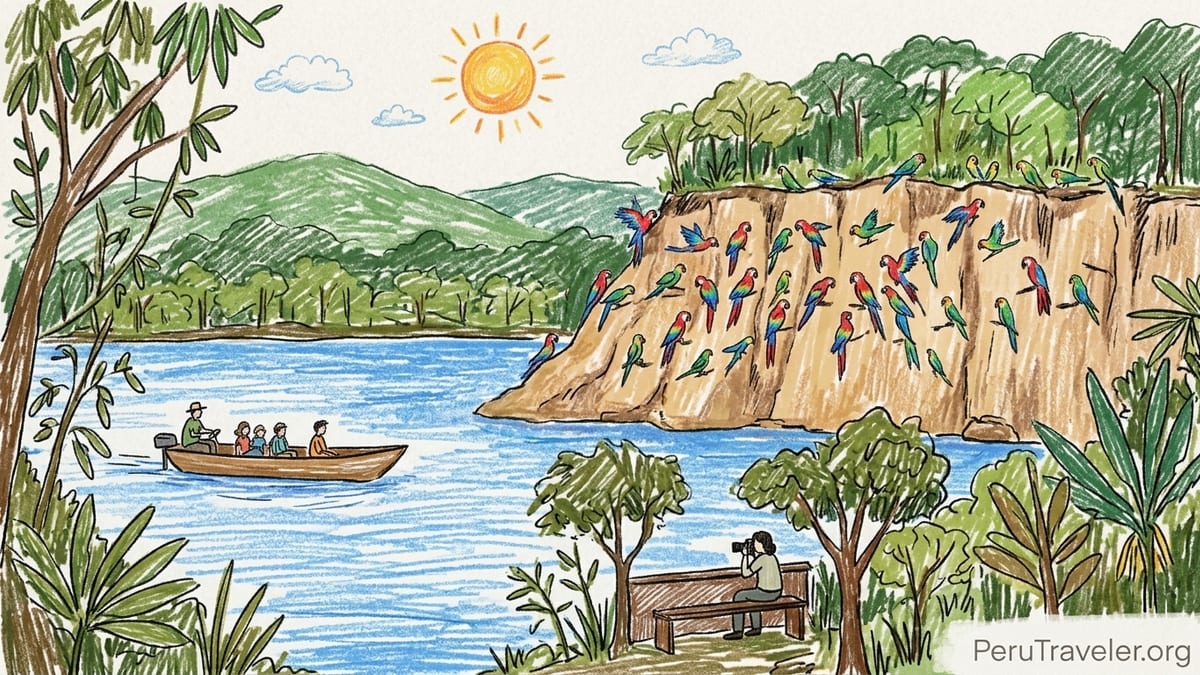
Tambopata National Reserve protects lowland Amazon rainforest along the Tambopata River in Peru’s Madre de Dios region. Within this mosaic of oxbow lakes, river beaches and terra firme forest are a series of naturally occurring clay banks where macaws, parrots and parakeets gather to eat mineral rich clay. The best known macaw licks accessible from Puerto Maldonado are Chuncho, several hours upriver, and Colorado, associated with the remote Tambopata Research Center. Both are within or adjacent to the reserve and reached only by river, which is why most serious macaw photography trips involve at least one night at an upriver lodge.
On a good clear morning at a major lick such as Colorado, visitors may see hundreds of large macaws circling and then settling on the vertical clay bank in tight, noisy clusters. Smaller licks closer to Puerto Maldonado and around mid-river lodges can still be rewarding, but often host more mixed flocks of parrots and parakeets, with macaws present in lower numbers or at greater distance. The spectacle is more intimate, but for many travelers it is more than enough to feel immersed in the birds’ world without the cost and travel time of reaching the very upper Tambopata.
The clay itself is usually a pale grey or tan, cut into a natural cliff by the river. Guides will settle you into a simple hide or on benches along the riverbank well before the birds descend. Activity tends to peak in the early morning, often between about 06:30 and 08:30, though the exact timing shifts with weather and season. In practice you will be sitting quietly for several hours, so it is worth thinking about comfort, clothing and protection for camera gear before you even board the boat in Puerto Maldonado.
Researchers studying macaws at Colorado and other licks have linked clay eating to neutralising toxic compounds in natural foods and obtaining essential minerals. For travelers, this behaviour explains why even pristine forest without a lick will rarely offer the same dense, reliable macaw concentrations. The concentration at clay banks is what makes Tambopata uniquely attractive to bird photographers who want more than distant flight shots.
Chuncho: The Classic Macaw Day Trip From Puerto Maldonado
Chuncho is the name that appears on most locally advertised “Macaw Clay Lick” excursions from Puerto Maldonado. Tour companies in town and online platforms sell full day trips that leave very early by road, then continue by boat up the Tambopata River to reach the lick. Several operators describe departures from around 02:30 to 03:00 from Puerto Maldonado, followed by roughly 3 hours on a combination of rough road and boat before dawn. This timetable is designed so the boat arrives at Chuncho shortly after first light, when macaws begin to gather in the trees above the cliff.
For travelers who do not want to commit several days and higher budgets to a deep jungle lodge, the Chuncho day tour can be an appealing compromise. You can sleep in a simple hotel in Puerto Maldonado, be collected at your door, visit the lick and be back in town by late afternoon or early evening. Prices promoted in late 2026 for full day Chuncho trips typically sit somewhere around the equivalent of a mid-range day tour in Peru, with inclusions such as transport, breakfast and lunch. Some operators sell the same itinerary as part of 2 day or 3 day macaw packages that add a night at a rustic lodge along the access road or river, plus a night walk or lake visit.
From a wildlife perspective, the downside of a same day Chuncho dash is its vulnerability to weather and timing. If rain, fog or heavy cloud move in just as you arrive, the macaws may delay feeding or not descend to the clay at all, and there is no second morning built into the itinerary. Photographers are also limited by whatever hide or boat position is available when their group arrives, which may be further from the main part of the bank than the angles used by groups that have stayed nearby and reached the lick even earlier.
Travel fatigue can also be a factor. Leaving town at 02:30, jolting along an unpaved road, then transferring to an open boat in pre-dawn chill makes the first macaws a thrilling reward but can be a struggle for younger children or anyone sensitive to long travel days. For some travelers, booking a 3 day / 2 night Chuncho program that stays at a basic lodge closer to the river is a more comfortable way to experience the same clay lick without the most extreme start times.
Colorado and the Tambopata Research Center Experience
Colorado is the clay lick associated with the Tambopata Research Center, historically a base for long term macaw research and one of the deepest jungle lodges that accepts regular tourism in the region. The Colorado lick sits upriver from Chuncho, inside the protected heart of Tambopata, in a stretch of largely unbroken primary forest. Reaching it from Puerto Maldonado requires a longer boat journey than Chuncho, typically broken by at least one overnight stop at a mid-river lodge used by the same operator.
Multi-night packages marketed around the Tambopata Research Center often run four days and three nights or longer. Guests usually spend the first night at a lodge nearer Puerto Maldonado, such as a sister property in the buffer zone, then continue upriver to spend two or more nights at or near the research center. Trips include dawn visits to the Colorado macaw lick, smaller parrot licks along side streams, and extended forest walks. Because you wake up minutes from the boat landing rather than three hours away in town, guides can adjust the exact departure to match the morning’s cloud and rain pattern.
In addition to macaws, these deep forest itineraries highlight mammals and specialty birds that are harder to encounter near town. Travelers regularly report seeing giant river otters on oxbow lakes, several species of monkeys, agoutis, peccaries and a long list of antbirds, manakins and other understory specialists. Night walks may reveal everything from tree frogs to tarantulas and sleeping birds. For bird photographers, the density and diversity of wildlife encounters at these distances from Puerto Maldonado can justify the significantly higher overall cost compared with a single macaw day tour.
The Colorado experience does come with trade-offs. Travel time from Puerto Maldonado airport to the remote lodge can easily reach 7 or more hours across road and boat segments. Packages tied to research lodges tend to be among the most expensive offered in Tambopata, with rates quoted in major currencies and structured as all inclusive programs that bundle guiding, accommodation, meals and transport. For travelers whose primary goal is a single morning with macaws rather than a full immersion in Amazon ecology, that price difference can feel steep, even though the cost per activity is often reasonable when broken down.
Smaller Clay Licks and Lodge-Based Macaw Viewing
Not every visitor to Puerto Maldonado needs to reach Chuncho or Colorado to enjoy quality time with parrots and macaws. Several lodges in the buffer zone around Tambopata National Reserve, and along the Madre de Dios River, market access to closer clay licks that can be visited in a short pre-breakfast outing. Some, like those near the Tambopata River’s lower stretches, can be reached by boat in less than an hour from mid-range lodges. These licks may not see the sheer numbers of large macaws that define the most famous sites, but they can offer excellent opportunities to watch mixed flocks at relatively close range without the long travel commitments.
For example, some lodges advertise early morning departures around 05:00 to reach nearby parrot and small macaw licks, returning for a late breakfast before continuing with other activities such as canopy tower visits or lake excursions. Guests might observe species like yellow crowned parrots, mealy amazons, white eyed parakeets and smaller macaw species feeding on the clay while red and green or scarlet macaws circle overhead or perch in adjacent trees. For families or travelers who value variety over a single signature spectacle, this combination of several shorter outings can be more engaging than one very early departure that revolves entirely around a single lick.
Some higher end properties closer to town have developed their own private clay licks on side streams or within short walking distance of the lodge. Because access is limited to in house guests, viewing groups remain small and photographers can spread out more easily along the viewing area. These setups also simplify logistics: you sleep in a comfortable room, walk out before dawn with your guide, and arrive at the hide before the first birds appear, with no night time road journeys.
When comparing lodge based licks with Chuncho or Colorado, the key differences are scale and reliability. Larger licks deeper inside the reserve tend to host more macaws on more days of the year, though no site offers guaranteed numbers. Smaller licks may be more affected by recent river levels, predation events or disturbance. Travelers deciding between them should think carefully about whether they are chasing a once in a lifetime mass macaw spectacle or seeking a broader Amazon experience where macaws are an important, but not exclusive, highlight.
Early Starts vs Staying Upriver: What Really Changes
From a practical travel planning perspective, one of the biggest decisions is whether to base in Puerto Maldonado or at a lodge closer to the macaw licks. A very early departure from town for a Chuncho day tour keeps your hotel options open, but at a cost in sleep and flexibility. You will be collected in the middle of the night, driven several hours, then moved to a boat so that you reach the riverbank opposite the lick at the correct window of light. If rain or mist delay the birds, there is limited room to adapt the schedule because you still need to make the full return journey before dark.
Staying at an upriver lodge, whether one linked to Chuncho, Colorado or a smaller clay lick, shifts that dynamic. Instead of a 02:30 pick up, you may wake between 04:30 and 05:00, have a quick coffee and board the boat from the lodge’s own dock. The boat ride to the lick could be 30 to 90 minutes, and if conditions are not favourable when you arrive, your guide may have some freedom to wait longer or adjust the vantage point. You will almost always be ahead of day trip groups coming from town, which often arrive after the dawn peak of activity.
Another important difference is the cumulative wildlife viewing time. Travelers who rush in and out for a single macaw session often comment that they saw little else along the way. Those who spend three or four nights at an upriver lodge build in repeated opportunities for lake visits, canopy platforms, mammal clay licks, night walks and general river cruising, each of which can produce memorable sightings. Over several days, even if one macaw morning is quiet because of weather, the overall experience tends to feel rewarding.
On the other hand, staying upriver means paying for a full package that bundles accommodation, meals and guiding, and dedicating several days of your itinerary. Independent travelers who prefer to organise and pay elements separately will find fewer options the further up the river they go. Once you reach lodges near Chuncho or Colorado, nearly everything functions on a fixed program basis rather than a pick and mix menu of excursions sold from town.
Permits, Authorized Operators and What Is Included
Tambopata National Reserve is a protected area administered by Peru’s national protected areas service. Officials emphasise that visitors must hire services from tour operators and guides authorized to work inside the reserve. The agency publishes directories listing companies and lodges granted permission to operate within Tambopata, which are updated periodically. Before booking, travelers can ask an operator for its company name and tax number, then cross check it against the most recent official directory or contact the reserve office in Puerto Maldonado for confirmation.
Entrance to Tambopata National Reserve is controlled, and access to specific zones such as the upper Tambopata where Colorado lies is limited to a smaller number of operators. Some mid-range Chuncho day tours quote a separate reserve fee, often collected in cash on departure or arrival at a checkpoint. Others fold the fee into an all inclusive price. Multi day lodge packages linked to established operators usually include the reserve admission in their published rates. When comparing offers, it is important to ask explicitly whether the Tambopata reserve fee is included, and whether there are any additional park or community charges for particular activities like visiting specific clay licks or oxbow lakes.
River transportation is another element that varies between tours. Most clay lick itineraries combine road and boat segments. Day tours to Chuncho commonly drive along a rural road from Puerto Maldonado for several hours, then transfer to a motorized canoe for the final stretch upriver. Packages for Colorado and deep Tambopata lodges rely mostly on boat transport from a river port reached by shorter road transfer. Because these boats are open and exposed to sun and occasional rain, travelers should pack dry bags, waterproof covers and light layers. Asking how long each segment will take, what type of boat is used and whether there is shade can help set realistic expectations, especially for families with children.
Authorized operators are also expected to follow codes of conduct around wildlife viewing, including maintaining minimum distances from clay licks and limiting group sizes at specific observation points. When discussing options, travelers can ask potential providers what guidelines they follow at the licks, whether they use hides or stay in boats, and how they manage crowding when multiple groups arrive at once. Clear, specific answers are a good sign that the company takes regulations and animal welfare seriously.
Day Tours vs Lodge Packages: Cost and Wildlife Value
Comparing the value of a single macaw focused excursion with a three or four night lodge stay means looking beyond the headline price. In Puerto Maldonado, commercial agents on the main plaza may quote eye catching low prices for clay lick tours that cover the boat ride and guide only, with meals, entrance fees and transfers charged separately. Other agencies present all inclusive Chuncho day tours that bundle hotel pick up, road transfer, boat transport, a simple breakfast and lunch, guiding and the reserve fee. By the time you include these extras, the gap between budget and mid range day trips often narrows.
Multi night lodge packages around Chuncho or Colorado initially appear more expensive because they include airport pick up, all river transport, accommodation, most or all meals, guiding and a full schedule of activities: the macaw lick, visits to oxbow lakes, night excursions, canopy platforms and sometimes cultural visits to local communities. Once you account for what you would otherwise spend on hotels and meals in town and add the cost of separate day tours to lakes, night walks and river trips, the per day difference between a quality lodge program and stitching together multiple independent excursions can be smaller than it seems.
Travelers report a broad range of prices for 3 and 4 day Tambopata lodge packages, reflecting differences in comfort, remoteness and brand. Budget friendly lodges in the buffer zone with access to smaller licks may charge rates that work out only modestly higher per day than a cluster of day tours from Puerto Maldonado. Deep reserve lodges tied to long running research projects usually sit at the higher end of the market, with rates that can exceed what many visitors to Peru budget for their Amazon segment. For serious birders and photographers, paying that premium can be justified by access to world class clay licks and high quality guiding. Casual visitors may be better served by a mid range lodge closer to town that still includes at least one reliable parrot or small macaw lick.
Another cost factor is equipment and support for photography. Some lodges and specialised birding tours provide stable benches, beanbags and even basic tripods at hides. A few high end operators offer rental binoculars for guests. Most budget day trips to Chuncho do not include such extras, so photographers must bring their own support and accept that viewing angles may be shared with a larger group. When enquiring, ask whether the macaw observation will be from a fixed hide on land or from a boat, as this affects both the stability for long lenses and the practical minimum shutter speeds you will need.
Bird Species, Viewing Distances and Photography Conditions
The headline species at Chuncho and Colorado are the large macaws: scarlet macaw, red and green macaw and blue and yellow macaw. In addition, visitors often see smaller blue headed macaws and chestnut fronted or red bellied macaws, as well as an array of parrots and parakeets. At smaller licks closer to Puerto Maldonado, the mix may shift toward more medium sized parrots such as mealy and yellow crowned amazons, white eyed and dusky headed parakeets, with large macaws appearing less frequently or in smaller numbers.
Viewing distances vary significantly between sites. At some clay licks, hides or riverbank benches may be positioned roughly 30 to 60 meters from the birds, offering excellent views to the naked eye and through standard 8x or 10x binoculars. At others, especially when observation must be from a boat on the river, the birds may be 80 meters or more away, which makes a noticeable difference for photography. For close portraits of feeding macaws at most licks, many visiting photographers favour focal lengths in the 300 to 500 millimeter range on full frame cameras. Those using crop sensor bodies may find 300 millimeters sufficient, though having extra reach is rarely regretted.
Light conditions at the licks can be tricky. Activity often begins in low pre-dawn light, with high contrast patches as the sun rises and strikes the pale clay and bright plumage. Humidity is high, and light rain or mist is common. Fast lenses help keep shutter speeds up while avoiding extreme ISO settings. Tripods or monopods are useful in hides, but may be cumbersome on narrower platforms or in boats. Beanbags placed on railings or benches can provide a more flexible support. Because guests must remain quiet and movement is limited, it is wise to set up your gear and test exposure as soon as you arrive, before the first flocks begin to circle.
Most operators and lodges ask guests not to use drones at or near clay licks, and regulations inside Tambopata National Reserve are restrictive regarding drone flights. The noise and visual presence of drones can disturb macaws and other wildlife. Similarly, guides typically instruct visitors not to attempt to approach the birds on foot beyond designated hides or viewing areas. Flash photography is either prohibited or strongly discouraged because it can startle birds and is unnecessary in the open air light of most licks once the sun is up.
Weather, Seasonality and Managing Expectations
Even when you reach a macaw clay lick at the technically correct time, there is no guarantee that large numbers of birds will descend to feed. Rain, strong wind, heavy cloud cover and the presence of predators such as raptors can all suppress activity. On wet mornings, macaws and parrots may prefer to stay in canopy trees, preening and waiting for conditions to improve. Sometimes they may gather in treetops above the lick, calling loudly but never coming down to the clay, a behaviour that can be both tantalising and frustrating for visitors.
Seasonally, activity can fluctuate with the fruiting cycles of trees and with river levels. During periods when natural foods high in certain compounds are abundant, macaws may visit licks more frequently to balance their diet. In drier months when river levels are low and more clay banks are exposed, there may be more potential feeding sites, which can dilute numbers at any single lick. It is difficult to predict exact best weeks in advance, and different guides offer varying personal opinions based on recent seasons, but mid year to early dry season windows are often popular with tour operators.
No responsible operator should guarantee a particular number of macaws or promise the “classic” wall of birds photograph. Marketing materials may show spectacular images taken over many years and multiple visits. Travelers should see these as examples of what is possible rather than expectations for a single morning. When evaluating tours, be cautious of any provider that uses absolute language about wildlife sightings or offers compensation specifically tied to macaw numbers. A more honest approach emphasises probabilities, recent observations and the broader set of experiences included in the itinerary.
For this reason, photographers and dedicated birders often choose itineraries with at least two mornings scheduled at a clay lick, whether that means a longer stay at a lodge near Chuncho or multiple days at a deep reserve lodge like those associated with Colorado. Building in that margin of error increases the chance that at least one session will coincide with favourable conditions, even if another morning is washed out by rain or dominated by a wary atmosphere after a predator sighting.
Who Should Choose What: Matching Trips to Traveler Types
Casual visitors to southern Peru who want a taste of the Amazon and at least a chance of seeing macaws are often well served by a two or three night lodge stay in the buffer zone around Tambopata or along the Madre de Dios River that includes access to a nearby parrot or small macaw lick. These packages usually bundle airport transfers, river transport, comfortable accommodation, meals and a variety of guided activities. Macaws may be only one element alongside lake canoeing, canopy tower views and night walks, but the overall experience feels rich and manageable without extreme wake up times or very long boat rides.
Serious bird photographers and dedicated birders whose main priority is capturing or observing large macaw gatherings should consider investing in a multi night program that reaches Chuncho with at least two mornings built in, or goes all the way to Colorado through a specialist lodge or birding tour operator. The additional cost compared with a one day outing is offset by greater control over timing, access to better viewing angles, repeated chances to adapt to light and behaviour, and the cumulative yield of other bird and mammal sightings along the way. Many photographers report that their most productive frames came on the second or third morning at a site, once they were familiar with the flight paths and perches.
Families may lean toward lodges that balance clay lick visits with shorter, varied activities appropriate for children: canopy towers, short forest walks with clear interpretive themes, canoe trips on quiet lakes and supervised night walks. For younger children, the extreme early start of a Chuncho day tour from Puerto Maldonado can be challenging, and the long travel hours may overshadow the time actually spent watching birds. A three night lodge program with one moderate pre dawn departure to a closer lick, plus flexible nap times and quiet afternoons in hammocks, tends to produce a more relaxed family experience.
Travelers whose principal aim is to observe wild macaws specifically, rather than to enjoy a general rainforest lodge stay, must weigh their tolerance for early mornings, long boat rides and higher package prices. Those with limited time and budget but strong motivation might accept the discomfort of a single brutally early Chuncho day tour from Puerto Maldonado, knowing that it offers at least a real possibility of seeing several macaw species at once. Others will find better value in saving for a future trip that allows them to stay upriver, where both Chuncho and Colorado style experiences can be approached with more time and less pressure.
The Takeaway
Planning a macaw focused trip from Puerto Maldonado is an exercise in aligning expectations, budget and tolerance for early mornings with the realities of Tambopata’s geography. Chuncho provides the most widely marketed path to seeing large macaw flocks for travelers based in town, but the logistics of a one day push leave little room for weather or timing mishaps. Colorado and the remote lodges associated with it open the door to some of the richest bird and mammal watching in the region, at a higher cost and time commitment. Smaller clay licks near mid river lodges, and private licks on lodge properties, offer gentler schedules and a more rounded rainforest experience, with macaws as part of a broader cast.
Whatever option you choose, remember that macaws are free living wild birds responding to weather, predators and food availability, not performance schedules. No reputable operator will guarantee numbers or behaviour. Focus instead on choosing an authorized provider, clarifying what is included in the price, understanding the transport and wake up times involved, and making sure the overall itinerary fits the kind of trip you want your Amazon segment to be. Whether you come home with a memory card full of close up portraits or a handful of more distant shots, the sound of hundreds of macaws calling over the river at dawn is likely to stay with you long after you leave Tambopata.
FAQ
Q1. Can I visit a macaw clay lick as a day trip from Puerto Maldonado?
Yes, many agencies sell full day trips to the Chuncho macaw clay lick that depart Puerto Maldonado very early in the morning. These combine a night time road journey with a dawn boat ride upriver. You reach the lick shortly after sunrise and usually return to town by late afternoon, but you only get one chance at the spectacle and must accept a very early wake up.
Q2. How can I check if a tour operator is authorized to work inside Tambopata National Reserve?
You can ask the company for its full legal name and tax number, then compare it with the latest official directory of tourism companies authorized to operate in Tambopata or contact the reserve office in Puerto Maldonado for confirmation. Authorized operators should be able to show current permits and clearly explain how and where they are allowed to operate within the reserve.
Q3. Are the Tambopata National Reserve entrance fees usually included in tour prices?
Many multi day lodge packages include the reserve entrance fee in their published rates, while some budget or day tour options list it separately and ask you to pay in cash at the checkpoint. When booking, you should always ask directly whether the Tambopata National Reserve fee, and any additional clay lick or lake access charges, are included in the final price.
Q4. What camera gear is recommended for photographing macaws at the clay licks?
For most licks, a telephoto lens in the 300 to 500 millimeter range on a full frame camera is ideal, paired with a body that handles higher ISO settings well. A crop sensor camera can make slightly shorter lenses more effective. A monopod or beanbag helps with stability, especially during long sessions. Waterproof covers or dry bags are important for protecting equipment during humid boat rides and sudden showers.
Q5. Are drones allowed at the macaw clay licks?
No, drones are generally not allowed at or near clay licks, especially inside Tambopata National Reserve. They can disturb macaws and other wildlife, and protected area regulations around unmanned aircraft are strict. Even where rules are less clear, most responsible operators forbid drone use on their tours to avoid stressing the animals and other guests.
Q6. What is the difference between Chuncho and Colorado clay licks for visitors?
Chuncho is more commonly offered as a long day trip or short lodge based program from Puerto Maldonado and is somewhat easier to reach. Colorado, accessed through deep reserve lodges linked to research projects, usually requires a multi day package with longer boat travel and higher overall cost. In return, Colorado visits are often combined with excellent opportunities for other wildlife deeper inside the reserve.
Q7. Is it worth paying more to stay at a lodge near the clay lick instead of in Puerto Maldonado?
For travelers focused on seeing and photographing macaws, staying near the lick usually provides better value in terms of time at the site, flexibility to adjust for weather and chances to visit more than once. While lodge packages cost more upfront, they include accommodation, meals, guiding and additional wildlife excursions, and reduce the need for repeated long transfers from town in the dark.
Q8. What happens if it rains on the morning of my macaw visit?
If it rains heavily, macaws and parrots may delay visiting the clay, stay in nearby trees or skip feeding there altogether. Your guide will typically wait with you for a reasonable period to see if conditions improve. However, especially on one day itineraries, there may be no possibility to reschedule. Longer lodge based stays sometimes allow another attempt on a subsequent morning.
Q9. Are macaw clay lick tours suitable for children and families?
They can be, but the suitability depends on your chosen itinerary and your children’s ages. The very early starts and long travel times required for Chuncho day trips can be tiring for younger children. Family friendly lodges closer to town that offer shorter pre breakfast outings to nearby licks, combined with varied daytime activities, often work better for families.
Q10. How far in advance should I book a macaw focused lodge or tour?
For trips to deep reserve lodges near Colorado or popular mid range lodges around Chuncho, it is wise to book several months in advance for peak holiday periods and the main dry season, when demand is highest. Day trips to Chuncho from Puerto Maldonado can sometimes be arranged closer to arrival, but spaces on quality tours with good guides may still fill up quickly during busy weeks.