


On my last morning in Puerto Maldonado, I set my alarm for 4:30 a.m., knowing that whether Lake Sandoval lived up to its reputation would depend on how much jungle I was willing to walk through before breakfast. This oxbow lake inside Peru’s Tambopata National Reserve is sold everywhere in town as the essential wildlife excursion, a place where giant river otters glide through palm shadows and hoatzin birds croak from the reeds. I joined an authorized group tour to see exactly what the experience is really like, from hotel pickup to the last paddle stroke back across the mirror-still water.
Booking an Authorized Lake Sandoval Excursion
I booked my Lake Sandoval trip a day in advance through a local agency in downtown Puerto Maldonado that works with a licensed operator. SERNANP, the Peruvian protected areas authority that manages the Tambopata National Reserve, requires visitors to enter with an authorized guide and to register at the Sandoval checkpoint, so I made a point of checking that the agency showed a current Tambopata permit in the office. Several agencies in town and many lodges along the Madre de Dios River offer similar programs, which can make it hard to distinguish one tour from another on paper.
For this article, I joined a shared full-day excursion with an advertised duration of about eight hours, priced at the equivalent of around 60 to 80 US dollars per person in late 2026 in a mixed-nationality group of eight travelers plus one naturalist guide and a boat driver. The price included hotel pickup in Puerto Maldonado, round-trip river transport, a simple boxed lunch and drinking water. The agency explained that the Tambopata National Reserve admission fee, currently 30 soles per day for foreign visitors and 15 soles for Peruvian nationals, might be either prepaid by the agency or collected directly at the control post. On my particular outing, it was bundled into the tour cost, but other travelers in my group had paid it separately in cash on different days.
The operator emphasized that departure would be early, around 5:15 to 5:30 a.m. from hotels in the town center, to maximize wildlife activity at dawn and to reduce walking in the worst of the midday heat. In practice, the minivan picked me up at 5:35 a.m., which was impressively punctual by local standards. After a ten-minute loop through downtown to collect the remaining participants, we drove another five minutes to the river port of Capitanía on the Madre de Dios, arriving shortly before first light.
At the port, our guide checked our passports or ID numbers against a printed list, explaining that SERNANP monitors daily visitor numbers entering the Sandoval sector. Several other groups from different companies were loading at the same time, their wooden motorized boats lined up along the muddy bank. Even at this early hour, Lake Sandoval clearly lived up to its reputation as the classic day trip from Puerto Maldonado.
River Journey to the Sandoval Checkpoint
We boarded a long, narrow Amazonian riverboat, roughly 15 meters in length with a roof and open sides. The operator provided life jackets for every passenger, and the guide asked us to keep them on for the entire river segment, which lasted about 35 minutes on a calm stretch of the Madre de Dios. The wooden benches were simple but reasonably comfortable for the short ride, and there was enough space between rows that taller travelers did not feel cramped. Our luggage for the day was limited to small backpacks, since anything extra would have to be carried during the forest walk.
As the boat pulled away from Puerto Maldonado, the sky shifted from indigo to a washed-out pink. On the left bank, the town lights faded; on the right, the dark wall of forest thickened. The guide used this quiet time to give a short briefing on Tambopata’s status as a national reserve, explaining that it protects a mosaic of habitats and that Lake Sandoval is one of its most heavily visited sites. She mentioned that the Sandoval route combines three distinct transport stages: the Madre de Dios boat transfer, a three-kilometer forest walk and a final canoe segment across the lake itself.
Wildlife along the river at this hour was present but not abundant. We spotted a few great egrets and herons on drifting logs, and a pair of blue-and-yellow macaws flew overhead, noisy silhouettes against the brightening sky. On another day, it might have been possible to see capybaras along the banks, but on this particular morning the shoreline was quiet. The boat driver kept a moderate speed, enough to move against the current while still allowing us to hear birds calling from the forested edge.
After about half an hour downstream, we veered toward the right bank where several wooden staircases rose from the muddy shoreline. This was the Sandoval port inside the reserve’s tourism sector. We disembarked carefully, as the lower steps were slick with wet clay. A basic toilet block and a narrow wooden shelter shaded a few benches where groups reorganized their packs before beginning the walk.
Walking the Forest Trail to Lake Sandoval
From the river landing, the trail to Lake Sandoval is officially around three kilometers long. SERNANP information notes about an hour of walking for this section, and that matched my experience quite closely. With a mixed group and several photo stops, it took us just under one hour and fifteen minutes from the port to the lake’s edge, including a five-minute pause at the main checkpoint to register and hear a short safety briefing from the ranger on duty.
The first stretch of trail followed a wide earthen path with some timber planks laid across the wettest sections. In late October, at the tail end of the drier season, the mud was ankle-deep in a few shaded hollows but mostly manageable in proper closed shoes or light hiking boots. During wetter months, especially from December through March, the same sections of trail can turn into a slippery channel, and several guides we met mentioned that knee-deep mud is not unusual. Humidity was intense even this early, with sweat soaking my shirt within twenty minutes of walking, and mosquitoes were active in any spot where we stopped longer than a few seconds.
In terms of accessibility, this segment is the part of the Lake Sandoval experience that most limits who can comfortably participate. There is an elevated trail project mentioned in official descriptions of the Sandoval sector, designed to improve access for visitors with mobility limitations. On the day of my visit, some portions of raised boardwalk existed, but they were intermittent and did not yet create a fully continuous, wheelchair-accessible walkway to the lake. Families with young children in our group managed the walk, but a couple with a stroller quickly realized they had to carry the child instead, as the path was too uneven for wheels. For travelers with knee, hip or balance issues, the combination of heat, mud and roots could be challenging, and I would strongly recommend discussing mobility needs with an operator in advance rather than assuming “easy walk” on a brochure means paved or flat.
Despite the physical effort, this section offered some of the richest sensory impressions of the day. The canopy climbed 30 to 40 meters above us, filtering the strengthening sunlight into a greenish glow. Cicadas buzzed in waves, and the occasional distant call of a tinamou echoed like a low whistle. We saw line after line of leaf-cutter ants carrying cut leaf fragments, a troupe of small brown capuchin monkeys briefly crossing high branches ahead of us, and several vibrant butterflies flickering just above the path. None of these sightings were dramatic on their own, but they created a sense of immersion that would be hard to experience from a boat alone.
Reaching the Lake and Boarding the Canoes
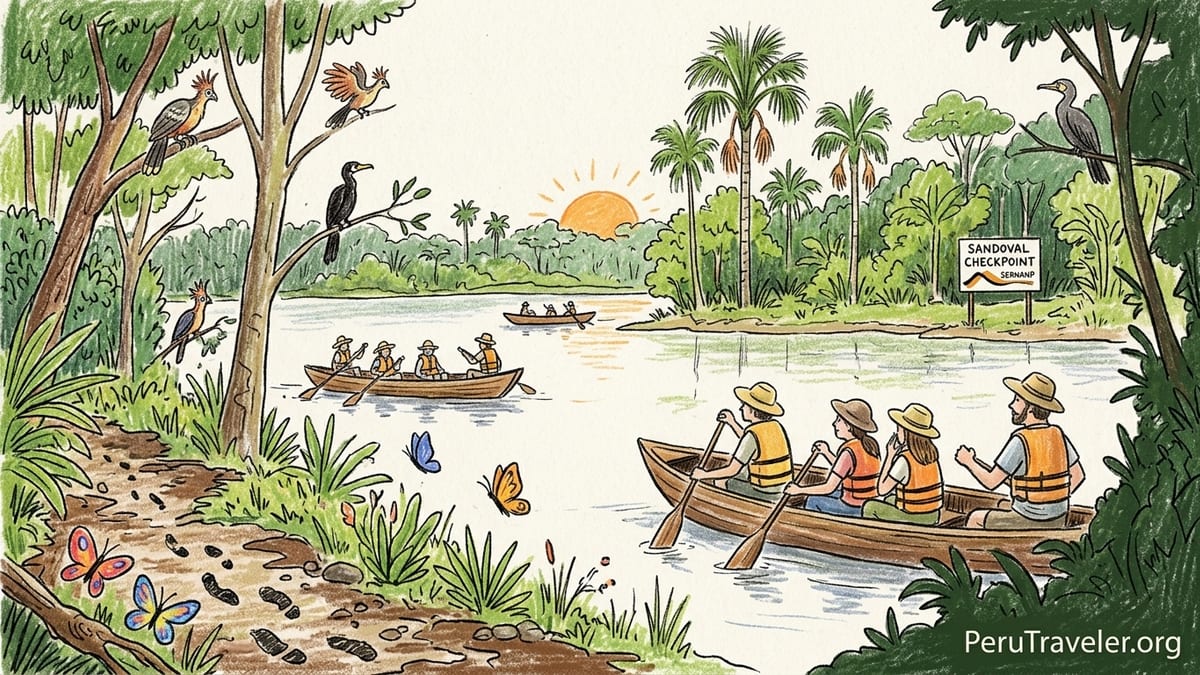
The first glimpse of Lake Sandoval came suddenly, through a break in the vegetation where the narrow forest trail met a calm side channel. On one side sat a basic wooden dock, a cluster of dugout and wooden canoes tethered to posts. A small field interpretation center stood a little way back, with posters about local wildlife and rules for navigating the lake, including speed limits, restrictions on swimming and minimum distances to maintain from giant river otter families if encountered.
Here we took a short break while the guide distributed life jackets again, this time smaller and less bulky than the ones used on the motorboat. Each canoe seated four to six people on two parallel wooden benches, with a local boatman at the stern handling the paddle. The operator used silent, non-motorized canoes within the lake’s main body, in line with reserve guidelines aimed at minimizing disturbance to wildlife. Some other groups we saw used small boats with electric motors in addition to paddles, but on the morning of my visit the water was still and only the occasional clunk of wood against wood broke the quiet at the dock.
The crossing from the narrow channel to the open lake surface took around fifteen minutes of steady paddling. The air felt even more humid here, and a thin mist lingered above the water. Tall Mauritia flexuosa palms framed the horizon, their spiky crowns towering above a ring of smaller trees, lianas and dense aquatic vegetation. Several hoatzin birds, with their ragged crests and prehistoric silhouette, perched on low branches near the waterline. We paused not far from them while the guide explained their odd digestive system and the role of oxbow lakes as refuges for specialized species like these.
At this stage we passed two simple lakeside lodges whose guests also use the lake, but day-trip groups like ours generally remain on the water rather than stopping at any private facilities. Our guide was careful to keep a low voice and reminded us to avoid sudden movements or loud conversations. She explained that the reserve has a tourism management plan for the lake, created partly to reduce stress on giant river otter families after earlier years when boats would crowd too close to them. As part of that plan, operators follow designated routes and maintain minimum approach distances if otters are present.
Searching for Giant River Otters on the Water
Our main objective on the lake was to look for giant river otters, an endangered species and one of the emblematic animals of Tambopata. The guide set realistic expectations from the start. She noted that Lake Sandoval is known to host giant otter families, but sightings are never guaranteed and often depend on time of day, weather and pure chance. Early morning and late afternoon generally offer the best opportunities, especially when the animals are fishing or grooming along fallen logs.
We spent just over two hours on the lake itself, from our initial entry at around 7:45 a.m. until we began paddling back toward the channel shortly before 10:00 a.m. During that time, we traced a slow loop along one side of the shoreline, cut across the middle near a patch of floating vegetation and then followed another edge back, keeping an eye and ear out for the characteristic ripples and snorts that would indicate otters on the move. Light wind ruffled the surface slightly but did not create waves.
On this particular outing, we did not see any giant river otters. The guide listened repeatedly, scanning with binoculars, but heard no contact calls and saw no telltale wakes. She explained that some families sometimes shift their activity further from the most frequented sectors of the lake or stay in side channels, especially later in the morning once boat traffic increases. We passed two resting spots where she had previously seen them, identifiable by flattened vegetation and fish remains on logs, which at least gave us a sense of where they had been active in recent days.
Although the lack of otter sightings was disappointing for several people in the group, other wildlife helped compensate. We watched black-collared hawks circling above, a trio of red-bellied macaws screeching from the palm crowns, and a few squirrel monkeys leaping between high branches near one of the lodges. Closer to the water, we saw a solitary black caiman’s head breaking the surface at a respectful distance, and numerous cormorants and kingfishers working the shallows. Importantly, our guide never claimed to see something she did not, and she refused to respond to another boat’s suggestion to approach closer to a log where they thought they had glimpsed an otter, explaining that crowding potential den areas can push the animals to leave.
Comparing Half-Day and Full-Day Excursions
Most agencies in Puerto Maldonado advertise Lake Sandoval excursions as either a six to seven hour trip or a longer full-day program. In practice, the main difference lies in how much time you actually spend on the lake rather than in transit, and whether the excursion includes a hot lunch at a lodge or just a packed meal. On my full-day outing, the total duration door to door was a little over eight hours, from 5:35 a.m. pickup to about 1:45 p.m. drop-off back in town.
Breaking that down, the initial motorboat transfers consumed roughly 70 minutes total across both directions. The forest walk, plus checkpoint registration and brief stops, accounted for about two and a half hours combined for the round trip. That left around two hours on the lake itself in the morning and a shorter, relaxed float of about 30 minutes near the dock while we ate our boxed lunches aboard the moored canoe under the shade of palms. In other words, of the full eight hours, approximately two and a half to three hours were truly devoted to slow lake exploration and active wildlife searching.
By contrast, travelers I spoke with in Puerto Maldonado who had joined shorter six- to seven-hour excursions described a tighter schedule with perhaps an hour and a half of paddling on the lake before turning back. Those tours usually depart later in the morning to cater to people arriving on first flights or night buses, which can reduce the chances of seeing giants river otters or more elusive species, simply because activity often drops as the sun climbs higher and temperatures rise. Guides from several companies agreed that the earlier a group can be on the water, ideally around sunrise, the better their odds for otters, though heavy rain, dense fog or noisy groups can still work against success.
For travelers choosing between these options, it is worth asking very specific questions before booking. I recommend asking how much time the company expects to spend on the lake itself, what typical departure and return times are, and how large the groups usually are. A longer advertised tour with a large group and minimal extra time on the water may not feel very different from a shorter product, while a well-organized six-hour trip with a small group that truly reaches the lake at dawn can be just as rewarding as a longer day with a lazier schedule.
Equipment, Food and Guide Quality
One of the strengths of my Lake Sandoval visit was the professionalism of the guide and boat team. The naturalist leading our group had several years of experience in Tambopata, spoke Spanish and functional English and carried lightweight binoculars that she shared with travelers who did not bring their own. Her explanations about forest succession, otter behavior and bird identification were clear and rooted in practical examples rather than memorized lists. She was also frank about the environmental pressures on the reserve, from increased visitor numbers to the impact of boat disturbance on sensitive species.
The canoes themselves were basic but well maintained, with no leaks and stable enough that even first-time paddlers felt secure. Each boatman controlled direction and speed with a single paddle at the stern, which allowed us to glide almost silently along the shore. Life jackets on the lake were functional, though slightly worn in appearance. Some had frayed straps, but all buckles closed properly. Travelers who are particular about gear might consider bringing their own small inflatable cushion or back support, as the wooden benches grow uncomfortable after an hour.
Food on this excursion took the form of a boxed lunch handed out mid-morning. It contained rice, a piece of grilled chicken, a small salad, a banana and a sealed bottle of water, with a vegetarian alternative available on request. There was no plastic cutlery, which reduced waste, and the guide collected all rubbish in a dedicated bag to carry back to town. Drinking water was available from a large jug on the motorboat as well, and the guide encouraged us to refill reusable bottles. There are basic bathrooms near the river port and at the checkpoint, but not at every rest stop, which is important to know for travelers who prefer more frequent facilities.
Interpretive infrastructure along the route was modest but helpful. At the checkpoint, simple panels described key species like giant river otters and black caimans, along with maps of the lake and code-of-conduct guidelines, including prohibitions on feeding wildlife, playing loud music or using flash photography at night. A small wooden observation tower exists near part of the lake, reachable by a short side trail used more frequently by visitors staying at nearby lodges than by day trippers. Our group did not climb it during this visit, but some agencies include it on longer itineraries.
The Reality of Wildlife and the Value of Early Starts
Lake Sandoval’s reputation can create very high expectations. Brochures in Puerto Maldonado windows are filled with photos of otter families spread across logs, caimans glowing under spotlight beams and trees heavy with monkeys and macaws. The reality of a single day trip, especially in a shared group, is often more subtle. On my outing, the overall wildlife tally was solid but not overwhelming: one group of capuchin monkeys on the forest trail, a distant group of squirrel monkeys from the canoe, several hoatzin, a handful of egrets and herons, multiple macaw flyovers, kingfishers, cormorants, one visible black caiman and an abundance of smaller birds and insects. Giant river otters, tapirs, anacondas and jaguars remained unseen, though the guide pointed out tracks and signs of some of these animals in the mud near the waterline.
Early departure clearly helped. We were on the lake before eight in the morning, which meant cooler temperatures, softer light and more bird activity. Another group that arrived around nine reported quieter conditions, with fewer birds calling and no monkey sightings near the same shoreline. Still, nature is never predictable. Heavy rain overnight can shift animal behavior, and sometimes even the earliest, quietest groups may miss the flagship species they came for. I appreciated that my guide repeated several times that “nothing is guaranteed,” framing every sighting as a privilege rather than a product.
For travelers who want to maximize their wildlife chances, spending a night or two at a lodge near Lake Sandoval or deeper inside the Tambopata region might be worth the additional cost. This allows for multiple visits to oxbow lakes at different times of day, night walks and more diverse habitats. However, these options can be significantly more expensive than a single day trip from Puerto Maldonado. Some visitors in my group had chosen the day tour precisely because their time or budget was limited, and for them, Lake Sandoval offered a compelling glimpse of the Amazon without the logistics of remote lodges.
The Takeaway
When I stepped back onto the motorboat at the end of the walk out, sweat-soaked and streaked with mud up to my calves, I asked myself whether Lake Sandoval had justified the early alarm, the river transfers and the three kilometers of sticky trail each way. The most memorable moment of the day was not a single spectacular animal but a combination of elements: the first quiet glide between Mauritia palms, a hoatzin shuffling along a branch only a few meters away, the sudden flash of macaws against the sky and the sense of floating encircled by intact forest while the rest of the world remained very far away.
From a purely wildlife checklist perspective, my visit delivered a moderate list of sightings without its most famous star. There were no giant river otters, no anacondas curled on logs, no troops of howler monkeys roaring across the canopy. What I did see was a living, complex ecosystem in motion and a management system trying, imperfectly but sincerely, to balance tourism with conservation. The reserve admission fee, the requirement to use authorized guides and the emphasis on quiet, non-motorized boats on the lake all pointed in that direction.
Would I return to Lake Sandoval? Yes, but I would do it differently. I would be inclined to hire a private naturalist guide or join a very small group with a clear focus on patient wildlife watching rather than a standard excursion built around fixed times. This could mean paying more, but it would allow for earlier arrivals on the lake, more flexibility to linger in promising areas and more detailed interpretation tailored to my interests. I would also seriously consider combining Lake Sandoval with a stay at a lodge deeper along the Tambopata River to experience a broader slice of the region’s remarkable biodiversity.
For first-time visitors to the Peruvian Amazon with limited days or budget, Lake Sandoval remains the signature, accessible way to slide into the rainforest from Puerto Maldonado. It will not always offer the postcard scene of otters posing on a log, and the walk can be hot and muddy. Yet the combination of river, forest trail and quiet canoeing through palm-ringed water creates a layered, memorable journey. Go with realistic expectations, respect the rules that protect the animals you hope to see, and you will leave with a deeper understanding of how fragile and precious this corner of Tambopata truly is.
FAQ
Q1. How much does a Lake Sandoval day trip from Puerto Maldonado cost?
Most shared group day trips currently range from about 60 to 80 US dollars per person, often including hotel pickup, river transport, guide and a basic meal. Ask if the Tambopata National Reserve admission fee of 30 soles for foreign visitors is included or paid separately in cash at the checkpoint.
Q2. How long does the Lake Sandoval excursion actually take door to door?
On my outing the tour lasted just over eight hours. That included roughly 70 minutes of river travel round trip, about two and a half hours of walking, around two hours of focused canoeing for wildlife viewing and additional time for registration, briefings and lunch.
Q3. How difficult is the walk to Lake Sandoval and is it suitable for children?
The forest trail is about three kilometers each way, with mud, roots and high humidity. Children who are comfortable walking that distance can usually manage it, but strollers do not work well and travelers with mobility limitations may find the conditions challenging, especially in wetter months.
Q4. Are there accessible facilities for visitors with mobility issues?
There are ongoing efforts to improve accessibility, including segments of elevated trail, but as of late 2026 the route is not consistently wheelchair-friendly. Basic handrails and boardwalks help in some sections, yet significant portions remain uneven, so it is important to discuss specific needs with an operator in advance.
Q5. What are the chances of seeing giant river otters on a single visit?
Lake Sandoval hosts giant river otter families, and many visitors do see them, especially on calm early-morning outings. However, sightings are never guaranteed, and it is possible, as on my trip, to spend several hours on the lake without encountering them at all.
Q6. Is it better to choose an early departure or a more relaxed schedule?
Early departures offer clear advantages for wildlife viewing, particularly for otters, birds and monkeys that are more active at dawn. A relaxed mid-morning start may feel easier but often coincides with hotter temperatures and quieter wildlife activity on the lake.
Q7. What should I wear and bring for the Lake Sandoval excursion?
Lightweight long sleeves, long trousers, closed shoes with good grip or light hiking boots, a hat, insect repellent, sunscreen, a reusable water bottle and a light rain jacket are all practical. Binoculars and a dry bag for electronics also improve the experience.
Q8. Is the canoeing portion physically demanding or suitable for non-paddlers?
Canoes are steered primarily by local boatmen, so participants rarely need to paddle unless they choose to help. The movement is slow and gentle, making it suitable even for travelers without previous paddling experience, as long as they can sit on a wooden bench for extended periods.
Q9. Can I visit Lake Sandoval independently without a tour?
No. Entry to the Sandoval sector of the Tambopata National Reserve is regulated, and visitors must be accompanied by an authorized guide or operator. This system helps control numbers, maintain safety and reduce disturbance to sensitive wildlife such as giant river otters.
Q10. Is a Lake Sandoval day trip enough, or should I also stay at a jungle lodge?
A day trip offers an excellent introduction to the Amazon for travelers with limited time or budget. However, staying at a lodge for several nights, either near Lake Sandoval or deeper inside the Tambopata region, generally provides more varied habitats, multiple wildlife outings and a higher overall chance of memorable sightings.