


Pacaya-Samiria National Reserve is one of the wildest corners of the Peruvian Amazon, and the experience here is very different from a standard Iquitos jungle lodge or a luxury cruise on the main Amazon River. Reaching the flooded forests and winding blackwater creeks of this vast protected area takes time, logistics and the right permits, which is why choosing between a three, four or five-day expedition from Iquitos matters far more than it might for a typical rainforest getaway.
Why Pacaya-Samiria Is Different From Standard Iquitos Jungle Tours
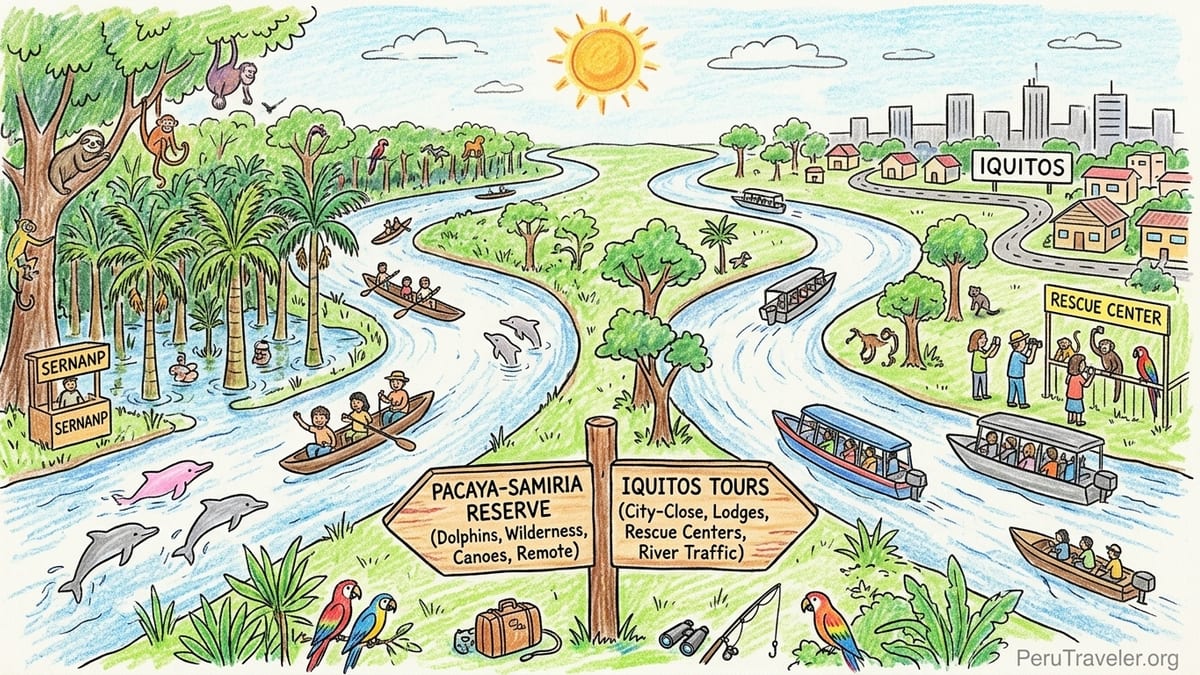
Pacaya-Samiria National Reserve protects more than twenty thousand square kilometers of seasonally flooded rainforest between the Marañón and Ucayali Rivers in northern Peru, several hours upriver from Iquitos. Instead of staying at a lodge just one or two hours from the city, Pacaya-Samiria expeditions usually begin with a road transfer of about one hour and a half from Iquitos to Nauta, followed by a further boat journey into the reserve or its buffer zones. The result is fewer villages, less river traffic and far more intact wildlife habitat compared with short, generic Iquitos jungle packages.
Operators that specialize in Pacaya-Samiria often focus on dugout or motorized canoe exploration, early-morning and night outings, and small, flexible groups. For example, some lodges based on the Yanayacu-Pucate River limit capacity to a few dozen guests and advertise that they sit roughly 180 kilometers from Iquitos, near small communities such as Yarina, about 60 kilometers inside the reserve itself. That distance translates into long boat rides and a genuine feeling of remoteness, which cannot be replicated at lodges closer to the city.
This remoteness also changes the style of trip. While many short Iquitos tours include visits to wildlife rescue centers or staged animal encounters, reputable Pacaya-Samiria operators focus on finding animals in the wild. Instead of a quick photo stop with a captive sloth, you are more likely to spend an afternoon scanning riverbanks for wild pink river dolphins or hiking sections of aguaje palm forest looking for monkeys and macaws. For travelers who want a true protected-area experience, this trade-off is usually worth the extra cost and longer travel times.
Because Pacaya-Samiria is a protected national reserve, all tourism services inside its boundaries must comply with rules set by SERNANP, the Peruvian protected-areas authority. There is an official list of authorized tour operators and community groups that have been granted permission to work in the reserve. Serious companies will be able to provide their authorization details, while others base themselves in buffer zones just outside the formal boundary and include day excursions into permitted sectors.
Understanding Routes: Yanayacu-Pucate, Samiria Basin and Other Sectors
Pacaya-Samiria is too large to “see it all” on any one trip, and especially not on a three-day package from Iquitos. In practice, most expeditions focus on one of a few legally accessible river basins and entry points. The Yanayacu-Pucate sector is the most common for tours that start in Iquitos and continue by road to Nauta. From Nauta, boats head up the Marañón River and then into the Yanayacu-Pucate, where there are both community campsites and established lodges. A typical four-day itinerary in this area might combine two or three nights at a lodge with one night of camping deeper in the flooded forest.
The Samiria River basin, entered near the town of Lagunas or from more distant control posts, is often associated with longer, more expedition-style trips. Travelers heading in from Lagunas usually reach the reserve after a long speedboat journey from Yurimaguas rather than Iquitos, and then continue by small boat for several days. Some Iquitos-based operators do advertise Samiria basin trips, but the additional distance means that a five-day or longer itinerary is far more realistic if you want to spend real time away from navigation channels and villages.
There are also smaller, controlled entry points and buffer-zone areas along tributaries where community groups operate basic programs focused on fishing, birdwatching or community life. For example, some cooperatives in the lower Marañón region offer homestays and canoe excursions that visit official control posts within Pacaya-Samiria during the day and return to community camps at night. These trips may be more affordable and culturally focused than lodge-based packages, but they still require valid permits for time spent inside the reserve.
Because of the distances involved, any company claiming to “cross the entire reserve” in three days from Iquitos is not being realistic. Simply reaching a mid-reserve lodge on the Yanayacu-Pucate can take most of a day in combined road and boat travel. Attempting to visit both the Yanayacu-Pucate and Samiria basins in one short itinerary would mean spending nearly all your time in fast boats, with little opportunity for dawn or night wildlife outings. When comparing programs, travelers should look for itineraries that concentrate on one basin and minimize unnecessary boat commuting once inside the reserve.
What Three-Day Pacaya-Samiria Expeditions Really Offer
Three-day, two-night Pacaya-Samiria itineraries are typically the shortest options that still reach the reserve from Iquitos. Many agencies market 3D/2N packages that include road transfer from Iquitos to Nauta, boat travel to a lodge or community camp and basic guided excursions. A realistic schedule usually involves a first morning departure from Iquitos, a lunchtime arrival in Nauta, and an afternoon boat ride that gets you to your lodge or camp before dark. That means you gain one late-afternoon outing on the first day, a full second day of exploration, and a final morning activity on day three before returning to Iquitos.
At the mid-range end of the market, some operators quote prices in the region of 350 to 450 US dollars per person for three days on a shared basis, which aligns with broader estimates of around 130 to 315 dollars per person per day for all-inclusive Amazon tours from Iquitos, depending on comfort level and group size. These prices usually cover Iquitos to Nauta transfers, motorized boat transport to and from the reserve area, basic lodge or tented accommodation, three meals per day, filtered drinking water, guided excursions and fishing equipment. English-speaking guides may be included, but some small local operators work primarily in Spanish unless English is requested in advance.
One useful real-world example is a 3-day Pacaya-Samiria camping itinerary marketed by a small Iquitos agency, which outlines specific activities: a first afternoon boat ride inside the reserve with chances to see pink river dolphins, nocturnal caiman-spotting excursions, short hikes to look for monkeys and birds, and piranha fishing from canoes. The itinerary is packed, and travelers still spend a significant share of day one and day three in transit. This underscores why three-day expeditions are best thought of as introductory samplers that provide a taste of Pacaya-Samiria rather than a deep immersion.
For travelers with very limited time who still want to set foot inside the reserve, these short trips can be worthwhile, especially if they clearly specify which sector they use and how much time will actually be spent on the water or trails rather than commuting. However, if wildlife observation and unhurried exploration are priorities, adding just one or two extra nights makes a substantial difference to the ratio of travel time to field time.
Four-Day Wildlife-Focused Trips and Five-Day Deep-Reserve Expeditions
Four-day, three-night Pacaya-Samiria expeditions represent a practical balance between travel time and wildlife opportunities for many visitors. With two full days inside the reserve and two partial days of transit activities, you gain more dawn, late-afternoon and night outings, which is when many rainforest animals are most active. For example, a four-day program built around a Yanayacu-Pucate lodge might include one night of camping on a riverside platform or in hammocks deep in the flooded forest, plus extra time for birding, dolphin watching and forest walks.
Price-wise, several mid-range packages that explicitly mention Pacaya-Samiria and include reserve entrance fees start around 500 to 850 US dollars per person for four days, depending on the standard of lodging. One lodge on the Marañón, within the buffer zone but with excursions into the reserve, lists a starting price of just over 840 US dollars for a 4D/3N all-inclusive stay, including transfers, boat transport, meals, guided outings and the official right of visit to Pacaya-Samiria. While this is higher than basic Iquitos jungle packages closer to the city, it reflects both the logistical costs and the more remote setting.
Five-day and longer trips are where Pacaya-Samiria begins to feel like a true expedition. A 5D/4N journey can push further along the Yanayacu-Pucate or Samiria basins, allowing for multi-night camping, downstream drifts under the stars and more time away from the main navigation channels. Travelers who join such itineraries often report a noticeable jump in wildlife encounters, simply because there are more dawn and night hours on the water and in the forest, and fewer interruptions for major relocations. Reddit trip reports, for instance, describe five and seven-day Pacaya-Samiria journeys as significantly richer in wildlife than three-day outings, even with similar daily schedules.
Given typical per-day costs for Pacaya-Samiria of roughly 150 to 300 US dollars, a five-day expedition might range from 750 to 1,500 US dollars per person, depending on group size, comfort level and whether the program is run by a community-based operator or a more upscale lodge. For travelers comparing that with a shorter, cheaper lodge stay nearer Iquitos, the key question is whether the extra budget is justified by the deeper immersion. If you care most about seeing a variety of wild monkeys, birdlife, river dolphins and night creatures in a quiet, protected setting, the extended time usually pays off in experience rather than in added amenities.
Camping Programs, Community-Based Alternatives and What Is Included
Pacaya-Samiria expeditions from Iquitos fall broadly into three categories: lodge-based trips in or near the reserve, mixed lodge-and-camping itineraries and community-based camping or homestay programs. All of them should clearly specify what is included. At a minimum, reputable operators include roundtrip transfer from Iquitos to Nauta, boat transportation between Nauta and the lodge or camp, accommodation, three daily meals, guided excursions, drinking water, basic fishing gear and the services of a licensed guide. Some add extras such as rubber boots, mosquito nets, camping mattresses and rain ponchos.
Lodge-based programs usually offer private or twin rooms with mosquito screens, en-suite or shared bathrooms with cold running water and electricity in certain hours of the day. In contrast, camping programs might involve sleeping in tents or hammocks under a roofed platform, often with simple pit toilets or composting toilets nearby. Showers can be bucket-style using filtered or river water. Meals are usually cooked by the boat crew or a camp cook, with menus centered on fish, rice, plantains, seasonal fruits and coffee or tea. Travelers with dietary restrictions should confirm in writing that the operator can accommodate them.
Community-operated alternatives, often organized by associations listed in regional tourism directories, tend to be more basic but can provide a high level of local knowledge and a direct contribution to conservation. For instance, groups of Cocama communities around the reserve have developed tourism circuits in partnership with SERNANP, where visitors sleep in community lodges or family homestays, join daytime canoe excursions inside permitted zones and observe activities like sustainable fishing or turtle egg monitoring. These programs may or may not advertise widely online, so verification through official protected-area visitor information or regional tourism offices is important.
Most serious operators either include the Pacaya-Samiria entrance and visit fee in the package price or list it as a separate line item. When looking at a sample 4D/3N Pacaya-Samiria lodge package sold through an international agency, the inclusion list explicitly mentions “entrance and right of visit to the Pacaya-Samiria National Reserve,” alongside transfers, meals and guided activities. If a company’s inclusions do not mention entrance fees at all, ask for clarification in writing. Paying this fee is not optional; it is required for legal entry into official sectors of the reserve.
Wildlife Expectations, Pink Dolphins and How Seasons Change the Experience
Pacaya-Samiria is famous for its river dolphins, monkeys, caimans and birdlife, but no responsible operator will guarantee specific wildlife sightings. Pink river dolphins are most often seen in the larger channels of the Marañón, Ucayali, Pacaya and Samiria Rivers, especially near confluences and oxbow lakes. Many three and four-day itineraries include multiple boat outings specifically to look for these dolphins, and trip reports frequently mention sightings, but the animals may surface at a distance or only briefly. Gray river dolphins are also present, and on some outings they are actually more active near moving boats than the pink species.
Monkeys are typically observed during early-morning and late-afternoon walks or canoe outings along smaller creeks. Commonly reported species include squirrel monkeys, howler monkeys and capuchins. In high-water season, when the forest is flooded, guides may use canoes to approach fruiting trees directly, increasing chances of close views. In low-water season, longer terrestrial hikes along riverbanks and forest trails allow you to scan the canopy from below. Travelers on five-day or longer trips usually report more monkey encounters simply because they spend more hours in these peak activity windows.
Caimans, night birds and frogs are the highlights of nocturnal outings. During low-water months, caimans concentrate in smaller water bodies, and guides use headlamps to spot their red eye reflections from boats. Birdlife varies with habitat; flooded varzea forests and lakes support herons, egrets, kingfishers and horned screamers, while drier levees and palm groves host parrots and macaws. Because conditions shift week to week, it is more accurate to think in probabilities than promises. A well-run five-day expedition during the right season, with multiple night outings and early starts, substantially increases the overall number of species you are likely to see compared with a rushed three-day itinerary.
Seasonality is crucial in Pacaya-Samiria. Scientific and tourism sources describe a broad high-water period from roughly February to May, with transitional months on either side, and a lower-water period from about June through October. During high water, much of the forest floor is inundated, creating an intricate network of navigable channels. This is the classic “flooded forest canoeing” experience many travelers imagine: paddling silently between tree trunks, with monkeys in the canopy and fish darting below. Trails close or become muddy, so walking time is limited, but access by canoe can be excellent for photography and quiet observation.
In the lower-water season, exposed riverbanks, beaches and mudflats appear, and aquatic wildlife such as fish, caimans and aquatic birds concentrate in smaller bodies of water. This is often described as the best time for fishing and for observing caimans and river turtles. More terrestrial trails open, allowing for longer hikes in search of primates and forest birds. However, some side channels become too shallow for boats, and itineraries may shift to follow deeper waterways. When choosing trip dates, travelers who prioritize flooded-forest canoeing might target late high-water or transitional months, while those focused on fishing and walking might prefer the lower-water period.
Practical Comfort: Mosquitoes, Bathrooms, Water and Safety
Pacaya-Samiria is a real rainforest environment, and comfort levels are different from a polished eco-resort near Iquitos. Mosquitoes and other biting insects can be intense, particularly at dusk and in flooded areas. Most operators recommend long sleeves, lightweight trousers, socks and a head net for sensitive travelers, along with repellent containing DEET or picaridin. Community-based programs and camping expeditions often provide mosquito nets for beds or hammocks, but it is wise to confirm this in advance and to bring a backup net or treated clothing if you are prone to bites.
Bathroom facilities vary significantly between lodges and camping circuits. Established lodges inside or near the reserve generally have flush toilets and simple showers with non-heated water, supplied either from wells or filtered river water. Campsites might rely on dry pit toilets or basic latrines, often separated from sleeping areas by a short walk. Some community programs have invested in ecological composting toilets to reduce pollution. If privacy and bathroom comfort are key concerns, look for operators that explicitly describe their facilities in pre-departure information, and do not hesitate to ask for recent photos.
Safe drinking water is another essential point. Reputable Pacaya-Samiria operators provide filtered or purified water at mealtimes and in refill stations for reusable bottles. Travelers rarely drink directly from the river, even in remote sectors, due to natural sediments and microbial contamination. On camping trips, guides might treat river water with purification tablets or filters before use. To reduce plastic waste, many operators encourage guests to bring their own water bottles and may limit the sale of single-use bottles once inside the reserve.
Given the remoteness of much of Pacaya-Samiria, emergency communication and evacuation plans matter. Serious operators carry at least one satellite phone or long-range radio for communication with Nauta or Iquitos, and have clear procedures for dealing with injuries or illness, including boat evacuation to the nearest health post. Travel insurance that covers emergency medical evacuation is strongly recommended. When comparing companies, ask explicitly what communication equipment they carry, how long an emergency evacuation to Iquitos would likely take from their usual camp locations, and whether their staff have basic first-aid training.
Verifying Legitimate Access and Choosing Between Operators
Because Pacaya-Samiria is well known among adventure travelers, it is sometimes used loosely in marketing, even by companies that operate primarily in buffer zones or lodge corridors closer to Iquitos. To ensure you are booking a legitimate Pacaya-Samiria expedition, start by asking the operator which control post or sector they enter, whether the itinerary spends nights inside the reserve boundary or only visits for day excursions, and whether the entrance fee is already included. Cross-checking the name of the company or community group with the official list of authorized operators and local groups maintained by SERNANP is also a sensible step.
Authorized commercial operators, including both Iquitos-based agencies and lodge owners, usually have more structured itineraries, better logistical support and multilingual guides. They are a solid choice if you prefer predictable comfort, clear safety standards and detailed pre-departure information. Many will share example day-by-day programs in advance, listing transfers, boat times, activity blocks such as “early-morning birdwatching by canoe” or “night caiman-spotting,” and approximate return times to Iquitos.
Community-led programs, often coordinated by associations of local residents living in and around the reserve, prioritize cultural exchange and direct conservation benefits. Their trips are sometimes less polished and may require more flexibility regarding accommodation and schedules, but they can offer unparalleled insight into daily life along the Marañón, Pacaya or Samiria Rivers. Some travelers combine approaches by booking with a licensed Iquitos agency that partners with community groups for camping segments inside the reserve; this can provide a blend of professional logistics and grassroots involvement.
As a rule of thumb, be wary of operators who advertise an unrealistically long list of sectors in the reserve for very short itineraries, or who promise guaranteed sightings of rare species like jaguars or giant otters. In such a large and complex protected area, responsible companies focus on well-known sectors like Yanayacu-Pucate or specific Samiria tributaries and speak in terms of probabilities rather than guarantees. Reading recent traveler reviews that specifically mention Pacaya-Samiria, checking for photos that clearly show control posts or official signage and confirming details in writing are all practical steps before paying a deposit.
Cost Comparison: Three, Four and Five Days From Iquitos
When comparing Pacaya-Samiria expeditions with generic Iquitos jungle packages, the most obvious difference is price per day. Recent analyses of Amazon tour prices from Iquitos indicate that all-inclusive trips, including transfers, lodging, meals and guided activities, typically range from about 130 to 315 US dollars per person per day, depending on lodging standard and remoteness. Pacaya-Samiria programs, which require additional boat fuel and staff time, tend to fall in the middle to upper part of that range.
As a practical benchmark, a three-day Pacaya-Samiria introduction might cost around 400 to 600 US dollars per person on a shared basis, including reserve entrance fees. A four-day wildlife-focused itinerary with mixed lodge and camping components may fall roughly between 500 and 900 US dollars, depending on whether it uses a higher-end lodge in the buffer zone or more basic community facilities. A five-day deep-reserve journey with multiple nights of camping, longer boat distances and smaller group sizes can easily range from 750 to 1,500 US dollars, particularly if run as a semi-private expedition.
From a value-for-time perspective, the jump from three to four days usually delivers the biggest increase in actual wildlife hours. Because day one and day three (or four) involve heavy transit between Iquitos, Nauta and the reserve, adding at least one extra full day means proportionally more dawn and night outings. Many experienced travelers advise that three days feel rushed, four days feel well-balanced and five or more days feel like a true immersion where you stop counting boat hours and start noticing animal behavior patterns instead.
There are also situations where a specialist, community-based Pacaya-Samiria expedition is a better choice than a generic Iquitos jungle package at a similar price. For travelers who prioritize being in a protected area, supporting local conservation initiatives and accepting simpler comfort, a five-day community-led trip that spends most nights in or near the reserve can offer more meaningful wildlife time than a four-day stay at a polished lodge closer to the city with a busier river corridor. On the other hand, if you are very sensitive to heat, insects or basic facilities and are more interested in an introduction to the Amazon than in deep immersion, a shorter, well-reviewed lodge stay outside the reserve might suit you better.
The Takeaway
Choosing between a three, four or five-day Pacaya-Samiria expedition from Iquitos is not just a question of budget. It directly shapes how much time you actually spend in the flooded forests, creeks and wildlife-rich backwaters of this enormous reserve versus on buses and boats. Three-day trips function as introductions that reach the edge of the experience, four-day itineraries supply a more balanced mix of travel and field time, and five-day or longer journeys unlock deeper sectors where the Amazon feels truly remote.
For most wildlife-focused travelers willing to invest in the logistics, a minimum of four days is a sensible target, with five or more days recommended if you want to combine camping, multiple basins or a strong community component. Whatever the duration, verifying that your operator is authorized to work in Pacaya-Samiria, understanding exactly what is included in the package and aligning your expectations with the realities of season, comfort and travel time will go a long way toward turning a once-in-a-lifetime idea into a rewarding, responsible expedition.
FAQ
Q1. How long does it actually take to reach Pacaya-Samiria from Iquitos?
From Iquitos it usually takes about one and a half hours by road to Nauta, plus two to four hours by boat to reach lodges or camps near the Yanayacu-Pucate sector. Reaching deeper Samiria basin camps can take even longer, especially on slower boats, which is why three-day tours feel tight on time.
Q2. Are Pacaya-Samiria entrance fees included in tour prices?
Many reputable operators include the Pacaya-Samiria entrance and visit fee in their package price and state this clearly in the inclusions. Others may list it as a separate line item to be paid in cash. If the entrance fee is not mentioned, ask for confirmation in writing before booking, as payment is required for legal access to the reserve.
Q3. Can I really explore the entire reserve on a three-day trip?
No. Given the size of Pacaya-Samiria and the travel time from Iquitos, a three-day itinerary can realistically focus on only one sector, typically near the Yanayacu-Pucate basin. Any company claiming to cross or cover the entire reserve in three days is likely exaggerating and will spend most of your time in transit.
Q4. What is the best season to see wildlife in Pacaya-Samiria?
Wildlife is present year-round, but experiences differ by season. High water from roughly February to May favors flooded-forest canoeing and access to remote creeks, while lower water from about June to October concentrates fish, caimans and aquatic birds and opens more walking trails. Rather than a single best month, it is better to choose based on whether you prefer canoe exploration or more terrestrial hiking and fishing.
Q5. How likely am I to see pink river dolphins?
Pink river dolphins are commonly reported in larger channels and river confluences in and around Pacaya-Samiria, and many itineraries include specific outings to look for them. Sightings are frequent enough that most multi-day visitors do see dolphins, but the animals are wild and no ethical operator can guarantee close encounters or certain behaviors.
Q6. What comfort level should I expect on camping and community-based trips?
Camping and community-based expeditions are usually simple. Expect mosquito-netted tents or hammocks, basic pit or composting toilets and bucket showers or limited running water. Meals are home-style, based on local fish, rice and plantains. Travelers who need private bathrooms, consistent electricity or fans may be more comfortable on lodge-based trips in or near the reserve.
Q7. How can I check if a Pacaya-Samiria tour operator is legitimate?
You can ask the company to specify which control post or sector they enter, whether they include official entrance fees and under what authorization they operate. Cross-checking names against lists of authorized operators published by the protected-area authority, and reading recent traveler reviews that mention Pacaya-Samiria by name, are practical ways to confirm legitimacy.
Q8. Do Pacaya-Samiria tours include fishing and equipment?
Most Pacaya-Samiria expeditions, especially four and five-day programs, include at least one outing focused on piranha or line fishing, and provide simple rods or hand lines at no extra cost. If fishing is a priority, confirm how many dedicated sessions are scheduled and whether more specialized gear can be provided or rented.
Q9. Is English commonly spoken by guides on these expeditions?
In mid-range and higher-end operations that target international travelers, at least one guide on each departure typically speaks functional English. Community-based and very small agencies may primarily use Spanish-speaking guides unless an English speaker is requested in advance, sometimes at additional cost. Clarify your language needs when booking.
Q10. How does a Pacaya-Samiria expedition compare with a regular Iquitos jungle tour?
Regular Iquitos jungle tours often stay closer to the city, use larger lodges and may include visits to wildlife centers or cultural demonstrations. Pacaya-Samiria expeditions involve longer travel, smaller groups and a stronger focus on wild habitats inside or near a protected reserve. They cost more and are less comfortable, but they usually deliver quieter rivers, richer wildlife encounters and a deeper sense of being in the Amazon rainforest.