


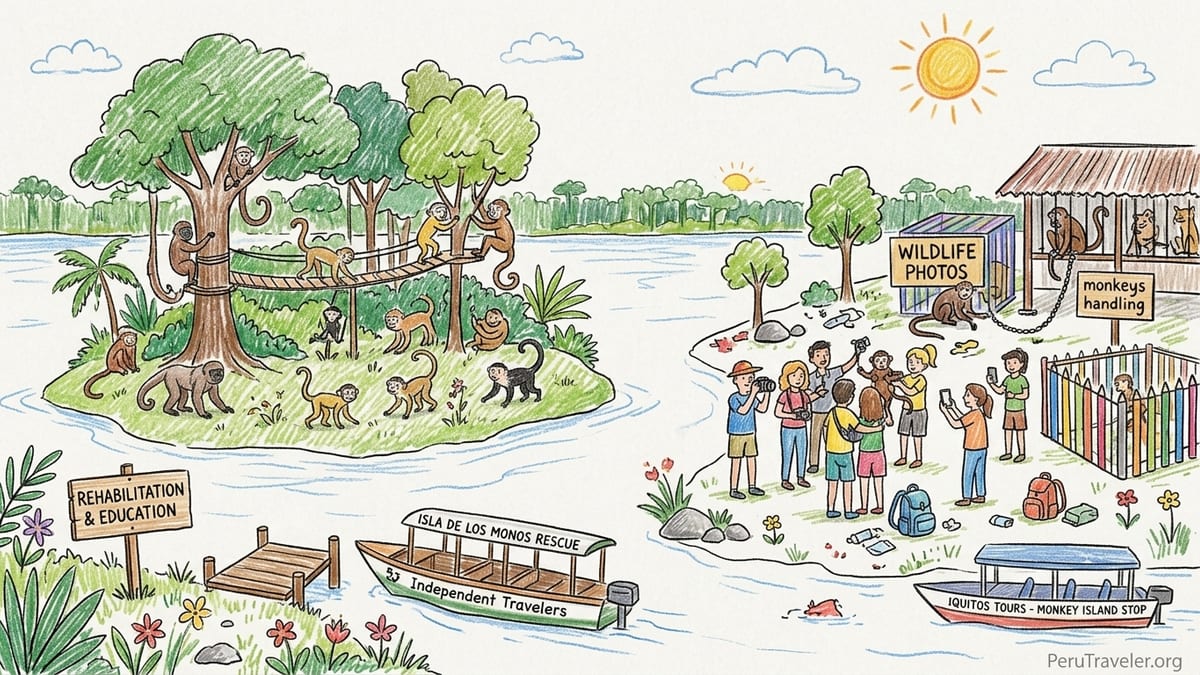
In Iquitos, almost every tout, hostel and tour kiosk seems to push a “Monkey Island” excursion. The photos look irresistible: travelers with tiny primates on their shoulders, kids feeding bananas to wide-eyed babies, influencers grinning under a tangle of tails. Yet behind those images are very different realities. Some places near Iquitos work to rehabilitate confiscated wildlife, while others exist mainly to supply a steady stream of animals for visitor selfies. On a recent visit, I set out to see what lies behind the marketing, focusing on the recognized La Isla de los Monos sanctuary and comparing it with other wildlife attractions and with the manatee-focused Centro de Rescate Amazónico.
Why “Monkey Island” Means Very Different Things Around Iquitos
Before you book anything in Iquitos, it helps to understand that “Monkey Island” is a sales term, not a single regulated attraction. Along the rivers around the city, multiple operators use the phrase in their tour descriptions, from genuine primate rescue projects to small riverbank zoos where monkeys and other species are kept mainly for handling and photos. On the malecón in central Iquitos and around Plaza de Armas, it is common to see laminated menus of excursions that list “Isla de los Monos” beside pink-dolphin watching, piranha fishing and night walks, with almost no detail about which facility you will actually visit.
There is, however, one well-documented sanctuary that most conservation organizations and responsible guides in Iquitos refer to when they talk about a legitimate Monkey Island experience: La Isla de los Monos, a 450-hectare rescue center on a river island about 30 kilometers from the city. It was established to receive monkeys confiscated from the illegal wildlife trade and from people keeping primates as pets, with the long-term goal of rehabilitation and, when possible, release into secure forest. The organization makes its mission and visiting logistics publicly available and has a consistent record of collaboration with Peruvian authorities and international partners.
At the same time, travel forums and traveler reports from Iquitos describe other “monkey islands” or animal stops where small enclosures, constant handling and a revolving cast of stressed animals raise serious welfare questions. Because many of these operations change names, move, or operate informally, it is hard to track them systematically. That uncertainty is precisely why it is so important to know how to recognize a genuine rescue center, what to expect there, and how it differs from a photo-driven wildlife attraction.
With that in mind, I planned my visit to La Isla de los Monos as a test case. The goal was to document each step in concrete terms: how I booked, what I paid, how long the river crossing took, what I actually saw on the island, and what kind of rules and explanations staff provided once I arrived.
Getting to La Isla de los Monos: Booking, Boats and Real Costs
La Isla de los Monos encourages visitors to arrange their trip in two main ways. The first is to contact the sanctuary directly through its official channels and pre-book a guided visit. The second is to travel independently using regular fast boats that depart from Puerto de Productores, a busy public port a short mototaxi ride from central Iquitos, and then connect onward by local boat to the island. Both options aim to bring you to the same place, but they feel very different in terms of logistics, cost and comfort.
For a structured experience, I contacted the sanctuary ahead of time and received clear instructions: travel by mototaxi to Puerto de Productores, then take a public or contracted fast boat upriver to the small port of Varadero, where staff from the sanctuary would meet arriving visitors and complete the transfer to the island. The quoted crossing time from Iquitos to Varadero was around 45 to 60 minutes depending on river level and boat type. When I double-checked this information against updated visitor pages and recent traveler reports, the times were consistent, with notes that low water in some seasons can extend the journey slightly.
In practical terms, my outbound transport cost broke down as follows. A mototaxi from near Plaza de Armas to Puerto de Productores in October 2026 cost 8 soles after a brief negotiation, within the usual 7 to 10 soles range described by locals. At the port, I paid for a seat on a scheduled fast boat to Varadero. Fares fluctuate with fuel prices, but in late 2026 the going rate for tourists reported by both the sanctuary and travelers was typically in the 25 to 35 soles range one way. On my trip, I paid 30 soles. From Varadero to the island, transport was organized directly by La Isla de los Monos as part of the visit, and there was no additional boat fee beyond the sanctuary entrance price.
For the return journey, I again used a fast boat from Varadero back to Puerto de Productores, paying the same 30 soles, and another 8 soles mototaxi to my guesthouse. All told, round-trip independent transport cost me about 76 soles, or a little over 20 US dollars at late 2026 exchange rates, not including the sanctuary admission itself. Travelers who combine their visit with a packaged excursion from Iquitos will usually pay more overall but have these steps bundled; day tours that include La Isla de los Monos commonly quote total prices in the 150 to 250 soles range per person, depending on group size and inclusions, with admission typically paid directly to the sanctuary on arrival.
Admission and Guiding at La Isla de los Monos
On arrival at La Isla de los Monos, visitors pass through a simple reception area. Here the team explains the rules, collects the admission fee, and organizes small groups with a staff guide. The sanctuary publishes its entrance fees in Peruvian soles and distinguishes between Peruvian visitors and foreign tourists. At the time of writing, published prices for international visitors were in the low tens of soles per adult, with reduced rates for children, and income used to cover food, veterinary care, salaries for local staff and maintenance of the island infrastructure. Exact figures can change with inflation and operating costs, so it is worth checking the sanctuary’s official information or asking directly when you book.
Guiding is not an optional extra here. Every visitor joins a structured walk with a staff member or trained volunteer who knows the island’s residents and their histories. On my visit, the guide began with a short briefing in Spanish and English about why the sanctuary exists. Many of the monkeys had been confiscated by wildlife authorities from markets, roadside stands or private homes, often after spending years on chains or in tiny cages. Others arrived as orphans after hunters killed adults for bushmeat or capture. The guide emphasized that, although some animals may now seek out human contact, that behavior is a legacy of their trauma and captivity, not a sign that holding or hugging them is harmless fun.
The visit followed a set route along cleared paths, raised walkways and open areas where free-roaming monkeys moved in and out of view. The entire circuit took roughly 1.5 to 2 hours, with frequent stops to talk about each species and individual case. At no point were visitors left to wander unaccompanied. This looked less like the casual “walk in, play with monkeys, walk out” model that some Iquitos tour flyers imply, and more like a structured educational visit with clearly managed interaction.
To keep group sizes manageable and reduce stress on the animals, the sanctuary limits the number of visitors that can be on the island at once. On the morning I visited, my group consisted of six travelers and one guide. This allowed enough space to spread out, observe behavior and ask questions without crowding every animal that appeared. Staff mentioned that during Peruvian school holidays and high tourism season, they sometimes ask walk-in visitors to wait for the next scheduled group to avoid overwhelming the animals.
Monkeys Actually Seen, Their Behavior and Visitor Rules
Because La Isla de los Monos focuses on rehabilitation, the species you see at any given moment depends on which animals have been rescued recently, which are in off-exhibit enclosures, and which are progressing toward release. During my walk, the guide pointed out woolly monkeys, squirrel monkeys, spider monkeys and capuchins, among others. Some individuals moved freely through the trees and over our heads, using the island’s secondary forest as a three-dimensional playground. Others stayed closer to wooden feeding platforms or shelter structures where food had been placed earlier in the day. A small number of more recently arrived or injured monkeys remained in larger enclosures away from heavy visitor traffic, where they could be monitored and recover without additional stress.
The guide explained that many of the free-ranging monkeys on the island are not truly wild, even if they can move about without cages. Years of dependence on humans for food, and habituation to people as playmates or caretakers, mean that full release into remote forest is not realistic for all individuals. Instead, the sanctuary uses the island itself as a semi-controlled environment where monkeys can live in social groups, climb and forage, and, in some cases, gradually reduce direct human contact. The staff were careful not to portray every story as a simple journey from rescue to release. In reality, many primates rescued from the pet trade will spend the rest of their lives in some form of human-managed care, because they no longer have the skills or fear of humans needed to survive independently.
Visitor interaction rules were clear from the start. Staff asked everyone to keep a respectful distance, not to chase or corner any animal, and not to offer food or attempt to grab a monkey for a selfie. They acknowledged that some individuals, especially ex-pets that arrived as juveniles, do choose to approach people on their own, occasionally climbing on a visitor’s shoulder or investigating a backpack. When that happened in our group, guides did not panic or shout, but they calmly reminded us to remain still, avoid sudden movements and let the monkey decide when to move on. In one case, a young capuchin climbed onto a traveler’s arm; the staff member gently redirected it with a piece of enrichment food and the moment ended quickly.
What was striking here was not the total absence of contact but the way it was managed and framed. Staff did not encourage holding animals for posed photographs, and they were explicit that human-centered selfies are not the sanctuary’s priority. They also discouraged loud noises and large camera flashes. In contrast to some zoo-like stops around Iquitos, I did not see any employee physically placing monkeys onto visitors for photos, nor any situation where an animal was repeatedly passed from person to person. While this is only one snapshot in time, it aligned with the sanctuary’s stated policy that animal welfare and rehabilitation goals come first, even if that means visitors leave without the close-contact image they imagined.
Independent Travel vs Packaged Excursions to Monkey Island
Travelers in Iquitos usually face a choice: visit La Isla de los Monos independently using local transport, or purchase a packaged day excursion that bundles river transport, guiding and sometimes additional stops. After doing the trip by myself and speaking with others who joined tours, the differences become clearer in several practical areas: cost transparency, time efficiency and control over your itinerary.
On the independent route, your biggest variables are boat schedules and river conditions. Fast boats from Puerto de Productores to Varadero leave when they have enough passengers, and in the busy morning hours this may mean waiting 20 to 40 minutes between departures. The one-hour crossing is followed by a short transfer organized by the sanctuary. You pay each leg separately in soles, so you always know what portion goes to transport and what goes to the sanctuary. Returning in the afternoon, I waited about half an hour for a boat with available seats. Including waiting time and the sanctuary visit itself, the total outing from central Iquitos took roughly six to seven hours.
Packaged excursions, often sold through hotels, agencies on the malecón, or online booking platforms, offer a simpler experience. A typical day trip that includes La Isla de los Monos will pick you up at your accommodation, transfer you by mototaxi or van to a river port, cross by private or semi-private boat, and return you to Iquitos in the late afternoon. Prices in 2026 for these packages tend to fall in the 150 to 250 soles range per person, depending on group size and whether lunch and other stops, such as visits to riverside communities or additional wildlife centers, are included. The key is to confirm in writing that your tour is visiting the recognized La Isla de los Monos rescue center, not a different “monkey island” focused on selfies.
From an animal-welfare perspective, independent travel has one clear advantage. By arranging your own transport to the correct port and paying admission directly, you avoid funding any intermediate stop that might involve handling captive wildlife for entertainment. That said, reputable agencies in Iquitos increasingly recognize traveler concern about ethics and will design itineraries that focus on recognized rescue centers and low-impact wildlife viewing. When evaluating a tour, it is worth asking detailed questions: Will we visit any place where animals are chained or kept in small cages? Is touching or holding wildlife promoted as part of the experience? Which specific rescue centers will we see, and how long will we spend at each?
In terms of cost, my independently organized day to La Isla de los Monos, including round-trip transport and admission, came in under the lower end of that 150 soles package range. Yet the savings were not huge once I factored in extra time spent arranging boats and the fact that I wanted only this one activity that day. For travelers with limited time, a carefully chosen package that goes directly to La Isla de los Monos without questionable extra stops can be good value, provided it is transparent about where your money goes and what kind of interactions are allowed.
Comparing La Isla de los Monos With Other Wildlife Attractions Around Iquitos
The deeper context around Monkey Island excursions only emerges when you compare La Isla de los Monos with other wildlife attractions marketed in Iquitos. Walk through town or browse local tour agencies and you will see offers for “animal rescue centers” on nearby rivers, visits to sloths and anacondas in villages, or stops at riverside houses that promise guaranteed up-close encounters with a rotating cast of wildlife. Some tours that advertise La Isla de los Monos also bundle in these extra visits as added value for the same day.
Traveler reports, conservation organizations and investigative work on wildlife-tourism impacts describe a consistent pattern in such places. Animals are often taken from the wild specifically to meet tourist demand, kept on short chains or in small cages, and brought out repeatedly for handling and photographs. Monkeys, sloths, macaws and caimans may be passed from person to person for selfies, with little opportunity to rest or avoid contact. Staff sometimes tell visitors that the animals are rescued, but there is little evidence of structured rehabilitation, veterinary support, or any plan to release individuals back into secure habitat. Because most of these operations are informal, there is limited external monitoring.
Iquitos is far from unique in this. Around the world, the growth of “wildlife selfie” tourism has been documented as a serious welfare concern. Conservation groups have highlighted how using wild animals as photo props can involve capture, transport, confinement and daily handling that cause chronic stress, injury and behavioral problems. Scientific research on wildlife selfies has found that images of people closely interacting with wild animals can normalize the idea of keeping them as pets, which in turn fuels demand in the illegal wildlife trade. In the Amazon basin, where enforcement resources are often limited, every new demand for tame animals creates incentives to remove them from already pressured ecosystems.
Against that backdrop, La Isla de los Monos presents itself explicitly as part of the solution. Staff work with confiscated animals brought in by authorities, document their cases, and publicly describe their long-term care needs. The sanctuary does not advertise guaranteed hands-on encounters, and during my visit I did not see any animal kept in a way that invited constant petting. There is still contact, as discussed earlier, but it is framed as an incidental consequence of rehabilitating ex-pets rather than the main visitor draw. This does not automatically make every aspect of life on the island ideal; rescue centers everywhere must compromise between limited funding, complex animal histories and real-world constraints. What it does show is a clear attempt to separate legitimate rehabilitation from the business model of repeat handling for selfies.
Responsible Alternatives: Centro de Rescate Amazónico and Other Centers
For travelers who want to support conservation work in the Iquitos region, La Isla de los Monos is only one piece of a broader network. On the Iquitos–Nauta road, about 13 to 14 kilometers from the city center, the Centro de Rescate Amazónico (CREA) focuses primarily on Amazonian manatees and other aquatic and terrestrial species rescued from trafficking and hunting. The center is backed by a partnership that includes a Peruvian research institute and an international aquarium foundation, and it positions itself as both a rehabilitation facility and an environmental education hub.
Visiting CREA feels very different from going to Monkey Island. Travel time is shorter: by mototaxi or taxi from central Iquitos, you reach the center in around 30 to 45 minutes, depending on traffic and road conditions. Admission fees are clearly posted at the entrance in soles, with separate rates for Peruvian and foreign visitors and discounts for children, students and seniors. As of late 2026, published prices for international adults were in the low tens of soles, with lower rates for children, and free entry for very young children. Guided visits follow a defined path past educational panels, manatee pools and enclosures for other rescued animals, such as macaws and sloths that cannot yet be released.
Animal viewing distances at CREA are generally greater than at La Isla de los Monos. You observe manatees from behind railings or above pools, watch feeding demonstrations from a respectful distance, and see other animals through enclosure barriers or from walkways. Staff and signage explain why each species is there, what threats it faces in the wild, and what the center is doing to prepare individuals for eventual return to protected areas where feasible. Physical contact is very limited. Visitors do not hold or pose with manatees, and any close interaction, such as touching a rehabilitated animal under staff supervision during a feeding demonstration, is carefully controlled and not guaranteed on every visit.
In terms of educational depth, CREA places strong emphasis on context. Panels and guides discuss hunting, habitat loss, boat strikes, and the illegal pet trade, and they encourage visitors to think about how everyday choices in the Amazon region and beyond affect these animals. La Isla de los Monos covers similar themes focused on primates but does so in a more immersive forest-island setting, where the presence of semi-free-ranging monkeys naturally draws attention. Both centers promote conservation messages, but they work with different taxa and rehabilitation challenges. For families with children, CREA can be a gentler introduction, with shorter walking distances, bathroom facilities near the entrance, and more predictable viewing. La Isla de los Monos, by contrast, involves boat travel, exposure to jungle weather, and more dynamic wildlife encounters.
Other alternatives near Iquitos include Pilpintuwasi, a butterfly farm and animal orphanage reachable by boat from the village of Padre Cocha, where visitors can learn about insect life cycles and see a variety of rescued mammals and birds, and several smaller community-based projects that focus on habitat protection rather than wildlife handling. In every case, the same principles apply: look for transparent information about where the animals come from, how long they stay, what release efforts exist, and what limits are placed on visitor contact. Rescue centers that prioritize the animals’ long-term welfare will usually be upfront about the fact that not every visit will yield perfect photo opportunities, and that some animals are intentionally kept away from public areas to give them the best chance at recovery.
What I Expected, What I Paid, and What I Learned
When I planned my day at La Isla de los Monos, I expected something between a small zoo and a rustic animal shelter: enclosures in the forest, a few monkeys roaming near visitors, and perhaps some loose talk about rescue. What I found was more nuanced. The sanctuary is not a pristine, human-free jungle, nor is it an untouched release site where animals live exactly as they would in deep forest. It is a managed island that sits somewhere between captivity and full freedom, shaped by the difficult histories of the animals it houses and the financial realities of running a rescue center in the Amazon.
Financially, the day was straightforward. I paid local rates for mototaxis to and from Puerto de Productores, boat fares in soles that matched what other passengers on my boats were paying, and an admission fee at the sanctuary consistent with its published structure. Compared with packaged tours I priced in Iquitos that combined Monkey Island with other stops, self-organizing saved some money and ensured that every payment either went to transport or directly to the sanctuary’s work. The real value, however, lay in the time I spent walking the island with a guide who knew each animal’s story and did not shy away from the hard parts.
In terms of wildlife, I saw several monkey species at relatively close range, observed social grooming, minor squabbles over food, and plenty of climbing and play in the tree canopy. I also saw enclosures that reminded me that many primates here are still undergoing medical treatment, quarantine or behavioral assessment. Staff openly discussed the limitations they face: lack of secure release sites for some species, the psychological impact of long-term pet-keeping on an animal’s ability to thrive in the wild, and the constant pressure of new confiscations that outpace available space and funding.
What concerned me most was not anything unique to La Isla de los Monos but the stories behind the animals. Many had spent years as chained backyard pets or tourist props along river villages and in market stalls. Some were still drawn to humans, seeking touch and attention that used to be their only stimulation. Even in a sanctuary, those behaviors are hard to unlearn, and they complicate efforts to reduce contact. Staff were candid that they must balance allowing these ex-pets some level of human interaction, which may comfort them in the short term, with the longer-term goal of encouraging more natural behaviors. For visitors, this means being prepared to appreciate the animals without demanding physical closeness.
By the end of the visit, I felt that my presence, and my entrance fee, did more to support conservation than to undermine it. The sanctuary’s educational messaging made it clear that buying, handling or posing with wild animals elsewhere only perpetuates the suffering that brought these individuals here. Comparing that with stories from travelers who ended up on tours that stopped at roadside cages or homes with chained monkeys, I was grateful for having done the research. If I returned to Iquitos, I would visit La Isla de los Monos again and also devote a separate half-day to CREA on the Iquitos–Nauta road, to round out my understanding of how different species are affected by the same forces.
The Takeaway: Who Should Visit and How to Avoid Unethical Handling
For families, wildlife enthusiasts and photographers, the question is not simply whether Monkey Island is worth visiting, but which Monkey Island you are being sold and on what terms. The recognized La Isla de los Monos sanctuary offers an experience grounded in rescue and rehabilitation, with structured guiding, clear interaction rules and a genuine attempt to prioritize animal welfare. It requires a bit more effort to reach, especially if you travel independently, but the time and money you invest contribute to ongoing care and public education rather than to capturing new animals for entertainment.
Families with children who are curious about Amazonian animals but not accustomed to long boat rides may find CREA an excellent starting point. The travel is shorter, facilities are more conventional, and the focus on manatees and other rescued wildlife comes with clear explanations appropriate for various ages. La Isla de los Monos suits families comfortable with jungle conditions, uneven terrain and the unpredictability of free-moving animals. In both places, parents should prepare kids in advance: explain that they are visiting animals that have already gone through hardship, that touching will be limited or discouraged, and that the kindest thing they can do is watch quietly and listen.
Wildlife enthusiasts who already understand the basics of responsible viewing will likely appreciate both centers, but for different reasons. La Isla de los Monos offers a rare chance to watch primate social behavior in a semi-natural forest setting, even if it is not a pristine wild troop. CREA provides insight into one of the Amazon’s most threatened aquatic mammals and the broader web of threats facing the region. Neither place guarantees photographic perfection, and both benefit from visitors who are patient, observant and more interested in behavior and context than in trophy shots.
For photographers, the key ethical line is simple: if an attraction promises or encourages you to hold, hug or pose with a wild animal that is not a domesticated species, reconsider your participation. On the river near Iquitos, tour offers that showcase anacondas draped over shoulders, sloths passed between visitors or monkeys kept on short chains for photos are clear warning signs. Choosing not to join those experiences, and instead directing your budget to organizations that limit handling and invest in rehabilitation, sends a small but important message about what kind of tourism you want to support in the Amazon.
Ultimately, Monkey Island Iquitos is worth visiting if by that you mean La Isla de los Monos and if you approach it as a chance to learn about the damage inflicted by the wildlife trade and what rehabilitation realistically looks like. Coupled with a visit to CREA and other reputable centers, it can form part of a thoughtful itinerary that lets you see Amazonian animals up close without reinforcing the harmful cycle of capture and selfies. The most rewarding moments will not be those where an animal sits on your shoulder, but the ones where you understand why it should never have been taken from the forest in the first place.
FAQ
Q1. Is the “Monkey Island” sold by Iquitos tour agencies always La Isla de los Monos?
Not necessarily. Many agencies and touts use the phrase “Monkey Island” for different stops, some of which are small zoos or private homes with captive animals. Always ask for the full name La Isla de los Monos and confirm that you are visiting the recognized rescue center on a river island, not just any place with monkeys.
Q2. How much does it cost to visit La Isla de los Monos independently from Iquitos?
Expect to pay separate fares for mototaxis to and from Puerto de Productores, fast boats between Iquitos and Varadero, and the sanctuary entrance fee in soles. In late 2026, travelers commonly report total round-trip transport costs in the equivalent of a little over 20 US dollars, plus an admission fee in the low tens of soles per adult. Prices can change with fuel and exchange rates, so confirm locally before you go.
Q3. How long does a visit to La Isla de los Monos take, including transport?
From central Iquitos, plan for roughly six to seven hours door to door. Each river crossing can take around one hour, plus waiting time for fast boats and the transfer from Varadero to the island. The guided circuit on the island itself usually lasts about 1.5 to 2 hours, depending on group questions and animal activity.
Q4. Are visitors allowed to touch or hold monkeys at La Isla de los Monos?
Staff explicitly ask visitors not to grab, chase or feed monkeys and do not promote holding animals for posed photos. Some ex-pet monkeys may approach or climb on visitors briefly of their own accord, but guides manage these interactions and discourage staged selfies. The focus is on observing behavior and learning about rescue stories rather than on physical contact.
Q5. How does La Isla de los Monos compare with the Centro de Rescate Amazónico (CREA)?
La Isla de los Monos centers on primate rescue on a forested island reached by boat, with semi-free-ranging monkeys and a stronger sense of being in the jungle. CREA is on the Iquitos–Nauta road, focuses on manatees and other rescued fauna, and offers a shorter, more structured visit with greater viewing distances and very limited physical contact. Both emphasize conservation but work with different species and rehabilitation challenges.
Q6. Is Monkey Island suitable for young children and older travelers?
It can be, but it requires realistic expectations. Reaching La Isla de los Monos involves boat travel, humidity, uneven paths and exposure to sun or rain. Families with very young children or travelers with mobility issues may find CREA on the Iquitos–Nauta road more comfortable. At either site, bringing water, sun protection, insect repellent and appropriate footwear is important.
Q7. What signs suggest that a wildlife attraction near Iquitos may be unethical?
Red flags include animals kept on short chains, very small or dirty cages, staff encouraging visitors to hold, hug or pose closely with wild animals for photos, and a rapid turnover of species that hints at ongoing capture from the wild. If the place cannot explain where its animals came from, what medical care they receive and whether any are released, it is wise to be cautious.
Q8. Can visiting La Isla de los Monos or CREA really help conservation?
Entrance fees and donations at transparent, well-managed rescue centers support food, veterinary care, staff salaries and educational programs. While one ticket will not save the Amazon, collectively this funding helps organizations care for confiscated animals, lobby for better enforcement, and teach local communities and visitors about threats to wildlife. The key is choosing centers that prioritize rehabilitation and education over entertainment.
Q9. Do I need to book a tour in advance to visit La Isla de los Monos?
Advance coordination is recommended, especially in high season, so the sanctuary can plan group sizes and ensure there is a guide available in your language. Some travelers go entirely independently by public boat without a pre-booked package, but contacting the sanctuary beforehand helps confirm current boat times, costs and any temporary access restrictions due to river conditions.
Q10. As a photographer, how can I capture good images without harming animal welfare?
Use longer lenses instead of moving closer, avoid flash around sensitive species, and focus on natural behavior rather than staged poses. Choose attractions that do not advertise hands-on encounters, be patient, and accept that sometimes the most ethical choice is to lower the camera and give animals space. Images that show animals behaving naturally in well-kept environments can be powerful tools for conservation without contributing to the demand for wildlife selfies.