


Choosing between Manu National Park and Tambopata may be the single biggest rainforest decision you make in Peru. One promises legendary remoteness reached after a long overland and river journey from Cusco. The other offers easier access from Puerto Maldonado with comfortable lodges and classic Amazon experiences. To move beyond brochure promises, I completed a full Manu expedition with an authorized operator and a guided Tambopata lodge stay, tracked every hour in transit, and wrote down what I actually saw and paid. This article compares those two concrete trips so you can decide which experience is worth your time, energy and money.
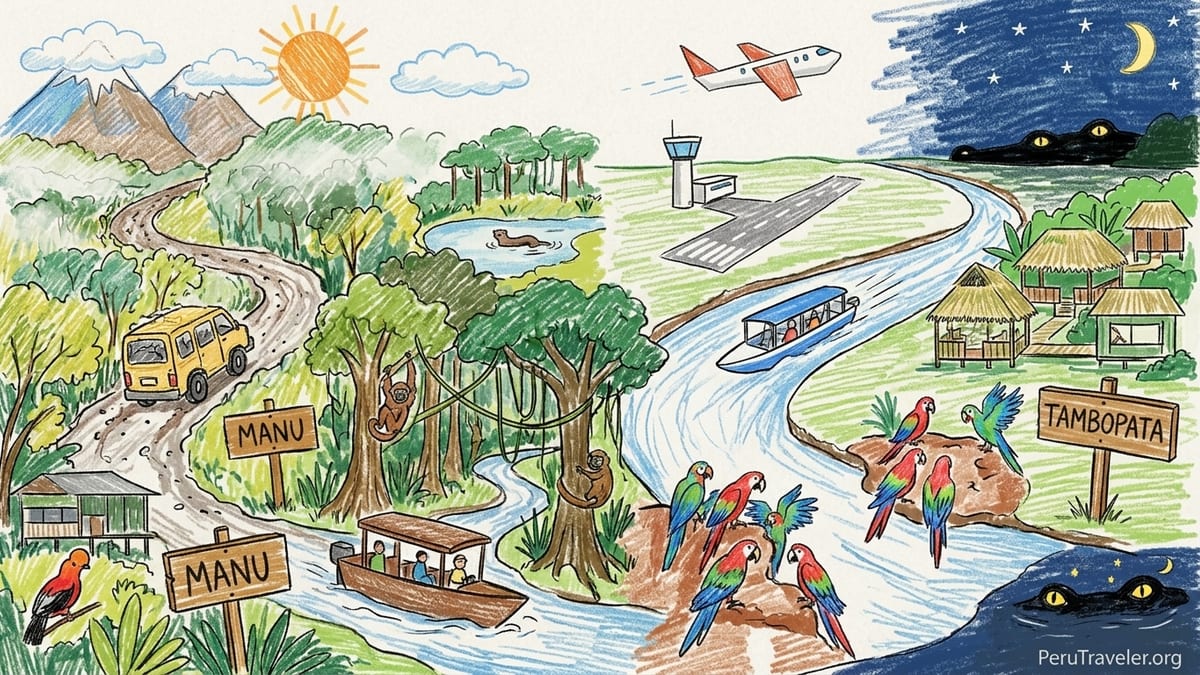
Manu vs Tambopata: What You Are Really Choosing
The first surprise when comparing Manu and Tambopata is that you are not simply choosing between two “jungles.” You are deciding between two very different logistics models and levels of remoteness. Manu requires a long road journey from Cusco through Paucartambo and the cloud forest down toward Atalaya, followed by hours of river travel on narrow motorized boats. Tourism there is tightly regulated and split between the Cultural Zone outside the core park, the Manu Reserved Zone where limited tourism is allowed, and restricted sectors used for research or strictly protected. In contrast, Tambopata revolves around the small Amazonian city of Puerto Maldonado, an airport-accessible hub where most travelers are on a boat within an hour of landing.
On paper, Manu is more remote and more expensive. Tambopata is easier and often cheaper, with more lodge comfort for the price. The question is whether Manu’s extra two days of buses and boats translate into richer wildlife encounters, deeper immersion and the sense of being truly away from it all, or whether the same budget would be better invested in a quality lodge deeper inside the Tambopata basin. Matching real itineraries against those promises is the only honest way to answer that.
For this comparison I joined a six-day Manu wildlife expedition with a Cusco-based operator licensed by the Manu National Park administration to enter the Manu Reserved Zone, and a four-day Tambopata package that based me upriver from Puerto Maldonado with clay lick, oxbow lake and night excursions included. Both trips were mid-range rather than ultra-budget or ultra-luxury, the sort of tours many independent travelers end up booking once in Peru.
Understanding Manu’s Zones: Cultural, Reserve and True Park Access
One of the most important distinctions in this decision is inside Manu itself. The “Manu” you see on a map is not the “Manu” most tours visit. According to Peru’s protected area authority, the wider Manu biosphere is zoned into a Cultural Zone with permanent human settlements and general tourism, a Reserved Zone where controlled nature tourism and research are allowed, and a restricted core where access is largely limited to scientific work and park management. Many agencies in Cusco sell “Manu” trips that never leave the Cultural Zone along the Alto Madre de Dios River, essentially circuiting community forests and private reserves outside the strictest national park sectors.
The six-day Manu trip I joined was explicitly marketed as a “Manu Reserved Zone Expedition” and the operator was listed by Manu National Park’s headquarters among agencies allowed to take visitors into the river Manu tourism sector with lake visits and established trails. That meant extra entrance procedures, check points and higher fees, but it also meant nights at an authorized lodge inside the official tourism zone rather than in the more accessible buffer forests. Shorter three-day “Manu” trips from Cusco, which I examined for comparison, tended to stop in the cloud forest and spend one or two nights in lodges along the Alto Madre de Dios without ever reaching the park’s inner river system.
This is not merely semantic. Wildlife density, forest maturity and overall sense of isolation increase drastically once you leave the bus-accessible corridor and push several hours downriver. When an agency lists “Manu Cultural Zone” in the title, you can expect mostly roadside cloud forest walks, riverbank secondary forest, and little of the prime lowland-forest experience that made Manu famous to naturalists. Only by joining a longer five or six-day Reserved Zone itinerary are you likely to spend time in the core tourism stretches of the Manu River itself.
The Long Road into Manu: Cloud Forest, Bumpy Buses and River Days
The journey into Manu from Cusco began before dawn with a minibus climb out of the city and over high Andean passes. It took around eight hours to reach the colonial town of Paucartambo, cross the famous Acjanaco pass and drop into the cloud forest road that clings to the mountainside. This road is narrow, often muddy in the wet season and subject to rockfalls. We stopped repeatedly for cloud forest birdwatching at several recognized pullouts where mixed tanager flocks, quetzals and occasionally the extravagant male Andean cock-of-the-rock can be observed in leks close to the road.
By mid-afternoon of day one we checked into a simple lodge at the cloud forest edge, with twin rooms, hot showers that functioned intermittently and hearty meals of soup, rice, vegetables and chicken. The bus day was long and bumpy but punctuated by real wildlife sightings: woolly monkeys and brown capuchins in roadside trees, mountain toucans and countless hummingbirds near lodge feeders. On day two we continued down to the lowlands and switched to a river boat at Atalaya. The recorded travel time on that second day was two hours by road and four by boat to a lodge in the Cultural Zone, with another four-hour boat run on day three to reach our first night at a rustic lodge inside the Manu Reserved Zone tourism sector.
In total, heading into Manu for this six-day trip required roughly twelve to thirteen hours of road travel and eight to ten hours of river time spread over the first three days. Return was slightly faster upstream but still demanded a full day by boat and bus. Transport was shared with other guests in long narrow boats equipped with outboard motors, life vests and basic rain covers. Comfort was functional rather than relaxing. Seats were wooden with thin cushions, toilets consisted of simple facilities at lunch stops and lodges, and weather swung from chilly mist in the cloud forest to intense lowland heat where temperatures approached the mid-30s Celsius with high humidity.
Tambopata from Puerto Maldonado: Quick Access and Smarter Use of Time
In Tambopata, the journey story looked very different. I flew from Cusco to Puerto Maldonado, landing mid-morning. Lodge staff met arriving passengers and transferred us by vehicle to an office in town for a quick bag repack and briefing, then drove about forty-five minutes along a paved and then dirt road to a small river landing. From there, a covered motorized canoe took about ninety minutes to reach the lodge, which sat several hours downriver from the city but still within the buffer zone of the Tambopata National Reserve. On longer itineraries that continue to lodges deeper in the reserve, visitors can expect four to four and a half hours of boat travel from town.
Counting check-in time and a relaxed lunch en route, I went from airport tarmac to hammock at the lodge in under four hours. That compression of logistics had two big consequences. First, I began wildlife activities the same afternoon, joining a forest walk and sunset boat ride on the river. Second, my four-day program provided three full nights and essentially three full days of wildlife excursions, rather than losing most of the first and last days to internal travel. It meant the majority of my Tambopata stay was spent on trails, oxbow lakes, night walks and clay lick visits instead of on buses.
The lodge itself offered private ensuite rooms with hot showers, solar-powered lighting and mosquito netting over comfortable beds. Meals were served buffet style, mixing Peruvian classics with simpler dishes for international visitors. While Manu’s lodges were clean and atmospheric, the Tambopata property clearly invested more in guest comfort, with better mattresses, more reliable electricity in the evenings and easier access to filtered water and snacks. I still had plenty of insects and the full rainforest soundtrack overnight, but the stay felt more like a relaxed base than an expedition camp.
Operators, Prices and What I Actually Paid
Costs change quickly in Peru, but by late 2025 and 2026 mid-range prices for Manu and Tambopata had settled into recognizable bands. For the Manu Reserved Zone expedition I joined a Cusco-based agency that bundled transport, lodges, meals, guiding and park permits into a single package. For six days and five nights, beginning and ending in Cusco, I paid the equivalent of roughly 1200 to 1400 US dollars per person depending on group size, with a clear surcharge for the Manu National Park and Reserved Zone access. This lined up with other published Manu multi-day rates that now often exceed 1000 dollars per person for itineraries that reach the main Manu River tourism sector.
In Tambopata, rates were lower and more varied. A number of Puerto Maldonado operators and lodges now advertise four-day, three-night packages in the 350 to 650 US dollar range per person, depending on lodge comfort and whether the reserve entrance fee and airport transfers are fully included. That usually covers accommodation, meals, guided excursions, and shared boat transport from Puerto Maldonado. Higher-end brands that maintain lodges within or next to the Tambopata National Reserve and emphasize research collaborations and more personalized guiding often charge closer to 800 to 1200 dollars for a similar four-day stay, while including a more complete menu of guided activities and better staff-to-guest ratios.
In both destinations, park or reserve entrance charges were technically separate line items but were bundled into my package cost. In Tambopata, the official entry ticket through Peru’s protected area service is currently a modest amount in Peruvian soles for foreign adults on standard itineraries, and lodges confirmed that this was paid on my behalf. In Manu, the fee structure was higher for the river tourism sector and included permits specifically tied to authorized operators and itineraries. I did not pay these in cash on the day. Instead, they appeared as part of the tour balance with the agency presenting proof of authorization and entry at checkpoints along the river.
Wildlife Reality: Manu’s Depth vs Tambopata’s Concentrated Highlights
On wildlife alone, Manu and Tambopata both delivered, but in slightly different ways. In the Manu Cultural Zone and along the Alto Madre de Dios River I saw troop after troop of howler, squirrel, capuchin and spider monkeys, along with capybaras on sandbars and an impressive diversity of birds, from macaws and toucans to numerous raptors. Once in the Manu Reserved Zone tourism sector, low human traffic and extensive old-growth forest made dawn and dusk boat outings feel genuinely wild. Over two days of lake and river exploration we had multiple sightings of giant otters on oxbow lakes, tapir tracks at mud wallows, caiman at night and countless bird species identified by our naturalist guide.
However, these encounters were mixed into long travel days and required early starts after tiring nights. Some of the best sightings happened incidentally from the moving boat, which meant limited photography time and the need to accept distant views. Forest trails inside the tourism zone were atmospheric but often quiet in the mid-day heat. The feeling of being deep in a vast protected area was palpable, but it came with long intervals where wildlife was heard more than seen, and where the dominant sensation was of scale and solitude rather than constant action.
In Tambopata, my wildlife list was shorter in species count but stronger in marquee experiences that were logistically targeted. An early morning visit to a riverbank clay lick placed us in front of large numbers of parrots and smaller macaws, with hundreds of birds swirling overhead for more than an hour. A separate trip to an oxbow lake yielded black caiman, hoatzins, roosting nightjars and a distant but satisfying view of giant river otters patrolling the far bank. Night walks near the lodge produced tarantulas, tree frogs, nocturnal insects and the eerie eye shine of arboreal mammals picked up by the guide’s flashlight.
Photographers on my Tambopata trip were particularly pleased with the clay lick and lake visits, which were structured around known wildlife hotspots and involved less time in transit. Birdwatchers on the Manu expedition appreciated the extended checklists and chance to see specialties of both cloud forest and lowland habitats, something Tambopata cannot match in a single trip. Yet even they admitted that the sheer effort required to reach Manu’s inner river stretches made short moments of action feel hard-earned rather than abundant.
Comfort, Bugs, Toilets, Weather and Emergencies
Comfort is where the gap between Manu and Tambopata widened. Manu lodges in the Cultural and Reserved Zones were clean and friendly, but facilities leaned to the rustic. Electricity was typically limited to a few evening hours via generator or solar, showers were lukewarm or cold, and toilets were shared in at least one of the interior lodges. Mosquito nets were provided but not always perfectly fitted. Paths could be muddy and dark at night, and washing clothes was difficult. Anyone with mobility limitations or a strong preference for modern hotel standards might find the combination of heat, insects and basic infrastructure challenging.
Tambopata lodges, by contrast, often market comfort as part of the experience. My lodge offered ensuite bathrooms with reliable flush toilets, regular hot water, and 24-hour or extended-evening electricity in common areas. Rooms were screened rather than fully enclosed, which kept the rainforest soundscape alive while still cutting insect intrusion. There were more ceiling fans, better lighting and simpler access to first-aid kits, bottled or filtered water and communication devices. In case of emergencies, the relative proximity to Puerto Maldonado and the presence of speedboats and radio or satellite communication provided an extra layer of reassurance.
Insect pressure was high in both destinations, especially after rain and around dusk. In Manu’s lowlands I experienced more intense bouts of biting insects and sandflies, particularly during boat landings and evening walks. In Tambopata, mosquitoes were abundant but felt somewhat more manageable near the lodge, where staff encouraged consistent use of repellent and proper clothing. Weather patterns were similar, with hot, humid days and cooler nights, though Manu’s altitudinal range meant that the first night in the cloud forest was distinctly chilly and damp, something to consider when packing layers.
Emergency resources are difficult to evaluate from a traveler’s perspective, but the presence of more lodges and transport operators in the Tambopata region appears to make evacuations simpler. In Manu, once inside the Reserved Zone tourism sector, you are several hours by boat from the nearest road and even farther from hospitals. Our guide carried a satellite phone and the agency had a protocol for serious incidents, yet everyone was candid that evacuations would be slow and heavily dependent on river conditions. That is part of the trade-off when choosing deeper remoteness.
Guides, Group Sizes and Responsible Access to Indigenous Territories
Guide quality can make or break rainforest trips. In Manu, our lead guide held a university degree in biology, had more than a decade of experience leading expeditions in the park and spoke fluent English and Spanish. His birding skills were excellent and his knowledge of mammal behavior helped us predict where to wait at lakes and clearings. In Tambopata, the lodge employed resident naturalist guides who had strong local knowledge and good English, but whose formal training varied. For general visitors, the Tambopata guiding standard was more than sufficient and often engaging. For specialist birders and scientific travelers, Manu’s highly experienced guides were a notch above.
Group sizes also differed. Manu expeditions tend to limit groups to eight to ten participants, particularly on Reserved Zone itineraries, because park regulations and logistic costs favor smaller, more cohesive teams. On my trip we were six guests, which allowed flexible stops and quiet wildlife observation. In Tambopata, excursions departed with between eight and fourteen people, splitting where necessary for specific interests. Families and couples seemed comfortable with that scale, but solo travelers seeking quieter hides or long photographic waits may need to plan around group dynamics or pay for more customized outings.
Both regions intersect territories used by Indigenous communities, including areas where people live in voluntary isolation or have limited contact with national society. In Manu, sections of the park and adjacent reserves are explicitly zoned to protect these groups, and tourism is strictly barred from entering or approaching such areas. Our guide was clear that sightings of distant canoes or smoke that might indicate uncontacted people would result in an immediate route change and a report to park authorities, not an opportunity for viewing. In Tambopata, community-managed tourism projects operate in some buffer-zone areas, but the same ethical principle applies: Indigenous territories and groups in isolation are not attractions and should never be treated as part of a wildlife checklist.
This is vital context when evaluating “remote” itineraries marketed with images of traditional dress or vague references to “uncontacted tribes.” Reputable operators in both Manu and Tambopata now emphasize that all cultural visits are conducted with communities that have chosen to participate in tourism, under agreed protocols, and that protected territories used by Indigenous peoples in isolation remain strictly off limits.
Five-Day Cost Comparison: What the Extra Money Buys
To compare value as fairly as possible, it helps to standardize time. Imagine you have five days to allocate in southern Peru and want a deep rainforest experience. In Manu, the realistic minimum for reaching the Manu Reserved Zone tourism sector is a five or six-day itinerary. In Tambopata, a four-day lodge stay plus a travel buffer can fit into that same window. Based on published rates and my own bookings in 2025 and 2026, a mid-range Manu Reserved Zone expedition of five to six days tends to cost between roughly 1100 and 1600 US dollars per person, starting and ending in Cusco, depending on group size and lodge choices. A solid four-day Tambopata package with clay lick and oxbow lake, starting and ending in Puerto Maldonado, usually runs between about 400 and 900 dollars per person for mid-range lodges, with higher-end properties charging more.
Assume, for comparison, 1300 dollars for a six-day Manu trip and 700 dollars for a four-day Tambopata stay, both including meals, guiding, shared transport and park or reserve entry. Over a five-day window, Manu devotes perhaps two and a half days to being primarily in transit and two and a half to active wildlife exploration. Tambopata, by contrast, converts three days almost entirely into guided activities and uses partial days for arrival and departure. That means each “wildlife-rich” day in Manu is more expensive in pure cash terms and also comes packaged with more fatigue. What you gain is layered habitat exposure from high cloud forest down to lowland river, plus the hard-to-quantify sense of being deep inside a vast protected area with few other boats.
Additional spending in Manu pays for scarce river transport, small lodges that operate on the margins of strict regulation, specialized guides and the complexity of moving food, fuel and staff up and down long rivers. In Tambopata, your money goes more into lodge comfort, structured excursions to nearby clay licks and lakes, and shorter transport chains from an airport city. Neither model is inherently better. The key is aligning them with your goals. If you dream of days of steady wildlife action with comfortable nights and minimal travel, Tambopata returns more visible experiences per dollar. If you want to feel that half your investment is going into simply reaching a place few others see, with all the trade-offs that implies, Manu justifies its higher cost.
The Takeaway: Remoteness, Experience and Where I Would Return
Looking back over both trips, the structure of my conclusion follows the same sequence many travelers face when they weigh these two destinations. Remoteness was highest in Manu. The journey from Cusco over high passes, down through dripping cloud forest and out onto long brown rivers created a real sense of transition. There were stretches on the Manu River where we saw no other boats for hours and the forest canopy felt endless. That emotional payoff was powerful, and for travelers who prize that frontier sensation it may justify almost any discomfort.
The journeys I actually made, however, were not romantic in every moment. The long hours in buses and boats were tiring, seats were basic, sun and rain alternated rapidly, and early mornings were non-negotiable. When I compared this with the relatively efficient flight and short boat transfer into Tambopata, where I was walking rainforest trails the same afternoon, I understood why many travelers leave Manu feeling that half their itinerary was spent getting to and from the action. For someone on a tight overall schedule in Peru, those extra internal travel days come at the expense of time in the Andes or along the coast.
In terms of wildlife actually seen with my own eyes, Manu delivered greater habitat diversity and a longer cumulative species list, especially for birds. However, Tambopata provided more tightly focused highlight experiences: macaw and parrot swirls at a clay lick, close views of giant otters on an oxbow lake, and multiple structured night outings that balanced adventure and safety. Guide quality was excellent on both trips, with a slight edge to Manu for serious birders and naturalists, and a slight edge to Tambopata for family-friendly interpretation and comfort.
What felt exhausting or overpriced? Manu’s extra cost did not feel inflated once I understood the number of staff, fuel, permits and logistics involved, but the ratio of transit to active time was high. At the halfway point of the journey back to Cusco I caught myself wondering whether a shorter Manu Cultural Zone and cloud-forest combination would have captured enough of the park’s magic at lower cost and with less fatigue. Tambopata, by contrast, felt fairly priced for the level of comfort and the density of experiences delivered each day. If I had to choose where to return with my own money, I would go back to Tambopata for focused photography and to share the rainforest with friends or family, and back to Manu only if I had at least a week and a very specific naturalist goal.
For travelers trying to decide, my recommendations are simple. Naturalists and keen birders with time, patience and a strong tolerance for rustic conditions will find Manu, particularly itineraries that genuinely reach the Manu Reserved Zone, a rewarding investment. Photographers and travelers who value predictable access to clay licks, oxbow lakes and canopy viewpoints with shorter transfers are likely to get more usable shooting hours from Tambopata. Families and time-limited visitors, especially those combining the rainforest with Machu Picchu and the Sacred Valley, are usually better served by Puerto Maldonado-based lodges where airport access, comfort and emergency logistics are stronger. Travelers who specifically value remote rainforest exploration and the feeling of being far from roads and towns, and who understand that this does not guarantee constant wildlife action, will find in Manu the deep expedition narrative that many dream about when they first imagine the Amazon.
FAQ
Q1. Is Manu National Park really worth the longer and more expensive journey?
For travelers who value deep remoteness, diverse habitats from cloud forest to lowland jungle and small group expeditions with specialist guides, Manu can be worth the added cost and effort. For those who mainly want accessible wildlife viewing, clay licks and comfortable lodges within a limited time, Tambopata usually offers better value.
Q2. How do I know if a “Manu” tour actually enters the Reserved Zone?
Check whether the itinerary explicitly mentions nights on the Manu River tourism sector and names lodges recognized by the park administration, and ask the operator to confirm that they hold current authorization to enter the Manu Reserved Zone rather than operating only in the Cultural Zone and buffer forests.
Q3. How many days should I plan for Manu compared with Tambopata?
To reach and meaningfully experience the Manu Reserved Zone, plan at least five or six days starting and ending in Cusco. For Tambopata, a three or four-day lodge package from Puerto Maldonado is enough for clay lick visits, an oxbow lake outing, night walks and several forest excursions.
Q4. Which destination is better for families with children?
Tambopata is usually better for families, because access from Puerto Maldonado is shorter, lodges tend to be more comfortable, and activities can be adapted easily to different ages. Manu’s long road and boat journeys and more rustic infrastructure are better suited to older children and teenagers with an interest in nature and adventure.
Q5. Are there big differences in wildlife between Manu and Tambopata?
Both regions are extremely rich in wildlife. Manu offers a broader range of habitats in a single trip and is especially strong for birders, while Tambopata often provides more concentrated experiences such as macaw clay licks and oxbow lakes with giant otters and caiman that are easier to access on shorter stays.
Q6. How uncomfortable are insects, heat and basic toilets on a Manu expedition?
Expect high heat and humidity in the lowlands, frequent biting insects, muddy trails and some simple or shared toilet facilities in Manu, particularly in inner lodges. With lightweight long clothing, good repellent and realistic expectations, most healthy travelers manage well, but those who require hotel-level comfort may find it challenging.
Q7. Can I visit areas with Indigenous peoples in isolation in Manu or Tambopata?
No. Areas used by Indigenous peoples living in isolation or with very limited contact are strictly protected and are not tourism destinations. Reputable operators will avoid these zones and will never advertise uncontacted peoples as an attraction.
Q8. Which destination is safer in terms of medical emergencies?
Both regions take safety seriously, but Tambopata has an advantage because lodges are closer to Puerto Maldonado, where there are air links and medical facilities. In Manu’s inner river tourism sector, any serious evacuation requires several hours of river and road travel back toward Cusco.
Q9. How much should I realistically budget for a quality experience in each place?
As an approximate guide in the current market, many mid-range six-day Manu Reserved Zone expeditions cost around the low to mid four figures in US dollars per person, while solid four-day Tambopata lodge packages often fall in the mid hundreds to around a thousand dollars per person depending on lodge standards and inclusions.
Q10. If I only have time and money for one rainforest destination in Peru, which should I choose?
If your priority is maximizing wildlife viewing and comfort inside a tight schedule, choose Tambopata from Puerto Maldonado. If your priority is experiencing a long, layered journey from Andes to deep Amazon with smaller groups and do not mind rustic conditions, choose a properly authorized Manu expedition that reaches the Reserved Zone.