


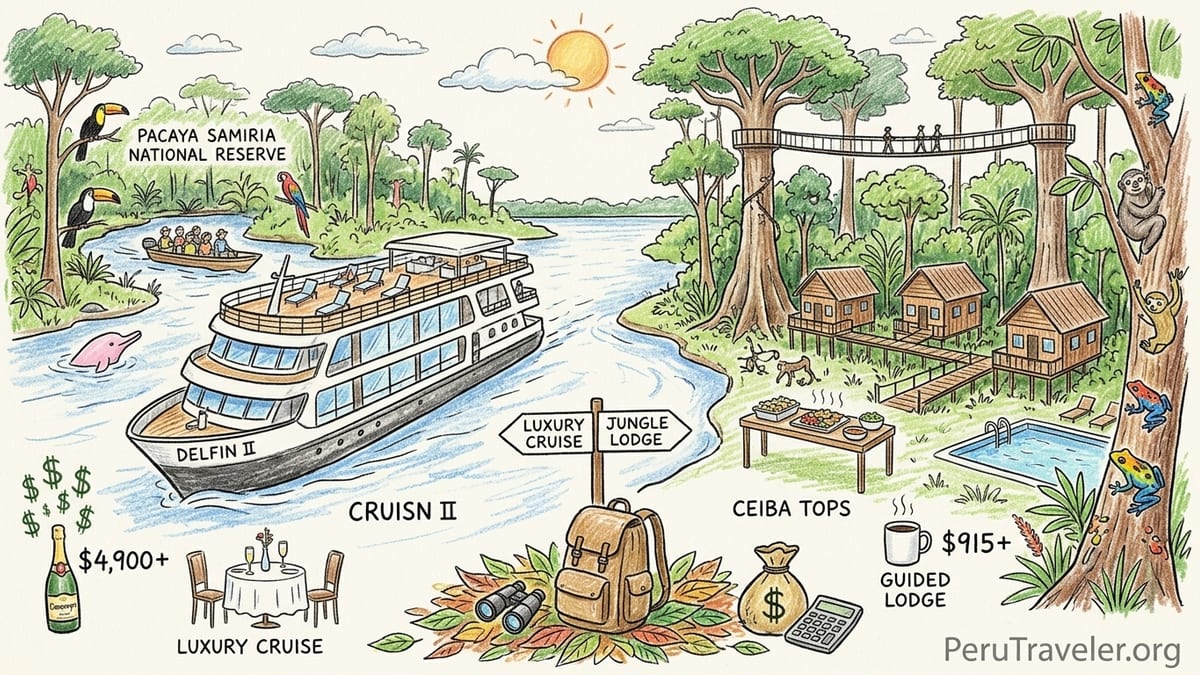
When friends ask whether a luxury Amazon River cruise from Iquitos is worth several thousand dollars per person, I now have a precise answer, because I have paid for both sides of the comparison. In August 2024 I joined a four-day, three-night Upper Amazon itinerary aboard the Delfin II, one of the best-known small luxury vessels operating out of Nauta near Iquitos. A few months earlier, in May 2024, I spent four days and three nights at Ceiba Tops, Explorama’s comfortable jungle lodge reached by speedboat from Iquitos. Both trips targeted broadly the same region of northern Peru, both promised expert naturalist guiding, and both were marketed as all-inclusive rainforest experiences. The difference was the bill: the Delfin II cruise cost about 4,900 US dollars per person for a suite on a four-night program according to 2024 rate sheets, plus extras, while my Ceiba Tops package started at 915 US dollars per person for four days and three nights including the canopy walkway extension, based on current published lodge tariffs. I went to see what the extra money actually bought.
The Exact Trips I Took and What I Paid
For the sake of clarity, this comparison is based on one organized cruise and one properly guided lodge stay that I personally completed in the Iquitos region. The cruise was a Delfin II Upper Amazon program round-trip from Nauta, marketed as four days and three nights, which in practice meant three full days in the Pacaya Samiria National Reserve plus embarkation and disembarkation transfers from Iquitos. The Delfin II is a 30-passenger luxury vessel with 14 spacious suites, large picture windows, air conditioning and a fine-dining style restaurant. Published 2024 rates for the four-night program run around 4,700 to 4,900 US dollars per person in a standard suite on double occupancy, and slightly more for the master suites at the bow. These rates include all onboard meals, non-alcoholic beverages, scheduled skiff excursions and transfers between Iquitos airport and the port at Nauta.
My lodge stay was at Ceiba Tops, one of Explorama’s river lodges about 40 kilometers downriver from Iquitos, combined with a day trip to the company’s canopy walkway and more remote ExplorNapo area. Explorama’s 2026 tariff sheet lists a four-day, three-night “Ceiba Tops with Canopy Walkway Special” at 915 US dollars per person, including accommodation, all meals, guided excursions and boat transfers from Iquitos. Shorter programs at Ceiba Tops start at 495 to 645 US dollars per person for one to three nights, which gives a sense of scale next to luxury cruise prices that typically start above 3,500 US dollars per person for three nights and go higher depending on cabin category.
For a realistic apples-to-apples comparison, I factored in all mandatory or highly likely additional expenses. On the Delfin II, that meant bar drinks beyond basic soft drinks, suggested crew tips and national park fees, which collectively added roughly 300 to 400 US dollars per person. On the Ceiba Tops program, extras included soft drinks and alcohol, optional activities such as night boat outings if not included in the package, and staff tips. Door-to-door for two adults, including flights from Lima to Iquitos, private transfers in Lima and Iquitos, and tips, my four-night Delfin II trip came to just over 11,000 US dollars. The four-day Ceiba Tops combination for two adults, including similar incidentals, came to just under 3,000 US dollars.
Cabin Versus Lodge Room: Comfort, Air Conditioning and Sleep
The most immediate difference between cruise and lodge appeared as soon as I walked into my Delfin II suite. The room felt more like a boutique hotel than a ship’s cabin, with polished hardwood floors, soft lighting, a king bed dressed in crisp Peruvian cotton, and floor-to-ceiling windows facing the river. Air conditioning ran quietly in the background and kept the room at a steady cool temperature, a real relief given that Iquitos averages around 26 to 27 degrees Celsius year-round with high humidity. The ensuite bathroom had a walk-in rain shower with constant hot water, high-end bath products and proper water pressure. Storage was generous enough for a week’s worth of tropical clothing, and sound insulation muffled most engine noise.
My room at Ceiba Tops was more like a solid three-star hotel in the jungle. The lodge offers private, air-conditioned rooms with tiled floors, simple wooden furniture, en suite bathrooms, and porches looking into the forest or gardens. The air conditioning units are more audible than those on the cruise ship and need to work hard, especially at night, but they are effective. Showers had hot water, though pressure varied a little at peak times. The beds used mosquito netting, and window screens kept most insects out, though not all. Overall, the lodge room was comfortable rather than luxurious: clean, functional and well suited to the climate.
Sleep quality was surprisingly similar in some respects and different in others. On the Delfin II, the motion of the river was mild and the engines quiet, but you are always moving, and occasional stops for late-night or pre-dawn skiff operations can create background noises. At Ceiba Tops, you sleep on solid ground, but the nocturnal forest chorus is much louder than the muffled river on the ship. Tree frogs, insects and distant howler monkeys create an immersive soundtrack. If you value silence and predictability, the ship might feel calmer; if you love feeling enveloped by the forest, the lodge offers that in a way a vessel on the main channel does not.
Meals, Atmosphere and Daily Rhythm
Meals on the Delfin II were unequivocally high-end. Breakfasts were plated or à la carte, with fresh tropical fruit, eggs cooked to order, Peruvian coffee and options like quinoa porridge or homemade granola. Lunches and dinners were multi-course affairs, often highlighting Amazonian ingredients such as paiche fish, cocona and camu camu. Presentation was restaurant-quality, and service matched: servers remembered dietary preferences and wine glasses were refilled discreetly. Dining was mostly at fixed times, with all guests sitting down together or in small groups, and the atmosphere was relaxed but quietly formal.
At Ceiba Tops, meals were served buffet-style at set hours in the central restaurant. Breakfast typically included fruit, bread, eggs, rice, and local dishes, while lunch and dinner rotated through simple main courses like grilled fish or chicken, rice, salads, and soups. Food was fresh and hearty, but not gourmet. The atmosphere was much more casual; you could arrive directly from a muddy trail and nobody minded, and groups mixed more freely. For travelers who enjoy culinary creativity and fine wine, the cruise is a clear step above. For those who simply need reliable, filling meals between outings, the lodge delivers at a fraction of the cost.
The daily rhythm also differs. On the cruise, each day followed a structured schedule of early morning skiff excursions, mid-morning presentations or siesta, afternoon outings and sometimes an evening cruise. Announcements signaled when to gather, and staff managed logistics tightly to keep people on time. At the lodge, the core activities were scheduled, but it felt easier to skip a walk, linger over coffee, or spend an afternoon in the pool if fatigue set in. That flexibility, combined with a less formal dining environment, gave the lodge stay a looser, less choreographed feel.
River Versus Forest: Excursions and Wildlife Time
On both the Delfin II cruise and at Ceiba Tops, my days were divided into guided excursions. What mattered to me was how much of that time involved genuine wildlife observation rather than being in transit. On the Delfin II four-day itinerary, I logged roughly eight excursions: five long skiff outings on blackwater tributaries inside the Pacaya Samiria reserve, two shorter village or cultural visits, and one night excursion for caiman spotting. Each skiff trip lasted between two and four hours. Once past the wide main channel of the Marañón or Ucayali, the smaller creeks delivered the classic flooded-forest experience, with overhanging vegetation, pink and gray river dolphins in the distance, and regular bird sightings.
Over the cruise, I had sustained views of several species of herons, kingfishers, macaws, toucans and hoatzins, plus multiple encounters with squirrel monkeys and capuchins moving through the canopy. Pink river dolphins appeared on most outings, though often at a distance or briefly surfacing. One morning we watched a troop of howler monkeys for nearly twenty minutes as they fed in a fruiting tree. At night we scanned for caimans and spotted eye-shine along the banks. When I totaled my notes, I estimated that about 60 to 65 percent of scheduled excursion time on the cruise was active wildlife observation, with the rest spent navigating to reach promising habitats or visiting communities.
At Ceiba Tops and the ExplorNapo area, the balance looked slightly different. Activities included guided forest walks on terra firme and seasonally flooded trails, canoe outings on smaller streams, a night walk, the canopy walkway, and one or two boat trips on nearby rivers. Transfer time from the lodge to some trailheads or the canopy site could be significant, especially for the full-day canopy excursion, which required a longer boat ride. Once in the forest, however, wildlife viewing tended to be more intimate. We stood beneath mixed-species monkey troops moving through the upper canopy, watched leafcutter ants working along the forest floor, and spotted poison dart frogs, sloths and a variety of birds from the elevated platforms of the canopy walkway.
Counting hours of true observation, my lodge-based program delivered a similar total of wildlife time to the cruise, but structured differently. Forest walks required more patience and attentiveness, while skiff-based viewing from the cruise allowed for covering more ground quickly but often at longer range. If I had to choose where I saw wildlife best, monkeys and forest insects were more compelling around the lodge, while river dolphins and large wading birds were easier from the cruise skiffs.
Guides, Interpretation and Group Size
Both the Delfin II and Ceiba Tops rely on Peruvian naturalist guides, many of whom grew up in Amazonian communities and later trained in biology or tourism. On the luxury cruise, guiding felt more polished. My assigned guide spoke excellent English, delivered structured briefings each evening about the next day’s activities, and used laminated field guides and sometimes a tablet slideshow for onboard presentations on topics such as Amazonian fish, floodplain ecology and conservation challenges in Pacaya Samiria. Group sizes on skiff excursions ranged from six to eight guests per guide, which allowed space in the boat and time for individual questions.
At Ceiba Tops, my guide was equally knowledgeable about local flora and fauna, but interpretation style was more conversational and less formal. Briefings happened on the trail or over meals rather than in a dedicated presentation lounge, and there were fewer props or visual aids. Group sizes varied more; on some walks we were four people, while on others, especially the canopy walkway day, there were ten or more guests in the same group. That occasionally meant wildlife was spooked sooner, and explanations had to be brief to keep everyone moving.
The key question was whether premium guiding on the cruise produced deeper ecological understanding. In my experience, the difference came less from pure knowledge and more from time and setting. Because the cruise includes built-in lecture time in air-conditioned comfort, it is easier to sit through longer, thematically structured talks that tie together hydrology, migration patterns and local livelihoods. At the lodge, by the time you return from a hot three-hour hike, most people understandably prioritize a shower and a cold drink over a long seminar. Guests who already love reading field guides or watching nature documentaries may get more from the cruise’s interpretation program. Casual travelers content with shorter explanations on the trail may not benefit enough from the extra structure to justify a several-thousand-dollar premium.
Logistics, Fixed Schedules and the Feeling of Structure
The greatest non-monetary trade-off between cruise and lodge is the level of structure. The Delfin II operates on a fixed itinerary that must coordinate navigation times, protected area permits, village visits and the ship’s kitchen schedule. That precision is part of the value proposition: you do not worry about anything, and everything runs like clockwork. The downside is that the program can feel tightly choreographed. Wake-up calls come early, often around 5:30 a.m., breakfast is served at set times, and skiff departures leave promptly. If you are tired and want to skip a morning excursion, you can, but you will be one of very few people staying behind, and you may feel you are wasting an expensive opportunity.
Premium service charges and suggested gratuities are another factor to consider. On a small luxury vessel, there is a large crew relative to guest numbers, and tipping recommendations reflect that. Prepaid service charges, bar bills and park fees can collectively add ten to fifteen percent to the headline cruise rate. Single supplements are also substantial, with some operators charging fifty percent over the double-occupancy rate for solo travelers in suites. That effectively prices many solo visitors out of the market.
At Ceiba Tops, schedules exist but are more forgiving. Morning walks still start early to take advantage of cooler hours and bird activity, but if rain is heavy or a group is not ready on time, departures flex. There is also more downtime between activities, and nobody blinks if you opt to nap in a hammock instead of joining an afternoon boat ride. Service feels friendly and efficient rather than white-glove, and there are no automatic service fees added to every drink. Tips are appreciated and expected but at a different scale, reflecting lower staffing ratios and the more modest price point.
In terms of transfers, both products require an initial journey from Iquitos to the river. For the Delfin II, this means a roughly 1.5-hour drive to Nauta and then a brief skiff ride. For Ceiba Tops, it is typically a 45-minute to one-hour speedboat transfer directly from the city’s pier. Compared with the time you spend on excursions, these transfers are minor, but they are part of the overall rhythm. Once aboard the cruise, you are committed to the ship’s pace until disembarkation. From the lodge, you have at least the theoretical option to adjust or extend your stay, or to combine Ceiba Tops with Explorama’s more remote lodges if you wish.
Costs Per Night, Per Excursion and Overall Value
When comparing value, I find it helpful to break costs down into per-night and per-excursion figures. Based on current rate sheets, a four-night Delfin II program at approximately 4,900 US dollars per person works out to about 1,225 US dollars per person per night before extras. If you assume two guided excursions per full day plus one on embarkation and disembarkation days, you might participate in six to seven significant outings. That yields a very approximate figure of 700 to 800 US dollars per person per guided excursion, though of course that price also includes your room, food and navigation.
For Ceiba Tops with the canopy walkway special at 915 US dollars per person for four days and three nights, the per-night rate is about 305 US dollars per person. If your stay includes, say, seven to eight guided activities over that period, including the canopy walkway, night walk, river excursions and village visit, then the approximate cost per guided outing comes in closer to 115 to 130 US dollars per person. Adding flights, transfers in Lima, bar bills and tips, my total spending for two adults over four days at Ceiba Tops was a little under 3,000 US dollars, or just over 375 US dollars per person per night.
From a strict financial perspective, the cruise is roughly three to four times as expensive per night and per excursion as the lodge-based program. In exchange, you receive a higher standard of accommodation and dining, a smaller guest-to-guide ratio, more formal interpretive programming, and the experience of moving deeper into Pacaya Samiria’s interior waterways rather than staying in the relatively accessible corridor near Iquitos. Whether that premium feels justified depends heavily on how much you value those elements relative to simply being out on the river and in the forest.
High Water, Low Water and How Seasons Shape Your Experience
The Iquitos region of the Amazon does not have a classic wet-dry split like some other parts of South America. It is hot and humid all year, with heavy rainfall every month. What changes more noticeably is river level. Broadly speaking, the high-water season runs from about December to May, when rivers swell and large areas of forest flood. The lower-water period runs from June to November, although local conditions can shift by several weeks in either direction. River level influences how and where boats and lodges operate, and therefore how much wildlife you may see and from what vantage point.
During high water, luxury cruises from Iquitos can penetrate deeper along narrow, flooded creeks, reaching mirror-flat lagoons and varzea forest where trees stand in several meters of water. Skiffs glide directly into the forest, and you can get close to canopy-level birdlife without leaving your seat. However, extensive flooding also means there is less exposed riverbank, and some terrestrial mammals disperse further from the main channels. Lodge programs in high water often shift more toward boat-based activities, even for properties that usually emphasize forest trails, because many paths are under water.
In lower-water months, more beaches and muddy banks emerge, which can attract wading birds, capybaras and caimans and make it easier to spot trackways along the shore. Lodges gain access to longer network of dry or damp trails, and walking becomes central again. Cruises still operate, but navigation routes may change to accommodate shifting sandbars and lower depths. For my own trips, May at Ceiba Tops fell in a transitional high-water period, which meant more canoeing through flooded forest and slightly fewer long forest hikes. August on the Delfin II was distinctly lower water, so skiffs focused more on side channels and banks where we saw sunning caimans and foraging birds at closer range.
When planning, it is important to recognize that high or low water can significantly modify itineraries without the operator being at fault. A lodge that emphasizes the canopy walkway might not be able to reach certain platforms if water levels are unusually high. A cruise that advertises specific lake visits may have to adjust if access channels become too shallow. Asking operators how they adapt excursions in different seasons, and reading recent trip reports, will give you a more realistic picture than relying only on brochure descriptions.
The Takeaway
Going into the Delfin II cruise, I expected an experience that justified its premium price through dramatically superior wildlife encounters, unprecedented comfort and a level of guiding far beyond what a well-run jungle lodge could offer. My earlier stay at Ceiba Tops had already set a solid baseline, with comfortable rooms, air conditioning, reliable food and access to a canopy walkway and remote forest. I wondered if doubling or tripling my budget would double or triple the magic.
What the extra money clearly bought on the cruise was a more luxurious bubble around the Amazon. My cabin, the dining experience, the small-group skiff excursions and the ease of moving deep into Pacaya Samiria without repacking bags all felt indulgent. Onboard presentations added structure and context, and service was attentive to the point of being anticipatory: cold towels after every outing, turn-down chocolates, and staff appearing with fresh juice the moment you stepped back on deck. If you dream of witnessing the rainforest while still enjoying boutique-hotel levels of comfort, a vessel like Delfin II delivers that promise.
Where I actually saw more wildlife, the picture was more nuanced. In terms of sheer variety of birds and river views, the cruise had an edge, particularly for pink and gray dolphins, hoatzins, macaws and large herons along the reserve’s backwaters. For intimate primate encounters, frogs, insects and a sense of being physically in the forest, the lodge’s trail network and canopy platforms provided at least as much, if not more, satisfying viewing. When I compared my field notebook species by species, the lodge days held their own surprisingly well against days in Pacaya Samiria accessed from the ship.
The main disappointments with the cruise were tied to its structure and cost. The schedule sometimes felt overly scripted, leaving little space to linger spontaneously when something interesting appeared outside of allotted excursion windows. The cumulative impact of service fees, bar charges and single supplements would make this product prohibitive for many travelers, especially solo visitors. At the lodge, disappointments were simpler: rooms were less stylish, insects were more present, and group sizes occasionally felt large, though still manageable.
In terms of value, if your priority is maximizing hours in genuine rainforest habitats per dollar spent, a well-chosen lodge near Iquitos with strong guiding represents significantly better value than a luxury cruise. You trade down in refinement but not necessarily in wildlife intensity. If, however, you are celebrating a special occasion, dislike the idea of rustic elements, or feel that an Amazon trip is a once-in-a-lifetime splurge where comfort matters as much as sightings, then a vessel like Delfin II can be worth the outlay. The key is to understand that you are primarily paying for style of travel and level of comfort, not for exclusive access to animals that cannot be seen from good lodges.
FAQ
Q1. Is an Iquitos Amazon River cruise worth it if I mainly care about wildlife?
For travelers focused almost entirely on wildlife, a high-quality jungle lodge around Iquitos generally offers comparable hours of animal observation at a fraction of the price. Luxury cruises reach deeper sections of Pacaya Samiria and can be excellent for river birds and dolphins, but lodges with good trail networks and canopy platforms can match or exceed them for monkeys, frogs, insects and forest birds while costing several times less.
Q2. How much should I budget for a luxury Amazon cruise from Iquitos?
Current published rates for upper-tier vessels on four-day itineraries from Iquitos often fall between about 3,500 and 5,000 US dollars per person in double occupancy, excluding flights, bar drinks and tips. For two adults over three or four nights, it is realistic to plan on spending between 8,000 and 12,000 US dollars once you include air tickets, private transfers and gratuities.
Q3. What does a jungle lodge near Iquitos cost compared with a cruise?
Comfortable lodges such as Ceiba Tops publish four-day, three-night programs with guided excursions and meals from around 900 to 1,500 US dollars per person, depending on the exact package. More basic community-run or rustic lodges can be cheaper, while specialist birding lodges or private custom programs can be higher, but overall the lodge model tends to be several times less expensive per night than a luxury cruise.
Q4. Will I be less comfortable at a lodge than on a cruise ship?
You will give up some refinements at most lodges compared with a vessel like Delfin II, especially in terms of room size, sound insulation, bathroom finish and gourmet dining. That said, many Iquitos-area lodges now offer air-conditioned rooms with en suite bathrooms, hot showers and swimming pools, which is more than adequate for most travelers. The main differences are style and level of service rather than basic comfort.
Q5. Which option is better for honeymooners or luxury travelers?
For honeymooners who want privacy, stylish surroundings and fine dining along with their wildlife, a small luxury vessel from Iquitos is hard to beat. Cabins feel romantic, service is personalized and moving through mirror-flat blackwater creeks at sunset is memorable. Couples who are more adventurous or budget-aware may find that a superior lodge with a private guide offers plenty of romance at a much lower cost, especially if they appreciate evenings under the forest canopy rather than in an air-conditioned lounge.
Q6. Is a cruise or a lodge better for families with children?
Families with young children often appreciate the space, safety and predictable routines of a lodge, where kids can use the pool between activities and return to the same room each night. Lodge programs can usually adjust activities to children’s ages and energy levels more flexibly. Cruises can be rewarding for older children and teens who are comfortable following structured schedules and spending long periods on skiffs, but some vessels have minimum age limits and less freedom to adapt the timetable.
Q7. How do insects compare between cruise and lodge stays?
Insects are part of any Amazon experience, but their impact differs. On a moving ship, you spend more time in breezy, screened, air-conditioned spaces, which reduces mosquito exposure outside excursions. At lodges, you are surrounded by forest and gardens, and you are more likely to encounter mosquitoes, ants and other insects around paths and rooms, although window screens and bed nets help. Anyone sensitive to bites should bring strong repellent, wear long sleeves and consider the slightly more sheltered environment of a cruise.
Q8. Which option provides better opportunities for serious wildlife photography?
Photographers who favor river scenes, reflections and birds in open habitats may prefer a cruise, where low skiffs offer stable shooting platforms and the vessel can adjust positions in open water. Those interested in macro subjects, primates in forest settings and the layered textures of tropical woodland often do better at lodges, where they can return repeatedly to nearby trails and platforms at different times of day. Ideally, combining a lodge stay with a cruise provides the broadest portfolio.
Q9. Does high or low water season matter more for cruises or for lodges?
Seasonal water levels influence both quite strongly but in different ways. High water favors cruise access to flooded forests deep inside reserves, while often shifting lodges toward more canoe-based excursions. Low water opens more forest trails and beaches for lodges and can improve chances of seeing shorebirds, caimans and tracks. Travelers who have their heart set on specific activities should ask operators how their itineraries change across high and low water periods before booking.
Q10. If I am on a tight budget, should I skip cruises entirely?
For budget-conscious travelers who still want a genuine Amazon experience, investing in a reputable jungle lodge with strong guiding is usually the smartest choice. You will see plenty of wildlife, support local jobs, and retain savings for other parts of Peru such as Machu Picchu or the Sacred Valley. Shorter or mid-range river trips from Iquitos do exist, but if they cut corners on safety, staffing or conservation practices, they are unlikely to match the overall quality of a well-run lodge stay.