


It is easy to skim past Tingo María on a Peru map, especially if you are focused on the Amazon gateways of Iquitos or Puerto Maldonado. Yet a few days in this small jungle city reveal a very different slice of the central Amazon, one framed by limestone ridges, a profile-shaped skyline called La Bella Durmiente and a cavern whose name, Cueva de las Lechuzas, hides its real stars. I based myself in town, entered through the official national park checkpoint and walked the short but sensory route to the cave, where the air turns heavy, the light thins and the harsh clicks of oilbirds replace traffic noise. This is what the journey actually looks and feels like, and what surprised me most inside the cave and around the rest of Tingo María National Park.
Staying in Tingo María and Organising the Cave Visit
Tingo María is compact enough that where you sleep genuinely shapes how you experience Cueva de las Lechuzas. I stayed in a midrange hotel a few blocks from the Plaza de Armas, in the dense core of mototaxi traffic, small restaurants and pharmacies. This central location mattered because almost all transport to the national park sectors, including the cave, is negotiated informally with drivers in the streets around the plaza and the main avenue. From here, it never took more than a couple of minutes to find a mototaxi willing to head toward the park entrance.
To reach Cueva de las Lechuzas you first need to get from the city to the official control point of Tingo María National Park, about 6 to 7 kilometers away along a paved road on the flank of La Bella Durmiente. According to current park information, that stretch takes roughly 10 to 20 minutes by vehicle. In July 2026, local sources and park-oriented travel guides reported mototaxi prices in the range of 10 to 15 soles one way, or around 15 to 25 soles for a round trip with waiting time included, provided you agree the total with the driver before setting off. I followed that pattern: we fixed a round-trip fare in advance and confirmed how long he would wait while I was inside the cave.
Admission to the park is controlled at the national park ticket booth beside the checkpoint. Based on the most recent SERNANP and visitor information available in 2026, the day ticket for Tingo María National Park is 30 soles for foreign visitors, 11 soles for Peruvian adults and 5 soles for Peruvian children, valid for one day and including the Cueva de las Lechuzas sector. Seniors over 65 and children under 5 are exempt from paying. The cave sector is open every day from 8:00 in the morning to 5:30 in the afternoon, which gives enough daylight for the short hike in and out.
Guides are not compulsory for the Cueva de las Lechuzas route, and at the time of my visit the park authority did not maintain a formal published list of authorized tour operators. Outside the gate, however, local guides sometimes offer their services. I chose to walk the route independently but took advantage of the brief orientation offered by park staff at the checkpoint. For travelers who want deeper interpretation of the limestone geology or oilbird ecology, hiring a local guide at the entrance can add context, but the basic trail and cave viewpoint are straightforward and clearly delimited by railings.
From City Streets to the Park Checkpoint
The transition from Tingo María’s grid of concrete to the edge of the national park is remarkably quick. From the plaza, my mototaxi headed out along a main avenue lined with small hostales, tire repair shops and fruit stands. Within five minutes, buildings began to thin out, replaced by scattered houses with tin roofs and small patches of plantain and papaya. Ahead, the silhouette of La Bella Durmiente, the "Sleeping Beauty" ridge that dominates the city’s skyline, grew larger and more detailed, her forested profile forming a reclining head, chest and knees.
As we gained a little elevation, the air felt hotter but a touch cleaner than in town. The road surface was entirely paved, which meant the 10 to 15 minute ride was smooth despite the mototaxi’s soft suspension. Long before we reached the gate, my driver slowed down near roadside signs with parrots and jungle motifs marking the approach to the Cueva de las Lechuzas sector. Here you start noticing more tour-oriented businesses: small restaurants with plastic tables, stalls selling honey and local coffee and modest lodgings for people who prefer to sleep closer to the park than in the city.
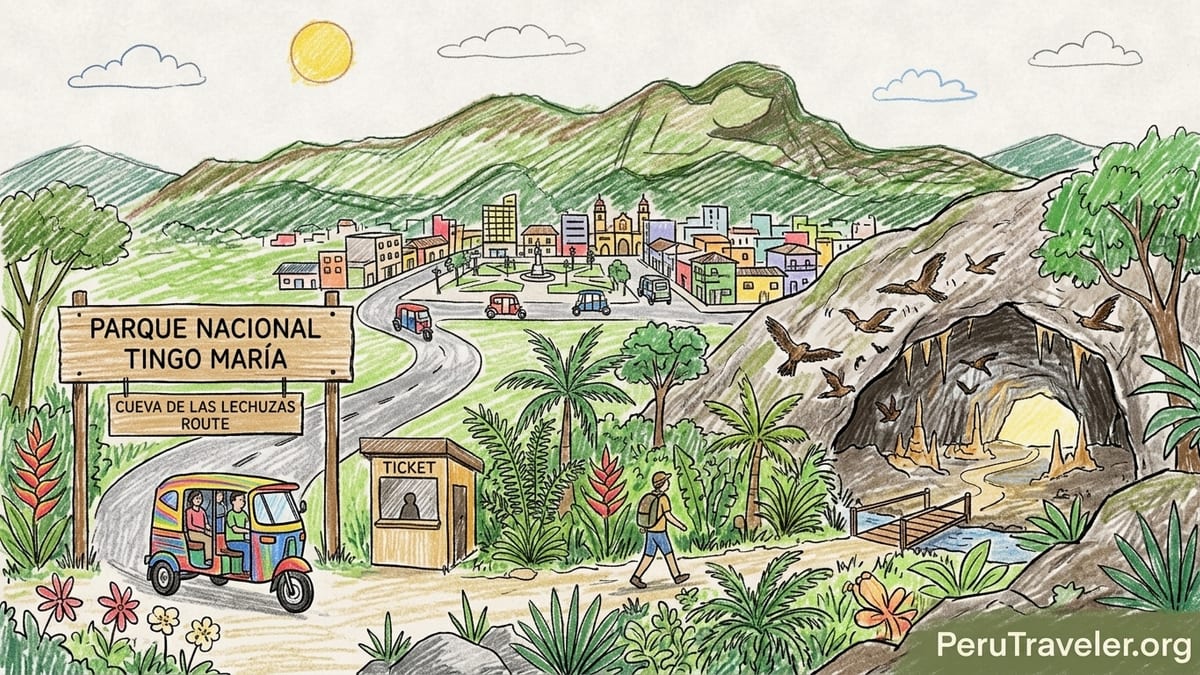
The official entrance is impossible to miss. A SERNANP sign announces Parque Nacional Tingo María and the Cueva de las Lechuzas route. Vehicles park in a gravel lot on the right side, while a small building to the left handles ticket sales and visitor registration. I paid the entrance fee in cash, received a paper ticket and listened as a ranger outlined the basic rules: stay on the marked trail, do not use flash photography inside the cave, avoid loud noises around the roosting birds and do not try to cross any barriers deeper inside the chambers.
From the checkpoint to the cave itself is not a backcountry expedition. The park inventory describes a roughly 500 to 600 meter walk that most visitors complete in about 10 minutes at a gentle pace. That felt accurate. The path begins as a packed-earth track and then alternates between concrete steps and stone-paved segments, always trending slightly uphill along the lower slopes of La Bella Durmiente. Even before entering the forest, the soundscape shifts. Mototaxis fade behind you, replaced by cicadas and the distant crash of water in the ravine below.
Approaching the Cave through Tropical Vegetation
Once past the initial open stretch, the trail ducks into proper montane forest. This is not primary, untouched jungle right from the start, but the canopy quickly closes overhead and filters the sun into a greenish light. The humidity is immediate. Glasses fog, camera lenses sweat and even at a slow walking pace I found my shirt sticking to my back. Park signage notes that the park sits in the Rupa Rupa or high jungle ecoregion, with average temperatures in the mid-twenties Celsius and significant rainfall, especially between October and April.
The path surface is mostly firm but often damp. Concrete steps help on the steeper portions, and there are metal railings in places where the slope falls away toward the stream. After a night of heavy rain, shallow puddles formed along some stretches, turning the stone slightly slick. I was happy to have shoes with good tread; flip-flops would have made the small descents down to viewpoints unnecessarily precarious. Every few dozen meters there are simple wooden benches where people can catch their breath, listen and look for movement in the foliage.
Botanically, the route offers a compact introduction to the park’s diversity. Park literature lists hundreds of bird, orchid and butterfly species for the wider protected area, but on this short approach walk what you mostly notice are broad-leafed understory plants, vines looping from tree to tree, occasional tree ferns and the flashes of color from heliconias and gingers. Insects hum constantly. Small birds cross the trail quickly. The smell mixes wet earth with a faint sweetness from fallen fruit fermenting in the leaf litter.
The first audible sign that you are nearing the cave is not the drip of water or the crash of an underground river, but an odd combination of rattling, chattering and clicking sounds riding on the air. It is easy to mistake this for a particularly agitated flock of bats. Rangers at the entrance had already hinted at what was coming, so as the trail curved around a final rocky buttress and the cave mouth came into view, I knew I was listening to guácharos, or oilbirds, the avian emblem of Tingo María National Park.
Inside Cueva de las Lechuzas: Humidity, Light and Sound
The entrance to Cueva de las Lechuzas is a grand vault, large enough that the threshold is bright with daylight and the first steps inside still feel spacious. Park descriptions call it a gigantic limestone cave, part of a system of several caverns that honeycomb the Bella Durmiente massif. From the viewing areas, you can see the main gallery stretching back and curving slightly, its ceiling laced with stalactites and its walls streaked with mineral stains.
The temperature inside feels cooler than the forest outside, but the humidity is even more intense. Moisture beads on exposed skin and drips steadily from the rock. The floor near the entrance is mostly solid, with portions of poured concrete and natural stone smoothed by thousands of footsteps. Metal railings create a clear boundary where visitors must stop. Beyond these, the ground slopes more unevenly toward pools and deeper, darker recesses of the cave, which are not open to the public for both safety and conservation reasons.
Park management has installed fixed lighting along the authorized route. These lights are strategically placed to illuminate the main chamber and key formations without fully dispelling the cave’s gloom. In the first section you still receive a wash of daylight from behind, but a few meters inside the light softens to a twilight glow where contours are visible but shadows dominate. As your eyes adjust, you begin to pick out hanging stalactites like rows of stone teeth and upthrust stalagmites that look like blunt pillars on the chamber floor.
Sound is the most striking element. Oilbirds roost and nest on ledges high in the cave walls, and their calls echo around the chamber in an overlapping chorus. Biologists describe these birds as unusual nocturnal frugivores that navigate with a form of echolocation, producing rapid series of clicks. In the cave, those clicks blend with harsher squawks and hisses as individuals jostle for space. There are also bats coexisting in side crevices, their small squeaks adding a higher, thinner layer to the soundscape. Park staff explicitly request that visitors avoid shouting or clapping, both to protect the birds and to keep the natural acoustic atmosphere intact.
Limestone Geology and Visitor Access Limits
Cueva de las Lechuzas is carved into a limestone ridge that forms part of the Bella Durmiente mountain chain. Over geological time, slightly acidic water has dissolved the rock along fractures, creating galleries, chimneys and underground drainage routes. The stalactites and stalagmites on display inside the main chamber are visible evidence of this slow process. Each is formed by mineral-rich water dripping and depositing tiny amounts of calcite over hundreds or thousands of years. Some formations near the visitor area resemble curtains, with thin parallel ridges, while others are squat columns where stalactites and stalagmites have met.
Scientific expeditions in the broader Tingo María karst area have mapped caves with a few hundred meters of passage, but only a fraction of that is legally accessible in this tourism sector. Park authorities have designated a single main gallery for regular visitors, with railings that define the farthest permissible point. It is tempting to imagine pushing deeper with headlamps and ropes, but those sections are reserved for research teams and specially authorized personnel. This restricted access is not a bureaucratic quirk. It reflects real risks in the form of slippery, uneven floors, hidden drops and the need to keep the most sensitive roosting areas free from disturbance.
The maintained visitor path inside the cave combines concrete pads, natural rock steps and metal stairs with handrails in steeper spots. Shortly after leaving the forest, you cross a small bridge structure that spans a damp depression; park assessments in recent years have noted the need to repair and maintain wooden elements as they age in the constant humidity. During my visit, the structural elements in the open-to-public zone felt sturdy, but it was obvious that any wooden planks exposed to dripping water will always require ongoing attention. I walked carefully, particularly near edges where the railings bordered darker drop-offs.
Artificial lighting significantly shapes the experience. Without it, only the very front of the chamber would be visible, and oilbird observation would be limited to fleeting silhouettes. With it, you can appreciate details on the walls and locate clusters of birds. That said, the lamps are not powerful show lights. They leave pockets of darkness intact and are oriented away from the main roosting shelves to reduce disturbance. Park staff reinforced that flash photography was not allowed and recommended that visitors either switch off camera flashes entirely or set phones to night mode without additional artificial bursts of light.
Oilbirds: Behavior, Ecology and Conservation
The cave’s name, "Cueva de las Lechuzas" or "Cave of the Owls," is misleading. Rangers are quick to clarify that there are no true owls roosting here. The emblematic species is the guácharo, known in English as the oilbird and scientifically as Steatornis caripensis. These birds are about the size of a pigeon, with long wings and tails, large eyes adapted to low light and a hooked bill. Unlike owls, which are predatory, oilbirds feed primarily on the oily fruits of certain palms and laurels, making them nocturnal fruit-eaters rather than hunters.
Oilbirds leave the cave at night to forage, flying out into the surrounding forest to pluck fruits and then returning before dawn. Inside the cave, they rely on an unusual form of navigation. In addition to their large eyes, they emit rapid series of audible clicks and use the returning echoes to orient themselves in the dark spaces of the cavern. Biologists who have studied the species across northern South America consider them a rare example of a bird using a type of echolocation, although it is not as sophisticated as bat sonar. In the resonant acoustic chamber of Cueva de las Lechuzas, this behavior becomes something you can literally hear as you stand quietly under the roosts.
Ecologically, oilbirds are important seed dispersers. By eating fruits and later excreting or regurgitating seeds at some distance from the parent trees, they help maintain forest diversity and structure. Studies in the Andes and Amazon foothills have shown that seeds passing through oilbirds can germinate successfully, suggesting that the birds play a meaningful role in connecting forest patches. In Peru, they are found in caves up to around 2,000 meters above sea level, including the mid-elevation setting of Tingo María. Their dependence on both intact roost caves and healthy fruiting forests makes national parks like Tingo María significant for their conservation.
Park staff avoid romantic folklore when talking about guácharos. Instead, they emphasize practical guidelines for minimizing disturbance. Visitors are asked to keep voices low, avoid sudden movements near the railings and resist the temptation to point bright flashlights toward the roosting shelves. The combination of low-impact behavior, limited-access trails and the absence of motorized intrusions inside the cave helps keep this colony relatively secure. During my time at the viewing area, families, couples and small tour groups came and went, and although cameras and phones were everywhere, most people complied with the no-flash rule after rangers reminded them.
Facilities, Safety and How the Reality Matches the Brochures
Before and after the cave visit, practical details outside the cavern influence how enjoyable the outing feels. At the Cueva de las Lechuzas sector, the national park provides restrooms near the entrance area, along with basic orientation services. In the buffer zone just outside the official gate, small eateries serve set lunches of rice, plantains and grilled chicken or fish, as well as juices and cold soft drinks. Prices are modest compared to Lima, which makes it easy to pair the cave visit with a meal in the same area before heading back to town.
On the trail itself, safety infrastructure is present but not overbuilt. Metal railings line the most exposed segments, especially near drops and in the cave interior. Concrete steps and stone paving reduce erosion and improve footing, but the constant humidity ensures that some surfaces remain slick. I saw several visitors wearing city sneakers move a bit tentatively in the darker sections. Good footwear and a small hand torch or headlamp, used sparingly and kept pointed toward the ground, add an extra layer of confidence, although the installed lighting makes the route passable without them during opening hours.
Compared with promotional photos that circulate in brochures and online galleries, the cave felt slightly smaller but more alive. Wide-angle images can exaggerate the sense of distance and scale, making chambers appear vast and empty. Standing in the real space, with the smell of guano, the steady drip of water and the dense sound of oilbirds, the impression is more intimate and sensory. The accessible portion is not an endless labyrinth. You see a single main gallery, lit and bounded. Rather than a disappointment, that containment made it easier to focus on specific details: a row of stalactites glowing in side light, the way one section of wall glistened where a tiny stream emerged, and the patterns of droppings and feathers on lower ledges.
Transport costs and logistics, which can often sour a day trip if mismanaged, were straightforward here. By agreeing on a round-trip mototaxi price in the city and paying the park fee at the official counter, there were no surprise charges. Drivers are accustomed to waiting at the parking area while visitors complete the cave circuit, typically an hour or two, and then returning via the same paved road to town. For those who prefer more structure, local agencies in Tingo María also offer half-day tours that package transport, entrance and guiding, but independent visitors who speak some Spanish will find the route easy to manage directly.
Beyond the Cave: Tres de Mayo and Viewpoints of La Bella Durmiente
To understand Tingo María National Park as more than a single cave, I set aside additional time to visit another authorized sector. The park service lists Tres de Mayo and Quinceañera as separate areas with established routes and opening hours from 8:00 in the morning to 3:00 in the afternoon. I chose Tres de Mayo because its route combines forest walking with access to clear river pools, a contrast to the enclosed environment of the cave.
From the city, Tres de Mayo is about 14 kilometers away by road, with a travel time in the 15 to 30 minute range depending on traffic and vehicle. I again negotiated a mototaxi in town, agreeing on a fare that covered both directions and a waiting period. The approach leaves the more urbanized strip behind more completely than the cave road, passing through stretches of farmland and secondary forest before reaching the modest park facilities at the sector entrance. There, rangers checked my park ticket, which still covered entry on the same day, and confirmed the closing time for the trail.
The trail at Tres de Mayo begins as a narrow footpath that follows a river upstream. Underfoot, the surface alternates between packed earth, stones and roots. Short wooden bridges cross side streams, and in a few muddy spots, simple boardwalks keep shoes out of the slickest patches. The humidity is similar to that near the cave, but here the canopy opens occasionally over the river, letting dappled sunlight glint off small cascades. Bird activity felt richer: I saw tanagers flashing through the branches and heard the harsh calls of parakeets overhead, reminders that the park as a whole shelters hundreds of bird species beyond the oilbirds themselves.
Several pools along the Tres de Mayo route are designated as safe for bathing, and visitors are allowed to swim where rangers indicate. During my visit, local families waded into waist-deep turquoise water while children splashed near the edges. Facilities are simple: there are no elaborate changing rooms or lifeguards, only the natural banks of the river, a few benches and occasional trash cans. Park staff encouraged visitors to avoid soap or shampoo in the water and to pack out all non-organic waste, in keeping with the park’s conservation goals.
Views of La Bella Durmiente accompany much of a stay in Tingo María, but it was from certain clearings on the way back into town that her form appeared most clearly. In late afternoon light, the ridgeline outlined the features of a reclining woman more sharply than at midday, with shadows deepening the separation between head, chest and legs. From a small mirador near the road, I watched as the sky pinked behind the silhouette and the forested slopes shifted through shades of green and blue. It is one of those geographic illusions that remains compelling even after you know exactly how it is formed.
The Takeaway
What surprised me most about Cueva de las Lechuzas was not its size or even its formations, but the way the oilbirds defined the entire experience. Their calls turned the cave into a living acoustic environment rather than a static geological exhibit. Standing under their roosts, with the echo of their clicks and squawks bouncing off the limestone, made the relationship between animal and habitat feel immediate and fragile.
Of the parts of the park I visited, the cave sector offered the most distinctive, almost otherworldly atmosphere, while Tres de Mayo gave a broader sense of the park’s forest and river systems and the everyday way local families use them for recreation. If I had to choose one, I would still send a first-time visitor to the cave, simply because there are very few places in Peru where you can hear and see oilbirds in such a focused, accessible setting. Yet the river pools of Tres de Mayo balance the trip with open sky, refreshing water and a more expansive sense of space.
Tingo María itself feels underdeveloped in ways that cut both ways for travelers. The lack of a polished, high-volume tourism industry means fewer formal guiding options and limited English signage, but it also keeps prices reasonable and the overall atmosphere relaxed. Some infrastructure inside the park, like older wooden bridges or railings, clearly requires ongoing maintenance in the face of constant humidity. More interpretive signs about geology and ecology along the trails would deepen the experience without requiring a guide.
Does Tingo María merit at least one overnight stay? From the perspective of someone who has experienced both the cave and another sector of the park, the answer is yes. The combination of central Amazon climate, limestone landscapes, oilbirds and the profile of La Bella Durmiente creates a sense of place that feels distinct from Peru’s better-known jungle hubs. Spending a night or two in town allows you to visit Cueva de las Lechuzas without rushing, relax by rivers like Tres de Mayo, and watch the ridge-line silhouette change with the light. For travelers willing to trade some polish for authenticity and proximity to a rare colony of nocturnal fruit-eating birds, Tingo María deserves a firm place on the map.
FAQ
Q1. How do I get from Tingo María to Cueva de las Lechuzas?
Most visitors take a mototaxi or taxi from central Tingo María, negotiating a round-trip fare. The paved road is about 6 to 7 kilometers and the ride typically takes 10 to 20 minutes each way.
Q2. How much does it cost to enter Tingo María National Park and the cave sector?
Recent official information indicates a day ticket of around 30 soles for foreign visitors, 11 soles for Peruvian adults and 5 soles for Peruvian children, with seniors over 65 and children under 5 entering free.
Q3. What are the opening hours for Cueva de las Lechuzas?
The Cueva de las Lechuzas sector is generally open daily from 8:00 in the morning to 5:30 in the afternoon, while other sectors such as Tres de Mayo and Quinceañera usually close around 3:00 in the afternoon.
Q4. Do I need a guide to visit the cave?
A guide is not mandatory for the standard visitor route to Cueva de las Lechuzas. Trails, stairs and railings make the circuit easy to follow, though hiring a local guide at the entrance can add useful context about geology and wildlife.
Q5. How difficult is the walk to and inside the cave?
The walk from the checkpoint to the cave entrance is short, roughly 10 minutes along a slightly uphill path with concrete steps and some stone sections. Inside the cave, the authorized area is limited and supported by railings and lighting, but humidity can make surfaces slippery, so sturdy footwear is recommended.
Q6. Can I take photos of the oilbirds in Cueva de las Lechuzas?
Photography is allowed, but park staff strongly discourage flash and bright lights because they can disturb roosting oilbirds and bats. Visitors are asked to disable flash on cameras and phones and to avoid shining torches directly at the birds.
Q7. Are there bathrooms and food options near the cave?
Yes. Restrooms are available near the park entrance in the Cueva de las Lechuzas sector, and simple restaurants and snack stalls operate in the buffer zone just outside the gate, serving set meals, drinks and local products like honey and coffee.
Q8. Is swimming allowed anywhere in Tingo María National Park?
Swimming is not allowed inside the cave, but in sectors such as Tres de Mayo, certain river pools along the marked trail are designated for bathing. Rangers on site indicate which areas are safe and permitted for swimming.
Q9. What is special about the oilbirds that live in the cave?
Oilbirds are nocturnal fruit-eating birds that roost in caves by day and forage at night. They use audible clicks to navigate in the dark, a basic form of echolocation, and play an important ecological role as seed dispersers in the surrounding forests.
Q10. How many days should I spend in Tingo María?
At least one overnight stay is recommended to visit Cueva de las Lechuzas without rushing. Two or more nights allow time for another sector such as Tres de Mayo or Quinceañera, plus moments to enjoy views of La Bella Durmiente from different points in the city.