


On my first afternoon in Pucallpa, I stood on the Yarinacocha waterfront watching small wooden boats nose up to the pier, their “peque peque” engines rattling over the water. Guides called out offers of dolphin tours and cultural shows. I had come for something different: time with Shipibo-Konibo artists who live around Lake Yarinacocha, learning about kené designs as living knowledge, not as a packaged performance. That choice changed everything about how I moved across the lake, where I slept, who I paid and what I took away from this corner of the Ucayali.
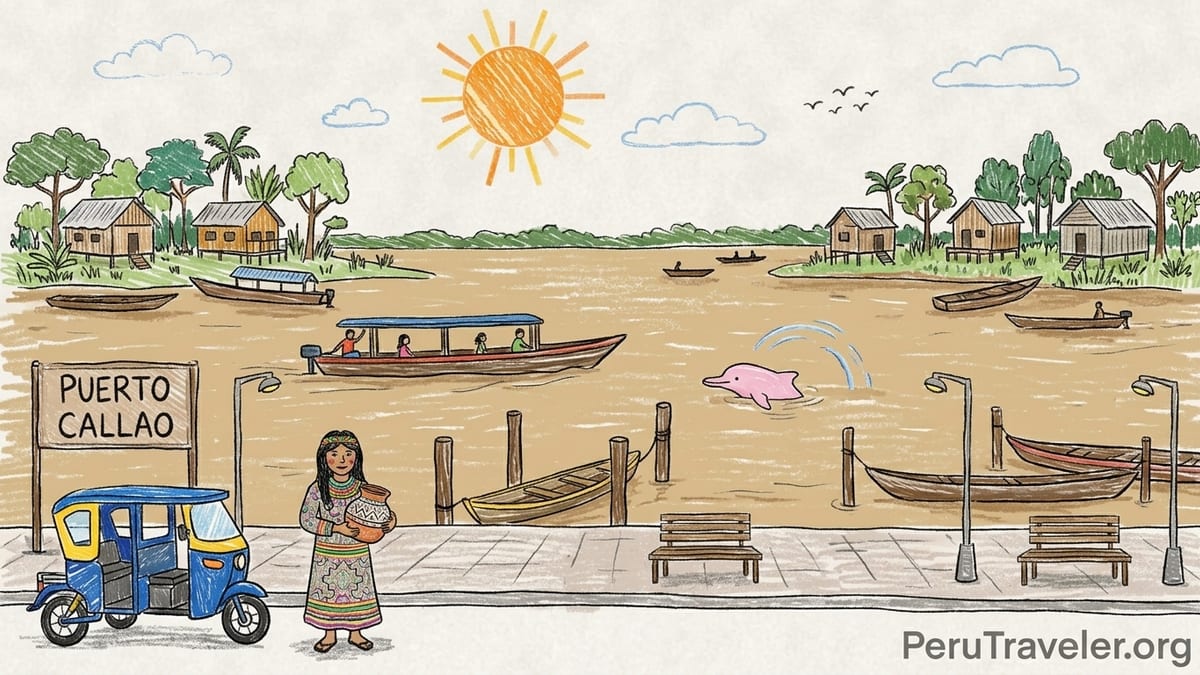
From Pucallpa to Puerto Callao: Arriving on the Yarinacocha Waterfront
I began the trip in central Pucallpa, staying one night at a mid-range hotel near the Plaza de Armas so I could reach the lake early. In October 2026, rooms with air-conditioning and private bathrooms in this area ranged from about 90 to 160 soles per night, while simpler guesthouses with fans could be found for 50 to 70 soles. I chose a modest hotel in that middle band to support a family-run business and to have a quiet base before heading to the water.
The next morning, a mototaxi ride from downtown Pucallpa to Puerto Callao, the main port of Yarinacocha district, took just under 25 minutes along an asphalt road that gradually left the city’s traffic behind for clusters of roadside shops and wooden houses. Drivers in October 2026 were charging around 6 to 10 soles for this route, depending on traffic and negotiation. I agreed on 8 soles before getting in, paid at the end and kept small change handy to avoid awkward bargaining.
Puerto Callao opens directly onto Lake Yarinacocha, an oxbow of the Ucayali River about 8 to 10 kilometers from Pucallpa. The new lakeside boulevard has benches, lighting and a paved promenade, but step down one level and you are in the working port. Here is where the trip truly begins: wooden canoes, long motorized boats and narrow peque peque crafts tied to rough posts, boatmen calling out “paseo por la laguna” and tourists pausing for photos with the water at their backs.
Even before choosing a boat, I noticed how tours were framed. Many signs and laminated price sheets advertised a standard circuit that promised “delfines rosados, comunidad nativa, paseo por la laguna” in three or four hours. The message was clear: wildlife and Indigenous culture as twin spectacles. I knew I wanted to avoid this packaged approach, so I took my time speaking with several boat operators instead of stepping into the first offer.
Choosing a Boat and a Guide: Time, Cost and Conditions on the Lake
Most boatmen at Puerto Callao work independently or are loosely associated with agencies and restaurants. In August and September 2026, shared group tours of 3 to 4 hours that combine dolphin spotting and a short community visit were advertised at roughly 40 to 70 soles per person, while private boats with a driver and informal guiding ranged between about 120 and 180 soles per hour, depending on boat size and amenities. A few platforms and agencies also quoted half-day excursions at similar levels, often adding a small commission.
Because I wanted flexibility to spend real time with artists, I hired a small motorized canoe privately. After some back and forth, we agreed on 160 soles for approximately four hours, including the crossing to San Francisco and additional time waiting while I visited artisan workshops. The boatman, who introduced himself simply as Jorge, clarified that fuel prices had climbed in 2026 and that rates also reflected his return time and the possibility of reduced work if he committed to a longer custom trip. Paying a bit more for that flexibility felt fair.
We left mid-morning, when the sun was already hot but the lake still relatively calm. Yarinacocha is a cutoff meander of the Ucayali: a long, curved body of water roughly 20 kilometers in length. It lies slightly west of the main river channel, but its identity is still deeply tied to the Ucayali. In the rising-water months, roughly December to April, the Ucayali pushes water back into the lake and into surrounding lowlands. During those months, communities closer to the shore see the water come right up to their houses. The dry season, from about June to September, reveals sandy beaches, steeper muddy banks and shallower approaches for boats.
As we navigated away from Puerto Callao, Jorge pointed to floating vegetation and mentioned that in the highest water months, some stretches feel almost continuous with the river. We passed small working boats heading the opposite direction, some loaded with plantains and yucca bound for the Pucallpa markets, others with families returning from town carrying sacks of rice or school supplies. These boats were the arteries of daily life rather than tourist props. The roar of peque peque engines mixed with the sound of water against the wooden hull, and I began to understand Yarinacocha not just as a pretty lake, but as one of the many bends in a river that structures Shipibo-Konibo life along the Ucayali and its tributaries.
San Francisco and Puerto Firmeza: Entering Communities on Their Terms
Several Shipibo-Konibo communities sit on the banks of Yarinacocha. San Francisco is one of the largest and most visible to tourism, located on the left margin of the lake and often promoted as the primary “comunidad nativa” to visit from Yarinacocha. Puerto Firmeza, further along the lake, is smaller, with around 40 families and a few hundred residents, and is recognized as a Shipibo-Konibo native community with its own authorities and titled territory. Both maintain communal organization and retain Shipibo-Konibo language and cultural practices, yet their relationships with tourism are distinct.
Before traveling, I had contacted a small cultural initiative that works with Shipibo-Konibo artists, who in turn put me in touch with a community representative in San Francisco. We spoke via messaging and agreed that I would visit on a specific day, arrive by late morning and first meet at the communal space where some artisans gather. This simple step of arranging the visit through someone chosen by the community, rather than only through a tourism agent, set a different tone. When we arrived, I checked in with the representative, introduced myself again and waited for the artists who wished to receive visitors that day.
San Francisco’s main tourism area features a row of stalls and small shops selling textiles, beadwork, ceramics and painted gourds. Nearby, some operators organize dance demonstrations or photo opportunities with performers wearing traditional clothing. My hosts were clear: if a group wanted to dance or sing for visitors, it should be because they chose to do so and were compensated appropriately, not because every tour expected a fixed “show” on arrival. On the day I visited, no public performances were scheduled, and my time centered instead on workshops and conversations with individual artists in their workspaces.
Later in the afternoon, we continued by boat to Puerto Firmeza, a quieter community further along Yarinacocha’s northwest margin. I had not pre-arranged formal workshops there and therefore limited my visit to a short walk with a community member who offered to show me the riverside and communal area, and to a brief stop at a family home where textiles were hung out to dry. Because activities had not been planned in advance, there were no demonstrations or staged interactions; I simply purchased a small piece of embroidered cloth from one artisan who had work available, paying the price she named and noting her name with her consent. The difference in atmosphere was noticeable: Puerto Firmeza received fewer day boats, and the few visitors there were often came with specific contacts or for longer stays.
Inside the Kené: Learning How Designs Are Drawn, Dyed and Fired
The most meaningful hours of my day unfolded in the shaded workspace of a Shipibo-Konibo artist in San Francisco. With her permission, I will call her by her full name: she introduced herself as artisan and kené painter Rosa Inuma. Rosa laid out a length of cotton cloth and showed me the faint pencil grid she had drawn by hand as a guide. From there, she used a fine-tipped brush to apply deep brown lines in a pattern of interlacing paths, curves and crossings that seemed to move across the fabric like currents in a river.
Rosa explained that many artists in Yarinacocha now work with commercial cotton and fabric paints because they are practical and durable for visitors who take pieces back to humid or urban environments. However, she still prepares natural dyes for certain works, especially larger textiles and ceremonial pieces. She showed me a small bowl of dark pigment made from the bark of a local tree, alongside lighter tones derived from leaves and seeds. Some artists in the area continue to use plant-based black and reddish browns, while others prefer synthetic colors for their consistency and faster drying times. The choice, she said, depends on the intended use of the textile and the artist’s own practice.
Next, we moved to the home of another artist, a ceramicist named María López, who works with clay from the lake region. Her yard held stacks of unfired pots and bowls, each marked with incised kené before being painted. María described how she collects and refines the clay, shaping pieces by hand rather than on a wheel, then firing them in simple open-air kilns or enclosed brick ovens depending on the size of the work and the weather. The geometric designs she etched onto the surface followed a similar visual language to Rosa’s textiles, but adapting the lines to the curve of a pot required another kind of skill.
Both artists emphasized that kené designs are not random decorations or general “tribal” motifs. Each pattern carries references to paths, plants, medicinal songs and the flows of the Ucayali and its tributaries. They told me that elders once painted kené using plant-based pigments directly on the skin as part of ceremonies and daily life, and that many women learned by watching mothers, aunts and grandmothers paint and embroider. Listening to them, it became clear that the value of these works lies not only in visual beauty but in the knowledge embedded in the lines, something too often erased when designs are treated as anonymous souvenirs on a tourist stall.
Paying Fairly and Recording Stories: Prices, Purchases and Consent
Throughout the day, I made a point of buying pieces only when I had time to speak with the artist and when they were comfortable being named. In Rosa’s workshop, I purchased a hand-painted cotton table runner measuring a little over one meter. She quoted a price of 220 soles, explaining that she had spent several days preparing the cloth, drawing the design and painting, then setting the colors. The payment went directly to her in cash, counted out slowly and placed in a small cloth purse she kept near her worktable. With her permission, I wrote down her full name, village and a summary of what she told me about the pattern’s meaning to keep with the piece once I returned home.
From María, I bought a medium-sized ceramic bowl with finely incised kené and a simple reddish-brown slip, for which she asked 90 soles. She explained that the design represented a path of protection for the family who would use it, referring to the way lines weave in and out like streams around islands in the Ucayali. Again, I paid her directly and noted her name and description of the design. She mentioned that sometimes intermediaries purchase ceramics in bulk for far lower prices and resell them at higher rates in Pucallpa or Lima, often without naming the artist. Hearing this confirmed the importance of buying as close to the maker as possible when conditions are safe and appropriate.
In Puerto Firmeza, I bought a smaller embroidered cloth from an artisan who introduced herself as Elena. The design, stitched in dark blue and brown thread on unbleached cotton, cost 60 soles. Elena told me she worked on embroidery in the evenings after tending to her family’s plot, and that the design echoed a healing song taught by her grandmother. She chose not to share her full surname for publication, and I respected that, referring to her simply as “Elena, artisan from Puerto Firmeza” in my notes. Recording that choice matters. Too often, pieces leave these communities with their stories stripped away, and names are either erased or exposed without consent.
Meals and demonstrations throughout the day occurred only when initiated and offered by the hosts. In San Francisco, one family invited us to share a simple lunch of grilled fish, plantains and cassava for 20 soles per person, served in their home courtyard. There was no buffet line or performance attached to the meal, just conversation about their children’s schooling and the seasonal changes in fishing. When another visitor asked a different household if they could see “a traditional dance,” the host gently replied that they organized group presentations only at certain times with the community authorities’ agreement and that unplanned requests were not appropriate. Hearing that boundary voiced clearly was an important part of understanding how tourism should work here.
Community-Directed Visits vs Standard Yarinacocha Tours
Back on the boulevard in Puerto Callao, it was easy to compare my day’s experience with what is typically sold to visitors. Most Yarinacocha sightseeing tours are advertised as half-day boat trips that combine three main elements: a ride across the lake, the possibility of seeing pink and grey river dolphins, and a stop at a “comunidad nativa” where tourists can buy crafts or watch a cultural demonstration. These packages are convenient and relatively affordable, which explains their popularity with travelers passing quickly through Pucallpa.
However, several problematic patterns emerge when culture and wildlife are bundled as guaranteed entertainment. First, the marketing language frequently promises dolphin observation as if these wild animals were scheduled attractions. Guides sometimes steer boats aggressively once a dolphin surfaces, crowding small areas of the lake and creating pressure on animals that approach out of curiosity rather than training. Second, cultural demonstrations such as dances or “traditional welcome ceremonies” may be presented as standard inclusions, leading some visitors to expect that every community will perform on demand, regardless of their own internal rhythms or preferences.
In contrast, arranging the visit through community representatives or through operators who work under clear community agreements shifts the center of gravity. In practice, this meant that my day was built around workshop time, conversations and the pace of the artists, not around a fixed timetable of shows. Dolphins, as it happened, did surface briefly at a distance during our return crossing, but Jorge simply slowed the engine and pointed them out without changing course or promising a closer approach. Their appearance felt like what it was: a gift of the river, not a contracted service.
This approach also changes how money flows. Standard tours booked on the boulevard usually involve a single payment to the boat operator or agency. Some portion may reach communities through craft purchases or agreed group fees, but the structure is rarely visible to the traveler. By contrast, on my community-directed day I paid several people separately: the boatman for transport and his time, the artisans directly for their pieces, the family for lunch and a modest contribution to the communal fund agreed in advance with the representative. The total cost for the day, including lodging, food, boat and purchases, easily surpassed what many visitors spend on a simple lake circuit, but it felt aligned with the depth of experience and the labor involved.
Lodging, Food and Practical Costs Around Yarinacocha
To meet the requirement of staying at least one night in Pucallpa or Yarinacocha, I divided my time between the city and the lake. After the first night in central Pucallpa, I moved for a second night to a modest guesthouse near the Yarinacocha waterfront. Rooms with fans, private bathrooms and intermittent Wi-Fi around Puerto Callao in late 2026 were priced in the region of 70 to 110 soles per night. A few eco-lodges located further along the lake, accessible only by boat, offered packages from roughly 100 to 150 US dollars per person for two nights including meals and guided walks. Those options suit travelers who want more immersion in the forest and river environment and who can commit more time.
Food around Puerto Callao is straightforward and hearty. Lakeside restaurants serve grilled fish, ceviche made from river fish, juanes (rice, chicken and spices wrapped in leaves), plantains and cassava. Main dishes near the waterfront typically ranged from about 18 to 30 soles in 2026, with fresh juices and soft drinks at 5 to 8 soles. It is worth asking restaurant staff how they source their fish, especially for species under pressure, and choosing places that work with local fishers and respect seasonal availability. When eating in communities, I made sure to clarify in advance whether the meal was a commercial arrangement and what it would cost, to avoid surprises and to ensure hosts were properly paid.
Transport costs can add up over several days, so it is useful to keep a rough budget. Between mototaxi rides in Pucallpa (around 4 to 10 soles per trip depending on distance), private boats on the lake (120 to 180 soles per hour for a small group or family) and shared tours if chosen (40 to 70 soles per person for a half-day circuit), two or three days around Yarinacocha might involve 300 to 600 soles in transport alone for one or two travelers. Adding accommodation, food and artisan purchases, a short visit that actively supports community-run activities might reasonably start around the equivalent of 60 to 100 US dollars per day for budget-conscious travelers, rising with more comfortable lodging and more art acquisitions.
Guiding arrangements vary. Some independent boatmen act as informal guides, sharing basic information about the lake and communities, often in Spanish only. Others work directly with community-based initiatives or small ethical operators that provide bilingual guiding and translation between Spanish, Shipibo and sometimes English. Daily rates for specialized cultural guiding and translation understandably sit higher, occasionally bundled into multi-day packages that start around several hundred US dollars. For travelers serious about in-depth learning, especially those who do not speak Spanish, investing in such support can be crucial for understanding and for avoiding missteps.
What I Learned About Contemporary Shipibo-Konibo Traditions
Spending even a short time around Lake Yarinacocha made clear that Shipibo-Konibo traditions are not static relics of the past, but part of a living, adaptive culture. On the lake, I met artists who split their time between agriculture, fishing, childcare and art production, who navigated smartphones and messaging apps as easily as they told stories about ancestral songs and plant medicines. Some had participated in international exhibitions or collaborations, while others sold mainly to occasional visitors or to intermediaries for regional markets.
One theme that surfaced repeatedly was the negotiation between continuity and change. Elders and middle-aged artists spoke of learning kené designs orally and visually, from relatives who carried patterns in memory and song. Younger artists sometimes experimented with new color palettes, mixed-media pieces or contemporary clothing cuts while still grounding their work in established design structures. Community leaders grappled with how to welcome tourism income without allowing cultural expressions to be flattened into generic performances ordered by time slot.
Another lesson concerned territory. Yarinacocha itself is just one bend close to Pucallpa in a much larger Shipibo-Konibo geography that stretches along the Ucayali and its tributaries. Artists in San Francisco and Puerto Firmeza reminded me that many Shipibo-Konibo families also maintain ties to more distant river communities, and that migration to Yarinacocha has been driven by multiple forces: access to schooling, health care, markets, and also deforestation and land conflicts deeper in the forest. To understand a textile or ceramic from Yarinacocha is therefore also to glimpse histories of movement, adaptation and sometimes loss.
Most importantly, I learned that respectful travel here starts with listening to how Shipibo-Konibo people themselves wish to frame their art, land and lives. It means arriving with realistic expectations about what a day on the lake can and cannot guarantee, being ready to shift plans if communities are busy with meetings or ceremonies, and understanding that the most meaningful moments might be quiet ones: an artist explaining a single line of a design, a shared plate of grilled fish, or a boat ride where dolphins remain unseen beneath opaque brown water.
The Takeaway
Looking back on my visit to Lake Yarinacocha, three encounters stand out. The first is the hours in Rosa’s workshop, watching kené designs emerge line by line while she spoke softly about the songs and river paths behind them. That experience turned abstract admiration for Shipibo-Konibo art into something relational and grounded. I could see the labor, concentration and memory in each section of the cloth, and I left with a piece whose story I had heard directly from its maker.
The second is the modest purchase from Elena in Puerto Firmeza. There was no elaborate demonstration, no official tour; just a shy offer of her embroidery, a short explanation of the song it echoed and an agreed price handed from visitor to artist. That exchange reminded me that not every meaningful encounter requires a full workshop or formal program. Sometimes, respect looks like accepting what is offered without pushing for more.
The third is less a moment than an unease. Watching a group tour arrive at San Francisco ahead of me, I saw visitors step off the boat expecting immediate entertainment: cameras already raised, questions shouted at children, a quick circuit of the craft stalls before heading back out to look for dolphins. The community members who received them were courteous, but I could sense a fatigue in repeating the same gestures for groups whose main priority was ticking off attractions. It was a quiet reminder that certain tourism practices, especially those that treat wildlife sightings and cultural demonstrations as guaranteed products, can feel inappropriate or even extractive.
If I return to Ucayali and Yarinacocha, I would plan for more time in community-run workshops and less movement in a single day. I would consider staying several nights with a family or at a community-managed guesthouse if invited, focusing on fewer artists in more depth rather than trying to see multiple communities in quick succession. Above all, I would continue to look for ways of traveling that center Shipibo-Konibo voices and choices, where art is approached as a living practice within a broader web of river, forest and family, and where a visitor’s presence supports that web rather than pulling it out of shape.
FAQ
Q1. How do I get from central Pucallpa to Lake Yarinacocha?
Most travelers take a mototaxi or taxi from the Plaza de Armas in Pucallpa to Puerto Callao, the main port on Yarinacocha, a ride of about 20 to 30 minutes on paved roads.
Q2. How much should I expect to pay for a boat tour on Yarinacocha?
In late 2026, shared group tours of around three to four hours were commonly priced between 40 and 70 soles per person, while private boats with a driver cost roughly 120 to 180 soles per hour depending on size and negotiation.
Q3. Is it necessary to book a visit to Shipibo-Konibo communities in advance?
For a respectful experience focused on workshops and art, it is strongly recommended to arrange visits through community representatives or operators who work with their permission, rather than arriving unannounced with a standard tour.
Q4. Can I count on seeing pink river dolphins during a lake tour?
No. Dolphins in Yarinacocha and the Ucayali are wild animals, and while they are present, sightings depend on time of day, season and luck, so they should never be treated as guaranteed entertainment.
Q5. What is a fair price for Shipibo-Konibo textiles and ceramics?
Prices vary widely by size, complexity and artist, but hand-painted textiles may run from tens to a few hundred soles, and finely worked ceramics from several dozen to over one hundred soles; paying the artist directly whenever possible is key.
Q6. Are there places to stay near the Yarinacocha waterfront?
Yes. Around Puerto Callao there are small guesthouses with basic rooms from about 70 to 110 soles per night, as well as a few higher-end lodges further along the lake that offer multi-day packages.
Q7. What should I keep in mind when photographing in Shipibo-Konibo communities?
Always ask permission before taking photos of people, workshops or ceremonies, and respect any community rules that limit photography or request that certain activities not be filmed.
Q8. When is the best season to visit Lake Yarinacocha?
The dry months from roughly June to September offer more stable weather and exposed lake beaches, while the higher-water months from December to April are better for understanding how the lake connects to the Ucayali and surrounding floodplains.
Q9. How can I tell if a tour is working respectfully with communities?
Look for clear information on how communities are consulted and compensated, flexible itineraries that adjust to community needs, and language that does not promise staged “shows” or guaranteed wildlife encounters.
Q10. What Spanish phrases are useful for respectful interactions with artisans?
Simple phrases such as “¿Puedo mirar su trabajo?”, “¿Cuánto cuesta esta pieza?” and “¿Puedo anotar su nombre para recordar quién la hizo?” help open conversations and show appreciation for the artist’s authorship.