


Laguna Azul, also known as Lake Sauce, has become Tarapoto’s favorite escape for travelers who want Amazonian scenery without committing to deep-jungle lodges. Just a couple of hours from the city, this warm, green-fringed lake is lined with small waterfront resorts, swimming docks and simple lodges where life revolves around the water, not long, humid hikes. This guide explains how to visit from Tarapoto, where to stay around the lake, how lakefront resorts compare with village guesthouses, and how to choose between day tours and overnight stays.
Why Laguna Azul Is San Martín’s Relaxed Lake Escape
Laguna Azul, or Lake Sauce, is a freshwater lake in the district of Sauce in Peru’s San Martín region. The lake sits at roughly 600 to 700 meters above sea level, about 50 to 55 kilometers south of Tarapoto, which keeps the climate warm but slightly cooler than the lowland Amazon. Instead of dense, hard-to-reach rainforest, you find a ring of low forested hills, pastures, palms and scattered houses, with a compact lakefront strip of small hotels and lodges facing the water.
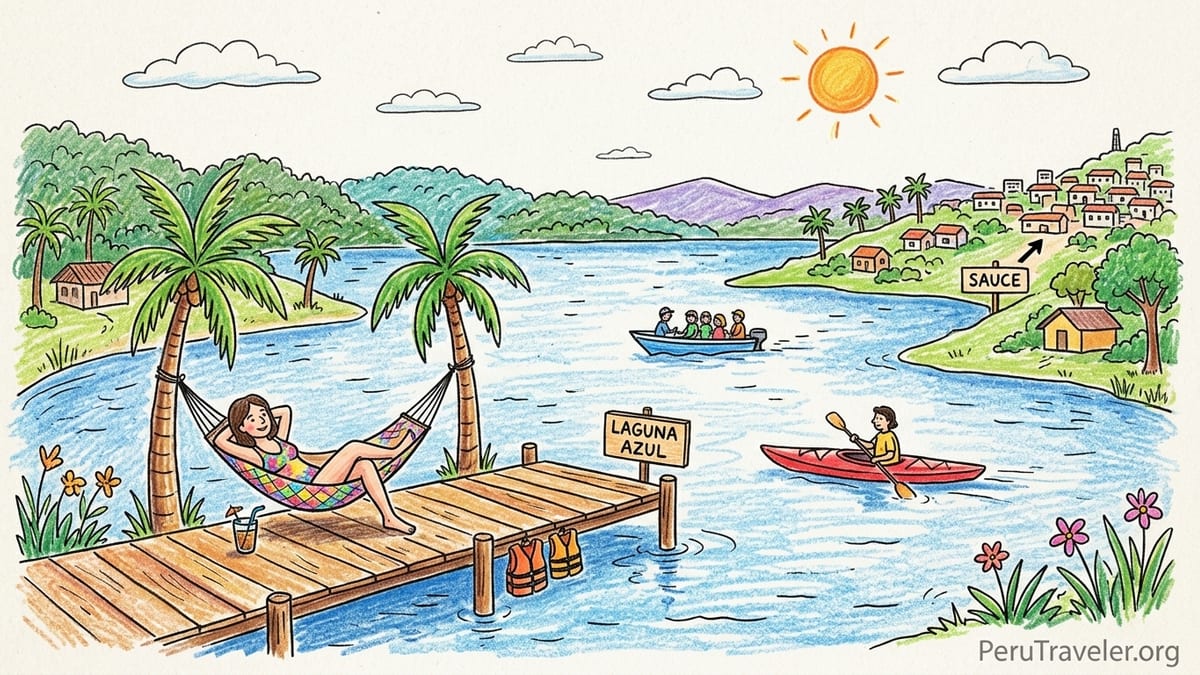
Travelers increasingly choose Laguna Azul over remote jungle expeditions when they want to swim, lie in a hammock and take short boat rides rather than commit to multiple days of river travel. Around Sauce the focus is on simple pleasures: jumping off wooden docks, paddling kayaks in the early morning, sipping a cold drink at sunset and taking quick excursions that rarely last more than a few hours. It is a good fit for couples looking for somewhere atmospheric to unwind and for families who prefer a pool and shallow lakefront over long boat transfers.
From Tarapoto, Laguna Azul is close enough for a day trip but far enough that travel takes a significant part of the day. Agencies in Tarapoto advertise full-day Laguna Azul tours that run for roughly nine hours, with shared prices in 2026 commonly between about 70 and 140 soles per person depending on group size and inclusions. This can be cost-effective for solo travelers with little time, but couples and families often get better value and a slower rhythm by spending one or two nights in Sauce instead of rushing back the same afternoon.
Because the lake is relatively compact, you can easily combine relaxation with a handful of short activities. A typical two or three day stay might include a one-hour motorboat circuit, a couple of 30-minute kayaking sessions, some casual fishing from the dock and perhaps a side trip to a viewpoint or nearby stream. Unlike more demanding Amazon lodges, these activities are optional add-ons rather than mandatory schedules, which is part of Laguna Azul’s appeal.
Getting from Tarapoto to Sauce and Laguna Azul
The journey from Tarapoto to Sauce is straightforward but involves a river crossing, which surprises some visitors. Road distance is around 50 to 55 kilometers. Including the short ferry over the Huallaga River, the trip normally takes between 1.5 and 2.5 hours depending on traffic, weather and waiting time at the crossing. The route is on a paved road, though there can be potholes and speed bumps, especially as you approach villages and the descent to the river.
Most independent travelers use shared cars or minivans that run between Tarapoto and Sauce through the day. Lodges such as Maloca Inn explain that colectivos depart from Tarapoto from around 5 a.m. to early evening and quote current one-way fares of about 20 soles per person. At the Huallaga River, vehicles roll onto a basic car ferry or platform barge that shuttles continuously when there is demand. The crossing itself takes only a few minutes, but you should factor in possible queues at busy times, especially holiday weekends.
Private transfers can be arranged through Tarapoto travel agencies or directly with some hotels for visitors who prefer door-to-door service. Prices fluctuate with fuel costs and seasons, but a realistic 2026 example for a private car or SUV from central Tarapoto to a waterfront hotel at Laguna Azul is often in the range of 200 to 300 soles per vehicle each way, with capacity for three or four passengers plus luggage. Families or small groups may find this reasonable compared with multiple colectivo tickets, especially if they are arriving late or leaving early when shared transport is less frequent.
Self-driving with a rental car is possible, but most visitors find it unnecessary given the availability of transfers and the fact that you will not use a vehicle much once at the lake. Parking at waterfront resorts is usually simple and informal, sometimes in a small gravel lot above the lakeshore. The final access track down to lake hotels can be narrow or unpaved, particularly in the rainy season, so drivers should be comfortable with basic rural road conditions.
Where to Stay: Waterfront Resorts vs Sauce Village Guesthouses
Accommodation at Laguna Azul falls into two broad categories. Most visitors gravitate toward waterfront resorts and lodges positioned directly on the lake, with private docks and pools. Others choose guesthouses or small hotels in Sauce village, a short tuk-tuk ride uphill from the water, where rooms tend to be cheaper and the atmosphere more local, with easy access to basic shops and simple eateries around the plaza.
Staying on the waterfront means you wake up to views of the lake, watch mist lifting off the water at sunrise, and step directly from your room to the dock or pool. Lodges often have their own small boats or easy access to local skippers, so arranging a one-hour circuit around the lake is as simple as asking at reception. Many include basic kayaks or stand up paddleboards for short, unguided outings. This style of stay suits couples prioritizing scenery and downtime, and families who want children to have safe spaces to play close to the water under supervision.
Village accommodation in Sauce is more about practicality and budget. Rooms may not have direct water views, but they are often significantly less expensive than full-service resorts. You also gain access to small local restaurants serving inexpensive set lunches, fruit markets and mototaxi drivers who can shuttle you to the lakefront or ferry ramp. From a village guesthouse, expect to pay a few soles for a quick mototaxi ride down to the lakeshore each time you want to swim or take a boat trip. Compared with waterfront properties, village stays can be simpler in design and amenities, with fewer landscaped gardens and minimal on-site activities, but they still work well for travelers who value cost over facilities.
In terms of noise and ambiance, both areas can be quiet during the week and livelier on weekends and holidays. On the lakefront, occasional loud music from restaurants or group tours may carry across the water on busy days. In town, there can be more traffic and square-side chatter in the evenings. Guests seeking the calmest atmosphere generally prefer midweek stays and choose properties a little away from the busiest public swimming areas.
Key Lakefront Resorts: Laguna Azul Hotel & Suites, Riosol, Sauce Resort and Independents
Among the better-known properties directly beside Laguna Azul, Laguna Azul Hotel & Suites, Riosol Laguna Azul and Sauce Resort (often marketed as El Sauce Resort) stand out in 2026 for facilities and services. They sit alongside a cluster of independent lodges such as Maloca Inn and several small lakefront hotels that offer a quieter feel at often lower rates. When comparing options, consider not only nightly price but also what is included in terms of meals, lake activities and transfers.
Laguna Azul Hotel & Suites in Sauce is classed as a mid-range hotel, with recent online rates around 130 US dollars per night including taxes for a double room on popular booking platforms. Rooms are air-conditioned, which is still a relatively rare feature at the lake, and the property has a lakeside setting with docks and common areas oriented toward the water. Facilities include a pool, restaurant and bar. It is a solid option for travelers who prioritize comfort and the security of a more established brand-like operation.
Riosol Laguna Azul, managed by a regional hotel group, positions itself in a slightly higher category than basic lodges but often below the top-end resorts. Recent package brochures from Tarapoto agencies list Riosol Laguna Azul in “hotel superior” plans with multi-day tariffs from around 339 soles per person for a package including transport and some tours, which implies standalone room rates that are competitive with other mid-range options around the lake. Riosol focuses on family-friendly facilities, such as pools and landscaped lawns, and often runs promotions through local agencies combining stays in Tarapoto city and Laguna Azul.
Sauce Resort, sometimes simply called El Sauce Resort, is one of the more upscale full-service properties on the lake. Recent bank partnership promotions for 2026 quote regular nightly rates of 550 soles for a traditional matrimonial room and 630 soles for a superior room with terrace, with discounted prices around 440 and 504 soles respectively for cardholders. These rates include breakfast a la carte, access to two pools, a lakeside lounge, game areas and the use of kayaks and stand up paddleboards on the lake for 30-minute periods. For couples who want a resort-style experience with multiple pools and on-site bars, Sauce Resort is among the most complete choices at Laguna Azul.
Independent lodges like Maloca Inn provide an alternative with a more intimate feel and often lower per-night packages. Maloca Inn, for instance, has advertised 3 day / 2 night promotions in 2026 for two people from roughly 445 soles midweek and 479 soles over weekends, including breakfast, use of the lakeview pool, access to a private dock and viewpoints, and a 30-minute kayak session for two. Rooms are simpler than at the largest resorts, but the direct lakefront setting, hammocks and relaxed service appeal to travelers who value atmosphere and price over extra pools or elaborate restaurant menus.
Facilities, Comfort and What Your Money Buys at the Lake
Comparing facilities helps explain why nightly rates at Laguna Azul vary so widely. At the upper end, Sauce Resort and similar properties usually provide multiple swimming pools, landscaped gardens, a main restaurant, at least one bar, dedicated play areas for children and inclusive use of non-motorized water equipment. The rooms may feature air conditioning, quality mattresses, hot showers, in-room safes and balconies or terraces that face or partially face the lake. Wi-Fi is generally available in common areas and sometimes in rooms, though speeds depend on regional connectivity and can drop during storms.
Mid-range properties such as Laguna Azul Hotel & Suites and Riosol Laguna Azul typically have at least one pool, a restaurant serving breakfast and main meals, basic bar service and a central dock. Air conditioning may be available in many rooms, though some budget categories or family cabins might rely on fans. Wi-Fi usually covers reception and dining areas. Activities like kayaking and paddleboarding might be free for short periods each day or charged separately per 30-minute session. On-site staff can help guests arrange boat tours, but those excursions may not be bundled into room rates.
Independent lodges and village guesthouses may operate with more modest facilities: a single small pool or just direct lake access, basic loungers and hammocks, and simple common spaces. Many of these properties rely on ceiling or standing fans rather than air conditioning, and some have hot water only in higher-category rooms. Wi-Fi availability can be limited, and mobile data coverage fluctuates between operators. However, the lower nightly cost often allows travelers to stay longer or to channel part of the budget toward private boat tours or additional local meals.
Families should check specifically for children’s amenities. Larger resorts sometimes have shallow kids’ pools, playgrounds or indoor game rooms with table football and table tennis. Independent lodges may instead offer open grass areas and simple games. In all cases, parents should confirm whether life jackets are provided for children in appropriate sizes during lake activities, as this can vary between operators.
Boat Tours, Kayaking, Paddleboarding and Fishing on Laguna Azul
Boat excursions are the core experience at Laguna Azul. Standard shared day tours from Tarapoto include a one-hour or longer motorboat circuit, usually stopping at a lakeside restaurant where visitors can swim and use basic facilities. For those staying overnight, resorts and lodge owners can arrange similar or more flexible private outings. Short private boat trips around the lake often start at around 50 to 80 soles per boat for roughly an hour, depending on negotiation, group size and whether swimming stops and photos at viewpoints are included.
Kayaking and stand up paddleboarding are increasingly common among mid-range and higher-end resorts. At Sauce Resort, for example, the use of kayaks and paddleboards for 30-minute sessions is included in current promotional room packages, essentially building non-motorized activities into the nightly rate. At lodges such as Maloca Inn, a 30-minute kayak hire for guests may be included in promotional bundles, or rented for a modest additional fee when not part of a package. The calm sections of the lake near resorts are usually suitable for beginners in the morning when winds are lower and boat traffic lighter.
Simple fishing is available in many locations around Laguna Azul, often carried out from docks or small rowboats using basic hand lines rather than sophisticated gear. Some local boatmen offer informal fishing outings, providing simple tackle and bait for a small supplement on top of the standard boat tour price. These activities are more about enjoying the scenery and passing a few quiet hours than about landing large fish. Travelers who are serious anglers should ask in advance what species are common in the lake and whether any restrictions apply.
Whatever the activity, life jackets are an important safety consideration. Reputable resorts and tour operators on Laguna Azul provide life vests for boat excursions, and some insist that passengers wear them throughout the trip. Kayak and paddleboard use may be more relaxed, but guests should always request a vest in their size, particularly for children or weaker swimmers. If equipment looks overly worn or damaged, it is reasonable to ask for a different vest or choose another operator.
Water Conditions, Swimming Advice and Seasonal Factors
Laguna Azul’s waters are typically warm, with many visitors swimming comfortably without wetsuits throughout the year. The lake is used both for tourism and local fishing, so clarity can vary with wind, rain and boat traffic. During or after heavy rains, water may look more turbid because of runoff from surrounding hills. Most resorts maintain small roped-off swimming areas off their docks, where depth is relatively controlled and motorboats stay outside the marked zone.
Travelers should follow local advice about where and when to swim. Staff at waterfront hotels know their sections of the lake well and can point out safe zones and typical depths. Parents with young children usually prefer to use resort pools for the youngest swimmers and reserve lake swimming for older kids under closer supervision. Swimming after drinking alcohol or during thunderstorms is discouraged, and evening swims should be kept close to well-lit areas with other people around.
Mosquito levels fluctuate with weather and time of day. Because Lagunas Azul and the town of Sauce sit at mid-altitude, mosquito pressure can be less intense than in some lower Amazonian sites, but there are still biting insects at dusk and dawn. Many resorts screen room windows and provide mosquito nets, but it is sensible to pack repellent and light long-sleeved clothing for evenings. Some properties also burn natural coils or use fans in common areas to reduce insects around dining and lounge spaces.
Rainy periods can affect not only water color but also short-term access to the lakefront and nearby dirt paths. Most of the main access road from Tarapoto and the core village streets are paved, but after heavy rains some minor tracks to small lodges become muddy. Travelers visiting in high-rainfall months should allow extra time for transport and check with their chosen hotel about current conditions before traveling, particularly if arriving late in the day when public transport slows.
Eating, Drinking and Excursion Prices Around the Lake
Food and drink costs are an important part of the total budget at Laguna Azul. At upper mid-range and upscale resorts, main courses at on-site restaurants often fall within a range of roughly 30 to 55 soles, with freshwater fish dishes such as grilled tilapia or local preparations of paiche alongside regional Amazonian specialties and standard chicken or pasta options. Non-alcoholic drinks like juices and soft drinks are usually in the 8 to 15 sol range, while cocktails and beers can run from about 15 to 30 soles depending on the property.
In simpler lakefront lodges and Sauce village restaurants, prices are lower. A set lunch menu of the day, including soup, a main dish and a drink, can be found around 12 to 20 soles in the town, with basic grilled fish plates near the lake priced from roughly 25 soles and up. This allows budget-conscious travelers staying in more affordable guesthouses to keep daily food costs relatively low, while those based at resorts sometimes choose to take a mototaxi into town for at least one meal to change the setting and save a bit.
For activities, shared day tours from Tarapoto typically package transport, the Huallaga crossing, a group boat ride and some free time at a lakeside restaurant for approximately 70 to 140 soles per person in 2026. Private one-hour boat rides organized through lakefront hotels can cost in the region of 50 to 80 soles per boat, with optional surcharges for extra time or additional stops. If kayaks and paddleboards are not included in the room rate, lodges may rent them for short sessions at a modest fee, often framed as 30-minute or one-hour blocks.
Additional excursions such as visits to viewpoints, small waterfalls around Sauce or local hot springs and thermal baths away from the lake can be added through agencies or direct negotiations with mototaxi drivers. These are generally half-day or shorter outings, with transport costs that scale with distance and the number of participants. Travelers should carry small bills in soles, as payment systems outside larger resorts are mostly cash-based.
Day Tour from Tarapoto vs Overnight Stay at Laguna Azul
Choosing between a day tour from Tarapoto and an overnight stay at Laguna Azul comes down to time, budget and travel style. On a standard full-day tour, agencies in Tarapoto pick guests up at their hotels mid-morning, drive to Sauce with a brief stop at the Huallaga River crossing, include a group boat ride and lunch stop, and return to the city in late afternoon or early evening. That means participants spend three to five hours of the day in transit and only a few hours on or beside the lake itself.
By contrast, visitors who take a colectivo or private transfer and stay two nights on the lakeshore gain a full uninterrupted day and two partial days around the water. For couples, a realistic 2026 cost comparison might look like this: two spots on a shared day tour at roughly 90 to 120 soles each, plus a mid-range Tarapoto hotel night at around 200 to 260 soles, versus a midweek 3 day / 2 night promotion at an independent lodge like Maloca Inn from approximately 445 soles total for two people, including breakfast, pool access and at least one short kayak session. At a higher-end resort such as Sauce Resort, two nights at standard public rates could run around 1100 to 1300 soles without discounts, but that includes greater comfort, resort pools and some activities bundled into the price.
Families in particular tend to benefit from overnight stays. A family of four might pay the equivalent of 300 to 400 soles or more for a shared day tour from Tarapoto, then still need a family room in the city. Using a waterfront family room or cabin for two nights, even at a mid-range resort, can offer more swimming time, more flexible meal schedules and less time sitting in vehicles with children. Additionally, staying beside the lake allows families to nap younger kids in the afternoon while older children continue using the pool or dock, something that is difficult on a tight day-tour timeline.
For travelers with very limited time or those who prefer city dining and nightlife, a Tarapoto base with a single day trip to Laguna Azul remains a logical choice. It works particularly well for solo travelers, who may find it cheaper to join a group excursion than to pay for solo occupancy at a lakeshore hotel and individual transport. However, for anyone with two or three nights spare in San Martín, allocating at least one or two of those nights to Sauce usually results in a more relaxed and immersive experience of the lake.
Combining Laguna Azul with Ahuashiyacu, Lamas and Alto Mayo
Although many Tarapoto agencies bundle regional highlights into multi-day packages, it is important to remember that Ahuashiyacu Waterfall, the hilltop town of Lamas and the Alto Mayo conservation area are separate excursions, not attractions on the shores of Laguna Azul itself. Visitors sometimes arrive expecting to walk from their lakefront hotel to a large waterfall or to colonial-style streets, but these sites each require separate transport from Tarapoto or connecting tours.
Ahuashiyacu, a popular waterfall on the main road toward Moyobamba, is typically visited as a half-day trip from Tarapoto, with a short forest walk from the parking area to the falls. Lamas, set on a hill overlooking the Huallaga valley, is usually another half-day excursion focused on viewpoints, local crafts and a small historic center. Alto Mayo, further west toward Moyobamba and Rioja, involves longer road travel and more time in protected forest areas, making it more suitable for separate one or two day visits from Tarapoto rather than quick add-ons to a Laguna Azul stay.
Travelers planning a broader San Martín itinerary may choose to spend two nights in Tarapoto city to visit Ahuashiyacu and Lamas, then move to Laguna Azul for two or more lake-centered nights, and finally continue west toward Alto Mayo if time permits. This sequencing reduces backtracking and acknowledges that each destination provides a distinct setting: waterfalls near the road, a high hill town, a mid-altitude lake and cloud forest reserves further afield.
Trying to combine all of these destinations into a single overnight at the lake often leads to rushed days and more time in vehicles than at the attractions themselves. Given the relative affordability of mid-range lodges around Laguna Azul compared with long-distance jungle lodges, it generally makes sense to slow down and give the lake at least one full day without extra road trips.
The Takeaway
Laguna Azul near Sauce is not a remote jungle camp or an extreme adventure destination. Its appeal lies in the combination of an accessible location, warm lake water, small waterfront resorts and low-key activities built around swimming, paddling and short boat rides. For many visitors to Tarapoto, two or three days here provide an ideal counterpoint to time spent in the city or on excursions to waterfalls and hill towns.
Couples looking for comfort and romance might focus on mid-range and higher-end lakefront resorts such as Sauce Resort, Laguna Azul Hotel & Suites or Riosol Laguna Azul, budgeting for at least two nights to enjoy the pools, restaurants and included kayaking sessions without the pressure of a same-day return trip. Families may lean toward properties with kids’ pools, open lawns and clear life-jacket policies, and they are often rewarded with better value by staying on the lake rather than paying for repeated day tours.
Weekend visitors from elsewhere in Peru can fly into Tarapoto, travel to Sauce on Friday afternoon, enjoy a full relaxed Saturday of swimming, boating and hammock time, and return to the city on Sunday for an evening flight. Independent travelers with more days might pair two nights at an intimate lodge such as Maloca Inn with additional nights in Tarapoto and Alto Mayo, building a balanced itinerary of city comforts, lakefront rest and cloud forest exploration.
Whatever the precise plan, treating Laguna Azul as a destination in its own right rather than as a short stop on a busy circuit maximizes its strengths. The more time you spend beside the water, the more its slow rhythms, early-morning stillness and warm afternoon swims come to define your San Martín experience.
FAQ
Q1. How long does it take to travel from Tarapoto to Laguna Azul in Sauce?
The journey usually takes between 1.5 and 2.5 hours each way, including the short Huallaga River crossing and any waiting time for the vehicle ferry.
Q2. Is it better to visit Laguna Azul on a day tour or stay overnight?
Day tours work for visitors with very limited time, but most couples and families get better value and more relaxation from at least one or two nights beside the lake.
Q3. How much does a full-day Laguna Azul tour from Tarapoto cost?
In 2026, shared full-day tours commonly range from about 70 to 140 soles per person, depending on the agency, group size and whether lunch is included.
Q4. What are typical room prices at Sauce Resort and similar lakefront hotels?
Recent examples show Sauce Resort charging around 550 soles for a traditional matrimonial room and 630 soles for a superior room with terrace, with periodic discounts through local promotions.
Q5. Are kayaking and paddleboarding included in resort prices?
Many higher-end resorts, including Sauce Resort, currently include 30-minute sessions of kayaking or paddleboarding for guests, while mid-range lodges may charge a small additional fee if not part of a package.
Q6. Is it safe to swim in Laguna Azul?
The lake is widely used for swimming, and resorts maintain designated swim areas near their docks. Visitors should still follow local advice, supervise children closely and use life jackets when recommended.
Q7. Do I need to worry about mosquitoes at Laguna Azul?
There are mosquitoes, especially at dusk and dawn, but many hotels use screens and nets. Bringing repellent and light long-sleeved clothing for evenings is advisable.
Q8. Can I visit Ahuashiyacu Waterfall or Lamas from Laguna Azul?
Those destinations are separate from the lake and are usually visited as half-day trips from Tarapoto, so most travelers plan them before or after their stay in Sauce rather than as quick side trips.
Q9. Is Wi-Fi reliable at the lake resorts?
Most mid-range and upscale resorts offer Wi-Fi in common areas and some rooms, but speeds can be variable and may drop during storms or busy periods.
Q10. How far in advance should I book accommodation at Laguna Azul?
Outside major Peruvian holidays, a few weeks’ notice is often enough, but for long weekends and school vacation periods it is wise to reserve well in advance, especially at the most popular waterfront resorts.