


Before visiting Iquitos, most of what I had heard about the Peruvian Amazon revolved around jungle lodges and river cruises. It was only after spending a morning in Belén Market and its riverside neighborhoods that the city itself finally made sense. Guided by a local who lives nearby, I moved from busy streets and food stalls to wooden walkways and boat lanes along the Itaya River, discovering an urban-Amazon reality that is messier, more flavorful and far more complex than any brochure suggests.
Meeting My Guide and First Impressions Around Belén
We met just after 7:30 a.m. in front of Restaurante Fitzcarraldo, a familiar landmark a short walk from Iquitos’ Plaza de Armas. Several local operators now use this corner as their standard meeting point for Belén tours, and my guide, Marlon, had already worked with visitors from across Peru, Europe and North America. I had arranged the visit the night before by messaging his WhatsApp number, which he also uses for bookings through major tour platforms. We agreed on a rate of 160 soles for a private three-hour walk and boat excursion, including his guiding, motokar transport to the market and coordination with a trusted boat driver in lower Belén.
The air was already thick with humidity. Iquitos sits in the heart of the Amazon basin, and average daytime highs hover around 31 to 33 degrees Celsius with high humidity most of the year. There is no true dry season, only months of more and less rain, so the streets glistened from a downpour earlier that morning. Within minutes we climbed into a motokar and rattled south toward Belén, the rush of warm air competing with the smell of exhaust and frying plantains drifting from breakfast stands.
As traffic slowed near Calle 9 de Diciembre, where the main market area begins, the atmosphere shifted. The asphalt gave way to patched pavement and puddles. Motokars idled beside handcarts piled with green plantains and sacks of rice. Loudspeakers on shopfronts advertised phone credit and low-cost clothing. This was Alto Belén, the “upper” district on slightly higher ground above the riverbank, and its streets felt more like a dense small town than a tourist attraction. There were very few foreign visitors in sight that morning, which meant I was entering Belén very much on local terms.
Before we stepped into the market proper, Marlon paused to explain our plan. We would spend roughly an hour moving through food, produce and medicinal sections, tasting a few dishes and drinks, then continue on foot toward the Itaya River. From there, river levels permitting, a local boatman he works with would take us into the lower, flood-prone neighborhoods that many people imagine when they hear “floating Belén.” The emphasis, he stressed, would be on observing respectfully and not treating residents as an attraction.
Inside the Market: Food Stalls, Produce and Amazonian Fish
The heart of Belén Market unfolded in tight corridors beneath patchwork roofing. Around us, vendors called out prices in rapid-fire Spanish, radios played cumbia and salsa, and the floor alternated between concrete and damp compacted earth. The first row we entered was lined with breakfast stalls. Large metal pots steamed over gas burners, and tables were crowded with workers eating before starting their day.
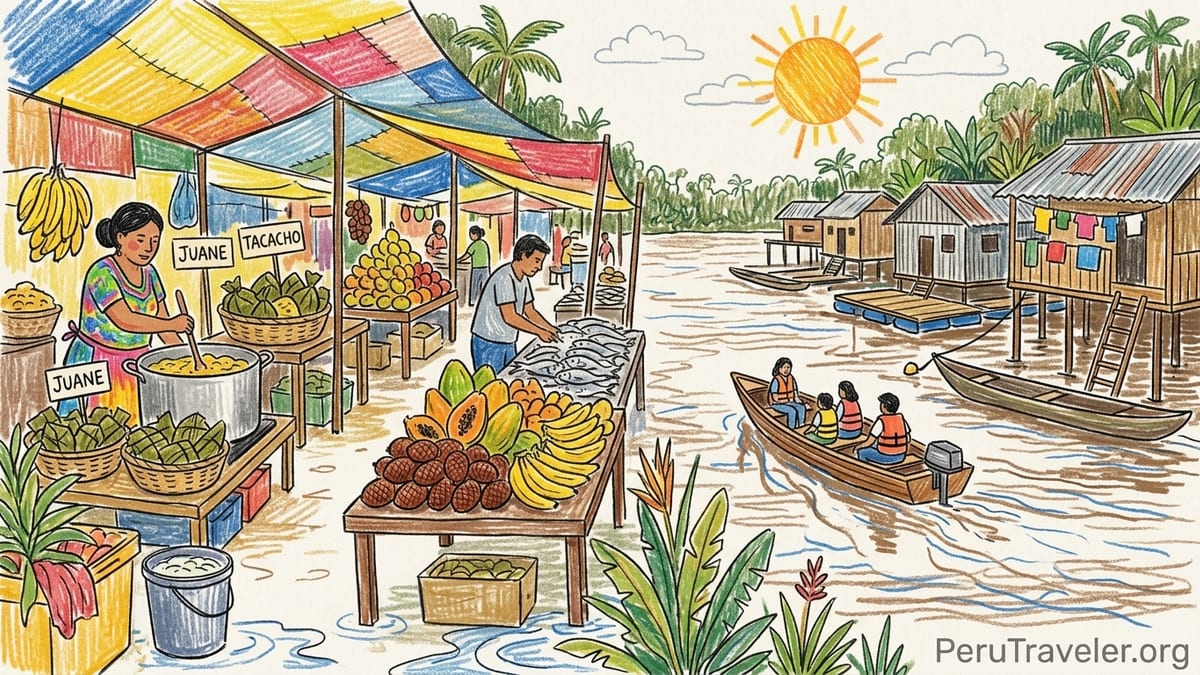
Marlon steered me to a stall where a woman was unwrapping green parcels from a stack of wide, glossy leaves. “This is juane,” he explained, “the classic jungle breakfast, especially near the Feast of San Juan in June.” I watched as she opened one parcel to reveal a compact mound of seasoned rice around a piece of chicken, with a dark olive and half of a hard-boiled egg hidden inside, all scented by the bijao leaf used for wrapping. I ordered one portion for 7 soles, along with a cup of camu camu juice for 4 soles. The juane was dense but not heavy, the rice flavored with turmeric-like spices and a hint of garlic, the chicken tender and deeply infused with the leaf’s vegetal aroma. It tasted like something meant to keep you going through a long day of heat and work.
Across the aisle, another stall was mashing roasted plantains in a large wooden mortar. This was tacacho, a ball of green plantain mashed with small amounts of fat and salt, traditionally served with cecina. We ordered a plate of tacacho con cecina for 12 soles. The vendor sliced thick strips of smoked pork from a hanging piece of meat, then quickly seared them on a hot griddle. The tacacho itself came as two fist-sized balls with crisp edges and a smoky aroma. Eaten together, the combination was deeply savory and slightly sweet, the texture of the plantain somewhere between mashed potato and firm gnocchi. Marlon explained that for many vendors, this is the meal that fuels them until mid-afternoon.
Further inside, the aisles shifted from prepared food to raw ingredients. Amazonian fish dominated one section, laid out on wooden tables. I recognized the broad fillets of paiche, one of the largest freshwater fish in the world, along with whole boquichico and palometa. Many fish still had scales and fins intact, and the vendors used long knives to clean and portion them on the spot. The smell was strong but not overwhelming, partly because buyers move quickly in the morning. I did not sample any raw preparations, but Marlon pointed out how popular grilled fish and patarashca can be here, especially when wrapped again in bijao leaves and cooked over charcoal.
Fruits, Herbs and Medicinal Stalls: Aguaje and Beyond
In the produce section, the colors changed from silver fish and beige rice to vibrant oranges, yellows and deep reds. Pyramids of bananas and plantains sat next to piles of guava, soursop and papaya. One corner was dominated by a fruit I had come specifically to try: aguaje. It looked more like a chestnut than anything typically found in a supermarket, with rust-colored scales covering a small oval fruit. Marlon bought a dozen for 5 soles from a vendor who peeled them with a practiced twist of a small knife, revealing pale yellow flesh beneath.
The taste of aguaje surprised me. The texture was firm yet creamy, similar to a very dense avocado, with a flavor somewhere between carrot and palm heart. Locals regard it as both a snack and a source of vitamins, and it appears in countless street-side coolers in the form of aguajina, a sweetened drink. We shared a plastic cup of chilled aguajina for 3 soles, its earthy flavor cut with sugar and a hint of lime. Of all the fruits I tried that morning, aguaje felt most embedded in everyday life, not just as an exotic curiosity.
We then turned into Pasaje Paquito, the narrow corridor of stalls famous for traditional remedies and plant-based products. Here, shelves were stacked with bottles of amber liquids, bundles of bark, roots tied with string and plastic jugs filled with macerated fruits and herbs. Names painted on the bottles hinted at aphrodisiac promises and good-luck potions, but behind the marketing was a long tradition of Amazonian plant medicine. While I did not consume any of these mixtures, Marlon described common ingredients like chuchuhuasi bark, sangre de grado sap and various aromatic leaves used for “baños de florecimiento,” ritual baths meant to bring good fortune. Our focus remained on observing rather than buying, and we discussed how some remedies overlap with formal healthcare while others stay firmly in the realm of belief.
Camu camu, another local fruit, appeared repeatedly in the form of juice. Known for its high vitamin C content, it is rarely eaten raw at the market due to its sharp acidity. Instead, vendors blend the pulp with water and sugar, selling it in plastic cups for around 4 to 5 soles. I tried a second glass from a different stall to compare. The drink had a tang similar to unsweetened cranberry juice mixed with lime, which made it especially refreshing in the heavy heat. Across these tastings, the market revealed itself less as a tourist spectacle and more as Iquitos’ pantry and pharmacy combined.
Hygiene, Raw Products and Food Safety Without the Stereotypes
Any honest account of Belén Market must address hygiene and food safety. Conditions vary from stall to stall. Some sections, particularly the early-morning fish and meat rows, feature bare wooden tables and open drains. At times the ground is wet not only from rain but from melted ice and wash water. Flies gather where vendors are slow to clear scraps. It is easy for a visitor to fixate on these scenes and frame Belén as chaotic or unsafe, yet that would be both incomplete and unfair.
Walking slowly with Marlon, I noticed that breakfast stalls with steady local clientele generally kept cleaner, more organized work surfaces. Many vendors covered ready-to-eat foods with cloth or plastic, handled money with one hand and food with the other, and reheated dishes thoroughly before serving. The juane I ate was unwrapped from a steaming pot, and the tacacho was fried to order. These are not clinical restaurant kitchens, but there is a practical awareness that sick customers do not return. I followed the same precautions I would in any open-air market: choosing busy stalls, favoring cooked food served hot, and avoiding raw salads or pre-cut fruits that had been sitting uncovered.
When we passed through the raw meat section, I chose not to purchase or sample anything, both for personal comfort and because my accommodation lacked refrigeration. Marlon explained that most locals shop early, then cook within hours. In this context, a piece of meat on a table at 7 a.m. is part of a daily routine, not evidence of neglect. At the same time, he acknowledged that municipal inspections remain inconsistent and that some practices, such as reusing dirty ice or leaving fish exposed into the afternoon, are a concern even for residents.
Overall, I left with a nuanced view. Belén Market is not a sanitized gourmet hall, and visitors should arrive with realistic expectations and some tolerance for grit. Yet it is also not the caricature of filth that sensational travel tales sometimes describe. Basic precautions, a selective eye and guidance from someone who knows which stalls are trustworthy can turn it into a rewarding place to eat and learn.
From Market to River: Entering Belén’s Waterfront Neighborhoods
After almost ninety minutes in the market, we walked downhill toward the Itaya River. The transition from commercial hub to riverside settlement was gradual. Concrete buildings gave way to wooden structures on stilts, and the street narrowed into walkways patched with planks. Children played with plastic bottles and improvised toys, while adults carried buckets of water or supplies up from the shore. Here, the term “floating neighborhood” starts to make sense, but not every house floats all year.
Marlon stopped at a landing where several wooden boats were tied, each powered by small motors known locally as “peque peques.” He negotiated briefly with a boatman he knows and confirmed the price in front of me: 25 soles per person for roughly 40 minutes on the river, with a minimum of two passengers. Because I was alone, we agreed on a total of 50 soles. The amount included fuel and his time navigating through the narrower flooded alleys of lower Belén, which can vary depending on the river level on any given week.
Before boarding, I looked around for safety equipment. The boat carried several foam lifejackets in a plastic sack, and Marlon insisted that I wear one, even though many locals travel without. The river surface was relatively calm, stained brown with sediment from recent rains, but floating debris reminded me that conditions can change quickly in flood season. We stepped carefully into the narrow hull, sat low on a wooden plank bench and pushed out into the traffic of other small boats ferrying people, goods and sometimes entire pieces of furniture between homes and the city.
As we moved along the edge of the neighborhood, I saw that the housing was a mix of structures on fixed stilts and houses built on floating platforms of timber and drums. Some doorways opened directly onto water, while others looked down onto muddy ground. Marlon explained that the Itaya and Amazon rivers follow a cycle of rising and receding water, known locally as creciente and vaciante. During peak high water, usually around March or April, many of the lower streets are fully navigable by boat. In the lower months, from roughly July through October, those same areas can stand largely on dry earth, with residents walking instead of rowing between homes.
Life on the Water: Housing, Transport and Daily Rhythms
The boat curved into a narrower side channel, and the sounds of the market faded. Here, daily life unfolded at water level. A woman washed clothes from a platform at the back of her house, beating them against a wooden board before hanging them on a line strung between two stilts. Children brushed their teeth at the edge of a doorway, spitting into the river below. A man patched his canoe with tar, preparing it for another day of carrying passengers or goods to the main city streets uphill.
Marlon spoke quietly about the pressures facing these communities. Many families here migrated from smaller river settlements, looking for schooling and work in Iquitos. Some houses, he pointed out, are part of formal relocation programs after severe floods like the one in 2012, when higher-than-normal water levels affected large portions of Belén. Others are informal additions, built gradually as relatives arrive. In all cases, river levels dictate everything from when children can reach school to how food arrives. At high water, a shop might receive fish directly by boat to its back door. In low water, the same goods must be carried across exposed mud in the heat.
Transport, too, follows the rhythm of the river. Our boat passed a small floating store that functioned as a kind of neighborhood convenience shop, stocked with cooking oil, instant noodles, soap and batteries. Customers arrived by canoe, tying up for a quick purchase. Elsewhere, we saw boats loaded with sacks of plantains heading toward the main market, and others carrying construction materials back toward the houses. In this sense, the Itaya is less a scenic backdrop than a liquid street network, essential to Belén’s survival.
Throughout the ride, we stayed in public waterways and did not approach homes unless residents signaled a greeting. Some waved, some watched impassively, and others ignored us altogether. At one point, a man in another boat called out a joking comment about tourists, and Marlon replied with a laugh in local slang that I could only partly follow. It underlined my role as an outsider. The goal, at least as framed by my guide, was to observe and understand a little more, not to consume poverty as entertainment.
Tourism Ethics: Wildlife Products, Photo Ops and the Role of the Guide
On our way back toward the market, we stopped briefly at a stretch of stalls that Marlon described as “complicated.” Here, some vendors offered animal skins, teeth and other wildlife-derived items alongside more standard handicrafts. I recognized patterns and textures that resembled caiman skin and possibly wild cat pelts, though I did not verify species with certainty. Marlon advised against purchasing any such items, both because of legal restrictions on protected species in Peru and because demand from visitors can encourage further hunting.
Nearby, another improvised stop had a young sloth and a small anaconda in cages, clearly positioned for tourist photos. This was one of the most uncomfortable moments of the visit. The animals were handled frequently, and while the handlers insisted they were well treated, the stress on the animals was obvious. I declined the invitation to hold or photograph them, and we moved on after a short conversation about how such operations persist at the fringes of markets like Belén. Responsible wildlife viewing in the Amazon requires distance and respect, not close-contact selfies.
These encounters highlighted the importance of a guide’s ethics as much as their knowledge. Throughout the morning, Marlon framed our choices. He pointed out where photography felt intrusive, especially in lower Belén, and asked permission before I took any picture in which individuals were recognizable. He also discouraged bargaining to the last centavo with small-scale food vendors, emphasizing that a few extra soles makes a real difference in their day. When we discussed tipping, he suggested a modest amount relative to our agreed fee, not a performative gesture.
In terms of cultural and historical context, the tour struck a balance. Marlon outlined the history of Belén as a riverside district that expanded with rural migration, talked about major flood years that reshaped policy and housing, and explained how market traders organize informal credit systems to purchase goods in bulk. At the same time, parts of the route did pass souvenir stalls that felt more oriented toward quick sales than storytelling. I did not feel pressured to buy, but I could imagine that larger group tours might skew more heavily toward shopping unless visitors ask explicitly for more context.
What I Spent: Food, Boats, Guides and Extras
For travelers planning a similar experience, concrete costs are useful. My spending that morning was straightforward. The agreed guiding fee was 160 soles for roughly three hours, which is within the range quoted by several local operators and hotels for a private Belén visit that includes both market and river sections. I added a 20-sol tip at the end, bringing the guiding total to 180 soles. Shared group tours booked through agencies or online platforms can cost less per person, often between 40 and 80 soles, but usually follow a more standard route and timetable.
Within the market, my food and drink expenses were modest. The juane and first glass of camu camu juice cost 11 soles together. The plate of tacacho con cecina was 12 soles. A cup of aguajina set me back 3 soles, and a second camu camu juice from another stall was 4 soles. Including a small bag of peeled aguaje fruits I bought to snack on later for 5 soles, I spent a total of 35 soles on food and drinks inside Belén. Portions were generous; I did not need another full meal until late afternoon.
The boat excursion into lower Belén cost 50 soles in total, paid directly to the boatman in cash. This matched the informal range you hear discussed locally, which often falls between 20 and 40 soles per person depending on group size, route and river conditions. I did not pay for any optional activities involving wildlife photo props or questionable souvenirs, choosing instead to allocate that part of my travel budget to food and to the guide’s fee.
In all, my combined spending for the morning, including guide, tip, food, drinks and boat, came to 265 soles. In U.S. dollar terms, that amounted to roughly the price of a mid-range restaurant dinner for two in a major city, but it granted access to the living core of Iquitos far more effectively than most packaged excursions. Visitors on tighter budgets could spend considerably less by joining a group tour or navigating the market independently, although the deeper understanding a good guide offers is difficult to replicate alone.
The Takeaway: What Surprised Me and How to Visit Responsibly
The biggest surprise of Belén was how normal it felt to the people who live and work there. For outsiders, the visual drama of houses hovering above seasonal water, boats threading between doorways and vivid piles of jungle produce feels extraordinary. For residents, it is simply where schoolchildren hurry between classes, where families shop for dinner and where traders negotiate prices at dawn. That everyday quality does not diminish Belén’s interest. If anything, it deepens it, revealing Iquitos not just as a staging point for remote adventures but as a complex Amazonian city negotiating river dynamics, migration and modern commerce.
The most meaningful part of my visit was not any single dish or dramatic view but the gradual shift from market noise to the quieter routines along the river. Eating juane elbow-to-elbow with workers who treat Belén as their daily cafeteria, tasting aguaje and camu camu from vendors who know exactly which farmer supplied them that week, and then watching how those same products move back out along the Itaya gave the experience a coherent logic. It was the Amazonian food chain in miniature, from river and forest to table and back again.
At the same time, certain scenes made me uncomfortable. The wildlife photo stalls were one example, as were moments when other visitors took intrusive close-up photos of people’s homes from boat level without asking. Poverty is visible in parts of lower Belén, and it deserves neither romanticizing nor voyeurism. Any traveler who comes here should be prepared to confront their own position in that dynamic, to ask permission before photographing people, and to recognize that behind every “picturesque” view is a household negotiating real challenges.
For first-time visitors to Iquitos, I would not recommend exploring Belén’s interior or riverside neighborhoods entirely on your own. Navigating the maze of market alleys and the shifting river paths can be confusing, and having a knowledgeable local guide significantly improves both safety and understanding. Going independently to the outer edges of the market area by day is possible for confident travelers, especially to eat from well-frequented stalls near the main streets, but the deeper layers of Belén are best approached with someone rooted in the community. If you treat that guiding relationship as a collaboration rather than a transaction, your time in Belén can become the most instructive urban-Amazon experience of your trip to Peru.
FAQ
Q1. Is Belén Market safe to visit for first-time travelers to Iquitos?
Belén Market is busy and can feel overwhelming, but visiting during daylight with a reputable local guide is considered reasonably safe. Like in any crowded urban market, you should keep valuables out of sight, use a money belt or inner pocket, avoid displaying expensive cameras or jewelry, and stay aware of your surroundings. Most visitors who take these precautions and follow their guide’s advice experience Belén without serious problems.
Q2. What is the best time of day to visit Belén Market?
The most interesting and active time to visit is early in the morning, roughly between 7 a.m. and 10 a.m., when fish and produce arrive and breakfast stalls are in full swing. By late morning some raw products begin to look tired in the heat, and certain sections become less pleasant to walk through. Afternoon visits can still be worthwhile for prepared food and Pasaje Paquito, but for a fuller picture of the market’s energy and fresher offerings, aim to arrive soon after sunrise.
Q3. Do I really need a guide, or can I explore Belén on my own?
It is possible to reach the outer edges of Belén Market independently by motokar and walk some of the main streets. However, a knowledgeable local guide adds significant value by navigating the maze-like alleys, pointing out safe and hygienic food stalls, explaining the history and culture of Belén, and arranging legitimate boat excursions in the lower neighborhoods. For first-time visitors, especially those with limited Spanish, hiring a guide is strongly recommended.
Q4. How much should I budget for a guided visit to Belén, including a boat ride?
Costs vary with group size and negotiation, but a reasonable estimate for a private three-hour visit that covers the market and a short lower Belén boat excursion is around 150 to 200 soles per person, including guide and boat. Shared group tours can be cheaper, sometimes between 40 and 80 soles per person, but may offer less flexibility. You should also set aside 20 to 40 soles for market food and drinks, paid directly to vendors in cash.
Q5. What should I wear and bring when visiting Belén Market and the riverfront?
Light, breathable clothing that covers your shoulders, comfortable closed-toe shoes with good grip, and a hat are advisable due to heat, humidity and sometimes muddy or slippery surfaces. Bring a small amount of cash in small bills, drinking water, hand sanitizer, insect repellent, and a lightweight rain layer in case of sudden showers. Keep backpacks zipped and worn in front in crowded sections of the market.
Q6. Is it safe to eat at Belén’s food stalls, and what dishes should I try?
If you choose busy stalls where locals are eating, focus on freshly cooked dishes served hot, and avoid raw salads or pre-cut fruits that have been sitting uncovered, eating in Belén can be both safe and rewarding for many travelers. Classic foods to look for include juane, tacacho con cecina, grilled river fish, and fresh fruit juices made from aguaje or camu camu. Travelers with very sensitive stomachs may prefer to try only cooked dishes and bottled drinks.
Q7. How do seasonal river levels affect visits to the “floating” part of Belén?
The lower neighborhoods of Belén sit along the Itaya River, where water levels rise and fall throughout the year. During higher water, often around March and April, many streets are navigable by boat and homes sit close to the waterline. In lower water months, from around July to October, these same areas can stand largely on dry ground, and visits may involve more walking on wooden walkways and exposed earth. The neighborhood does not float year-round, and what you see will depend on when you visit.
Q8. Are there ethical concerns about wildlife products and animal photo opportunities in Belén?
Yes. Some stalls sell products apparently derived from wild animals, such as skins or teeth, and certain informal stops offer photo opportunities with captive sloths, snakes or other wildlife. Buying these products or paying for such photos can encourage continued hunting and poor treatment of animals. A more ethical choice is to avoid these activities, support guides and vendors who focus on food and cultural experiences, and save wildlife viewing for authorized reserves or lodges that follow clear conservation guidelines.
Q9. Is photography acceptable in Belén Market and the riverside neighborhoods?
Photography is generally allowed in public areas, but it is important to be respectful. Always ask for permission before photographing individuals at close range, particularly in lower Belén where homes and daily routines are very exposed. Avoid taking intrusive pictures inside or directly into homes, and do not treat people’s living conditions as spectacle. If your guide suggests putting the camera away in certain situations, follow that advice.
Q10. Can I pay with a card in Belén, or do I need cash?
Belén Market is overwhelmingly cash-based. Most vendors accept only soles, and large notes can be difficult for them to change. You should withdraw cash in Iquitos’ center before visiting and carry it in small denominations to make transactions easier. Some organized tours may accept card payment for the guiding fee itself, but food, drinks and boat rides will almost always require cash.