


After years of writing about Peru, I finally did what many Amazon-bound travelers debate but rarely test fairly: I booked comparable three-night rainforest stays in both of the country’s major jungle gateways, Iquitos in the north and Puerto Maldonado in the south. I flew in, stayed at central hotels, transferred out to lodges on tributaries, did dawn and night excursions, and took careful notes on costs, logistics, wildlife sightings and overall feel. What follows is not a ranking from a city-day stopover, but a ground-level comparison from someone who slept in both forests, rode both rivers and paid both bills.
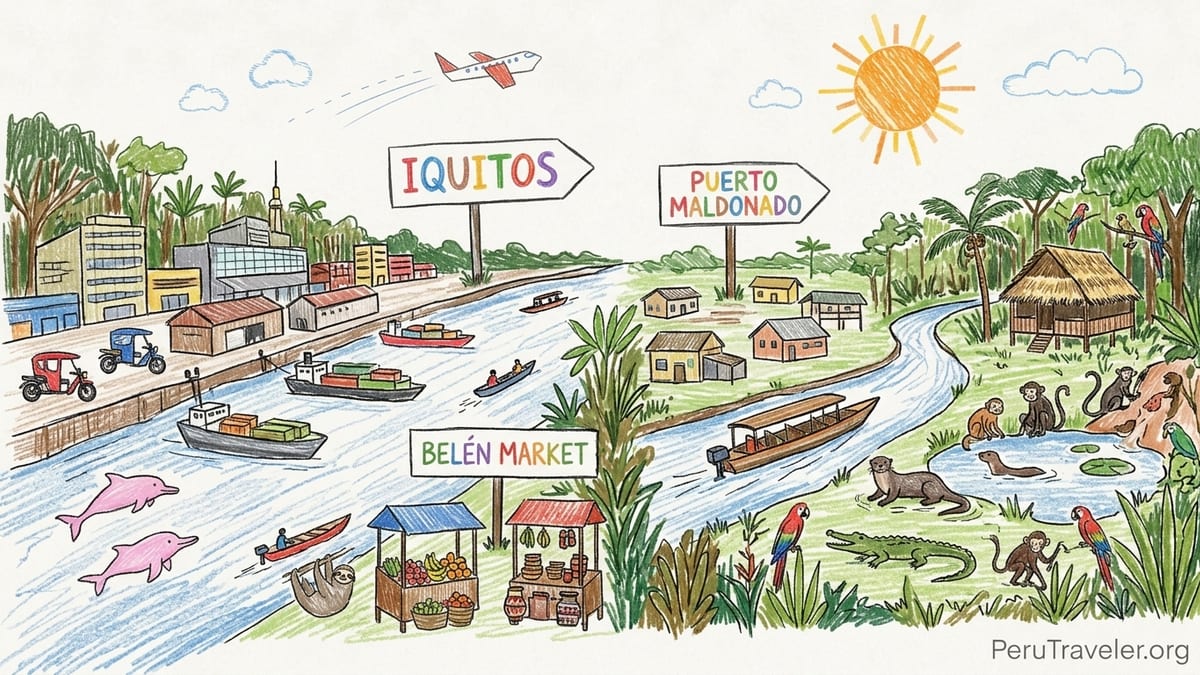
Setting the Scene: Two Very Different Amazon Gateways
Iquitos and Puerto Maldonado are often mentioned in the same breath, yet they feel like different worlds. Iquitos is a full-fledged Amazonian city of several hundred thousand inhabitants, cut off from the rest of Peru by road and reachable for ordinary visitors mainly by air or long-distance riverboat. Daily flights from Lima take about 1 hour 45 minutes and serve a bustling airport that funnels visitors straight into a hot, noisy sprawl of mototaxis, riverfront warehouses and river tour offices clustered along the Itaya and Amazon rivers.
Puerto Maldonado by contrast is a much smaller frontier town on the Madre de Dios River, with a compact center and a calmer, more provincial vibe. It is still hot and humid, but there are far fewer vehicles, a lower skyline and more visible jungle on the horizon. Crucially, Puerto Maldonado is tied into Peru’s overland network via the Interoceanic Highway, which links it with Cusco. That single fact makes it far easier to combine a rainforest stay here with Machu Picchu and the Sacred Valley without doubling back through Lima.
On paper, both places promise “the Amazon.” In practice, they sit in different parts of the basin and on different river systems. Iquitos opens onto the main Amazon and large tributaries like the Nanay and Itaya. Puerto Maldonado is the door to the Madre de Dios and, upriver, the Tambopata River and its nationally protected reserve. Those river systems shape not only the scenery and wildlife density but also how much time you spend getting from an airport hotel to your hammock in the forest.
For this comparison I required myself to spend at least three nights in each region and to complete a similar mix of activities: daytime wildlife walks, night excursions, boat-based wildlife watching and time in both a gateway hotel and a proper jungle lodge. I also tracked what it cost two adults to travel independently in town and to book full-board lodge packages.
Getting There and Getting Around: Air, Road and River
My Iquitos leg began in Lima. A one-way flight from Lima to Iquitos typically runs somewhere in the range of 70 to 150 US dollars per person in economy, depending on season and how far in advance you book. The flight time was just under two hours. Landing in Iquitos, I found mototaxis waiting outside and paid the equivalent of about 5 US dollars for a 20-minute ride into the historic center and riverfront. There is no intercity road to Iquitos, so once you arrive, your only onward options are boats and planes.
Puerto Maldonado offered more routing flexibility. From Cusco, I tested both a flight and the overland connection. The median one-way airfare between Cusco and Puerto Maldonado has recently hovered around the equivalent of 70 US dollars, with occasional lower fares in Peruvian soles on specific dates. The flight took about 40 minutes. On my return leg, I tried the overnight bus along the Interoceanic Highway. It was cheaper than flying but took roughly 10 hours, with the predictable trade-off in comfort and time.
River logistics also differed sharply. In Iquitos, most lodges organize a combination of road plus boat from the city. One widely cited example is a premium three-day Iquitos Amazon lodge tour priced around 420 US dollars per person, including boat transfers, meals and guided excursions for 72 hours in the forest. Other midrange lodges near the city quote similar packages in the 350 to 500 dollar per person range for three days, with private lodges slightly higher if you request a customized program. Boat rides can be long; I spent 2 to 3 hours on a motorized canoe to reach a tributary lodge, depending on river level.
In Puerto Maldonado, the pattern is a short vehicle transfer from the airport or downtown to a river port on the Madre de Dios, followed by a motorized canoe ride to a lodge along the Madre de Dios or farther up the Tambopata. Many lodge programs advertise a 1-hour drive plus 1-hour boat ride combination to midrange lodges near the Tambopata Reserve, or about 1.5 to 2.5 hours by river to lodges deeper along the Tambopata itself. Because Puerto Maldonado is smaller, airport to riverport transfers were quick; I was on the water within about 30 minutes of landing.
First Impressions: City Life, Markets and Riverfronts
Spending a night in each gateway city before heading into the forest proved essential to understanding the character of both regions. Iquitos is lively, sometimes chaotic, and surprisingly urban. The malecón along the riverfront fills with families, street food carts and souvenir vendors in the evening. Colonial-era rubber boom mansions flank the plaza, and the city’s famous Belén Market spreads inland from the river in a labyrinth of stalls selling everything from jungle fruits to traditional medicines.
Belén is fascinating but confronting. The market area has been undergoing changes, including the recent demolition and planned reconstruction of the historic Casona de Belén structure, and visitors should be prepared for intense smells, crowds and occasionally confronting views of bushmeat or live animals. I visited with a local guide through an Iquitos-based tour operator that runs “Belén and communities” excursions. A day tour that combined Belén with nearby river communities was quoted at roughly 50 to 80 US dollars per person, depending on group size, and included a guide and boat navigation along seasonal routes near the market area and adjacent rivers.
Puerto Maldonado’s center felt more like a sleepy regional town. There is a central plaza, a market with local produce, and a riverfront from which local boats depart, but the urban sightseeing is limited. In one afternoon, I had essentially covered the key streets and the main viewpoints. Accommodation in town tended toward small hostels and simple hotels, with basic double rooms often available in the 25 to 60 US dollar range per night, and a few more comfortable lodgings priced higher. Nightlife was modest, with a handful of bars and restaurants near the main square.
If part of your Amazon dream involves colorful but gritty city life on the river, Iquitos clearly wins. If you prefer to keep urban time to a minimum and head straight to the forest, Puerto Maldonado’s more compact gateway and quick exit to the river may suit you better.
Lodges, Packages and What You Actually Pay
To keep comparisons fair, I focused on three-night lodge stays including full board, boat transfers and daily guided excursions in each region, and then cross-checked with published 2025 and 2026 prices from several operators. From Iquitos, one premium eco-lodge advertising a three-day jungle tour currently lists a rate close to 420 US dollars per person, based on double occupancy, including transport from Iquitos, all meals and guided outings. Another operator that publishes 2026 prices for Amazon tours from Iquitos describes similar all-inclusive rates that generally fall between about 350 and 600 US dollars per person for three days, depending on the standard of accommodation and the depth of the itinerary.
Independent hotel and tour combinations in Iquitos can be cheaper. I booked a midrange river-view hotel in central Iquitos for roughly 60 US dollars per night for a double room, including breakfast. Adding airport transfers at around 10 US dollars each way and a full-day Belén and river communities tour in the 50 to 80 dollar per person range, two adults could realistically spend three nights in Iquitos city plus two full days of activities for around 600 to 800 US dollars total, not counting flights.
In Puerto Maldonado and Tambopata, pricing spans an even wider range. A Spanish-language jungle program overview for Tambopata lodges cites three-day, two-night rainforest packages at approximately 189 to 325 US dollars per person including meals, basic excursions and lodge accommodation. More specialized operators list higher figures. One Tambopata-focused company outlines 2025 rates for superior-category lodges in a range equivalent to roughly 320 to 600 US dollars per person for 3 days and 2 nights in the reserve, with full board and bilingual guides. At the higher end, an international adventure outfitter highlights an upscale lodge near the edge of the Tambopata Reserve where three days and two nights in 2025 are priced from about 1,520 US dollars per room, including meals and activities.
For my own Puerto Maldonado stay, I chose a midrange lodge accessible by about two hours of combined road and boat travel. The three-day, two-night package was priced at just under 400 US dollars per person and included transfers from Puerto Maldonado airport, full board, guided walks, a night excursion and a visit to Sandoval Lake. A comparable four-day program, offered by another local operator, listed 4 days and 3 nights at around 470 US dollars per person with visits to a macaw clay lick and an oxbow lake to search for giant otters and caimans.
Time Costs: How Long It Took to Reach the Forest and Start Exploring
In the Amazon, hours spent in transit are hours that you are not on a trail listening to howler monkeys. I paid close attention to that trade-off in both regions. In Iquitos, my flight arrived mid-morning. Between airport formalities and the mototaxi into town, I reached my downtown hotel in roughly 40 minutes. The next morning, my lodge’s staff met me at the hotel, drove me to a local port and transferred me to a motorized canoe. The total journey from hotel to lodge, including waiting time, was close to three hours on a mix of road and river. By early afternoon, I was sitting under a palm-thatched roof with a cold drink while the staff explained the program.
Daily excursions from the Iquitos lodge required additional navigation. To reach an early-morning birding spot or dolphin-watching area, we often rode 30 to 60 minutes by boat along flooded forest channels or the main tributary. A typical day started with a wake-up knock around 5:00 a.m., coffee and a quick snack, a dawn boat ride to search for pink river dolphins or macaws, a mid-morning walk, lunch at the lodge, rest, and then an evening or night outing for caimans and nocturnal mammals.
In Puerto Maldonado, the start-up time felt shorter. I landed just after noon, met my guide by the tiny arrivals hall, and within half an hour we were driving to a river port on the Madre de Dios. From there, a one-hour boat ride took us to the lodge, with the manager welcoming us in the mid-afternoon and a brief jungle walk scheduled before sunset. The total time from plane door to lodge hammock was under three hours.
Once based in Tambopata, many activities began directly from the lodge or with a short boat ride. Reaching Sandoval Lake required about 30 minutes by boat downstream on the Madre de Dios, plus a 40-minute forest walk to the paddle-canoe dock. Lodges deeper in the Tambopata Reserve that I researched but did not stay at often advertise longer initial transfers of 2.5 to 3.5 hours upriver from Puerto Maldonado, but with shorter day-to-day commutes once you are there, since you are closer to macaw clay licks and core wildlife areas.
Excursions and Wildlife: What I Actually Saw
Comparing wildlife between regions is always influenced by luck and season. I visited Iquitos at the tail end of the rainy season, with higher water levels, and Puerto Maldonado early in the dry season, when trails were more accessible. In Iquitos, my lodge-based program included multiple boat safaris, a canopy tower, night walks and community visits. Over three nights, I saw pink river dolphins surfacing in the distance on two separate outings, several species of monkeys including squirrel monkeys and pygmy marmosets, sloths resting in cecropia trees, and a broad mix of birdlife such as toucans, oropendolas and herons. Night excursions turned up caimans, bats and a variety of frogs and large insects.
The Iquitos wildlife felt dispersed along the river and channels, with stretches of quiet paddling punctuated by bursts of activity. My guides were experienced but juggle multiple language groups in the high season, and although we covered considerable ground, some outings felt like surveys rather than deep immersion in a single hotspot. Still, spotting river dolphins and sloths in the wild was unforgettable, and the cultural interactions with river communities provided another layer of interest that Puerto Maldonado did not always match.
In Tambopata and around Puerto Maldonado, wildlife encounters were more tightly clustered around specific features such as clay licks and oxbow lakes. On a dawn visit to Sandoval Lake accessed from my midrange lodge, we paddled quietly along mirror-still water bordered by palm forest. Within an hour, we had watched a family of giant river otters fishing and vocalizing at close range, black caimans resting in the shallows, and hoatzins exploding from the reeds. Macaw and parrot clay licks, visited with another operator on a separate morning, produced dense congregations of red and green macaws and parakeets swirling around exposed riverbank cliffs.
Overall, the density and predictability of wildlife in the Tambopata area felt higher in my experience. Monkeys were regular visitors in the canopy near the lodge; troops of capuchins and howler monkeys were heard or seen daily. Birdlife was more varied on the forest trails than in the more river-focused Iquitos program. On the other hand, I did not see river dolphins in Puerto Maldonado, as these species are not present in the same way along the Madre de Dios and Tambopata rivers near the city.
If I tally strictly by headline animals genuinely seen with my own eyes, Tambopata gave me more macaws, monkeys, giant otters and caimans, while Iquitos delivered the iconic Amazon river dolphin and a stronger sense of human life along major rivers. For pure wildlife photography, particularly of birds and mammals at predictable sites, I would give a narrow edge to Puerto Maldonado and the Tambopata Reserve.
Costs in Practice: Four-Night Example for Two Adults
To make the price comparison concrete, I built a simple four-night model itinerary for two adults in each region, based on current published ranges and what I actually paid. In Iquitos, imagine two nights in the city and two nights at a full-board lodge. A midrange central hotel at 60 US dollars per night for a double room totals 120 dollars for two nights. A three-day, two-night lodge package at around 420 dollars per person comes to 840 dollars for two adults, including meals and transfers. Add airport transfers at about 20 dollars total, plus one full-day Belén and river communities tour from the city at roughly 60 dollars per person, or 120 dollars for two. The four-night, mixed city-and-lodge stay in Iquitos comes out at approximately 1,100 dollars for two adults, excluding flights and personal extras.
In Puerto Maldonado, a similar four-night model might include one night in town and three nights at a lodge, which is more typical because many Puerto Maldonado packages start the same day you arrive. A simple but comfortable hotel in central Puerto Maldonado at 50 dollars for a double room covers the first night. A three-night lodge package at a midrange level, using current examples around 470 dollars per person for 4 days and 3 nights including macaw lick and Sandoval Lake, totals 940 dollars for two. Airport transfers are usually bundled, but budgeting 20 dollars for a taxi and incidental town transport keeps expectations realistic. A separate half-day Sandoval Lake excursion from town, if not included in your lodge stay, is often priced between the equivalent of 20 and 40 US dollars per person in local currency through agencies in Puerto Maldonado’s center. Adding one of these for two adults brings the ballpark total to about 1,050 to 1,100 dollars for four nights, again excluding flights.
What surprised me most was how close the midrange cash outlay could be between the two regions when you combine hotels, transfers, activities and full-board lodges. Puerto Maldonado can certainly be more expensive at the luxury end, where wildlife-oriented brands and upscale eco-lodges quote well over 1,500 dollars per room for a three-day program, but it can also be competitive at the budget and midrange level if you choose more basic jungle lodges and book directly with local operators.
If you strip things down to city-only stays with day tours, Iquitos has the edge for value. Hostel beds and basic guesthouses can drop below 30 dollars per night per room, city food costs are lower and there is a wider range of budget tour agencies competing for Belén and short river tour business. Puerto Maldonado has fewer ultra-budget options and leans more toward bundled lodge experiences.
Drawbacks and Disappointments: What Did Not Match the Brochures
Neither destination was perfect. In Iquitos, the main disappointment was logistical friction. The city’s busy waterfront, the seasonal changes in river level and the fact that many lodges share similar access routes can create bottlenecks. On one occasion, a delayed boat departure and last-minute change in docking point meant we spent nearly an extra hour loading supplies and passengers before heading out. The river can be rough in sections, and those prone to motion sickness may find the ride tiring. Within the city, traffic noise, humidity and occasional power outages intruded on any dreams of a quiet jungle eve spent in a central hotel.
Wildlife expectations in Iquitos also need to be managed carefully. Marketing images often feature iconic species photographed after long, patient observation in remote corners of the basin. On a three-night stay near the main Amazon tributaries, it is entirely possible not to see large cats or rare primates, and to log only fleeting glimpses of dolphins. The gap between high brochure promises and what an average visitor sees in a short stay can feel wide if guides do not set realistic expectations.
In Puerto Maldonado, the flip side of the efficient lodge logistics is that the gateway town itself can feel underwhelming. After an afternoon in the central market and a stroll to a viewpoint over the Madre de Dios, I found little else to do that genuinely added to my rainforest understanding. If your flight arrives very early or departs late, you may end up with hours in town that feel like filler time. Lodge transfers can also be more expensive than expected, especially with high-end operators, and some visitors report that the cost per day at Tambopata lodges has climbed toward 300 dollars or more per person, which can be a shock after seeing lower package prices advertised in general Peru travel brochures.
I also encountered variability in guide enthusiasm and group sizes in both regions. In Iquitos, one night walk had more than ten people following a single guide on a narrow trail, which made it hard to hear explanations or see smaller animals. In Tambopata, a separate excursion to a clay lick timed to office hours rather than optimal bird activity left us sitting for long stretches with only a few parrots in view. Choosing operators that spell out maximum group sizes and including guide quality as a primary selection criterion is essential.
The Takeaway: Which One I Would Book Again and For Whom
Looking back at my time in both Iquitos and Puerto Maldonado, my verdict depends heavily on the type of traveler and the broader itinerary. Personally, if I had to book another four-night Amazon stay tomorrow with my own money, I would lean slightly toward Puerto Maldonado and the Tambopata area, for two main reasons: the relative ease of combining it with a Cusco and Machu Picchu trip via both road and air, and the higher density of wildlife encounters I experienced around oxbow lakes and clay licks.
In terms of expectations, Iquitos excelled at delivering an energetic, sometimes overwhelming sense of the Amazon as a lived-in landscape. Belén Market, the riverside malecón, and the constant coming and going of cargo boats and mototaxis made it clear that this is a working river city, not just a tourism gateway. Puerto Maldonado felt more like a functional staging point for national parks and reserves, with most of its magic unfolding upriver rather than in town.
For ease of arrival, Puerto Maldonado wins for travelers already in southern Peru, particularly those in Cusco. A short flight or overnight bus links the Andes to the Madre de Dios basin, and same-day transfers to lodges are the norm. Iquitos is straightforward if you are flying in from Lima or abroad, but you must commit to an “air and river only” loop, with no realistic road exit.
On lodges and tours, both regions offer a full spectrum from rustic to high-end. Iquitos has a slight edge in independent city-based stays and last-minute tour options, while Tambopata stands out for well-structured lodge programs with clear wildlife focus, often built around specific features like Sandoval Lake or macaw clay licks. Guide quality varied in both, but my most rewarding natural history briefings and my closest mammal and bird encounters took place upriver from Puerto Maldonado.
When I tally wildlife actually seen on comparable three-night forest stays, my Puerto Maldonado notes list more macaws, monkeys, giant otters and caimans, and more concentrated birdlife. My Iquitos records weight more heavily toward river dolphins, sloths and riverine community life. My only real disappointments were occasional overcrowded tours and scheduling that did not always match the rhythms of wildlife, both solvable with better operator selection.
For first-time Amazon visitors whose main Peru goal is Machu Picchu and the Sacred Valley, I recommend combining that Andean route with a Puerto Maldonado or Tambopata stay of at least three nights. The overland and air connections are simply more efficient, and the wildlife payoff is strong even on shorter itineraries. Families with children may also appreciate the shorter daily boat rides and the relatively predictable viewing at clay licks and lakes.
For wildlife photographers, especially those targeting macaw licks, giant river otters and a diversity of monkeys in a compact timeframe, I found the Tambopata area superior. The combination of oxbow lakes and clay licks concentrates animals in ways that suit early-morning hides and long-lens work. For couples seeking romance, either region can work, but Iquitos offers more evening city life and riverside dining before or after a lodge stay, while Puerto Maldonado’s charm is quieter and more lodge-centered.
Travelers whose priority is cultural immersion and a sense of the Amazon as a human landscape might prefer Iquitos. Belén Market, urban riverfront life and the mix of boatmen, shopkeepers and fish sellers offer a raw but memorable introduction to how people live with the forest and river. Finally, independent travelers focused on budget may find more possibilities to negotiate last-minute deals and mix city nights with day tours in Iquitos.
FAQ
Q1. Is Iquitos or Puerto Maldonado better for combining the Amazon with Cusco and Machu Picchu?
Puerto Maldonado is better if you want to link the rainforest with Cusco and Machu Picchu, because it connects by both short flight and overland bus along the Interoceanic Highway, while Iquitos requires a separate flight loop.
Q2. Which destination is cheaper for a four-night trip for two adults?
At the midrange level, total cash outlay for four nights and a mix of city and lodge stays is surprisingly similar, roughly around 1,000 to 1,100 US dollars for two adults in each region, excluding flights. Iquitos can be a bit cheaper for city-only stays with day tours.
Q3. Where will I see more wildlife in a short three-night stay?
In my experience, the Tambopata area near Puerto Maldonado delivered denser wildlife around oxbow lakes and macaw clay licks, including giant otters, caimans and multiple monkey species, while Iquitos stood out for river dolphins, sloths and human river life.
Q4. Is Belén Market in Iquitos safe to visit?
Belén Market can be intense and crowded, so it is best visited with a reputable local guide or tour, taking normal big-city precautions with valuables and being prepared for confronting sights such as bushmeat and live animals.
Q5. Do I need malaria pills for Iquitos or Puerto Maldonado?
Health recommendations change over time, so you should consult a travel medicine specialist before your trip. Both regions are in the Amazon basin and you may be advised to take antimalarials and other precautions such as mosquito repellent and long sleeves.
Q6. Are lodge packages worth the price compared to booking everything independently?
For most travelers, full-board lodge packages that include river transport, meals and guided excursions represent good value, especially in Puerto Maldonado where independent transport upriver can be complex. In Iquitos, experienced independent travelers can sometimes save money by combining city hotels and locally booked day tours.
Q7. How many nights should I spend in the Peruvian Amazon?
Three nights in the forest is an absolute minimum to feel the rhythm of the jungle. Four or five nights, either at a single lodge or split between lodge and city, gives a better chance of varied wildlife encounters and relaxed pacing in both Iquitos and Puerto Maldonado.
Q8. Which destination is better for families with children?
Puerto Maldonado is often easier for families, because of shorter overall transfer times to lodges, more predictable wildlife at lakes and clay licks, and the ability to schedule a compact rainforest stay alongside a Cusco-based itinerary.
Q9. Can I visit both Iquitos and Puerto Maldonado on the same trip?
Yes, but doing both properly with at least three nights in each forest area generally requires at least two weeks in Peru and additional domestic flights, so it suits travelers with more time and budget.
Q10. Do I need to speak Spanish to enjoy either destination?
Many lodges and tour operators in both regions provide bilingual guides, and basic English is widely available in tourist services, but knowing some Spanish can improve interactions in markets, with boat crews and in smaller local businesses.