


Reaching Machu Picchu in 2026 is no longer as simple as “taking the train from Cusco.” Travelers must pick between two operators, multiple departure stations, bimodal bus and train combinations, several service classes and strict entry times for the citadel itself. Choosing badly can mean an exhausting 18 hour day, missed entrance slots or hundreds of extra dollars spent for window upgrades that add little to the experience. This guide compares PeruRail and Inca Rail using current services, real sample fares for the same October 2026 travel date, and explains how to combine trains, buses and tickets into one coherent plan that actually works.
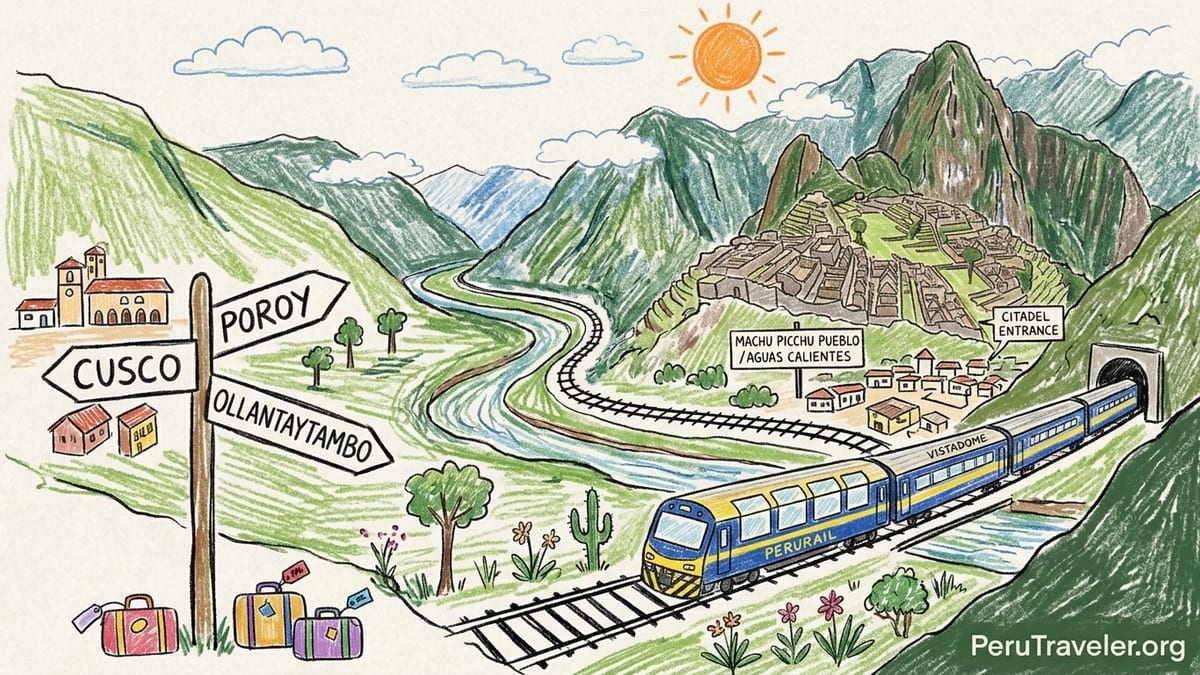
Understanding the Geography: Cusco, Sacred Valley and Machu Picchu Pueblo
The first step to choosing the right train is understanding where you actually board. Cusco sits high in the Andes at about 3,400 meters, on a plateau above the Sacred Valley. Machu Picchu itself is not in Cusco, and there is no road directly from Cusco to the ruins. Instead, almost all visitors travel by rail along the Urubamba River to the town officially called Machu Picchu Pueblo, still commonly known as Aguas Calientes. This town is the railway terminus at the base of the mountain, not the archaeological site, and onward access to the ruins is by shuttle bus or a steep hike.
Within the city of Cusco there are several important names to distinguish. Wanchaq is a bus and rail hub in the lower part of town that today functions mainly as the starting point for bimodal services. When you see a “Cusco bimodal” ticket, it usually means coach departure from Wanchaq, then a transfer to a train at Poroy, Pachar or Ollantaytambo. San Pedro is the central train station near Cusco’s historic market; PeruRail has progressively reintroduced departures and arrivals here on selected services in 2026, offering a more convenient downtown option for some trains. Neither of these is anywhere near Machu Picchu itself, but both are relevant boarding points depending on the ticket you purchase.
Once you leave the Cusco basin, the track follows the Sacred Valley of the Urubamba River. Here the key stations are Poroy, Pachar, Urubamba and, above all, Ollantaytambo. Poroy, around 30 to 40 minutes by road from Cusco’s center, used to be the main “Cusco area” railhead in dry season. For 2026, PeruRail has partly restored direct trains from Cusco to Poroy and on to Machu Picchu, but has also shifted several services to operate as disembarkation or boarding points only for passengers connecting by coach. Pachar is a small valley station near the river, also used as a transfer point on some bimodal services rather than a town where most people stay the night.
Ollantaytambo, about 1.5 to 2 hours by road from Cusco, is the critical railway town of the Sacred Valley. It is the last major road access before Machu Picchu, and both PeruRail and Inca Rail operate dense schedules between Ollantaytambo and Machu Picchu Pueblo. Urubamba, another valley town upstream, appears in the PeruRail timetable as an additional boarding point on some Vistadome services, but has fewer departures than Ollantaytambo. Finally, Machu Picchu Pueblo / Aguas Calientes at the end of the line is purely a rail and pedestrian town; there are no cars, and the only way from here to the citadel entrance is the Consettur shuttle buses or the walking trail.
PeruRail vs Inca Rail: Routes, Stations and October 2026 Changes
Only two companies are authorized to run regular tourist trains between the Cusco region and Machu Picchu Pueblo: PeruRail and Inca Rail. PeruRail is the older and larger operator, with a broader network that also includes Lake Titicaca routes. In the Machu Picchu corridor, PeruRail offers trains and bimodal services from Cusco (San Pedro and Wanchaq), Poroy, Urubamba and Ollantaytambo. Inca Rail focuses tightly on the Ollantaytambo to Machu Picchu segment, adding its own bimodal bus and train combinations from Cusco.
For 2026, an important development is PeruRail’s operational notice covering services from May 1 onward. The company announced that it would restore selected trains from Cusco’s San Pedro and Poroy stations, while at the same time adjusting how some services use Pachar and Poroy. Certain trains that in previous years were marketed as running “Cusco to Machu Picchu” now involve bus segments between Wanchaq, Poroy, Pachar and Ollantaytambo, and in some cases Pachar or Poroy function as intermediate disembarkation points for passengers connecting to coaches rather than final railheads. This means that travelers relying on older guidebooks that describe a simple, continuous rail trip from Cusco to Machu Picchu risk misunderstanding when and where they will be on a bus instead of on tracks.
In practical terms, PeruRail sells three main types of Machu Picchu product in 2026. First, classic rail tickets starting from Poroy, Urubamba or Ollantaytambo and ending at Machu Picchu Pueblo. Second, “Bimodal” tickets from Cusco that combine a coach from Wanchaq or San Pedro to a valley station, then a train. Third, a handful of special departures that reintroduce more straightforward Cusco to Machu Picchu trains in the drier months, although these still follow the same physical route through Poroy and the Sacred Valley. Inca Rail mirrors this structure on a smaller scale, marketing trains between Ollantaytambo and Machu Picchu, plus its own bimodal services that start in central Cusco by bus and connect to rail at Ollantaytambo.
Because of these 2026 changes, it is vital to look closely at the words “Bimodal,” “Cusco” and any mention of Wanchaq, San Pedro, Pachar and Poroy when searching timetables. A Cusco origin does not guarantee that you will be on rails the whole way. Travelers who especially value the train experience often choose to travel by road independently from Cusco to Ollantaytambo and board the train there, which can also shorten the total travel time and reduce the number of transfers.
Classes and Onboard Experience: Expedition vs Voyager, Vistadome vs 360° and More
Both operators segment their services into several branded classes. On PeruRail, the main Machu Picchu products are Expedition, Vistadome and Vistadome Observatory. Expedition is the baseline tourist class, with comfortable reclining seats, wide side windows and standard luggage racks. Decoration is simpler, with Andean fabrics and overhead storage, and food and drink are generally available as paid snacks rather than included full meals. For many travelers this level feels similar to an economy class intercity train in Europe.
Vistadome is PeruRail’s mid range panoramic product. Cars feature larger, slightly curved side windows and overhead glass panels that bring more light and views of the surrounding peaks. Onboard, passengers usually receive a light snack box and hot drinks included in the fare, and daytime services often feature short live dance or fashion demonstrations showcasing Andean textiles. The Vistadome Observatory goes a step further by adding a dedicated observation car with bar service and an open balcony or open style end section designed for better photographs, along with live music. Seating in the regular Vistadome cars is similar, but passengers can walk through to the observatory area during the trip.
Inca Rail works with four broadly comparable categories on the Machu Picchu route: Voyager, 360°, Prime and First Class. Voyager is the standard class, often used by independent travelers and small groups. Cars are bright and modern with large windows, but without an observatory section, and snacks and drinks may be sold on board or lightly included depending on the exact ticket. The 360° service emphasizes panoramic viewing, with extra tall windows and additional glass panels above your head. Like PeruRail’s Vistadome, the 360° train usually includes a snack box and non alcoholic drinks in the fare.
The Prime and First Class products occupy the upper end of Inca Rail’s range. Prime offers wider, more spacious seats in a quieter carriage, with upgraded snacks or light meals and a generally calmer environment. First Class is framed as a semi luxury experience, with a dedicated waiting room at Ollantaytambo, welcome cocktails, multicourse meals served on board and more attentive table style service. For travelers used to business class on airlines, Prime and First Class will feel familiar, although journey times remain identical to lower classes because all trains share the same track and speed limits between the Sacred Valley and Machu Picchu Pueblo.
Real Fares and Schedules: What Tickets Cost in October 2026
To understand the real cost difference between operators and classes, it is important to look at fares on the same date and at similar departure times. Mid October 2026 searches for randomly chosen weekdays on official booking engines and consolidators show that a one way PeruRail Expedition ticket from Ollantaytambo to Machu Picchu often starts around 60 to 70 US dollars for early morning departures, with some trains priced higher closer to 80 or 85 dollars at very popular hours. Vistadome on the same route and date tends to fall in the range of about 90 to 120 dollars depending on time, while Vistadome Observatory often prices from the mid 100s upward on peak services, sometimes approaching 150 dollars or a little more for favored morning trains.
On the same October dates, Inca Rail fares from Ollantaytambo to Machu Picchu show Voyager departures roughly in the 60 to 85 dollar band, broadly overlapping with PeruRail Expedition. The 360° service generally sits a step higher, around the low 80s to low 100s, while Prime tickets can climb into the 110 to 140 dollar range, and First Class departures are notably more expensive, frequently exceeding 150 dollars and heading toward 200 dollars or more on prime morning slots. All of these examples assume standard tourist fares and ignore occasional deeply discounted promotions that may appear for specific days or hours that are inconvenient for most visitors.
From Cusco using bimodal services, round trip prices rise substantially because of the added coach segments and longer distance. Sample October 2026 PeruRail searches for bimodal Expedition Cusco to Machu Picchu and back, combining bus from Wanchaq and train from Ollantaytambo, return fares in roughly the 150 to 190 dollar per person bracket depending on time of day. Upgrading to Vistadome bimodal typically adds 30 to 60 dollars round trip, which means that a Cusco based traveler might easily pay around 200 to 240 dollars per person for mid range panoramic rail and coach on a convenient schedule. Inca Rail’s bimodal Voyager and 360° combinations from Cusco exhibit similar or slightly higher pricing, often in the 170 to 230 dollar round trip zone once both bus and train are factored in.
The key takeaway is that the real price difference between PeruRail Expedition and Inca Rail Voyager for a straightforward Ollantaytambo to Machu Picchu return is modest when bought on the same date with comparable departure times. On a two way journey for two adults, that difference may amount to 20 to 40 dollars total at most. The true jumps in cost occur when upgrading from base classes to panoramic and premium products, or when adding the convenience of starting and finishing in Cusco rather than transferring independently to the Sacred Valley.
Bimodal Services, Boarding, Baggage and Travel Formalities
The term “bimodal” causes confusion, but in the Machu Picchu context it simply means that your ticket includes both a coach and a train. If you buy a Cusco bimodal departure from either PeruRail or Inca Rail, you will board a bus at a city location, usually Wanchaq or near the historic center, and ride for around 1.5 to 2 hours down the Sacred Valley to a railway station such as Ollantaytambo or Pachar. There you disembark and follow staff instructions to board the correct train carriage to Machu Picchu Pueblo. On the return, the process works in reverse, ending back in Cusco.
Passengers must pay attention to where the coach departs from. Wanchaq is slightly downhill from the center of Cusco, while some departures or check in formalities may use offices closer to the historic core. Operators usually specify that you must arrive at the boarding point at least 30 minutes in advance for pure train departures and 45 minutes in advance for bimodal services, to allow time for check in, baggage tagging and transfers. Coaches are generally modern tourist buses or minibuses with assigned capacity, and late arrival can result in losing your spot with limited options for rebooking on the day, especially in high season.
Both PeruRail and Inca Rail apply baggage limits on Machu Picchu services because of space constraints on board. Policies evolve, but typical allowances are around one small or medium sized bag per person of about 5 to 8 kilograms, plus a personal item like a daypack. Large suitcases are discouraged and may be refused at check in; travelers staying longer in the region often leave excess baggage at their Cusco hotel or a storage service in the Sacred Valley before boarding. Seat selection on the booking engines varies by class and company, sometimes allowing precise choice for a small extra fee, other times assigning seats automatically based on availability.
Tickets for both rail operators are personal and must match the passenger’s identity document. Foreign travelers almost always use their passport number when booking, as this is the same document required to purchase Machu Picchu entry tickets. At check in for the train and at the entrance to the citadel itself, staff may ask to see both your ticket and your original passport. Digital confirmations on a phone screen are increasingly accepted on trains and buses, but carrying a physical backup printout remains sensible in case of battery issues or scanning problems. Travelers are strongly advised to book trains and Machu Picchu entry well in advance for any date in high season or around local holidays, as October 2026 already shows heavy demand on early morning entry slots and prime trains.
Why Departing from Ollantaytambo Often Makes Sense
Logistically and financially, many travelers are better off basing themselves in the Sacred Valley and boarding the train at Ollantaytambo rather than insisting on a same day round trip from Cusco. The road transfer from Cusco to Ollantaytambo typically takes around 1.5 to 2 hours depending on traffic and stops. When you add the 1.5 hour train ride from Ollantaytambo to Machu Picchu Pueblo, the 30 minute shuttle up to the ruins and similar times in reverse, the total travel time for a Cusco to Machu Picchu day trip can exceed 10 hours even before including check in margins and any delays.
By contrast, a traveler already staying in Ollantaytambo can walk or take a short tuk tuk ride to the station, board an early train and reach Machu Picchu Pueblo in under two hours. This simplifies catching the highly coveted first shuttle buses that line up from around 5 to 5:30 a.m. in Aguas Calientes for 6:00 a.m. entry tickets. Families with children, older travelers and photographers interested in softer morning light often appreciate reducing the pre dawn wake up and long evening return drive that a Cusco same day trip entails.
Financially, the price difference between a bimodal Cusco ticket and a pure Ollantaytambo rail ticket for the same date and departure can be similar to or higher than the cost of hiring a private taxi or shared transfer from Cusco to the valley, especially for two or more people. For example, if a round trip bimodal Expedition ticket costs around 170 dollars per person from Cusco, while the equivalent Ollantaytambo to Machu Picchu rail segment is around 120 dollars, a couple might save about 100 dollars in total and gain flexibility by arranging their own road transfer and staying one night in Ollantaytambo on either side of their Machu Picchu day.
Sleeping in the Sacred Valley also helps with acclimatization because valley towns sit lower than Cusco, often around 2,800 to 2,900 meters, which can make the first night at altitude more comfortable. Many visitors follow a sequence of arriving in Cusco, heading straight down to the valley for one or two nights in Urubamba or Ollantaytambo, visiting Machu Picchu from there, then returning to Cusco for museums and city sights once their bodies have adapted slightly to the thin air.
What Happens After You Arrive in Machu Picchu Pueblo
Stepping off the train at Machu Picchu Pueblo is not the end of the journey. The archaeological park entrance lies roughly 25 minutes up a steep, switchback road. To get there, most visitors take the Consettur shuttle buses that depart from near the river in Aguas Calientes. Tickets for these buses are sold separately from all train fares and Machu Picchu entrance tickets. Recent traveler reports and local information indicate that the standard foreign adult price in 2026 is about 24 US dollars per person for a round trip or around 12 dollars one way, payable on site in the town or online through authorized channels.
Buses begin running from around 5:30 a.m., timed so that the first passengers can reach the citadel gates close to the 6:00 a.m. opening. At peak times, particularly around sunrise, queues form well before the first departure, and travelers with early entry tickets often line up 45 to 60 minutes in advance. The ticket itself is date specific but not tied to a particular departure time up, which allows some flexibility so long as you reach the entrance around your allotted Machu Picchu time slot.
An alternative is to hike up the steep path from Aguas Calientes to the entrance, which usually takes 1.5 to 2 hours for reasonably fit travelers. While this saves bus fare, it does not reduce the need for a timed Machu Picchu entry ticket, and in wet or very hot conditions it can be demanding, especially before dawn. Regardless of whether you choose the bus or the trail, entering the archaeological site requires a separate ticket purchased in advance from the Ministry of Culture or, for limited next day availability, in person at the cultural center in Machu Picchu Pueblo.
In 2026, standard foreign adult prices for the main Machu Picchu circuit tickets are denominated in Peruvian soles. A commonly chosen route such as Circuit 2 “classic” costs in the region of 150 to 160 soles per adult, roughly equivalent to slightly more than 40 US dollars at recent exchange rates, while more complex circuits that add Huayna Picchu mountain cost somewhat more. Tickets are strictly personalized with your full name and passport number at the time of purchase, valid only for one entry window on a specific date, and official rules expect most visitors to complete the main circuits within a maximum of around four hours.
Are Panoramic and Premium Trains Worth the Extra Cost
Whether Vistadome, Vistadome Observatory, 360° and premium classes justify their price difference depends strongly on your priorities. On the Ollantaytambo to Machu Picchu segment, the rail line hugs the valley floor beside the Urubamba River. Mountains tower above on both sides, and weather can shift from bright sun to low cloud and drizzle in minutes. Large windows and overhead glass panels do make a tangible difference, particularly for photographers who want to capture snow capped peaks, Inca terraces and glimpses of the river without pressing a camera lens against scratched standard windows.
Compared with Expedition and Voyager, the panoramic classes do feel more open and airy. However, both PeruRail and Inca Rail already equip even their base services with reasonably generous side windows, so the jump is less dramatic than some marketing photos suggest. On a cloudy or wet day, the ceiling glass may be streaked with rain, and reflections from interior lighting can limit photography. Travelers who plan to spend most of their time looking out and snapping pictures will still appreciate the extra visibility, while those who tend to read or chat may notice only marginal improvement.
The real added value of premium trains usually comes in onboard service and crowding levels. Vistadome, Vistadome Observatory, 360° and First Class style products often have fewer seats per carriage, more legroom and sometimes larger tables. Light meals or snack boxes plus hot drinks are often included in the price, and some services provide live music or traditional dance demonstrations. In First Class, multicourse menus and bar service transform the trip into a quasi dining car experience, enjoyable for couples celebrating a honeymoon or older travelers who value comfort over cost.
From a budget perspective, the question is how that upgrade compares against other uses of your money in the trip. If moving from Expedition to Vistadome on a single one way costs roughly 30 to 40 dollars extra, a couple upgrading both directions might spend an additional 120 to 160 dollars. That same amount could cover a comfortable mid range night in Aguas Calientes or Ollantaytambo, or pay for a private guide inside Machu Picchu. Many experienced visitors therefore book one direction in a panoramic class, often the daylight leg into the valley, and use a cheaper standard class for the return when they are tired and less interested in views.
What a Full Machu Picchu Trip Really Costs in 2026
To grasp the overall budget, it helps to run through realistic examples. Consider first two adults planning a relatively economical but comfortable visit in October 2026, staying one night in Ollantaytambo and one in Aguas Calientes. They might hire a private taxi or shared transfer from Cusco to Ollantaytambo for a total of about 60 to 80 US dollars between them, then purchase round trip Expedition or Voyager tickets from Ollantaytambo to Machu Picchu Pueblo for around 120 to 140 dollars per person, totaling perhaps 260 dollars for both. Machu Picchu entry tickets for a standard circuit could add roughly 45 dollars per person, or about 90 dollars in total.
Bus tickets between Aguas Calientes and the citadel at about 24 dollars per person round trip would then contribute another 48 dollars. If they choose a midrange hotel night in Ollantaytambo around 60 to 90 dollars and a comparable night in Aguas Calientes at perhaps 80 to 120 dollars, accommodation may weigh in around 150 to 200 dollars. Summing those figures yields a ballpark of 550 to 700 dollars for the complete experience for two adults, excluding meals and local taxis but including road transfer from Cusco, trains, buses, entry tickets and two nights’ lodging.
For a family of four, say two adults and two children aged between 8 and 15, some costs scale while others do not. Train tickets generally price children somewhat lower than adults but still substantial; on 2026 tariffs, families frequently report paying in the region of 400 to 600 dollars total for round trip train tickets alone depending on class and timing. Machu Picchu entry offers discounted child rates, bringing the total for four standard circuit tickets into a range of roughly 130 to 180 dollars. Bus tickets at 24 dollars round trip per person come to 96 dollars for four. Road transfers between Cusco and the valley may not cost much more for four than for two, especially when using private taxis or dedicated tourist services.
When a family chooses to compress everything into a single day tour from Cusco, the numbers shift. Independent booking with bimodal services may produce a combined cost around 250 to 300 dollars per adult once all trains, buses and entrance fees are counted, while children add somewhat less. All inclusive day tours marketed in Cusco and online often quote figures in the 350 to 450 dollars per adult range for foreigners for 2026 travel, with children discounted, bundling bimodal transport, Machu Picchu entry, shuttle buses and a group guide. That premium buys simplicity and a single point of contact but can be 20 to 40 percent more expensive than carefully piecing together each component yourself.
These figures remain approximate because exchange rates and specific train choices matter, but they illustrate the key idea. The marginal difference between PeruRail and Inca Rail for a like for like base class train is often modest compared with the overall trip cost. The major decisions that significantly increase or decrease your budget are whether to stay overnight in Aguas Calientes or try a long same day return, whether to base in the Sacred Valley or Cusco, which Machu Picchu circuit you select, and how much you value onboard comfort versus simple transport.
Independent Bookings vs Complete Day Tours
Travelers face a further choice between assembling their own itinerary and buying a complete Machu Picchu day tour. Independent planning means purchasing the train (or bimodal) tickets directly with PeruRail or Inca Rail, buying the Machu Picchu entrance separately through official channels, arranging Consettur bus tickets and booking accommodation as needed. This requires more research but gives fine grained control over departure times, routes and where to spend the night. It also avoids agency markups on tickets that, by law, cost the same at face value regardless of who buys them.
On the other hand, one day tours marketed as “Cusco to Machu Picchu and back” typically include hotel pick up, shared coach transport to the valley, round trip train in at least a base class, the shuttle bus and a group guided visit inside the citadel. In 2026 pricing samples, these packages for foreign adults often cluster around the equivalent of 350 to 450 dollars from Cusco, with lower rates in Spanish speaking groups and higher ones for small private tours. Agencies may use either PeruRail Expedition or Inca Rail Voyager as their default train product, upgrading to Vistadome or 360° at added cost.
The advantages of such tours are clear for travelers short on time or reluctant to navigate Spanish language booking interfaces. Once paid, you mostly follow instructions about when and where to be, and a guide usually coordinates ticket checks and timing inside the site. The disadvantages are reduced flexibility, potential for very early and late hours in a single long day, and limited influence over exactly which Machu Picchu circuit or train timetable is used. Some budget tours also select very early or very late trains to minimize their own costs, leaving participants with less time at the ruins than they expected.
This tradeoff also affects families and older travelers. A well run mid priced tour can be a relief if nobody in the party is comfortable handling logistics, while independent arrangements can be more rewarding for those who enjoy planning and want the freedom to change plans, linger for photos or spend an afternoon soaking in the hot springs at Aguas Calientes instead of racing straight back to Cusco.
The Takeaway
When choosing between PeruRail and Inca Rail in 2026, focus less on brand and more on the specific departure times, boarding stations and classes that fit your Machu Picchu entry slot. For most travelers, PeruRail Expedition and Inca Rail Voyager offer similar comfort at similar prices on equivalent departures. The bigger decisions are whether to base yourself in Cusco or the Sacred Valley, whether to split the trip over one or two nights, and how much you value panoramic views and onboard meals over saving money for guides, hotels or extra experiences.
Budget travelers generally get the best value by traveling independently, staying at least one night in Ollantaytambo or Aguas Calientes, using Expedition or Voyager trains and allocating money saved toward a good local guide inside the ruins. Families often find that basing in the Sacred Valley and avoiding an extremely long same day Cusco return keeps everyone happier, even if that means paying a bit more for convenient mid morning trains. Couples celebrating honeymoons or anniversaries might sensibly indulge in one direction on Vistadome, Vistadome Observatory, 360° or First Class, especially during daylight, while keeping the other leg in a cheaper class.
Photographers and scenery lovers benefit from panoramic cars, but should weigh the cost against the reality of variable weather and reflections. Luxury travelers who value service, quieter cars and inclusive dining will appreciate premium classes and may prefer PeruRail’s Vistadome Observatory or Inca Rail’s First Class paired with a high end hotel in Aguas Calientes or the Sacred Valley. Regardless of budget, anyone with a 6:00 a.m. or 7:00 a.m. Machu Picchu entry should strongly consider sleeping in Aguas Calientes the night before. This simple choice does more to reduce fatigue and the risk of missing your time slot than almost any window or meal upgrade on the train.
FAQ
Q1. Is PeruRail or Inca Rail cheaper for the Machu Picchu train in 2026?
In October 2026, base class fares on comparable departures are usually quite similar. PeruRail Expedition and Inca Rail Voyager from Ollantaytambo to Machu Picchu often differ by only a few dollars when checked for the same date and time. Larger price differences appear when comparing panoramic or premium services, or when adding bimodal bus segments from Cusco.
Q2. Do I need to start in Cusco, or can I just board the train in Ollantaytambo?
You can absolutely board in Ollantaytambo, and many travelers prefer this. You reach Ollantaytambo by road from Cusco, stay overnight in the Sacred Valley, and then take an early train, which shortens the travel day and simplifies catching morning Machu Picchu entry slots.
Q3. What exactly does “bimodal” mean on Machu Picchu tickets?
“Bimodal” means your ticket includes both a coach and a train segment. You usually board a bus in Cusco at Wanchaq or another city location, ride to a valley station such as Ollantaytambo or Pachar, then transfer to the train to Machu Picchu Pueblo. The return works the same way in reverse.
Q4. Is arriving at Machu Picchu Pueblo the same as arriving at the ruins?
No. Machu Picchu Pueblo, also called Aguas Calientes, is the town at the base of the mountain where the trains stop. From there you must take a separate Consettur shuttle bus or hike up to the archaeological entrance, which takes around 25 minutes by bus or 1.5 to 2 hours on foot.
Q5. How far in advance should I book my train and Machu Picchu tickets?
For 2026 travel, it is wise to secure Machu Picchu entry tickets several weeks or even months ahead for peak months or specific circuits, then book trains as soon as your entry time is confirmed. Early morning slots and convenient mid morning trains can sell out well in advance, particularly around weekends and holidays.
Q6. Are panoramic trains like Vistadome and 360° really worth paying more?
Panoramic cars do provide larger windows, more light and better views for photos, plus usually include snacks and drinks. Whether they are “worth it” depends on your budget and priorities. Many travelers compromise by using a panoramic class in one direction during daylight and a cheaper class for the other leg.
Q7. What luggage can I bring on the Machu Picchu trains?
Both operators restrict baggage on this route because storage space is limited. Typical allowances are one small or medium bag of around 5 to 8 kilograms per passenger, plus a personal item. Large suitcases are discouraged, so it is common to leave excess luggage at a hotel in Cusco or the Sacred Valley.
Q8. Can I use a photo of my passport or do I need the original?
You should carry your original passport. Train companies and the Machu Picchu entrance staff may ask to see the physical document that matches the name and number printed on your tickets. While digital copies can help in emergencies, they are not a guaranteed substitute.
Q9. Is a same day round trip from Cusco to Machu Picchu recommended?
It is possible but long. Including hotel pickup, buses, trains, shuttles and visiting time, the day can easily stretch to 14 hours or more. Many travelers, especially families and older visitors, find it more comfortable to stay at least one night either in Ollantaytambo or Aguas Calientes.
Q10. Should I book a full day tour or organize everything independently?
If you value simplicity and do not mind paying more, full day tours from Cusco bundle transport, entrance and guiding into one package. If you prefer flexibility, want to choose specific trains and circuits, or are watching your budget closely, independent booking usually offers better value and more control over the pace of your visit.