


At 3:20 in the morning, standing under a yellow streetlamp in central Arequipa with a thermos of coca tea and two extra layers stuffed into my daypack, I finally understood what a “budget” Colca Canyon tour really means. I had paid the equivalent of about 30 US dollars in a small agency just off Plaza de Armas for a shared two-day Colca Valley tour that included transport, a basic hotel in Chivay, breakfast on both days and guiding, but not lunches, dinners or the official Colca tourist ticket. What I bought on paper was a sightseeing excursion with condor watching. What I experienced over the next forty-eight hours was a lesson in high altitude, bus-tour efficiency and why staying overnight in the canyon region gives a far richer sense of place than any one-day dash from Arequipa ever could.
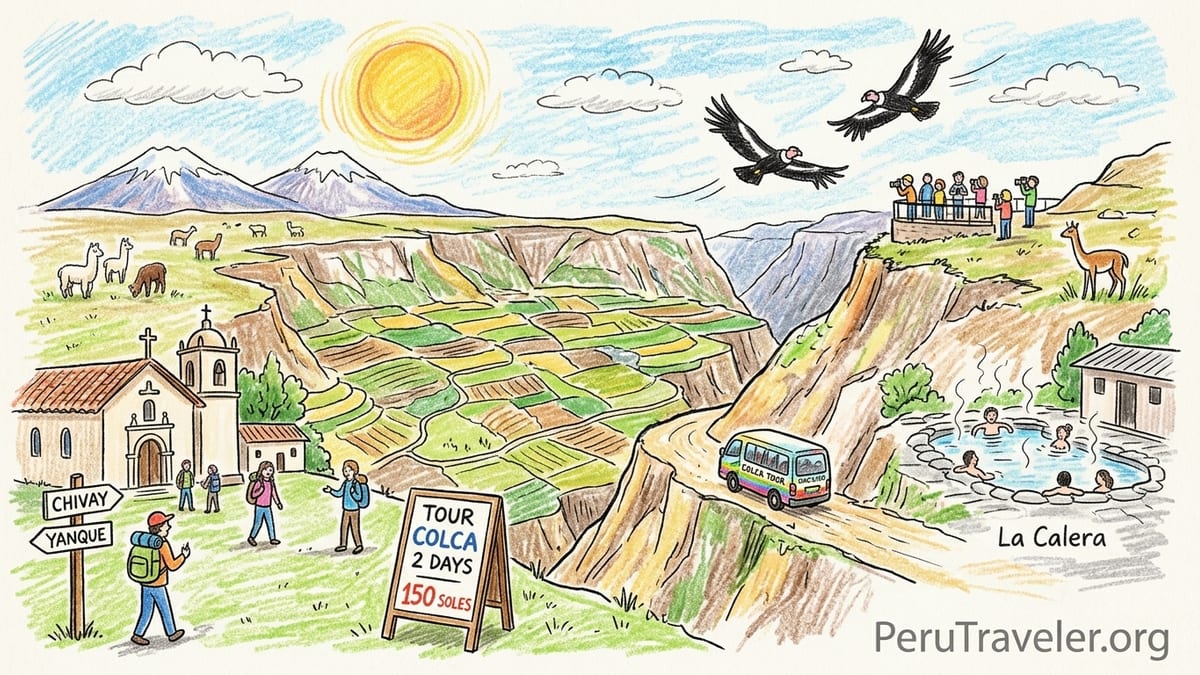
Booking a Two-Day Colca Tour in Arequipa
In 2026, walking around Arequipa’s Plaza de Armas in the late afternoon, I found more than a dozen storefront agencies advertising Colca Canyon departures for the next morning. Signs on sandwich boards quoted prices in big marker letters, from about 120 to 180 soles for a two-day bus tour with one night in Chivay or Yanque, roughly 32 to 48 US dollars depending on hotel category. Online agencies and international operators were quoting between 60 and 120 dollars for similar two-day itineraries with more comfortable lodging and more consistent English-speaking guides. In the end I chose a mid-range shared tour at 150 soles, sold by a local agent but operated by a different company, something that is very common in Arequipa’s tightly interlinked tour market.
The price covered pickup at my hostel in Arequipa, transport in a 24-seat tourist minibus, one breakfast each day, a simple buffet dinner in Chivay, a night in a basic but heated hotel and guiding in Spanish and English. Not included were the Colca Tourist Ticket, the so-called boleto turístico, which at the time of my visit cost 70 soles for foreign visitors, as well as any optional entrance to the La Calera hot springs, drinks and additional snacks. The fact that the entrance ticket is separate is easy to miss in the sales pitch, but the guide collected the fee in cash from each passenger on the road just before we reached the Colca Valley.
The agent told me pickup would be “around 3:15” in the morning, a flexibility that quickly became a recurring theme. The minibus finally pulled up at 3:35. Seats filled with a mix of Peruvian families from Lima, a German couple, two Chilean backpackers and a handful of solo travelers. This was not a private, slow-travel experience. It was a budget group tour designed to move quickly, but with just enough time built in to justify two days rather than one.
From the first moment, I knew that anyone considering Colca needs to decide not just whether to go, but how much time and money they want to invest, and how early they are willing to wake up to make it happen.
Crossing the Salinas y Aguada Blanca Reserve at Altitude
By 4:00 the bus had cleared Arequipa’s outskirts and begun to climb toward the Salinas y Aguada Blanca National Reserve. This protected landscape stretches between the regions of Arequipa and Moquegua, a high Andean plateau with volcanic peaks on the horizon. The asphalt road rose steadily from the city’s roughly 2,300 meters above sea level to well over 4,000 meters. Inside the bus, the air grew cooler and thinner with each switchback, while most of us dozed in broken, neck-bent naps.
Our guide announced over the microphone that the highest point of the journey would be the Mirador de los Volcanes near the Patapampa pass, at about 4,900 to 4,910 meters above sea level. When we finally stepped out there just after sunrise, roughly 7:00 in the morning, the temperature hovered just above freezing in late dry season. My phone showed 1 degree Celsius, and my breath puffed white in the still air. Wearing only a light fleece and a windbreaker, I felt the cold seep through quickly. Several people in lighter clothing retreated to the bus after a few photos of the stone cairns and the snow-dusted silhouettes of Misti, Chachani and Ampato volcanoes on the horizon.
The altitude made itself felt in small but unmistakable ways. A few travelers complained of mild headaches and slight dizziness. Walking up a short slope from the parking area to a viewpoint left my heart pounding in my ears. Vendors at the roadside stalls sold coca tea and hot anise drinks, and our guide encouraged us to sip slowly and move gently, reminding everyone that we were still hours away from the relative comfort of the Colca Valley’s lower elevations.
Wildlife sightings here were real but subtle. In the half-light along the reserve road, the driver slowed to point out groups of wild vicuñas grazing beside the highway, their tan and white coats catching the first hints of sunrise. Later we spotted a few alpacas and llamas near stone corrals belonging to local herders. Flamingos sometimes gather at the region’s high lakes, but on this trip there were none visible. The absence itself was a quiet reminder that this is not a zoo and that wildlife sightings are never guaranteed, even on routes that pass through protected areas.
First Impressions of the Colca Valley and its Villages
Around 8:30 we descended toward the Colca Valley proper. The landscape softened, with steep slopes giving way to the patchwork of pre-Inca and Inca agricultural terraces that contour the hillsides above the river. Morning light began to reach the bottom of the valley, and with it came the first promise that we had left the harshest of the high plateau behind. Chivay, the main town and commercial hub of the valley, appeared as a dense cluster of low buildings and tin roofs, flanked by cultivated fields and eucalyptus groves.
Here we stopped for a buffet breakfast included in the tour price. The restaurant was large and unmistakably designed for tour groups, with long tables and a self-service spread of scrambled eggs, bread, fruit, yogurt and mate de coca. It was not a glamorous meal, but it felt luxurious after hours on the road. From our table window we could see local residents walking toward the central market, children in uniforms heading to school and mototaxis buzzing past, evidence of a daily rhythm that continued regardless of our transient visit.
After breakfast and the collection of the 70-sol Colca entrance ticket, our bus continued along the valley, now following the river upstream. We stopped at a series of viewpoints, including traditional miradores near the villages of Yanque, Achoma and Maca. Each offered a slightly different angle on the terraces, which in late dry season were shades of green and yellow, carved into the slopes like giant staircases. Small stone churches, often in whitewashed colonial style, anchored the plazas of these villages. Our time in each place was brief, usually fifteen to twenty minutes, enough to photograph the church façade, peek at women selling knitted alpaca hats and sample a local cheese, but not enough to sit in a café or talk at length with residents.
These quick stops highlighted both the strength and weakness of a standard two-day tour. Compared with a one-day excursion, which often hurries straight from Arequipa to the condor viewpoint and back, we at least had the chance to see several villages and walk a little through their streets. Yet everything remained carefully timed. When a few of us lingered near an artisan stand in Maca, admiring carved gourds, the guide gently but firmly ushered us back to the bus to avoid delaying the schedule.
Mirador Cruz del Cóndor: Time, Crowds and Actual Sightings
For many travelers, the highlight of any Colca visit is Mirador Cruz del Cóndor, the well-known condor viewpoint located near the narrowest and deepest section of the canyon accessible by road. We arrived there around 9:45 in the morning on the first day, a fairly typical timing for tours that left Arequipa around 3:30. The parking area was already busy, with more than a dozen buses and vans jostling for space, and a steady flow of visitors moving along the dirt paths strung out along the canyon rim.
I walked past the main cross monument to a slightly quieter balcony about five minutes along the path. The canyon here fell away almost vertically, a drop of more than a thousand meters to the river below. The air vibrated with anticipation. Guides pointed to nesting sites on the opposite cliff, explaining that the rising thermals of late morning often encourage the condors to take flight. Yet even in high season there are days when none appear, and our guide reminded us that sightings could never be guaranteed.
On this particular visit, patience was rewarded. At about 10:15 a young Andean condor appeared, gliding out from the shadow of the cliff on broad wings marked by a clear white band. It circled below us at first, far enough away that many people reached for binoculars or zoom lenses. Then, catching a stronger thermal, it rose higher and passed level with our viewpoint, perhaps 30 or 40 meters from the balcony edge. Phones came out, shutters clicked in rapid fire, and a murmur of excitement rippled through the crowd. A few minutes later two larger adults joined, identifiable by their imposing size and darker plumage, tracing lazy loops along the canyon wall.
The experience was both wild and strangely crowded. At least a hundred people lined the main balconies, many jostling for a better angle. Selfie sticks rose overhead. Vendors walked the edges selling coffee and snacks, and tour leaders used flags to keep their groups together. Yet because our tour allowed nearly an hour and a half at Cruz del Cóndor, we could step away from the busiest spot and stand quietly at a secondary viewpoint where only a handful of visitors gathered. From there, the condors’ repeated flights felt more intimate, and I could hear the soft rush of air when one bird passed relatively close.
Friends who had done a one-day tour from Arequipa later told me their buses had arrived even later, closer to 11:00, by which time some days the thermals weaken and condor activity diminishes. They also mentioned having barely 40 to 50 minutes at the viewpoint before turning back toward Chivay for lunch. My two-day itinerary, in contrast, not only gave more time for the condor watch but also meant we did not immediately face another four or five hours of driving back to the city after leaving the viewpoint.
Chivay, La Calera Hot Springs and a Night in the Valley
After leaving Cruz del Cóndor just before midday, our bus rolled back down the valley, revisiting some of the same villages seen in the morning but without long stops. We reached Chivay around 13:30 for lunch at another buffet restaurant. This meal was not included in the tour price, and I paid about 40 soles for a spread heavy on soups, stews and local quinoa dishes. While it was clearly set up for groups, the food was hearty and provided a useful break before the afternoon’s optional activities.
In the mid-afternoon the guide offered an excursion to the La Calera hot springs, located about 3.5 kilometers from Chivay along the river. Entrance here was explicitly not included in either the tour cost or the Colca tourist ticket. At the time of my visit, the price board at the entrance quoted 20 soles for adult foreign visitors, collected at a separate ticket office. I decided to join, partly out of curiosity and partly to see if soaking in thermal waters at about 3,600 meters altitude would help with the fatigue from the early start.
The La Calera complex consisted of several pools of varying temperatures, all fed by mineral-rich thermal springs that reach the surface so hot they need to be cooled before use. Late in the afternoon, the air temperature had dropped to around 10 degrees Celsius, and steam rose visibly from the pools. Changing facilities were simple but functional, and most visitors, both Peruvian and foreign, relaxed in the hotter pools with views toward the valley slopes. After an hour of soaking in water that felt close to 37 or 38 degrees, my muscles loosened and the altitude-induced tightness in my chest eased somewhat.
That night we stayed in a small family-run hotel on the edge of Chivay. The room was basic, with two firm beds, a small electric heater and a private bathroom with sometimes-lukewarm water. Temperatures outside fell close to freezing after sunset, and even with the heater running intermittently and two heavy blankets, the room felt crisp by early morning. Yet sleeping there, at roughly 3,600 meters, made a noticeable difference to how my body handled altitude the next day. Compared with travelers who attempt Colca as a one-day trip and return to sea-level-like elevations quickly, the overnight stay allowed my system to adjust gradually, making light walks and viewpoints on day two far more comfortable.
Two-Day Bus Tour vs True Colca Trek
It is important to distinguish between the kind of two-day Colca Valley tour I joined and a true Colca Canyon trek. My itinerary focused on road-accessible viewpoints, villages and the condor balcony, with short, mostly flat walks of ten to twenty minutes from bus to lookout. Several travelers I met in Arequipa, however, had booked a two-day descent to the canyon floor near Sangalle oasis, returning to Arequipa on the second evening or continuing to Puno the following day.
Those trekking tours, often priced online between 80 and 120 US dollars including basic accommodation in simple lodges in the canyon, involve a very different physical commitment. Descending into Colca means dropping around 1,000 to 1,200 vertical meters on steep, often dusty trails. The climb out on the second day is the real test. Many routes start the ascent from Sangalle as early as 4:30 or 5:00 in the morning to avoid hiking in the full sun, and even moderately fit hikers report taking three to five hours to reach the canyon rim again.
Guides I spoke with in Chivay were frank that the two-day trek is not ideal for first-time high-altitude hikers who are not accustomed to sustained climbs. They instead recommended a three-day version, which breaks the climb into shorter segments, or suggested that travelers more interested in landscapes and villages than physical challenge should stick with the bus-based valley tour. The standard two-day sightseeing tour, while tiring because of early starts and hours on the road, is accessible to a far wider range of visitors, including families with children and older travelers.
Still, if your goal is to “experience the canyon” in the fullest sense, there is no substitute for actually descending to the river and looking back up at the cliffs you crossed by bus above. The crucial point is preparation. A cheap two-day group trek, bought at the last minute in an Arequipa agency, may not include enough information about elevation gain, required fitness or gear. Sturdy footwear, warm layers for cold mornings and plenty of water capacity become far more important once you leave the relative comfort of the road-accessible viewpoints.
The Trade-Offs of a Budget Group Tour
Traveling in a cheap shared bus tour from Arequipa to Colca carries inherent trade-offs. On the positive side, the price I paid, around 150 soles, offered excellent value for what was included: round-trip transport over several hundred kilometers of Andean roads, guiding, a night’s accommodation, two breakfasts and logistical handling of tickets and timings. For solo travelers, especially, it is difficult to arrange private transport and similar services for anything close to that cost.
The downsides became evident over the course of the two days. The very early start meant that much of the first half of Day 1 passed in a sleep-deprived fog, and afternoon energy flagged again on the long drive back through the high plateau on Day 2. Repetitive commercial stops broke up the journey in ways that occasionally felt more oriented toward vendors than visitors. Twice we spent twenty minutes at roadside stalls that offered nearly identical alpaca products and snacks to those found elsewhere, without any meaningful interpretive context about local weaving traditions or agriculture.
Interaction with local communities remained, for the most part, superficial. While we saw residents working fields, tending livestock and attending markets, there was little structured opportunity to speak with them beyond quick exchanges when buying fruit or souvenirs. A private tour or independent travel with more time in one or two villages, such as staying two nights in Yanque and walking the surrounding trails, would likely allow a more authentic connection with daily life in the valley.
Despite these limitations, the group dynamic had its own charm. Conversations developed on the bus between segments of the journey. People shared snacks and compared notes on where else in Peru they had traveled. Our guide, who handled the bilingual commentary with patience and humor, also answered questions about seasonal agricultural cycles, local festivals and the impact of tourism on Colca communities. Even within a relatively rigid structure, there were moments of genuine learning and exchange.
Did the Overnight Stay Really Improve the Experience?
Looking back, I keep returning to the question many Colca-bound travelers ask: Is a two-day trip with an overnight stay noticeably better than a day trip from Arequipa, given the extra cost and time? After completing the journey, my answer is a qualified yes. The overnight element did not transform the experience into a slow-travel immersion, but it shifted the rhythm enough to make the landscape and altitude far more enjoyable.
Practically, spreading the distance over two days reduced the number of consecutive hours spent in the bus. On a one-day itinerary, you might leave Arequipa as early as 3:00, reach Cruz del Cóndor mid-morning, eat a hasty lunch in Chivay and then endure another four hours back to the city in the afternoon. That is eight to nine hours of driving sandwiched around brief stops. On my two-day tour, we still had a very early start on Day 1, but the afternoon slowed down with the hot springs and a relaxed evening in Chivay. Day 2 involved a later departure, additional viewpoints and a more leisurely return through the reserve.
Altitude acclimatization also mattered. Sleeping at 3,600 meters gave my body time to adapt. By the morning of Day 2 I felt noticeably more comfortable at viewpoints around 4,000 meters than I had the previous morning when we first crossed Patapampa. For travelers coming from sea level or from Lima, this gradual acclimatization can make the difference between spending the day with a nagging headache and actually enjoying the scenery.
From a purely financial perspective, the overnight stay roughly doubled my overall Colca budget once accommodation, extra meals, the hot springs entrance and incidentals were included. Summing everything, I spent about 150 soles on the tour, 70 on the entrance ticket, 20 on La Calera, roughly 80 on lunches and additional drinks and a small amount on souvenirs. For that total outlay, I felt I received fair value, especially in comparison with the effort of organizing independent transport and lodging for a similar timeframe.
The Takeaway
If I had to name a single favorite viewpoint from the entire trip, it would not, perhaps surprisingly, be the main balcony at Cruz del Cóndor, impressive as the circling birds were. Instead, my most memorable moment came late on Day 2 at a quieter viewpoint above the terraces near Yanque, where the bus stopped almost as an afterthought. The afternoon light slid along the stone walls, children’s voices floated up from fields below, and the canyon walls framed a scene of human-scale agriculture that has shaped this valley for centuries. There were no vendors here, no crowds, just a few of us leaning on a simple railing and taking in the scale of the landscape.
The most disappointing aspect of the experience was the feeling of being shuttled between nearly identical commercial stops, particularly on the return leg across the high plateau. While I understand that vendors depend on tour groups for income and that drivers need rest breaks, I would have preferred fewer, slightly longer interruptions that offered either a short walk in the reserve or a more structured introduction to local culture rather than five-minute photo and shopping pauses.
Was the overnight stay worth it? For me, yes. The chance to soak in the La Calera hot springs after a long road day, to sleep in the thin but crisp Andean air and to wake up already in the valley outweighed the added expenses. I felt I had time to absorb the contours of the Colca landscape instead of simply ticking off its famous viewpoint. If I were to return, however, I might choose a slightly more expensive two-day itinerary that minimized redundant shopping stops and added a short, guided walk along the canyon rim or through terraced fields.
Given the choice between repeating this two-day tour and taking a one-day excursion from Arequipa, I would choose the two-day version again without hesitation. If I had more time and was confident in my fitness, I might instead opt for a three-day trek that descends to the canyon floor and climbs back out at a manageable pace. For travelers balancing limited vacation days, budget spreadsheets and varying levels of hiking ambition, a thoughtfully chosen two-day trip with at least one night in Chivay or Yanque remains, in my view, the best compromise between comfort, cost and genuine appreciation of one of Peru’s most remarkable canyon landscapes.
FAQ
Q1. How much should I budget for a two-day Colca Canyon tour from Arequipa?
For a shared two-day bus tour with one night in Chivay or Yanque, expect to pay roughly 120 to 180 soles for the tour itself, plus 70 soles for the Colca tourist ticket, additional meals not included in the package and any extras such as La Calera hot springs. In practice, many travelers spend the equivalent of 60 to 100 US dollars in total over the two days once everything is added.
Q2. What time do two-day Colca tours usually leave Arequipa?
Most budget and mid-range group tours pick up travelers between 3:00 and 3:45 in the morning in central Arequipa. The early start allows enough time to cross the high plateau, stop for breakfast in Chivay and still reach Mirador Cruz del Cóndor by mid-morning, when condor activity is considered more likely.
Q3. How cold and high does the road get on the way to Colca Canyon?
The main road from Arequipa crosses the Salinas y Aguada Blanca National Reserve and climbs to around 4,900 meters above sea level at the Patapampa pass. Early in the morning, temperatures there can hover close to freezing, or even a little below in the coldest months, while strong sun later in the day can make it feel warmer. Warm layers, gloves and a hat are essential for comfort.
Q4. Are condor sightings at Cruz del Cóndor guaranteed?
No, condor sightings can never be guaranteed. Many days, especially in the dry season, visitors do see Andean condors riding the thermals along the canyon walls between roughly 8:30 and 11:00 in the morning, but weather patterns, wind and the birds’ own behavior mean that some tours see only distant specks or none at all.
Q5. What is the difference between a two-day bus tour and a two-day Colca trek?
A two-day bus tour focuses on road-accessible viewpoints, villages and condor watching, with only short, easy walks. A two-day trek usually descends around 1,000 to 1,200 vertical meters into the canyon and requires a steep, sustained climb back out early the next morning. The trek demands solid fitness and appropriate gear, while the bus tour is suitable for a much wider range of travelers.
Q6. Do I need to be worried about altitude sickness on a Colca trip?
Many people feel some effects of altitude such as mild headaches, fatigue or shortness of breath around the Patapampa pass and in Chivay, which sits at about 3,600 meters. Staying hydrated, moving slowly, avoiding heavy meals on the first day and spending at least one night in the valley usually help. Those with known altitude sensitivity or medical conditions should seek advice from a health professional before traveling.
Q7. Is La Calera hot springs included in Colca tour packages?
Entrance to La Calera hot springs is almost always separate from both the tour price and the Colca tourist ticket. Expect to pay an additional fee at the gate in local currency. Tours typically offer the visit as an optional afternoon activity on the first day, and travelers can choose to join or stay in Chivay instead.
Q8. What kind of accommodation can I expect on a budget two-day tour?
Most budget and lower mid-range tours use simple hostels or family-run hotels in Chivay or Yanque, with private or shared bathrooms, basic furnishings and, often, limited heating. Rooms can be cold at night, and hot water may not be fully consistent. If you want more comfort, consider a slightly more expensive package that specifies a three-star hotel or better.
Q9. Can I travel independently to Colca Canyon instead of joining a tour?
Yes, it is possible to take public buses or shared vans from Arequipa to Chivay or Cabanaconde and organize your own accommodation and day hikes. Independent travel offers more flexibility and deeper village time but requires careful attention to bus schedules, altitude and route-finding, especially if you plan to trek into the canyon without a guide.
Q10. If I only have one full day in Arequipa, is a Colca Canyon day trip still worthwhile?
If your time is very limited, a full-day tour can provide a quick taste of the Colca Valley and, with luck, a view of condors in flight. Be prepared, however, for a very long day with eight to nine hours on the road and only short stops. If your schedule allows, adding an extra day and staying overnight in Chivay or Yanque gives a far more relaxed and rewarding experience.