


Lima’s reputation as a global food capital often revolves around tasting menus and months-in-advance reservations, but my two days of eating in the city proved that the story is much bigger. By spending time in Surquillo’s markets, walking and eating through Miraflores and Barranco on a guided tour, and splurging once on a top-tier Nikkei dinner, I saw how everyday Limeños actually eat and how that connects to the fine dining headlines.
Starting in Surquillo: A Market Morning Beyond Miraflores
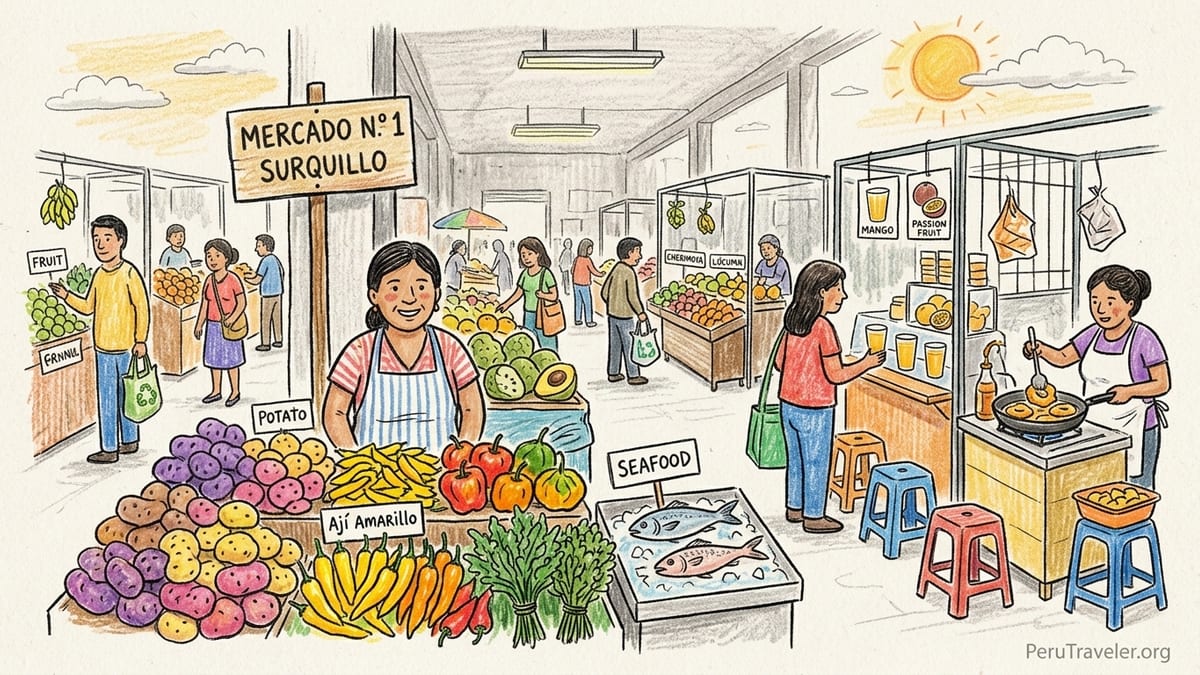
I based myself in Miraflores, but my first serious food stop was just over the district line in Surquillo, a neighborhood that has become a gastrotourism magnet in its own right. I arrived at Mercado N.º 1 de Surquillo shortly after 9 a.m., when the outer aisles were already busy with locals shopping for the day’s lunch. The building itself is not pretty in any curated way. It is concrete, fluorescent lights and rows of metal stalls, but the produce counters were an immediate introduction to Peru’s biodiversity. One stall had at least ten types of native potatoes piled in low mounds: tiny purple huayro, yellow peruanita and papas rosadas with pink skins and pale interiors. When I asked the vendor which one was best for causa, she pointed to the yellow potatoes and said, in Spanish, that they stayed creamy and bright after being mashed with lime and ají amarillo.
A few steps away, the seafood area smelled intensely of the Pacific. Counters were stacked with corvina, bonito and slabs of tuna on crushed ice, with buckets of small shellfish at their feet. One fishmonger was cleaning a large flounder while another was trimming tentacles from firm, pearly octopus. When I admitted I was planning to eat ceviche later that day, he explained that most ceviche stands in the market and the surrounding streets buy fish early in the morning and serve it until about mid afternoon, which is why Limeños rarely order ceviche at night. He also emphasized that the lime and ají in leche de tigre are not magic disinfectants, only part of what makes raw seafood safer when handled quickly and kept cold.
The market’s fruit section offered a different kind of discovery. Stalls were stacked with mangoes, papayas, granadillas, lúcuma and cherimoya. I stopped at a juice stand where plastic stools were already full of office workers. I ordered a blend of mango and maracuyá (passion fruit) in water, not milk, for 8 soles, partly out of caution about dairy and partly to taste the fruit more clearly. The vendor assured me they washed fruit with filtered water and used purified ice. The juice was bright and tart with a light sweetness and came in a tall glass that could easily have served as a small breakfast.
My last stop in the market was a stall selling ajíes and herbs. Plastic baskets overflowed with fresh ají amarillo, ají limo, rocoto and the tiny, fiery charapita. The woman running the stall let me smell huacatay, a Andean herb often called Peruvian black mint, which reminded me of basil crossed with tarragon. When I asked about spice levels, she laughed and said that in Lima most restaurant food is milder than the chilies suggest, because so many visitors underestimate Peruvian heat. The real fire, she said, was in homemade salsas, not on the plate.
Breakfast and Market Snacks: First Tastes and First Soles Spent
Although many food tours include breakfast, I wanted to see what a quick everyday market meal looked like before joining any organized group. Near the back of the Surquillo market, I found a tiny stand with two metal tables offering tamales and sandwiches. I ordered a tamal criollo with pork for 7 soles and a small coffee for 4 soles. The tamal arrived wrapped in banana leaf, with the masa tinted yellow from ají amarillo and studded with a strip of pork and one black olive. The texture was softer and more custardy than Mexican tamales, with a gentle heat that built slowly rather than burning outright.
For a midmorning snack, I followed a line of locals to a stall doing brisk business in picarones. These ring-shaped fritters made from squash and sweet potato were being fried in a wide pan of oil, then drenched in chancaca syrup made from unrefined sugar. A portion of four picarones cost 10 soles and came piled on a small plate, still sizzling. The outside was crisp with an almost lacy texture, while the interior stayed tender and slightly chewy, with a subtle squash flavor underneath the caramel sweetness of the syrup. It was more substantial than I expected, and I was glad I had shared the plate with a friend from my hostel, who I had met over breakfast and who joined me just in time for dessert.
Including the juice, tamal, coffee and shared picarones, I had spent 29 soles by late morning, or roughly the cost of a single cocktail in some Miraflores restaurants. It was a useful baseline for the rest of the weekend, and it also set a standard for how satisfying simple, everyday food could be in Lima without any reservations or headline-making chefs.
Hygiene-wise, both the juice stand and the picarones stall worked fast, kept food hot and equipment reasonably clean. Surfaces were not spotless, but ingredients were fresh and turnover was high. It was not risk-free for a foreign stomach, and anyone with a sensitive system or strict dietary restrictions would likely be more comfortable at a sit-down café, but nothing about the setup felt careless or abandoned.
Guided Food Tour Through Miraflores and Barranco
That afternoon I joined a guided food tour that focused on Miraflores and Barranco, booking a small group experience that promised a mix of traditional dishes and modern takes. The provider offered a four hour walking tour with ten distinct tastings across the two districts. The price at the time of my visit was 310 soles per person, including all food, nonalcoholic drinks and taxi transfer back to Miraflores at the end. Our group had eight participants, mostly international visitors, and one Peruvian couple who had joined out of curiosity about their own city.
We met at Parque Kennedy in Miraflores at 2 p.m., where our guide, a Limeña in her thirties, sketched out Lima’s food history before we ate anything. She explained how Spanish, African, Chinese and Japanese migrations layered onto indigenous Andean ingredients, giving rise to creole dishes such as lomo saltado, Chinese influenced chifa cooking and Japanese Peruvian Nikkei cuisine that blends raw fish with Peruvian flavors. She also emphasized that what the world now sees on lists of top restaurants grew out of everyday stews, street snacks and market food rather than the other way around.
The walking route took us along Av. Larco towards the Malecón, down residential backstreets to a small café for our first tasting and then to a neighborhood huarique, or hidden spot, for ceviche. After that we crossed by car to Barranco to explore its streets and finish with anticuchos and picarones in a small plaza. In total we walked roughly four kilometers, enough to earn the food but not so much that the tour felt like a forced march.
In Miraflores, our first tasting was causa limeña, served in a modern café that had grown out of a family catering business. The causa came as a neat cylinder of chilled yellow potato seasoned with lime juice and ají amarillo, layered with avocado and a filling of shredded chicken lightly dressed with mayonnaise. The portion was half the size of a typical restaurant starter, just enough for about four bites. The potato was silky and bright, with a citrus tang that cut through the richness of the filling. Our guide used this dish to explain how Peruvian cooks use potatoes not just as a side but often as the main structure of a dish, and how ají amarillo provides flavor more than searing heat.
Ceviche at a Recognized Cevichería vs Menú del Día
The ceviche stop was at a modest but well known cevichería in Miraflores, a place that locals recommend for its fish rather than its décor. Here the tour included a shared platter of ceviche clásico, along with a small glass of leche de tigre. A full portion of ceviche at this restaurant was priced at 42 soles, and the kitchen plated roughly that amount for every two people on the tour. The ceviche combined cubes of corvina with red onion, cilantro, ají limo and plenty of lime juice, served with cancha (toasted corn) and sweet potato. The fish tasted firm and very fresh, with the lime acidity strong but not harsh, and the ají adding a gentle heat that lingered at the back of the throat rather than burning the tongue.
Our guide described how Lima’s cold Humboldt Current supports a huge variety of fish and how ceviche has shifted over time from long, heavily marinated preparations to much shorter cures that leave the fish closer to raw. She also addressed the risk question directly. Even in reputable cevicherías, there is some risk in eating raw or nearly raw seafood, especially for travelers unused to local bacteria or with compromised immune systems. Her advice echoed what I had heard at the market: eat ceviche at busy places in the late morning or midday, avoid it late at night, and listen to your own body’s limits.
The next day, I decided to compare that cevichería experience with a simple menú del día. In a side street of Miraflores near Av. Benavides, I found a small restaurant with a handwritten sign advertising a lunch menu for 22 soles. The menu offered a choice of starter, main and a jug of refresco, a light fruit drink. I chose a quinoa soup followed by pollo guisado with rice. The soup came in a medium bowl filled with soft quinoa, diced vegetables and a light chicken broth, while the main plate held a leg of chicken in a tomato and ají panca sauce, plus a large mound of white rice. The flavors were homestyle, comforting and far less acidic and spicy than ceviche. Portions were generous enough that I left full, and the dining room was packed with office workers on their lunch break.
Comparing the two, the cevichería delivered intensity and precision, with each bite carefully balanced, while the menú del día offered everyday comfort at a fraction of the price. For a food focused visit, both felt essential. One showed why Lima’s seafood draws so much attention worldwide, and the other showed how a regular weekday lunch works for most locals.
Barranco Evenings: Anticuchos, Lomo Saltado and Picarones
On the tour’s Barranco section, we started with anticuchos, skewers of marinated beef heart grilled over charcoal. The restaurant we visited was small and family run, with a grill visible from the tables. Our tasting consisted of one skewer per person, roughly half the size of a full order. A regular portion on the menu was priced at 28 soles. The meat had a smoky char on the edges and a tender, almost liver like interior, marinated in vinegar, garlic, cumin and ají panca. The flavor was rich and slightly mineral, and the spice level stayed mild, with more heat available in the salsa on the table.
Later, at a casual Barranco restaurant set in a restored republican house, we sampled lomo saltado. Our shared plate was sized as a generous half portion; a full plate on the menu cost 38 soles at the time of my visit. The dish combined strips of beef tenderloin with red onion, tomato and yellow ají, all quickly stir fried in a wok with soy sauce and vinegar, then served with rice and fries. This was where the Chinese influence on Limeño cuisine felt most obvious. The sauce had a savory, almost smoky depth from the wok, and the fries soaked up the juices without turning soggy. The heat was gentle, letting the acidity and soy speak louder than the chili.
For dessert the tour circled back to picarones at a stand off one of Barranco’s small plazas. Compared to the market stall, these picarones were slightly smaller and crispier, with the same chancaca syrup but a touch more orange zest in the mix. A portion of four cost 12 soles, and the tour included two per person. Eating them standing up, with music floating over from a nearby bar and the Barranco streets slowly filling for the evening, felt like a good reminder that Lima’s sweets are often designed for sharing on the street rather than sitting in a café.
Barranco’s charm at night also made it easy to keep eating independently once the tour ended. After we said goodbye to the guide, a few of us walked to a nearby bar for pisco sours at around 32 soles each, and shared a plate of yucca fries with huancaína sauce for 24 soles. Though the bar was squarely aimed at a mixed local and visitor crowd, portions were fair and service attentive. It was in this setting that the spread between daily menus, neighborhood spots and more polished venues became clearest.
Tasting Nikkei: Using Maido as the High End Benchmark
Lima’s international reputation now leans heavily on its high end restaurants, particularly Nikkei dining that blends Japanese techniques with Peruvian ingredients. During my weekend, I did not secure a full tasting menu at Maido, which has been recognized internationally and whose multi course Nikkei experience currently runs into the high hundreds of soles per person. Instead, I used Maido as a benchmark for what counts as premium and chose a more flexible Nikkei dinner elsewhere in Miraflores that accepted walk ins for the bar.
At this mid range Nikkei restaurant, I ordered three dishes and shared a dessert, spending a total of 185 soles before tip. The first dish was a tiradito of white fish in a creamy ají amarillo sauce for 58 soles. Thin slices of fish arrived in a shallow pool of bright yellow sauce, garnished with cancha and slivers of red onion. The texture was closer to sashimi than ceviche, and the sauce carried moderate heat wrapped in a velvety emulsion. The second dish was a plate of Nikkei style nigiri, six pieces for 72 soles, including salmon with ponzu, tuna with rocoto paste and a seared white fish drizzled with a soy reduction. Each piece was small but precisely seasoned, and the rice held together without being dense.
The third savory dish was a lomo saltado inspired stir fry served over rice instead of fries, at 55 soles. Here the beef was cut smaller, and the seasoning leaned more towards soy and ginger than vinegar, with slices of ají adding a moderate heat. Dessert, shared between two people, was a lucuma and chocolate parfait for 28 soles, with layers of lucuma flavored cream and dark chocolate. Portions at this restaurant were elegant rather than large, and a full dinner for one person would reasonably involve two savory dishes and a dessert, plus a drink. A pisco based cocktail cost around 38 soles, similar to Barranco bar prices.
Talking with the bartender about Lima’s Nikkei scene, he mentioned that while Maido sets a reference point at the very top in terms of price and recognition, many locals experience Nikkei cooking through more casual spots like this one or neighborhood sushi counters. For visitors, it means that tasting Japanese Peruvian combinations does not require a three hour tasting menu or a months ahead reservation, even if those options exist for those who want them.
It is worth noting that raw fish appeared in several of these dishes, and the same cautions applied as with ceviche. The restaurant made a point of explaining that they used treated water in the kitchen and served fish delivered daily, but they openly acknowledged that no place serving raw seafood is completely risk free. For travelers with shellfish allergies or concerns about cross contamination, a clear conversation with the server and choosing cooked dishes such as tempura or stir fries would be safer.
Costs and Value: A Food Focused Day and Weekend in Lima
By the end of two days, my notebook showed a clear pattern of spending. On my first full day, I spent 29 soles at the Surquillo market in the morning, 310 soles on the afternoon and evening guided food tour, and about 56 soles on extra drinks and a shared snack afterwards in Barranco. That brought the day’s total to 395 soles, roughly split between one structured experience and a string of simple, casual bites. The second day was more independent: 22 soles for a menú del día lunch in Miraflores, 185 soles for the Nikkei dinner, and another 18 soles for daytime coffees and a small bakery snack, for a total of 225 soles.
Looked at across the weekend, I spent 620 soles on food related activities and meals, with 310 soles of that as a tour fee and 310 soles as direct spending on meals, snacks and drinks. The tour represented the single largest line item but also bundled several dishes, commentary and transportation into one price. Independent meals ranged from 22 soles for a filling lunch to almost 200 soles for a composed Nikkei dinner. Using a high end tasting menu as a reference point, where a single meal can cost several times my entire weekend’s food budget, helped me appreciate just how much Lima offers below the marquee level.
For travelers deciding how to allocate their own budgets, a balanced approach works well. One structured food tour or cooking class can provide context that would take days to gather alone and can help you taste iconic dishes such as ceviche, causa, anticuchos and picarones with explanations. After that, alternating between modest menús del día, mid range neighborhood restaurants and perhaps one splurge lets you see the full gradient of Lima’s food culture without relying solely on its most expensive addresses.
It is also important to factor in non monetary costs such as stomach comfort and dietary needs. I avoided raw leafy salads unless I was confident filtered water was used, stuck to busy places for raw seafood dishes and spaced out heavy meals with lighter market snacks and fruit juices. Travelers with strict gluten free diets, severe shellfish allergies or other conditions will need to plan more carefully and consult with guides and servers, but they can still participate in much of Lima’s food scene by focusing on grilled meats, stews and potatoes and being candid about their constraints.
The Takeaway
After two days of focused eating, what surprised me most about Lima was not the finesse of its high end plates but the coherence between street food, market snacks and restaurant dishes. The causa at a contemporary café tasted like a refined version of what market vendors described. The anticuchos in Barranco echoed spices I had already smelled in Surquillo. Even the Nikkei plates, with their sashimi style fish and soy based glazes, felt grounded in the ceviche counters and stir fry woks that define so many everyday lunches.
If I had to choose dishes to order again, ceviche clásico at a busy, respected cevichería would top the list, followed closely by anticuchos hot off a charcoal grill and picarones shared in a plaza at night. For comfort and value, the simple menú del día in Miraflores is something I would happily repeat, especially on days when I wanted a break from raw seafood and complex flavors. The Nikkei dinner was clearly the most expensive independent meal I had, but it also delivered a distinctive angle on Peru’s culinary identity, and for me it justified its cost once during the trip.
The most memorable local stop, however, was still Surquillo market in the morning. Seeing native potatoes and chilies in their raw form, talking with vendors about which variety suited which dish and watching locals shop for lunch grounded everything that came afterward. It reminded me that the tasting menus making international headlines rely on the same produce and fish that line those market aisles.
As for whether a premium tasting menu is necessary to appreciate Lima’s food scene, my answer after this weekend is no, but it can be a powerful extra. You can understand and enjoy a great deal simply by spending time in markets, joining a thoughtful food tour and eating at regular restaurants where locals sit at the next table. A high end tasting menu, if you choose and can afford it, then becomes an additional lens rather than the main story. Lima’s food culture is big enough to hold both a 20 sol lunch menu and a once in a lifetime Nikkei counter, and the city makes the most sense when you taste across that spectrum.
FAQ
Q1. Is it safe to eat ceviche and other raw seafood in Lima?
It is never completely risk free to eat raw or nearly raw seafood, especially for travelers, but many busy cevicherías manage risk carefully through daily deliveries, cold storage and high turnover. Eating ceviche at lunchtime in popular spots and avoiding little used stands late at night can reduce, but not eliminate, the chance of stomach issues.
Q2. How much should I budget per day for food in Lima on a food focused trip?
A traveler who combines one structured food tour or special dinner with everyday meals might spend between 200 and 400 soles per day on food, depending on choices. Simple market breakfasts and menús del día keep costs low, while Nikkei dinners, cocktail bars and guided experiences quickly increase the total.
Q3. Do I need to book a famous tasting menu restaurant to enjoy Lima’s food scene?
No. Markets, neighborhood restaurants, bakeries and mid range cevicherías already offer a rich picture of Lima’s food culture. A tasting menu at a high profile restaurant can be a memorable extra if it fits your budget, but it is not essential to understanding what people in Lima actually eat.
Q4. What dishes should first time visitors prioritize trying?
Many visitors focus on ceviche, causa, anticuchos, lomo saltado, ají de gallina, picarones and at least one Nikkei or chifa dish. These plates together show how Peruvian ingredients combine with Spanish, African, Chinese and Japanese influences in both everyday and more polished cooking.
Q5. Are Lima’s food tours worth the price?
For travelers with limited time or little Spanish, a good food tour can be worth the cost because it combines several tastings with explanations of history, ingredients and customs. It also reduces guesswork and can help cautious eaters navigate raw seafood, spice levels and hygiene more comfortably.
Q6. How can I eat like a local without overspending?
Look for menús del día at lunchtime, which usually offer a starter, main and drink for a modest fixed price. Combine these with occasional market snacks, bakery visits and a few meals at neighborhood restaurants recommended by locals rather than relying only on places that appear in international guides.
Q7. What about drinking water and ice in Lima restaurants and markets?
In higher end and many mid range restaurants, water and ice are usually filtered or bottled, but you should still ask if you are unsure. At markets and street stalls, it is safer to choose cooked foods, hot drinks and juices made to order where you can see whether they use bottled water or purified ice.
Q8. Is Lima manageable for travelers with food allergies or dietary restrictions?
It can be, but it requires planning and clear communication. Severe shellfish or fish allergies are challenging in a city where seafood is central, and gluten free travelers need to ask carefully about sauces and thickeners. Guided tours and restaurants used to international visitors are often better prepared to handle specific needs.
Q9. When is the best time of day to explore markets like Surquillo?
Morning is ideal, typically between 8 a.m. and midday, when produce and fish are freshest and stalls are fully stocked. By early afternoon, some items may sell out and seafood counters begin to wind down, especially those that supply ceviche stands that focus on lunchtime service.
Q10. How many days should I spend in Lima just for food?
Two full days allow time for a market visit, one guided tasting experience and several independent meals across different districts. Food focused travelers who want to include a high end tasting menu, a cooking class and more neighborhood exploration could easily fill three or four days without running out of interesting places to eat.