

From Cusco, Rainbow Mountain is sold as the day trip you simply cannot miss. Brochures in every travel agency window show a lone hiker in a bright jacket, standing in front of a perfectly striped mountain under deep blue sky. After doing the classic Vinicunca tour and a separate visit to Palccoyo, I can say the reality is far more complicated, and whether it is “worth it” depends heavily on your expectations, fitness and tolerance for thin air, early alarms and crowds.
What the Photos Made Me Expect
Before I booked, Vinicunca was already in my head from social media. The algorithm kept serving me near-identical shots: a rainbow-striped ridge painted in saturated reds, yellows and turquoise, with a single person standing on the opposite hill. The sky was always cloudless, the air looked crisp and dry, and the slopes around the mountain seemed strangely empty of people, horses or mud. It felt like a high-altitude version of a studio shoot where everything had been arranged for the perfect frame.
Walking around Cusco’s historic center in October 2026, those same images shouted from agency posters. Many boards quoted similar promises in English and Spanish: “Easy hike,” “All inclusive,” “See the real-life Photoshop mountain.” Several agencies advertised shared tours from roughly 70 to 200 soles per person, breakfast and lunch included, with departures “around 4:00 a.m.” from central hotels. The sales pitch focused on the colors and price, not the fact that Vinicunca’s viewpoint sits above 5,000 meters, higher than Everest Base Camp.
I expected a challenging but manageable walk on a clear day, with colors that matched the photos if the light cooperated. I also thought the timing would be tight but reasonable: early pickup, a couple of hours’ drive, breakfast, then a steady climb with ample time on top. Crucially, I imagined space at the viewpoint to soak in the scene and set up my camera without feeling like I was queueing at a theme park.
For Palccoyo, the alternative “rainbow” area, the marketing was subtler. A few agencies in Cusco advertised it as an easier, less crowded option, with a “45 to 60 minute gentle walk” reaching viewpoints at around 4,800 to 4,900 meters. Photos showed multiple colored ridges and fewer people. I assumed Palccoyo would mean lower altitude stress and a more relaxed day while still delivering the same kind of striped landscapes, just without the viral fame of Vinicunca.
The Real Journey: Pickups, Road Time and Hidden Costs
My Vinicunca experience started in the dark at 3:30 a.m., when the van pulled up outside my guesthouse in San Blas. The tour, booked in person the previous afternoon, cost the equivalent of about 35 to 40 US dollars at the October 2026 exchange rate. That price included pickup, a local-style breakfast and lunch, an English-speaking guide and basic oxygen in the vehicle. It did not include the community entrance fee to Rainbow Mountain, which the guide collected in cash near the trailhead and which came to a modest extra sum in soles per person.
The drive from Cusco to the breakfast stop near Cusipata took roughly two hours. The roads were paved but winding, and I was glad I had brought a warm layer; the van was chilly and the outside temperature close to freezing as we climbed through the Andean countryside. Breakfast was served in a large roadside dining hall used by several companies at once: simple buffet eggs, bread, jam and coca tea. It was functional rather than charming, but it served its purpose and gave my body time to adjust a little more after three days of acclimatization in Cusco.
From Cusipata to the Vinicunca trailhead took roughly another 90 minutes on a combination of paved and dirt roads. This part of the journey revealed how big the Rainbow Mountain business has become. Long lines of tourist vans and minibuses snaked toward the parking area, sharing the road with local herders and their alpacas. At the trailhead, rudimentary toilets were available for a small cash fee. They were absolutely worth using before starting the hike, although standards were basic and you needed to bring your own tissue and hand sanitizer.
For my Palccoyo trip, booked with a different agency later in the week, the structure was similar: pre-dawn pickup between 4:00 and 4:30 a.m., a breakfast stop around Cusipata, then continuing toward Checacupe and up into the Palccoyo area. The overall road time was slightly shorter than Vinicunca by maybe 30 to 45 minutes, but it was still a solid three to four hours each way including stops. The tour price was higher than the cheapest Vinicunca offers displayed in Cusco and fell more in the 50 to 70 US dollar range for a small group, which the agency justified by calling Palccoyo a “more exclusive” route with fewer buses and more guide attention.
The Final Walk: Distances, Gradient and Thin Air
At Vinicunca, our guide gathered the group at the parking area and explained the numbers in straightforward terms. The starting point sat at around 4,500 meters above sea level. The walk to the main viewpoint would cover roughly 3 kilometers one way, with about 400 to 500 meters of elevation gain, topping out close to 5,000 to 5,100 meters at the ridge opposite the colored mountain. He emphasized that the difficulty was not the distance, which would be considered an easy half-day hike at low altitude, but the combination of height, wind and cold.
Walking out of the trailhead, the first ten minutes felt steeper than the map suggested. The path then leveled into a long, gradual valley, with the final 20 to 30 minutes steepening again as we climbed the switchbacks to the viewpoint. I had already spent five nights between Cusco and the Sacred Valley, done a couple of shorter walks above 3,800 meters and drank plenty of water that morning. Even so, the last stretch slowed me to a measured, almost meditative pace. My heart rate spiked with very little exertion, and conversation became limited to a few words between deep breaths.
From the trailhead to the viewpoint took me just under 90 minutes at a steady but cautious pace, including a few pauses to drink water and take photos of grazing alpacas and the Ausangate peaks in the distance. Fitter members of the group who were also well acclimatized made it in around an hour. Others took closer to two hours, with the guide offering encouragement and checking in regularly on how people felt. Horses were available for much of the route, led by local handlers, and some travelers in my group chose to ride. The horses stopped before the steepest final section, which everyone had to hike on foot.
Palccoyo felt physically different from the beginning. The starting elevation was already high, around 4,700 meters, but the distance and gradient were milder. From the vehicle drop-off to the main viewpoints the path followed a broad ridge, climbing gently rather than lunging upward. It took me about 40 to 50 minutes to reach the primary viewpoint with three distinct colored ridges in sight. There were optional side detours to a rock forest and further lookout points. Although the air was just as thin and conversation still came in short bursts, the absence of a single very steep push made the day feel less intense on the lungs and legs.
How the Altitude Actually Felt
I arrived at Vinicunca knowing the numbers on paper but still underestimated how 5,000 meters would feel after a short night and a bumpy ride. At the valley bottom, walking slowly on the gentler sections, I felt a manageable breathlessness and an elevated pulse. As the trail steepened near the top, each step required conscious pacing: inhale, step, exhale, step, repeat. My chest felt tight, but not in a medical sense, more like my usual hiking capacity had been cut in half. I did not develop the headache, nausea or dizziness associated with altitude illness, but several people in our larger crowd did report pounding headaches and had to rest longer or turn back with the assistant guide.
The thin air influenced my behavior more than I expected. I became careful about squatting for photos, because standing back up too quickly left me momentarily lightheaded. I drank warm coca tea at breakfast and kept sipping water through the walk. My appetite was lower than usual at lunch, a common high-altitude effect, and I felt unusually tired on the drive back to Cusco. These sensations were uncomfortable but within the realm of normal responses to altitude; if I had felt chest pain, confusion, or persistent shortness of breath even at rest, I would have alerted the guide immediately and descended.
At Palccoyo, despite the slightly lower maximum elevation than Vinicunca, I still felt the strain. Starting the walk already above 4,700 meters meant there was no long warm-up at “only” 4,000 meters. The difference was that there was more room to slow down and less pressure to push for a single summit. Our small-group guide reiterated that we could turn around at any point and that enjoying the scenery at our own pace was more important than reaching every viewpoint. I still needed frequent short pauses to catch my breath, but I never felt compelled to lean heavily on trekking poles or count the steps to the next bend in the same way as the steep final climb at Vinicunca.
In both places, the key lesson was that acclimatization and self-awareness matter more than bravado. By the time I visited Rainbow Mountain, I had already slept several nights in Cusco and in the Sacred Valley and done shorter high-altitude walks. Without that preparation, my day on Vinicunca would have been far less enjoyable, and possibly cut short. No price or photo is worth ignoring how your body responds to high places.
What I Actually Saw: Colors, Clouds, Mud and Crowds
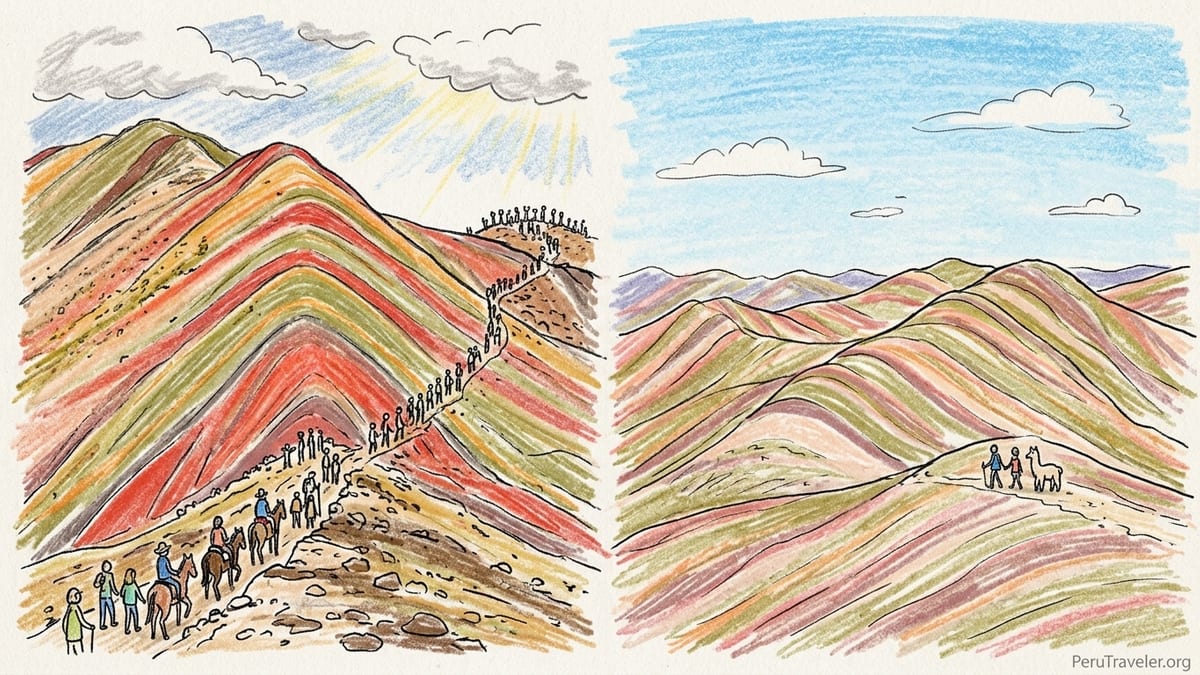
Arriving at the Vinicunca viewpoint, the first feeling was not awe at the colors but surprise at the number of people. Hundreds of hikers, horses and guides converged on a narrow ridge. A disorganized queue formed at the classic photo spot where you stand with the striped mountain fanning out behind you. Guides took turns acting as photographers. It was good-natured but hectic. I had maybe 30 to 60 seconds in the “iconic” position before needing to move aside for the next person.
The mountain itself looked different from the hyper-saturated posters in Cusco. The stripes were clearly visible, especially the rusty red and olive tones, but the turquoise and yellow bands were subtler. Thin cloud drifted across the sun, softening contrasts. Patches of snow lingered on the opposite ridge and meltwater turned sections of the path into slick mud. The wind was cutting, and gloves were essential for handling a camera without numbing fingers. It was beautiful, but in a raw, high-mountain way that did not quite align with the flawless marketing shots.
I asked our guide about this discrepancy, and he smiled. On some mornings in the dry season, he said, the air can be crystal clear and the sun hits Vinicunca at just the right angle to make the colors pop. Many tour companies use those exceptional days for their promotional images, boosting the saturation further during editing. For my visit in the shoulder season, the view felt more muted and natural, like a weathered rock painting rather than a neon rainbow painted yesterday.
Palccoyo’s scenery felt more expansive but less instantly recognizable. Instead of one iconic mountain, the area offers several parallel ridges with mineral stripes, plus a forest of upright stone formations in the distance. The colors were again more delicate than the posters suggested, though certain slopes glowed with soft reds and creams when the sun broke through the clouds. Crucially, there were far fewer people. On my visit, I shared the main viewpoint with perhaps two or three other small groups, and there was no queue for photos. I had ample time to set up shots, change lenses and wait for the light to cooperate without feeling rushed.
What Disappointed Me About Vinicunca
The main disappointment at Vinicunca was not the mountain itself but the sense of being funneled through a very tight schedule. Between the long drive, breakfast, the hike and the need to regroup by a set time so the driver could return to Cusco before evening, our actual time at the main viewpoint felt surprisingly short. From arrival at the top to beginning the descent, I had roughly 40 to 50 minutes, during which I tried to balance catching my breath, taking photos and simply absorbing the scene.
The crowding compounded that rushed feeling. There were moments when the ridge felt dangerously congested, particularly near the best-known photo angles where people backed up toward the drop while posing. Guides tried to maintain order, but with multiple large groups arriving within the same hour, the space simply filled faster than it could clear. Finding a quieter vantage point required walking a little further along the ridge away from the knots of people clustered around guide flags.
The other disappointment came from noticing environmental pressure on the landscape. Heavy foot traffic had widened parts of the trail into braided paths, and some sections turned to deep mud in the wetter months. While many operators do provide basic information about not littering and respecting local community rules, the sheer number of boots and hooves passing through every day takes a toll. Standing there, it was impossible not to think about the balance between sharing a remarkable place with the world and preserving it for future visitors and local communities.
Very cheap tours, those advertised in Cusco for prices at the absolute bottom of the market, raised additional questions. Travelers I met on other days described bare-bones experiences: minimal guide communication in English, shorter time on the mountain, cramped vans and little attention to altitude comfort beyond the basics. My own mid-range group trip felt safe and reasonably well run, but it was clear how shaving a few dollars off the price could easily mean cutting into time at the destination or support on the trail, neither of which you want to compromise when you are this high above sea level.
Was Palccoyo Better, or Just Different?
Palccoyo did not feel like a consolation prize. It felt like a different kind of high-altitude day, one that prioritizes space and variety over a single postcard image. The walk was shorter and gentler than Vinicunca, and the viewpoints offered grand panoramas of several colored ridges at once. I could hear the wind and the occasional bleat of alpacas more clearly than human voices, something that rarely happened at Vinicunca’s main ridge.
In terms of difficulty, Palccoyo is generally easier underfoot but should never be mistaken for a low-altitude option. The viewpoints still sit around 4,800 to 4,900 meters, which is well above anything most travelers experience in their daily lives. The shorter walk simply means you spend less time exerting yourself, not that your lungs are suddenly spared the realities of thin air. Families and older travelers in my group appreciated the gentle gradient and the flexibility to stop at a lower viewpoint if they preferred, but everyone still moved slowly and breathed deeply as they climbed.
Cost-wise, Palccoyo tours in October 2026 often sat slightly higher than the rock-bottom Vinicunca offers, especially if you chose a smaller group or more specialized operator. That premium translated into a looser schedule and more time at the viewpoints. Our guide encouraged us to linger, to explore side paths and to take a break just to sit and look, something that felt almost luxurious after the tight timing at Vinicunca. There were fewer souvenir stalls and less of a marketplace atmosphere at the trailhead, which also contributed to a calmer mood.
Was it better? For me, as someone who values room for photography and reflection, yes. Palccoyo offered a more balanced compromise between effort, altitude and reward. But I also understood why many visitors still choose Vinicunca: its outline is instantly recognizable, and there is a certain thrill in standing at a place you have seen so many times on screens. The right choice depends on whether you prioritize that iconic shot or a quieter, more spacious day in similar terrain.
What I Would Choose Again
If I were planning another trip to Cusco, knowing what I know now, I would rank the options differently than the glossy flyers suggest. With several acclimatization days available and a strong desire to see the classic Rainbow Mountain with my own eyes, I would still consider Vinicunca, but I would be far more selective about how I visited. I would look for a tour that either leaves earlier with a smaller group or one that aims for a later arrival to avoid the mid-morning crush, even if that meant paying more than the cheapest offers on the street.
For most travelers who want rainbow-striped landscapes without such an intense climb at extreme altitude, I would lean toward Palccoyo. It is still a long day, and it still demands respect for altitude, but the overall pacing and crowd levels made it much more enjoyable for me. The fact that the walk is shorter does not magically transform it into a family-friendly stroll, yet it does create a more forgiving environment for people who are fit but not avid high-altitude hikers.
Between early, large-group tours and later, smaller or private trips, the trade-off is straightforward: earlier and cheaper typically means more people but a lower price per person, while later and smaller means a quieter experience at a higher cost. After feeling the crunch at Vinicunca, I would personally accept the extra expense of a small-group or thoughtfully timed tour, especially if photography or a sense of space matters to you.
Most importantly, I would not treat Rainbow Mountain as an automatic “must” for every Cusco itinerary. If I were traveling with people who struggled at altitude, or if my time in the region was short, I might instead choose a lower-altitude Sacred Valley excursion that still offers dramatic scenery and cultural depth without pushing close to 5,000 meters. Rainbow Mountain is remarkable, but it is not the only way to experience the Andes.
The Takeaway
Rainbow Mountain is worth it for some travelers and a poor fit for others. The day to Vinicunca is long, starting before dawn in Cusco, rolling through a series of stops and culminating in a taxing climb to around 5,000 meters on a crowded ridge. The colors are real but softer than the edited images suggest unless you are lucky with weather and light. The crowds, queues for photos and visible wear on the landscape can undercut the sense of wild discovery that the marketing implies.
Palccoyo offers a compelling alternative, with multiple colored ridges, fewer people and a shorter, gentler walk that still unfolds at serious altitude. It does not remove the need for acclimatization or self-awareness, but it does give you more breathing room in every sense. Paying a little more for a smaller group or better timing can significantly improve your experience at either site.
For photographers, Vinicunca delivers the recognizable shot, but only if you are prepared for limited time at the main viewpoint and the possibility of flat light, cloud or snow. Palccoyo rewards those who enjoy composing wider landscapes and working with subtler colors. Experienced hikers who relish a physical challenge at high altitude may appreciate Vinicunca’s steeper push, while those who prefer a more relaxed outing will likely feel more at home on Palccoyo’s rolling ridges.
Families and travelers sensitive to altitude, or those visiting the Andes for the first time, might be better served by dedicating a full day to the Sacred Valley instead. Places like Chinchero, Moray, Maras and Pisac sit lower than 4,000 meters, offer rich cultural encounters and dramatic views, and allow you to immerse yourself in Andean landscapes without testing your limits at 5,000 meters. In the end, the best trip is the one that matches your body, your interests and your idea of a memorable day in the mountains.
FAQ
Q1. Is Rainbow Mountain Peru really as colorful as the photos?
The colors are real but usually softer and more muted than the heavily edited images used in marketing. Light, cloud and recent weather all affect how vivid the stripes appear on the day you visit.
Q2. How hard is the hike to Vinicunca if I am already acclimatized?
For someone who has spent several days in Cusco and done shorter high-altitude walks, the distance feels moderate, but the final climb at around 5,000 meters can still feel very strenuous. Expect to walk slowly, pause often and take about one to one and a half hours each way.
Q3. What time do tours from Cusco to Rainbow Mountain usually start?
Most shared group tours begin pickups between about 3:00 and 4:30 a.m. from central Cusco. This allows time for the three to four hour drive, a breakfast stop, and the hike while still returning to the city by late afternoon or early evening.
Q4. How much does a Vinicunca day tour cost compared with Palccoyo?
As of late 2026, basic group tours to Vinicunca sold in Cusco’s center often range from budget prices in soles that convert to a few dozen US dollars up to mid-range options that cost roughly 35 to 65 US dollars, depending on inclusions. Palccoyo tours tend to sit slightly higher, especially for small-group or more specialized operators, reflecting smaller groups and less crowded routes.
Q5. Is Palccoyo a low-altitude alternative to Rainbow Mountain?
No. Palccoyo’s viewpoints still sit close to 4,800 to 4,900 meters, only somewhat lower than Vinicunca. The walk is shorter and less steep, which many people find easier, but you are still operating at serious altitude and need proper acclimatization.
Q6. Can I take children or older relatives to Rainbow Mountain?
It is possible, but you need to consider their previous experience at altitude, overall fitness and comfort with cold, wind and early starts. Palccoyo is generally more suitable for mixed-ability groups because the walk is shorter and the path is gentler, but it is still very high and requires caution.
Q7. Are the very cheap Rainbow Mountain tours advertised in Cusco a good deal?
They may save money, but travelers often report tighter schedules, more crowded vehicles, limited English guidance and less flexibility at the mountain. When you are going above 4,500 meters, paying a bit more for better logistics, clear communication and adequate time on the trail is usually a wiser investment.
Q8. How long do you actually spend at the viewpoint on a typical Vinicunca tour?
On many shared tours, groups spend about 40 minutes to an hour at the main viewpoint, depending on weather, group speed and the company’s schedule. This window must cover catching your breath, taking photos and enjoying the view, so the time can feel shorter than it sounds.
Q9. Which is better for photographers, Vinicunca or Palccoyo?
Vinicunca offers the iconic single-mountain shot recognizable from social media, but it is busy and you may have only brief moments at the prime angle. Palccoyo is quieter and lends itself to wide, layered landscapes, making it better for photographers who enjoy working with composition and changing light rather than chasing a single famous frame.
Q10. Should I choose Rainbow Mountain or a lower-altitude Sacred Valley tour?
If you are fit, acclimatized, and eager for a high-altitude challenge with dramatic geology, Rainbow Mountain can be very rewarding. If you have limited time in Cusco, are nervous about altitude or are traveling with people who prefer gentler conditions, a full-day Sacred Valley tour often provides a richer and more comfortable introduction to the region’s landscapes and culture.