


Many travelers arrive in Peru knowing they want “an Amazon experience” but not realizing how different the country’s rainforest regions are. Puerto Maldonado and Tambopata, Iquitos and Pacaya Samiria, and the remote Manu Biosphere each offer very different combinations of wildlife, comfort, transfer times and cost. Choosing the right area and lodge is the single most important decision you will make about your Amazon trip.
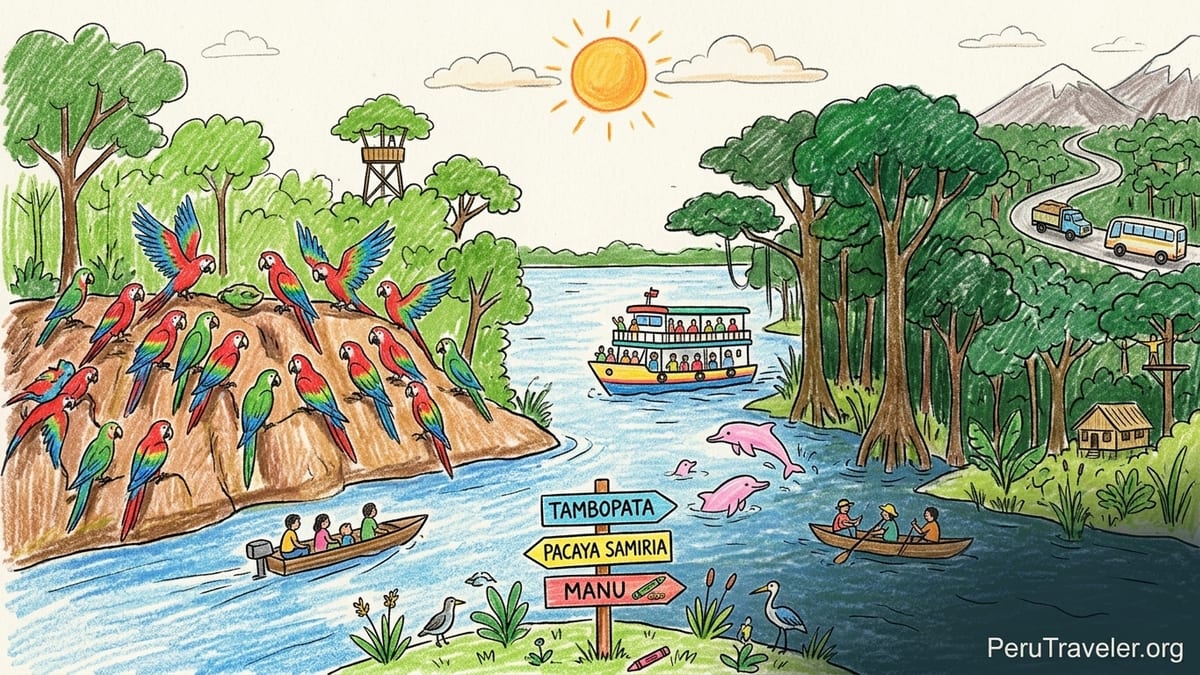
How Peru’s Three Main Amazon Regions Compare
Peru has three major gateways to the Amazon: Puerto Maldonado in the southern Tambopata region, Iquitos in the northern lowlands, and the Manu road and river corridor between Cusco and the Madre de Dios. All three are true rainforest, but they differ in accessibility, style of trip and level of wilderness. That is why the first decision should not be which lodge looks nicest, but which region matches your time, budget and expectations.
Puerto Maldonado works best for travelers who want relatively easy access and comfortable lodge packages. The small city has an airport with daily flights from Lima and Cusco, so it combines naturally with a Machu Picchu itinerary. From town, lodges on the Tambopata and Madre de Dios rivers can be reached in one to four hours by motorized canoe. Many of the best known properties here focus on clay-lick excursions for macaws and parrots, canopy towers, oxbow lakes and family-friendly activities.
Iquitos offers a very different experience. There are no roads connecting Iquitos to the rest of Peru, so you must fly in from Lima or another Amazon city. Once there, you can stay in a lodge on the Amazon or its tributaries a few hours away, or board a river cruise that travels deep into the Pacaya Samiria National Reserve. This region is all about being on the water: flooded forest, river dolphins, canoe excursions and village visits. Transfer times are generally longer than Puerto Maldonado, but you see the Amazon River itself and can penetrate some of the wildest rainforest in Peru.
Manu is the most remote choice and suits travelers who prioritize biodiversity over comfort or convenience. Reaching the lodges and research stations inside the Manu Biosphere Reserve and surrounding protected areas usually involves a full day or more of road travel from Cusco followed by a long boat ride. Once there, you are in extremely rich rainforest where birdwatching, primate viewing and specialist nature guiding are the focus. Electricity is often limited, and you will feel far from medical care and cities. Manu works best as a dedicated expedition rather than a short add-on.
Puerto Maldonado & Tambopata: Accessible Jungles and Clay Licks
Puerto Maldonado is the most straightforward Amazon add-on after Machu Picchu. Flights from Lima to Puerto Maldonado frequently take around two hours non-stop, with recent sample round-trip fares starting near 140 to 200 US dollars depending on season and airline. Flights from Cusco are even shorter, often around 45 minutes to an hour, operated by major domestic carriers. This means you can finish a Sacred Valley or Inca Trail trip and be in lowland rainforest by lunchtime the next day without long overland journeys.
From Puerto Maldonado, well established operators such as Rainforest Expeditions run lodges including Posada Amazonas, Refugio Amazonas and Tambopata Research Center on the Tambopata River. Posada Amazonas sits roughly an hour or so upstream from the city by boat, Refugio Amazonas is deeper, and Tambopata Research Center can require a boat journey of several hours into the heart of the Tambopata National Reserve. These distances matter. The closer lodges are more accessible if you are worried about long boat rides or have young children, but the deeper you go, the more continuous protected forest surrounds the lodge.
Clay licks are a highlight of the Tambopata region. Several programs from Refugio Amazonas and especially Tambopata Research Center include dawn excursions to large clay banks where hundreds of macaws and parrots may gather to eat mineral-rich clay. It is important to understand that this is a natural phenomenon, not a feeding show. Activity depends on weather and the birds’ behavior, so no lodge can guarantee a spectacle on a given day. However, staying three or four nights increases your chances. Many Tambopata itineraries also include visits to canopy towers for treetop birding, oxbow lakes for chances of seeing giant river otters and caimans, and guided night walks for frogs, insects and nocturnal mammals.
Most Puerto Maldonado lodges operate on three, four or five-day packages that bundle transfers, meals, guiding and activities. A three-day program at a midrange lodge near the city might start in the approximate range of 450 to 700 US dollars per person in double occupancy. Deeper lodges with macaw clay-lick access and higher service levels can cost more, often from the mid hundreds of dollars per person per night upwards in high season, especially when park fees and private guides are included. These example figures are intended as ballparks; you should confirm exact current rates with the operator before booking.
Iquitos & Pacaya Samiria: River Journeys and Northern Lodges
Iquitos lies in northeast Peru, accessible only by air or river. Several daily flights connect Lima and Iquitos, usually taking about two hours. When you fly in, you step out into a hot, humid river city and immediately sense that this is a different Amazon from the Tambopata region. The main attractions here are life on the Amazon River and access to the Pacaya Samiria National Reserve, a vast protected area of flooded forest between the Marañón and Ucayali rivers known for pink river dolphins, abundant birdlife and mirror-like blackwater lagoons.
Lodges around Iquitos vary widely in comfort and location. Some are only an hour or two by boat from the city along the Amazon or the Momon and Nanay tributaries. Others, such as Pacaya Samiria Amazon Lodge, are several hours away on the Marañón River in the buffer zone of the reserve, roughly 120 kilometers from Iquitos. According to its current program descriptions, Pacaya Samiria Amazon Lodge offers all-inclusive stays from two to six days that bundle Iquitos transfers, full board, guided excursions and reserve access, with a published starting price in the low 600 US dollars per person range for three days and rising to roughly the mid-1400s for six days.
The deeper you go from Iquitos, the more the experience shifts from lodge-based relaxation to expedition travel. Grand Amazon-style lodges and small-ship cruises that venture into Pacaya Samiria often require three or more hours of combined road and boat travel each way. In return, they provide better opportunities to look for river dolphins, primate troops, sloths and large flocks of waterbirds far from the constant noise and boat traffic around Iquitos itself. Many programs include canoe excursions at dawn and dusk, night boat rides to look for caimans, short walks on levees or forest trails, and visits to riverine communities that fish, farm and harvest forest products.
Prices in the Iquitos region cover a wide spectrum. Locally arranged budget trips to simple jungle camps may cost the equivalent of roughly 70 to 150 US dollars per person per day, all inclusive, especially if you join a small group. Established lodges with private rooms, screened windows and hot showers generally charge more, from several hundred dollars per person for a three-day, two-night package. River cruises, particularly luxury vessels with spacious cabins and air conditioning, can reach into the thousands of dollars per person for four or five days. Recent brochures for high-end cruises on the Amazon and Pacaya Samiria show starting prices of around 3,000 to 4,000 US dollars per person for four-day programs in double cabins, reflecting the higher level of comfort and staffing.
Manu: Deep Biodiversity and Specialist Nature Guiding
Manu Biosphere Reserve and the surrounding cloudforest and lowland rainforest form one of the most biodiverse areas on Earth. Unlike Puerto Maldonado or Iquitos, there are no short flights that drop you into the lowlands next to the best lodges. Instead, most trips start in Cusco with a full day of driving across the Andes into cloudforest, followed by a boat transfer along the Madre de Dios or Manu rivers. Reaching remote lodges inside or near the reserve can take two days of travel each way. In return, you reach areas where wildlife densities are high and human disturbance is limited.
Manu itineraries tend to be longer, frequently seven to nine days including travel, and they attract birdwatchers, photographers and natural history enthusiasts. Many trips include overnight stops in cloudforest accommodations where you can see Andean cock-of-the-rock display leks, then continue down to river lodges surrounded by terra firme and floodplain forest. Clay licks here may attract macaws and tapirs, and river journeys offer chances to see giant river otters, black caimans and large numbers of birds. Local operators and research-linked lodges stress that these are possibilities, not promises. Even in very rich rainforest, wildlife viewing depends on weather, river levels and patience on the trails or boats.
Comfort levels in Manu vary from quite simple to reasonably comfortable, but they are almost always less polished than the easiest-access options near Puerto Maldonado. Electricity may be available only at certain hours from generators or solar panels. Mobile phone signals are often absent once you leave the last roadhead, and medical care is limited to basic first aid with evacuation taking many hours if something serious occurs. This remoteness is precisely why serious naturalists value Manu, but travelers should approach it as a true expedition, not as a quick side trip.
Lodge Quality, Amenities and What Your Package Really Includes
Across all three regions, most rainforest lodges work on a package basis. The quoted rate typically includes airport pickup, boat transfers, accommodation, three meals a day, guided group activities and entry fees to nearby reserves or clay licks. It usually excludes flights to the gateway city, bottled soft drinks and alcohol, tips for staff and guides, and optional private tours. When you compare costs between Puerto Maldonado, Iquitos and Manu, always look at exactly what your package covers and how many guided outings are included each day.
In Puerto Maldonado, properties such as Posada Amazonas and Refugio Amazonas offer rooms with private bathrooms, mosquito screening and some level of 24-hour electricity in the main areas, with charging times specified for guests. Tambopata Research Center offers several room categories, from standard to suites, with hot water and spacious verandas, but still open to the forest on one side to keep you connected to the environment. In Iquitos, lodges in the midrange bracket often provide fans, nets and private bathrooms with cold or lukewarm showers, while higher-priced lodges and cruises may feature air conditioning and hotel-style amenities. Manu lodges are more likely to have simple but clean rooms, shared or private bathrooms, and scheduled generator electricity for lighting and battery charging.
Program content also differs. Many Puerto Maldonado and Manu programs explicitly include macaw or parrot clay-lick visits, canopy towers or platforms, oxbow lake canoeing and guided nocturnal walks. Around Iquitos and in Pacaya Samiria, itineraries lean toward boat-based wildlife spotting, pink and gray river dolphin watching, and visits to small communities or conservation projects. Clay licks are less of a focus in Iquitos than in Tambopata, while river dolphins and flooded forest experiences are more prominent. Before booking, ask the operator which activities are guaranteed to be offered, and which wildlife they regard as realistic possibilities rather than expectations.
Children’s policies are important if you are traveling as a family. Some deeper lodges in sensitive wildlife areas either set minimum ages, such as eight or twelve years old, or recommend that young children stay at closer-in properties like Posada Amazonas rather than committing to very long boat rides. Others welcome children of all ages but ask parents to supervise them closely during walks, canoe outings and quiet times at clay licks. At the higher end, some Iquitos-area and Tambopata lodges can arrange private family guides or kid-focused interpretation for an additional fee.
Close to Town or Deep in the Forest: How Location Shapes Your Experience
One of the most important choices you will make is whether to stay relatively close to a regional city or travel several hours by boat into protected forest. Lodges near Puerto Maldonado or Iquitos may be within one to two hours of the airport, so you reach them the same day you land and have more time to relax. However, they are also closer to villages, farms, traffic noise and light pollution from the city. You will still see wildlife, but you are more likely to share the rivers with other tour boats and encounter secondary forest along some trails.
Deep-forest lodges, such as Tambopata Research Center in the Tambopata National Reserve or river-based camps in Pacaya Samiria and Manu, require significantly longer transfers, often four to eight hours in a motorized canoe after an initial road segment. This travel time is not wasted. It is an introduction to the landscape, and you will often see birds, river dolphins or capybaras on the way. Once you arrive, you are surrounded by continuous forest and a much lower density of other visitors. The trade-off is that returning to the city in an emergency takes time, and you may have very limited connectivity.
Health and mobility considerations matter here. If you or someone in your group has a condition that might require prompt medical attention, or if long boat rides on wooden benches sound uncomfortable, a lodge within two hours of Puerto Maldonado or Iquitos could be a better choice. These still provide night walks, canopy towers or river excursions and give a strong sense of the rainforest without the logistical complexity of extreme remoteness. Travelers in good health with a strong wildlife focus may find the extra journey to a research station or deep reserve zone well worth the effort.
Flights, Itineraries and How the Amazon Fits With Machu Picchu
The most common pattern for first-time visitors is to visit Lima, Cusco and Machu Picchu first, then end with three or four days in the Amazon. This sequence helps with altitude adjustment. You arrive at sea level, ascend gradually to the 3,400 meters of Cusco and the Sacred Valley, then finish at low elevation in the rainforest where the air is warm and oxygen-rich. Puerto Maldonado is particularly well suited to this pattern because its airport has regular flights to both Lima and Cusco.
Current domestic flight schedules list multiple daily services between Lima and Puerto Maldonado, with flight times around two hours. There are also direct flights between Cusco and Puerto Maldonado, generally around one hour. Using these, you can travel from Cusco to Puerto Maldonado in the morning, transfer straight to your lodge and join an afternoon boat outing or forest walk the same day. Return flights to Lima allow you to connect onward to international departures without re-entering Cusco.
For Iquitos, most travelers connect through Lima. You might fly Lima to Iquitos for a three to five-day lodge stay or river cruise either before or after the highland portion of your trip. Because there is no road between Cusco and Iquitos, combining Machu Picchu and Iquitos requires at least one extra domestic flight leg. Manu, by contrast, is usually accessed directly overland from Cusco, so it works best if you devote a solid week or more after your Sacred Valley time to the rainforest, rather than trying to squeeze it into a three-day gap.
It is worth noting that some high-concept projects, including new Amazon lodge and experience brands under development for future opening dates such as 2027, are being advertised long before they welcome guests. These can be exciting, but their operating details, access logistics and long-term conservation commitments are not always fully proven yet. For travel in the near term, it is safer to book lodges and river operators that are already running regular departures, have clear safety and environmental policies, and can confirm current conditions on the ground.
Health, Vaccinations and Safety in the Peruvian Amazon
Any trip to the Amazon requires a conversation with a travel medicine professional. Authoritative guidance from sources such as the United States Centers for Disease Control and Prevention notes that the Peruvian Amazon is an area where malaria transmission and yellow fever virus can occur, particularly at elevations below 2,500 meters on the eastern side of the Andes. Travelers heading to rainforest areas are typically advised to be up to date on routine vaccines and to discuss hepatitis A, typhoid, yellow fever and malaria prophylaxis according to their specific itinerary and health profile.
Recommendations can change, and they may differ depending on whether you are visiting, for example, city neighborhoods in Iquitos, lodge zones near Puerto Maldonado, or remote sections of Manu or Pacaya Samiria. Some operators report that malaria cases are uncommon in the particular areas they visit, but they still point guests to CDC and similar agencies for official guidance. Because vaccines such as yellow fever need time to become fully effective, many clinics ask travelers to schedule appointments four to six weeks before departure whenever possible.
On the ground, insect protection is vital. Lodges typically provide bed nets and may have screens in sleeping areas, but you should bring long-sleeved shirts, long pants, socks, and an effective mosquito repellent for skin and clothing. Many visitors also pack a light scarf or buff to cover the neck and wrists at dusk, plus a small medical kit with personal medications, rehydration salts and treatments for minor stomach or skin complaints. Deep-forest lodges are usually several hours from formal medical facilities, so good prevention and honest disclosure of any pre-existing conditions to your tour operator are both essential.
Safety in terms of crime is generally less of an issue at remote lodges than in gateway cities. In Iquitos and Puerto Maldonado, as in any city, take normal precautions with valuables, use registered taxis recommended by your lodge or hotel, and avoid wandering alone in unfamiliar neighborhoods late at night. On boats and trails, always follow your guide’s instructions, wear life jackets when required, and avoid swimming in rivers unless it is explicitly approved and supervised by your operator, as currents and underwater hazards can be deceptive.
What You Can Expect to Spend: Budget, Midrange and Luxury
For two adults, a realistic minimum budget for a short Amazon stay in Peru starts at roughly 900 to 1,200 US dollars total for a three-day, two-night basic lodge package in Puerto Maldonado or Iquitos, not including domestic flights. This kind of trip might include a shared room with private or semi-private bathroom, all meals, airport and boat transfers, and one or two group excursions per day. It may not include park fees, premium activities or English-speaking specialist guides, so read the inclusions carefully.
Stepping up to midrange comfort, two adults might expect to pay somewhere around 1,600 to 2,400 US dollars total for a three or four-day stay at an established lodge such as Posada Amazonas, Refugio Amazonas or a comparable Iquitos-area property with comfortable private rooms, hot showers, more structured naturalist guiding and a broader activity program. Longer four or five-day packages will cost more, but they also spread the fixed cost of transfers and park entries over more full days in the forest, which often represents better value.
Luxury travelers seeking air-conditioned suites, fine dining and small group or private guiding in deep protected areas should anticipate budgets at a different level. For two adults, a four or five-day high-end river cruise out of Iquitos into Pacaya Samiria, or a multi-night stay in a flagship lodge with suite-level accommodation and dedicated naturalist guides, can reach the 6,000 to 9,000 US dollar range or higher, excluding international flights. In many of these cases, the price includes exclusive experiences, flexible daily schedules and a high staff-to-guest ratio. All cost figures here are approximate and can vary substantially with season, currency fluctuations, promotions and room categories.
Domestic flights and pre- or post-nights add to these totals. As a rough guide, two round-trip domestic flights between Lima, Cusco and an Amazon gateway might add 400 to 800 US dollars for two adults, depending on booking class and timing. Tips for lodge staff and guides, bar tabs, laundry and optional activities could add another 20 to 60 US dollars per day. Because so much of the Amazon experience is bundled, your main leverage on cost is usually the length of stay, level of comfort and depth of remoteness you choose.
Who Should Go Where: Matching Regions to Travelers
For families, Puerto Maldonado and the accessible parts of Tambopata are usually the best choice. The short flights from Cusco, moderate boat transfers and established family-friendly lodges make logistics easier, and activities like canopy towers, oxbow lake canoe trips and night walks are engaging for older children. Look for properties that explicitly welcome families, have flexible meal times and can arrange earlier returns from walks if younger travelers tire in the heat.
Wildlife photographers and dedicated birders often gravitate to Manu and the deepest parts of Tambopata where multi-day stays at research-oriented lodges or secluded river camps maximize time in rich habitats. Here, dawn hides at clay licks, quiet boat drifts across oxbow lakes and long forest trails provide repeated chances to perfect shots of macaws, primates and forest floor species. Iquitos and Pacaya Samiria also work well for photographers focused on river dolphins, reflections on blackwater lagoons and village life along the riverbanks.
First-time Amazon visitors who want a taste of the rainforest without extreme remoteness are often happiest with a three or four-day lodge stay near Puerto Maldonado or within a half day of Iquitos. These trips give you enough time for macaw or parrot clay-lick outings, canopy walks, night excursions and downtime in a hammock, all with private bathrooms and reasonably comfortable beds. They fit neatly at the end of a Machu Picchu itinerary and require less complex packing and health planning than a week-long deep expedition.
Luxury travelers deciding between the regions might choose Iquitos for high-end river cruises and boutique lodges with air conditioning, fine dining and spa services, or Tambopata for premium suites at lodges like Tambopata Research Center combined with exclusive clay-lick access and expert guiding. Travelers seeking a genuine, multi-day wilderness experience with the fewest other people around are likely to find Manu or Pacaya Samiria expeditions most rewarding, accepting simpler accommodation and long travel days in exchange for immersion in remote forest and the sense of being far from everyday life.
FAQ
Q1. How many days should I spend in the Peruvian Amazon?
Most travelers get a meaningful experience with three or four days, which allows two full days of excursions plus travel time. For deep areas like Manu or Pacaya Samiria, five to seven days gives a better balance between long transfers and time on the trails or rivers.
Q2. Is Puerto Maldonado or Iquitos better for a first-time visitor?
Puerto Maldonado is usually more convenient if you are already visiting Cusco and Machu Picchu, thanks to short direct flights and relatively quick lodge transfers. Iquitos is better if you want to see the Amazon River itself and are interested in river dolphin watching or river cruises.
Q3. Do I need yellow fever and malaria protection for all Amazon lodges?
Health authorities note that malaria and yellow fever are present in parts of the Peruvian Amazon, but recommendations depend on your exact itinerary and health history. You should consult a travel medicine specialist well before departure rather than relying on lodge information alone.
Q4. Are macaw clay licks guaranteed on Tambopata or Manu trips?
No lodge can guarantee that macaws will be active at clay licks on specific days, because the birds’ behavior depends on weather, predators and other factors. Choosing a program with several mornings near a clay lick improves your chances, but sightings are never certain.
Q5. Can young children visit the Amazon lodges?
Many lodges near Puerto Maldonado and some around Iquitos welcome children, but deep-forest properties may set minimum ages or caution families about long transfers. It is essential to check age policies and discuss your children’s needs with the operator before booking.
Q6. What level of comfort can I expect at midrange Amazon lodges?
Midrange lodges usually offer private rooms with mosquito nets or screened windows, private bathrooms with hot or warm showers, scheduled electricity for lights and charging, and included meals. Air conditioning is more common on higher-end cruises and a few upscale lodges than in standard jungle accommodations.
Q7. How do Amazon trips fit with a Machu Picchu itinerary?
A common plan is to visit Lima, then Cusco and Machu Picchu, and finish with three or four days in the Amazon near Puerto Maldonado. Short flights from Cusco to Puerto Maldonado make this sequence easy, and ending at low altitude feels relaxing after time in the high Andes.
Q8. What are realistic total costs for two adults for a short Amazon stay?
Very roughly, two adults might spend from around 900 to 1,200 US dollars for a basic three-day lodge package, 1,600 to 2,400 US dollars for midrange comfort, and 6,000 US dollars or more for luxury cruises or suite-level lodge stays, with domestic flights and tips additional.
Q9. Are lodges near cities much worse for wildlife than deep-forest lodges?
Lodges close to Puerto Maldonado or Iquitos can still offer good wildlife experiences, especially for a short first visit, but you may see more human activity and altered forest. Deep-forest lodges usually provide richer wildlife encounters, at the cost of longer transfers and greater remoteness.
Q10. Should I wait for future Amazon lodge projects or book an established property?
If you are planning travel in the next year or two, it is usually wiser to choose an established lodge or cruise with a proven operating record and clear safety standards. Ambitious future projects may change timelines or operating details before they open to guests.