


I went back to the Nazca Lines in September 2026 with one clear rule for myself: I would not judge the flights from blogs or decade-old reviews. I would only write about them after taking a real small-plane tour with a currently authorized operator, asking direct questions about safety, weather and money, and then deciding whether those brief aerial views justified the long journey from Lima and the rising price tag.
Booking the Flight in 2026: What Has Changed
I based myself in Nazca for this trip and booked a morning flight directly through a local agency that works with several small-aircraft operators flying out of María Reiche Neuman Airport. The first surprise was how much more structured the process felt compared to a few years ago. After the fatal Aerodiana crash on 1 August 2026, in which a Cessna 208 Grand Caravan went down near Nazca with 13 people on board, Peru’s aviation authority tightened checks on sightseeing operators and aircraft. Some companies were suspended, and only those that passed fresh inspections were gradually allowed to resume flights while the investigation continued. That context now shapes every booking conversation, and it should shape yours too.
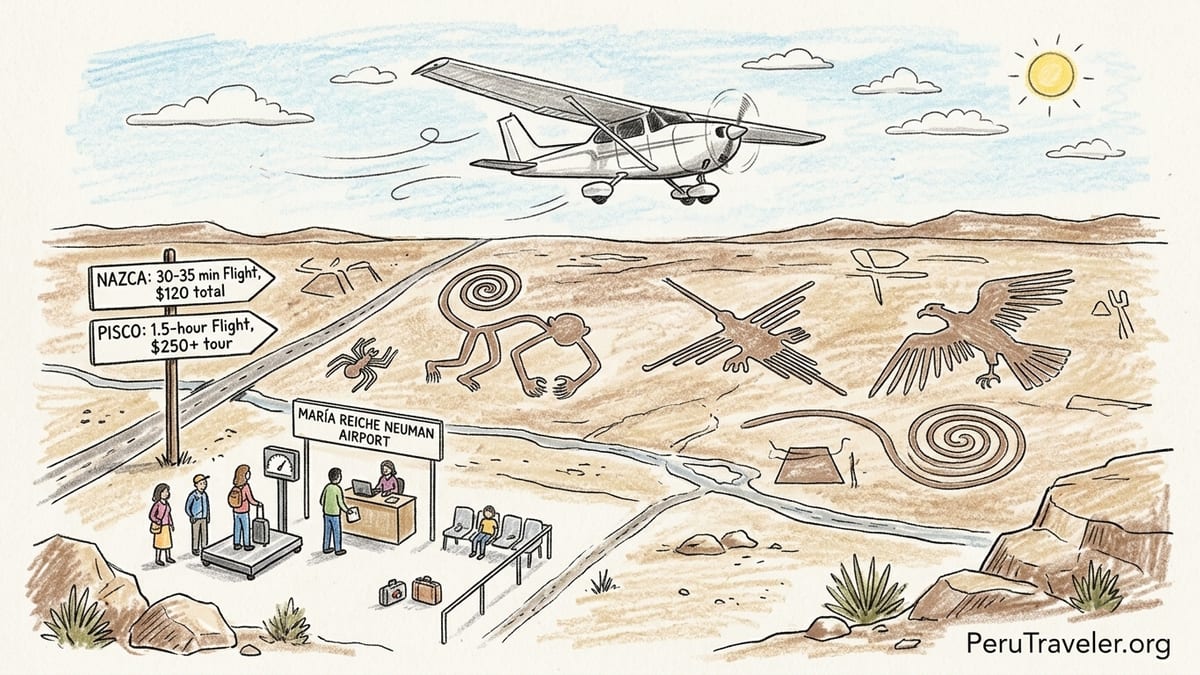
When I reserved my seat, the agency asked for my passport details, approximate weight and my flexibility over two mornings in case of wind or low cloud. The base fare on my September weekday was quoted a little above 90 US dollars for a standard 30 to 35 minute circuit from Nazca, plus around 25 to 30 US dollars in airport tax and local charges payable in person. Prices were higher for weekends and peak season, and significantly more for the longer flights from Pisco that many travelers pair with Paracas. The important point is that most websites advertise a bundle price, so you should always ask the seller to separate the actual airtime, the aerodrome tax and any ground transport so you know what you are paying for.
To check that I was not dealing with a middleman inventing an airline, I asked for the exact operator and aircraft type in advance. In 2026, names such as AeroNasca, AeroParacas, Movil Air and Alas Peruanas are still among the more established players at Nazca and nearby airfields, while Aerodiana has been under particular scrutiny since the crash and has operated only after temporary suspension and inspection by the Dirección General de Aeronáutica Civil (DGAC). I cross-checked the operator’s name with DGAC’s public lists and recent local reporting, and only then confirmed payment. This extra step added ten minutes to booking and gave me far more peace of mind than any glossy brochure ever could.
Finally, I clarified one easily misunderstood detail: was the “35-minute flight” airtime from take-off to landing, or a marketing label for a longer excursion that included hotel pickup and airport waiting time. For Nazca departures, agencies generally confirmed 30 to 35 minutes in the air, including passes over roughly a dozen major figures. For longer Pisco departures that target travelers staying in Paracas or joining day trips from Lima, the realistic airtime can be in the region of 80 to 100 minutes, with the rest of the “12-hour tour” taken up by the drive from Lima and back. Asking this before you pay will prevent disappointment later.
At the Aerodrome: Weigh-ins, Seat Assignments and Safety Briefings
On flight day my minibus pickup from central Nazca took around 15 minutes to reach María Reiche Neuman Airport, a compact aerodrome a few kilometers from town. Inside the small terminal, the atmosphere felt more like a bus station than a big international airport: plastic chairs, tour groups watching short videos about the geoglyphs, and agents calling out names for each departure. The first formal step was weighing passengers. Each of us stood on a scale, sometimes with our daypack, so the ground staff could distribute weight evenly in the aircraft. For taller or heavier travelers this can feel uncomfortable, but it is a normal and important part of small-plane safety that you should expect.
I was flying in a single-engine Cessna, a high-wing aircraft with roughly a dozen seats, including the pilot and co-pilot. Before we stepped through security, the airline representative showed us a printed seating plan. Families were kept together where possible, but final seats were assigned according to weight, not who booked first. I had requested a window seat when I booked and asked again at check-in. The staff explained that every seat was by a window and that the pilots would bank the aircraft in both directions so passengers on each side would get symmetrical views.
The safety briefing was more thorough than I had expected from some older reports. A short video in Spanish and English explained seat belts, the location and use of life vests, and the importance of keeping cameras inside the aircraft. The crew then repeated the key points in person, adding one detail that tends to be glossed over in marketing: turbulence and motion sickness are possible, especially on windy days, and they urged anyone feeling unwell to signal early. They also emphasised that flights would not depart if strong winds, low cloud or poor horizontal visibility made viewing or safe operation questionable, even if that meant cancellations at short notice.
Security itself was quick but real. Bags passed through a scanner, and liquids were allowed but checked manually. At the apron, ground staff guided us in single file to the aircraft, where we took a brief look at the exterior. I asked the crew about their schedule, and they mentioned that the aircraft would fly no more than a few circuits that morning, with mandated breaks and fuelling checks. I could not independently verify every maintenance claim, but hearing a structured explanation and seeing paperwork on a clipboard felt more credible than a vague “everything is fine”.
Understanding Flight Options: Nazca vs Pisco vs Lima Tours
The classic Nazca experience is the short flight from Nazca itself. From María Reiche Neuman Airport, most operators run circuits of about 30 to 35 minutes in the air, passing over a sequence of famous geoglyphs including the Whale, Trapezoids, Astronaut, Monkey, Dog, Condor, Spider, Hummingbird and others. Some companies also sell a slightly longer loop of around 45 minutes that adds additional figures or the Palpa lines to the route. These flights are generally the cheapest option and the least demanding logistically if you are already in southern Peru, for example traveling between Ica and Arequipa.
Pisco departures target a different traveler. From Lima, you can join a full-day excursion that leaves the capital very early, drives roughly three and a half hours down the coastal highway to Pisco or Paracas, flies from Capitán FAP Renán Elías Olivera Airport and then returns by evening. The key is that the flight itself is longer. Recent itineraries and planning guides describe airtime from Pisco in the region of one hour and twenty to one hour and forty minutes over the Nazca and Palpa areas, allowing more time over the figures but also keeping you in a small aircraft longer. The cost is higher, often several hundred US dollars per person once you include transport from Lima and any bundled Paracas or Huacachina activities.
Finally, there are multi-day combinations that weave Nazca into a broader south coast loop. It is possible, for instance, to travel from Lima to Paracas, visit the Ballestas Islands and the Paracas National Reserve, continue to Huacachina for dune buggies and sandboarding, then go on to Nazca for a flight and perhaps the viewing tower before carrying on toward Arequipa. Some agencies advertise two-day packages trying to include Paracas, Pisco, Huacachina and Nazca in one compressed program. On paper this sounds efficient. In reality, it means early morning wake-ups, multiple check-ins, and little flexibility if wind grounds aircraft in Nazca or Pisco. During my visit, several travelers I met who were on such tight schedules had to skip their flight or the dunes when delays cascaded.
The most important practical lesson is to distinguish clearly between “flight duration” and “tour duration.” For Nazca departures, your real time in the air is usually under 40 minutes. From Pisco it can exceed 80 minutes. A Lima day tour may run 12 to 14 hours door to door, but the majority of that is road time. Ask for the precise expected airtime, in minutes, from wheels up to wheels down, and plan the rest of your day around that figure, not around the marketing language.
Seeing the Hummingbird, Monkey, Spider and Condor From the Air
Once airborne, the reason people still pay to do this becomes obvious very quickly. The Nazca desert is an enormous, pale-brown pampa cut by dry riverbeds and the thin line of the Panamericana Sur. From a few hundred meters up, the famous figures appear gradually, almost shyly, as slightly darker grooves against the sand and gravel. Our pilot narrated in both Spanish and English, calling out each geoglyph ahead of time and banking the Cessna first to the left, then to the right so that everyone could get a clear look.
The Hummingbird appeared first among the true “stars.” It is remarkably elegant from the air, a long beak pointing almost like an arrow, wings spread and tail feathers fanned. Its outline is delicate but coherent, and I found it one of the easiest to recognize even before the pilot pointed it out. Next came the Monkey, contorted into its famous spiral tail. Here the effect of altitude was striking: photos in books never communicated how large the body and tail feel when you can see tiny highway vehicles crawling along the edge of the plateau far below for scale.
The Spider and Condor required a bit more concentration. On our circuit the sunlight was slightly hazy, and the lines did not “pop” as hard as in high-contrast aerial photographs. The Spider’s legs and angular body gradually resolved as the pilot traced them with wing dips, but more than one passenger around me initially confused it with other shapes. The Condor was easier to spot once I knew to look for its outstretched wings and wedge-shaped tail, though from one side of the plane its head was partially obscured by overlapping straight lines. This underscored a point that glossy images online rarely mention: you will not always see a perfect postcard view. Real aerial sightseeing is often a sequence of quick, oblique glances that your brain assembles into something coherent a second later.
Photographing the figures was both easier and harder than I had anticipated. On the easy side, the aircraft’s high wings and large windows gave clear downward views, and the pilot announced turns with enough warning for us to have cameras ready. On the difficult side, the constant banking, occasional bumps of turbulence and the temptation to lean across your neighbor make it very easy to end up with slanted horizons and blurred shots. The passengers who left their cameras on wide angle, shot bursts and accepted some distortion captured the best results. Those who spent time switching lenses or obsessing over settings often missed the key seconds over each figure.
Motion Sickness, Weather and the Reality of Small-Plane Flying
Before flying I had read plenty of warnings about nausea on Nazca flights and had packed motion sickness tablets. I took one a little over half an hour before boarding, which may have helped. Even so, the tight banking turns, especially in the first ten minutes, produced a noticeable queasiness. The aircraft alternated between left and right circles to give everyone their view, and that repetitive rolling is exactly what troubles many stomachs. In our group of ten passengers, two became clearly airsick. One used the paper bag provided, the other managed to hold on until landing but looked miserable. I had a mild headache afterwards and needed water and fresh air before continuing my day.
The key point is that your experience can vary significantly depending on the weather. On my September morning the wind was moderate and the air mostly smooth, with only light chop near a ridge. In the peak wind season, especially later in the day when thermal currents build over the desert, bumps can be stronger and the aircraft may need steeper angles of bank to keep everyone’s view. These are normal for trained pilots and within the aircraft’s design limits, but they can feel dramatic to passengers unused to light aviation. If you know you are prone to motion sickness, speak with a medical professional before travel about appropriate preventative medication, use it as directed, and consider choosing the earliest possible flight when the air is often calmer.
Weather can also affect visibility and safety decisions. Local pilots watch not only wind speed and direction but also low cloud drifting in from the coast and dust haze raised by desert gusts. On one of the mornings I spent at Nazca, flights were delayed for more than an hour due to poor horizontal visibility. The sky above the airport looked acceptable, but out over the main figure area the view was washed out, reducing contrast between the lines and the surrounding surface. A pair of late-morning departures was eventually cancelled. This was frustrating for those on tight schedules, but it was the right decision. A flight where you can barely distinguish the geoglyphs defeats the entire point of the experience.
My own takeaway is that you should build flexibility into your itinerary and mental expectations. Accept that the desert is a real environment, not a theme park. Even in the dry season, wind and haze can intervene. You may need to wait, rebook or, in rare cases, give up your flight altogether for safety reasons. No dramatic photo is worth pressuring crew to depart in marginal conditions.
Costs, Ground Viewpoints and Why the Plane Still Matters
The financial side of Nazca is where many travelers feel ambivalent. From Nazca itself, the combination of base fare, airport tax and transfers for a standard 30 to 35 minute flight can easily reach the equivalent of 120 to 150 US dollars per person in 2026, with variations by season and exchange rate. From Pisco, particularly on day trips from Lima that bundle transport, meals and sometimes Paracas or dune-buggy excursions, the total outlay often climbs into the several-hundred-dollar range. That is a serious expense for a short, sometimes uncomfortable experience.
Ground viewpoints offer a cheaper alternative but do not fully replace the aerial perspective. North of Nazca, beside the Panamericana Sur, a metal viewing tower allows visitors to see a small number of figures from a modest height. From this mirador, you can look down on shapes such as the Tree and the Hands, and get a good sense of how extremely subtle the scraped lines appear against the vast desert surface. It is an excellent reality check on the fragility of the site and how easily modern infrastructure has cut through it. However, you cannot see the famous Hummingbird, Monkey, Spider, Condor or Astronaut properly from this tower, nor from the highway or surrounding flat ground. Their full outlines only emerge at higher altitudes.
During this trip I visited both the tower and flew. At the tower, I paid only a small entrance fee and spent twenty minutes climbing, observing and taking photos. I enjoyed the stop, but the view felt partial, almost like reading one chapter of a book and guessing the rest. From the plane, the broader composition became clear. The geometric lines, long trapezoids and animal figures formed a coherent landscape across tens of square kilometers, and I could appreciate not just individual shapes but their relationship to dry valleys, ancient pathways and the modern road. No photograph or satellite image had prepared me for that cognitive shift. For that reason, if you care deeply about the Nazca Lines as a cultural landscape, the aerial view remains uniquely powerful.
That said, not everyone needs to pay for a flight. For travelers on strict budgets, those with strong fear of flying or serious motion sickness, and families for whom the cost multiplies quickly, the combination of the viewing tower, a local museum visit and good documentaries at home may be enough. The key is to be honest with yourself about your priorities. If your main goal in Peru is trekking around Cusco or exploring the Amazon, and Nazca lies awkwardly out of your way, you may not regret skipping the flight at all.
Safety After the 2026 Aerodiana Crash: What You Can Actually Check
Any evaluation of Nazca flights in 2026 has to grapple with the Aerodiana crash on 1 August of that year. A Cessna 208 Caravan operated by the company went down near Nazca while performing a sightseeing flight. All 13 people on board, including 11 tourists and 2 crew members, were killed. In the days that followed, Peru’s Ministry of Transport and Communications stated that the DGAC had ordered a temporary suspension of Aerodiana’s operations as a preventive measure while investigators examined the circumstances of the accident. In subsequent weeks, some aircraft and operators, including Aerodiana, were gradually allowed to resume flights after passing specific checks, even as the formal investigation continued. As of late October 2026, authorities have not published a final, definitive cause, and any speculation beyond official statements would be irresponsible.
For travelers, the uncomfortable truth is that flying in small aircraft always carries some risk, especially in rugged or weather-exposed environments. You cannot eliminate this risk entirely, but you can make more informed choices. The first step is to verify that any operator you consider is authorized by the DGAC. This can be done by consulting official lists of licensed operators, checking recent advisories from the Ministry of Transport, and asking your agent to show you the company’s air operator certificate details. If the staff cannot clearly state which airline you will fly with, what aircraft type will be used, and whether it is currently cleared for sightseeing operations, take your business elsewhere.
The second step is to ask practical questions about maintenance and crew. You are unlikely to get access to full maintenance records, but you can ask simple, concrete things: How many aircraft does the company operate on Nazca routes? Are flights crewed by both a pilot and a co-pilot? How many flights per day does each aircraft normally complete? Are there written, public weather minima for cancelling flights? Reputable operators will have calm, specific answers, whereas vague reassurances like “everything is very safe” without detail should ring alarm bells. You can also observe how staff respond to deteriorating weather on the day. Companies willing to cancel or delay flights when the wind picks up or visibility drops are, in my view, a better bet than those pushing to fly at all costs.
Seat assignment and cancellation policies are another layer of safety and comfort. Some operators guarantee that every passenger has a window, others emphasise that while every row has windows, not every specific seat will get identical views. Read the small print on refunds in case of weather cancellation, partial cancellation or if you personally decide to skip the flight due to nerves or illness. In Nazca, I saw a mix of policies. A few agencies offered full refunds for weather cancellations and partial credits if the route had to be shortened. Others offered only rebooking, which is of little use if you must leave on an overnight bus that same evening. Clarifying this in writing at the time of booking will save stress later.
Is It Worth the Detour From Lima, and Should You Stay Overnight?
From a purely logistical perspective, Nazca is awkward. It sits several hours’ drive south of Lima on the way toward Arequipa, which means that a round trip solely for the flight can eat an entire day or more. Some people tackle it as a brutal overnight-bus-in, morning flight and afternoon-bus-out combination. After trying versions of this in the past and making the trip again this year, I lean strongly toward staying at least one night in Nazca if you are serious about seeing the lines from the air.
Overnighting buys you flexibility. If wind or haze grounds flights on your first morning, you still have a second window. You can schedule the very first departures of the day, when the air is calmer and visibility is often better, and you can add the viewing tower or a visit to nearby sites such as the Chauchilla cemetery or local aqueducts without feeling rushed. On my September trip, friends who stayed overnight had successful flights on their second morning after a weather cancellation on the first. Others who attempted a same-day in-and-out from Huacachina missed out entirely when delays pushed their departure too late.
Whether combining Nazca with Paracas or Huacachina becomes “too much” depends largely on your travel style. Two-day loops that include Paracas boat tours, Pisco flights, desert buggies and Nazca in rapid succession leave very little slack. They can work for energetic travelers who accept the risk of dropping one element if weather or fatigue intervene. For slower travelers, or those particularly focused on archaeology rather than adrenaline activities, it may be better to decouple Nazca from dune buggies altogether. A calm evening in Nazca town, an early flight and an unhurried bus onward to Arequipa or Cusco turned out to be a far more humane rhythm than the hyper-compressed packages I saw.
In my own case, I ultimately felt that the short Nazca flight did justify the journey from Lima, but only because I had structured my broader itinerary to include other south-coast stops and onward travel. If I had been flying back to Lima afterwards solely to catch an international flight, I might have felt differently. The Nazca Lines are extraordinary, but Peru is full of extraordinary places, and you will always be trading one experience for another.
The Takeaway: Expectations, Experience and Who Should Fly
Looking back, my expectations before this 2026 trip were a mix of awe and apprehension. Awe at the idea of seeing a UNESCO-listed archaeological landscape from above, apprehension about stepping into a small aircraft in a region that had very recently seen a deadly crash. I worried about whether the operators really followed higher safety standards now, whether the motion sickness warnings were exaggerated, and whether thirty-odd minutes in the air could possibly be worth more than a hundred dollars and a full day out of my itinerary.
The booking and safety concerns turned out to be both justified and manageable. It did take extra effort to verify my operator’s authorization, confirm the aircraft type, ask about maintenance and weather policies, and ensure that my airtime would be as advertised. That felt tiring compared with booking a standard commercial flight, but it also left me better informed. At the aerodrome I saw staff enforce weight-based seating, postpone flights due to visibility and give straightforward safety briefings that mentioned the possibility of turbulence and sickness. None of this eliminates risk, but it is a healthier culture than one that pretends risk does not exist.
The actual flight delivered what I had hoped it would. Seeing the Hummingbird, Monkey, Spider, Condor and other figures unfold across the desert, framed by long geometric lines and dry valleys, produced a very specific kind of wonder. I did experience mild motion sickness and needed time afterwards to recover, and a couple of photos I had envisioned in my head proved impossible from a constantly banking aircraft. A few figures were harder to identify than I expected, especially in slightly hazy light, and some passes felt rushed. Yet the overall impression was of having glimpsed an enormous, ancient artwork in its proper scale, something I could not replicate from the ground tower or from photographs alone.
What disappointed me most was not the flight itself but the inflexibility of some tour packages I observed around me. Travelers who had been talked into aggressive two-day combos with Paracas and Huacachina often found themselves at the mercy of wind delays, with no slack in their schedule and limited refund options. The final expense, when they added up flights, taxes, transfers and missed activities, felt painful. My more modest plan, centered on Nazca with one night in town and a straightforward onward bus, felt better value for the emotional and logistical cost.
Would I repeat a Nazca Lines flight? Yes, but selectively. I would fly again from Nazca itself, ideally at a different time of year or time of day to see how the light changes the figures, and only with an operator I had taken the time to verify once more through official channels. I would be slower to sign up for a long Pisco departure unless I were already staying in Paracas and had several days to play with.
For archaeology enthusiasts and serious history travelers, I think an aerial tour is still worth it, even in this more sobering 2026 context, provided you approach it with clear eyes about risk, cost and logistics. For photographers, the flight offers unique perspectives but not guaranteed perfect shots, so consider it a chance to document impressions rather than to produce gallery prints. Families should balance the thrill and educational value for older children against the stress, cost and nausea potential for younger ones. And for travelers who decide that a small-plane flight is not right for them, that is a completely valid choice. You can still appreciate the Nazca culture through ground viewpoints, museums, books and documentaries, and you can redirect your budget and energy to the Andes, the Amazon or other parts of Peru that may resonate more strongly with you.
FAQ
Q1. How long is a Nazca Lines flight from Nazca and from Pisco?
From Nazca, most standard flights offer about 30 to 35 minutes in the air over the main geoglyphs. From Pisco, airtime can be in the region of 80 to 100 minutes, often sold as part of a much longer full-day excursion from Lima or Paracas that includes road transfers.
Q2. How much does a Nazca Lines flight cost in 2026?
In late 2026, a typical Nazca departure can cost in the ballpark of 90 to 120 US dollars for the flight itself, plus roughly 25 to 30 dollars in airport taxes and local charges. Pisco departures and Lima day tours are significantly more expensive once you include transport and bundled activities, so you should confirm current prices directly with your chosen operator or agency.
Q3. Is it safe to fly over the Nazca Lines after the Aerodiana crash?
All flying carries some risk, and the Aerodiana accident on 1 August 2026 was a serious reminder of that. After the crash, Peru’s DGAC temporarily suspended Aerodiana, carried out checks and then allowed some aircraft and operators to resume while the investigation continued. There is still no publicly announced final cause. Travelers should verify that their chosen operator is currently authorized, ask about safety practices and accept that small-aircraft flights have inherent risks that cannot be completely removed.
Q4. How can I check if a Nazca Lines operator is authorized?
You can cross-check the airline’s name against information provided by Peru’s aviation authorities and recent public advisories, and you can ask the agency to show you the company name, air operator certificate details and aircraft type on your booking documents. If staff cannot clearly state who will operate your flight or avoid answering questions about authorization, it is safer to choose another provider.
Q5. Will I get a window seat and can I choose which side of the plane?
Small aircraft used for Nazca flights typically have all seats next to windows, but exact assignments are usually based on passenger weight distribution rather than personal preference. Pilots normally bank the plane first to one side and then the other over each figure so that everyone gets a reasonable view. You can request a particular side, but safety and balance will always come first.
Q6. How bad is motion sickness on Nazca Lines flights?
Many people feel at least mild queasiness because the aircraft banks repeatedly in tight circles so each side can see the geoglyphs. A minority become quite sick, especially on windier days. If you are concerned, speak to a medical professional before your trip about suitable motion sickness medication, choose an early-morning flight when the air may be calmer, and avoid heavy meals and alcohol beforehand.
Q7. What happens if weather is bad on the day of my flight?
If strong wind, low cloud or haze make flying unsafe or viewing poor, reputable operators will delay or cancel departures. Policies vary, but many agencies offer rebooking or refunds when flights are cancelled due to weather. It is essential to confirm these conditions when you book and to build at least one buffer half-day into your schedule in case of delays.
Q8. Can I see the Nazca Lines from the ground without flying?
There is a roadside metal viewing tower north of Nazca where you can see a small number of figures from above, along with some natural viewpoints on nearby hills. These give a partial sense of the lines but do not reveal the full scale or classic shapes of famous figures such as the Hummingbird, Monkey, Spider and Condor, which are best appreciated from the air.
Q9. Is it worth staying overnight in Nazca instead of doing a long day trip from Lima?
Staying at least one night in Nazca greatly improves your chances of flying, because you can rebook if weather disrupts the first attempt and choose calmer early-morning departures. Long same-day trips from Lima or Huacachina are possible but exhausting and leave little flexibility if conditions change.
Q10. Who is a Nazca Lines flight best suited for, and who might skip it?
The flight is especially meaningful for travelers interested in archaeology, ancient cultures and landscape photography who can tolerate small-plane motion and the higher cost. People with severe fear of flying, strong susceptibility to motion sickness, very tight budgets or limited time in Peru may reasonably decide to skip the flight and focus on other regions such as Cusco, the Sacred Valley or the Amazon.