


Planning Machu Picchu is not just about permits and train tickets. Where you sleep in the days around your visit can shape everything from how you feel at altitude to whether you are stumbling to a 3:30 a.m. taxi or rolling your suitcase five minutes to an early train. After spending several nights split between Cusco and the Sacred Valley bases of Ollantaytambo and Urubamba, and revisiting current 2026 prices and transport options, I would plan that pre-Machu Picchu stretch very differently next time.
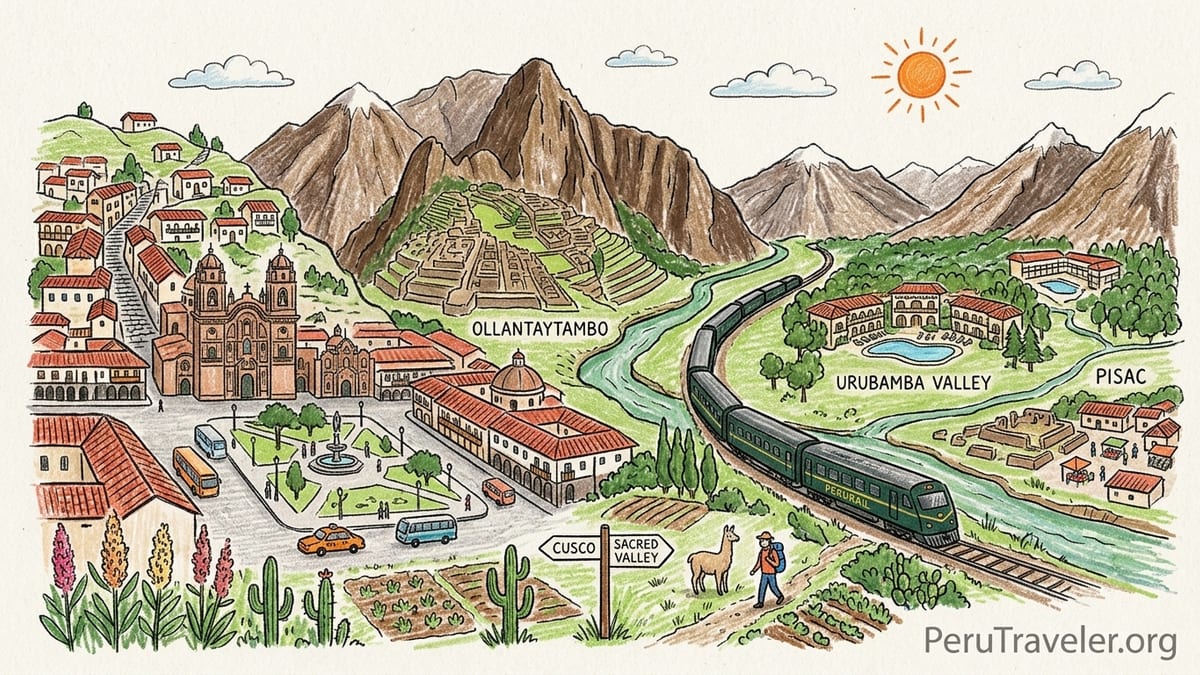
Cusco First Impressions: History, Height and Everyday Practicalities
My first three nights were in Cusco’s historic center, a few blocks from Plaza de Armas. At around 3,400 meters above sea level, Cusco hits you the moment you step out of the airport. A licensed taxi to the center in 2026 runs in the region of 25 to 35 soles depending on traffic and haggling, which is reasonable for the 20 to 30 minute ride, but the combination of thin air and fumes from constant traffic is noticeable on arrival.
Staying within a five minute walk of Plaza de Armas gave me classic postcard Cusco: colonnaded arcades, the cathedral, and narrow lanes leading to San Blas. Mid-range hotels immediately around the square in October 2026 were typically pricing standard doubles between 260 and 420 soles per night including breakfast, with properties like Casa Andina Standard Cusco Catedral and similar three star hotels around that level offering buffet breakfasts, reliable hot water, and decent Wi-Fi. Closer to San Blas, small guesthouses came in lower, roughly 180 to 260 soles with breakfast, but often at the cost of climbing steep cobbled streets.
Everyday logistics are excellent in central Cusco. In a ten minute radius on foot I had multiple money exchanges, small supermarkets, inexpensive bakeries, and a long list of cafes and restaurants serving everything from 15 sole menu del día lunches to high-end tasting menus. San Pedro Market was about a fifteen minute walk, an easy morning outing for fruit juices, simple breakfasts, and the first encounter with coca tea. For a first-time visitor comfortable walking slowly uphill, it is hard to beat this level of convenience.
The downside revealed itself each night. Traffic in the center is heavy until late, and even on supposedly quiet side streets there is constant horn noise and the rumble of tour buses. Many colonial buildings were never designed with soundproofing, so even with interior rooms you hear courtyard conversations and early departures. Heating is another detail visitors underestimate; few mid-range hotels have central heating, relying instead on plug-in radiators that take the edge off but leave stone floors cold. I slept under several blankets but still woke up once or twice from cold, something I did not experience at lower elevation in the valley.
Cusco by Neighborhood: Plaza de Armas, San Blas and Beyond
Over multiple nights I tested three different Cusco locations: just off Plaza de Armas, up in San Blas, and closer to San Pedro Market. Around the main square, everything felt posh and polished. Historic mansions hide boutique hotels behind wooden doors, and you can walk out in the evening and choose between pisco bars, rooftop restaurants and live music venues within a block. Museums such as the Inka Museum and the Cathedral complex were within a ten minute walk, and tour operators for Sacred Valley and Rainbow Mountain excursions cluster around the plaza, making last-minute bookings simple.
San Blas, higher up the hill, offers narrower streets, artisan workshops and a more bohemian feel. The walk from Plaza de Armas takes about ten to fifteen minutes but involves steep stairs. Accommodation prices are a little lower than the plaza itself; simple but charming guesthouses with character courtyards and breakfast included were commonly pricing standard doubles around 180 to 230 soles in late 2026. At night, San Blas is quieter than the main square but you still hear distant traffic and the occasional late-night reveler making their way home.
The San Pedro area, closer to the market and the San Pedro train station, felt more local and a bit more chaotic. Here I found some of the best value mid-range hotels for travelers on a budget, with prices around 150 to 220 soles including breakfast for clean, functional rooms. Walking to the Plaza de Armas took around ten minutes on flat streets, and most tour pick ups included this zone without complaint. Being near the market is handy for budget meals and snacks, but this part of town is busier in the early morning as vendors set up, and some streets feel more congested with buses and colectivos.
Across all neighborhoods, I could move around easily without a rental car, using short 8 to 12 sole taxi rides when I did not feel like walking uphill. For excursions, most agencies included door-to-door pick up. What started to weigh on me after a few days, however, was not the logistics but the altitude. Even walking slowly, I was out of breath on inclines, and I slept lightly. It did not prevent me from enjoying museums and restaurants, but I felt less rested than I wanted before a major day at Machu Picchu.
Ollantaytambo: Living Above the Tracks and Below the Terraces
After Cusco, I moved to Ollantaytambo for two nights, and the change in atmosphere was immediate. The village sits at roughly 2,800 meters, so still high but enough of a drop that climbing stairs to my second floor room felt easier. A private transfer from Cusco to Ollantaytambo in 2026 is typically quoted around 220 to 320 soles for a car or van that takes 1.5 to 2 hours depending on traffic. Shared colectivos from Cusco’s Pavitos street cost much less, usually under 20 soles per person, but they drop you on the edge of the village, which is less appealing if you are hauling luggage.
I stayed first at a small guesthouse near the main square and then at a hotel closer to the train station. Mid-range double rooms with breakfast in Ollantaytambo were commonly available between 180 and 260 soles in late 2026. Examples included simple stone-built inns with hot showers, electric heaters and hearty breakfasts of eggs, bread and fruit. Near the station, places like long-established guesthouses built into the historic compound give you the unique experience of sleeping within sight of the platforms while still being able to walk into the village center in ten minutes.
The village itself is a highlight: cobbled Inca streets with running water channels, a compact Plaza de Armas lined with cafes, and the giant terraces of the Ollantaytambo ruins towering above. I could walk from my hotel to the archaeological site entrance in under ten minutes, and buying a partial tourist ticket at the booth allowed me to explore both Ollantaytambo and Pisac on different days. Restaurants were fewer and more modest than Cusco, but I still had a decent choice each night, from wood-fired pizza to quinoa soups and trout dishes in the 25 to 45 sole range for mains.
Evenings in Ollantaytambo are genuinely quiet once the day tour buses leave. After about 9:30 p.m., the village center felt almost sleepy, with only a handful of travelers lingering in bars. That made for much better sleep than in Cusco. The trade-off is that if you arrive hungry at 10 p.m., your options are limited. Noise from the trains was surprisingly minimal when staying slightly back from the station; only hotels directly beside the tracks had noticeable vibration when an early service rolled through.
Urubamba: Resort Bubble vs Real-World Convenience
Urubamba, roughly midway along the valley, became my base for two nights in a resort-style property outside town. The elevation here is slightly lower again than Ollantaytambo, around 2,900 meters at the river with some hotels stepping up the hillside. I noticed that my sleep improved compared with Cusco, and early-morning headaches eased. It is important to stress that this is anecdotal experience rather than evidence that lower altitude prevents illness, something no serious medical source guarantees. Some travelers feel better at 2,800 to 2,900 meters, others do not.
Price-wise, Urubamba is where the Sacred Valley shows its upscale side. Well-known resorts with landscaped gardens, views of the surrounding peaks and spa facilities were typically quoting from around 800 to 1,500 soles per night for double occupancy in October 2026, including breakfast, with high-end names priced above that. A beautiful hacienda-style property I stayed at cost approximately 1,000 soles per night including a large breakfast, heated rooms and access to a small spa pool. Dinner in the on-site restaurant, plus drinks, easily added another 150 to 250 soles for two people.
The main trade-off became clear once I tried to leave the resort without a private driver. Many of the top properties are several kilometers outside Urubamba town along rural roads. While the hotels can arrange taxis to Ollantaytambo or Pisac, these are not the ubiquitous street taxis of Cusco. A private one-way transfer from my Urubamba resort to Ollantaytambo station was quoted just under 100 soles and took about 45 minutes, and a run to the Cusco airport was easily 250 to 300 soles. For a couple staying several nights and doing multiple excursions, those private transfers quickly add hundreds of soles to the total bill.
Inside the resort bubble, life was wonderfully easy: buffet breakfasts overlooking the valley, hot-water bottles placed in beds each evening, and manicured lawns where alpacas grazed at sunset. Outside that bubble, there was no strolling into town for a cheap empanada. Without your own rental car or a prearranged driver, resort stays in Urubamba can feel logistically awkward, especially if you want to catch early trains or return late from Machu Picchu. For travelers who prioritize comfort and downtime over spontaneous eating out or nightlife, the trade-off may be fine. For anyone counting soles or valuing flexibility, Urubamba’s luxury comes with real-world inconvenience.
Pisac and the Cultural Valley Beyond the Trains
Pisac provided a very different Sacred Valley experience during a daytime visit and an overnight stay in a small inn on the edge of the village. Crucially, Pisac is not a train hub for Machu Picchu. There is no tourist train station here, so you still need to transfer to Ollantaytambo or the Cusco area to board a train. That means Pisac works best as a cultural complement to your Machu Picchu base rather than a functional substitute.
The village sits below one of the most impressive Inca archaeological sites in the region, with sweeping agricultural terraces and hilltop ruins connected by stone paths. I used the same tourist ticket that covered Ollantaytambo to enter the site, and a local taxi from the village up to the high entrance cost around 20 to 25 soles in 2026, saving my legs for the descent through the ruins. The Sunday, Tuesday and Thursday markets in Pisac still draw both locals and visitors, with textiles, ceramics and produce filling the main square and side streets.
Accommodation in Pisac is generally simpler and more budget-friendly than in Urubamba. I paid around 150 soles for a private room with breakfast in a family-run inn, and other options I researched in late 2026 ranged from under 120 soles for basic guesthouses up to 260 soles for more stylish lodges. Evenings were relaxed and much quieter than Cusco, with only a handful of restaurants open after 9 p.m. There is almost no nightlife, which many travelers may find restful after busy days of sightseeing.
As a base specifically for Machu Picchu, however, Pisac introduces extra transfers. The drive from Pisac to Ollantaytambo takes around 1.5 to 2 hours, usually involving a connection through the main Cusco valley road. For my own itinerary, Pisac worked best as a one-night or day-trip add-on, before continuing on to Ollantaytambo for the night before my Machu Picchu train.
Machu Picchu Logistics: Why I Departed from Ollantaytambo
Once you start looking at actual train times in 2026, the advantage of staying in Ollantaytambo the night before Machu Picchu becomes very clear. Regular PeruRail and Inca Rail services leave from Ollantaytambo to Machu Picchu Pueblo as early as around 5:00 to 6:30 a.m., with journey times of roughly 1.5 hours depending on service class. A typical morning Expedition or Voyager train around 6:00 a.m. from Ollantaytambo arrives before 8:00 a.m., leaving enough time to take the bus up to the citadel for a mid-morning entrance slot.
To catch that same 6:00 a.m. train from Cusco, you would need to leave the city around 3:30 to 4:00 a.m. by private car, in the dark and cold, for a winding drive to the valley. Some “bimodal” departures from Cusco combine a pre-dawn bus segment to Ollantaytambo followed by the same train, stretching the total journey to three and a half to four hours door to door. Ticket sellers sometimes advertise a departure around 4:20 a.m. from Cusco bus stations, connecting to a train that reaches Machu Picchu Pueblo close to 8:00 a.m., but the reality is still an extremely early start.
By staying in Ollantaytambo, my own pre-Machu Picchu morning looked very different. I woke at 4:45 a.m., had a basic breakfast provided early by the hotel, and walked ten minutes with my small daypack to the station for a 6:10 a.m. train. I did not need a taxi, did not sit in traffic, and was boarding with energy rather than fighting sleep. The return was similarly simple; arriving back at Ollantaytambo in late afternoon, I could either stay another night or continue by pre-booked transfer to Cusco in the evening.
Ticket prices vary widely by operator, time, and how far in advance you book, but in 2026 it is common to see basic tourist train fares from Cusco to Machu Picchu bundled with bus and return starting around the equivalent of 320 to 450 soles per person in economy services, and more if you travel in higher classes or closer to peak dates. From Ollantaytambo alone, one-way fares can be lower, and by avoiding the Cusco bus leg and an extra very-early-morning transfer, you save not only comfort but often some money on private cars. For my two-person journey starting in Ollantaytambo, the combined return train and bus tickets ended up noticeably cheaper than the Cusco bimodal quote I had originally considered.
Five-Night Cost Comparison: Cusco Only, Valley Only, or Split Stay
To make sense of what I actually spent versus alternative setups, it helps to lay out a realistic five-night model using 2026 prices I encountered or confirmed. Exchange rates fluctuate, so I will keep everything in Peruvian soles to avoid false precision. These are not absolute minimums, but grounded mid-range examples.
In my real split-stay itinerary, I spent three nights in Cusco at an average of around 300 soles per night for a mid-range hotel with breakfast near the center, then two nights in the Sacred Valley, one in Ollantaytambo at 220 soles and one in a more comfortable Urubamba resort around 1,000 soles. Total accommodation for five nights was therefore roughly 2,120 soles. Add in a 30 sole taxi from Cusco airport to the center, a 260 sole private transfer from Cusco to Urubamba, a 100 sole private transfer from Urubamba to Ollantaytambo, and a 240 sole night transfer back to Cusco after Machu Picchu. That is approximately 630 soles in ground transfers beyond city taxis.
For Machu Picchu itself, two standard class train tickets Ollantaytambo to Machu Picchu Pueblo and back, plus bus tickets up and down for two people, came to just under 900 soles in total at the time I booked. A one-day entrance ticket to the citadel was around 150 to 200 soles per person depending on the specific circuit and timing. For two people, the combined entry cost about 320 soles. Altogether, my five-night split itinerary around Machu Picchu, including accommodation, inter-town transfers, and Machu Picchu transport and entry for two, sat in the region of 3,970 soles, not counting meals and other tours.
By contrast, a Cusco-only five-night stay in a similar 300 soles per night hotel would total around 1,500 soles in accommodation. Add 30 soles for the initial airport taxi, then plan on either bimodal train tickets from Cusco or an early private transfer plus train from Ollantaytambo. In practical terms, a full Cusco to Machu Picchu to Cusco transport package for two, with bus and train and no Sacred Valley hotel nights, would likely total between 1,100 and 1,400 soles in 2026 for mid-range services, plus the same 320 soles in entry tickets. Ground transfers within Cusco are lower without the valley; perhaps another 100 soles over several days. That puts a realistic five-night Cusco-only itinerary including Machu Picchu for two near the 3,050 to 3,320 sole range.
A Sacred Valley-only five-night option, split between two or three nights in Ollantaytambo at roughly 220 soles per night and two or three nights in a comfortable but not ultra-luxury Urubamba or Pisac property at say 300 to 400 soles per night, might bring total accommodation to around 1,300 to 1,600 soles. However, you would then need private transfers both from Cusco airport to the valley and back, likely totaling 500 to 600 soles round trip. Add in the 900 soles for two person Machu Picchu train and bus transport and 320 soles in entry tickets. Without any Cusco nights, museum tickets or local taxis, such a five-night valley-only itinerary with Machu Picchu for two sits around 3,020 to 3,420 soles. In other words, for mid-range travelers, costs between the three models can end up surprisingly similar once all transfers are counted. What really shifts is comfort and convenience, not necessarily the total budget.
Comfort, Altitude and the Hidden Cost of Inconvenience
Breaking down those five nights, the pattern that mattered most in practice was not the precise nightly rate but how I felt each morning and how easy it was to get around without my own car. Cusco delivered on walkability and culture: I could visit museums, markets and restaurants entirely on foot and book excursions for the next day with little effort. The trade-offs were disturbed sleep from noise and the constant awareness of altitude. While I managed fine, I would hesitate to keep a friend in their sixties there for five consecutive nights without at least one or two lower nights built in.
In Ollantaytambo, everyday comfort improved despite slightly more basic rooms than in Cusco. Sleep quality was noticeably better thanks to quiet evenings, and walking at 2,800 meters felt kinder on the lungs. Being able to check my train departure on foot at the station and then wander back to the hotel removed an entire layer of anxiety about transfers. That reduction in stress is difficult to price in soles, but for me it justified the slight duplication of having paid for nights in both Cusco and the valley.
Urubamba’s resort indulgence was wonderful in the moment, but the need to pre-arrange almost every outing subtly made me feel less independent. When I wanted to pop into town for extra bottled water or a cheap meal, the cost of calling a taxi just for a short hop made me think twice. On days when you are content to stay inside the resort, that is fine. But when stacking those private transfer costs over multiple days, the math quickly narrows the gap between a mid-range split itinerary and a supposedly once-in-a-lifetime luxury stay that delivers less practical freedom.
The hidden cost in all three bases is the price of your time and energy. Early pre-dawn departures, long drives back after a full Machu Picchu day, and the mental load of wondering whether your driver will arrive on time before a fixed train departure all add up. At the planning stage I underestimated how much these factors would influence my enjoyment, and I focused too much on finding a single “perfect” base rather than a combination that balanced culture, rest and logistics.
What I Expected, What I Booked, and Where I Would Stay Again
When I first sketched this trip, I expected to spend almost all nights in Cusco. The plan was simple: base myself near Plaza de Armas, enjoy the restaurants and nightlife, take a long Sacred Valley day tour, and then do Machu Picchu as a long day trip using a bimodal service from Cusco. The Sacred Valley featured in my notes mainly as a place to pass through on the way, perhaps with a quick lunch in Urubamba and an afternoon stop in Ollantaytambo.
Booking reality nudged me into a different path. I reserved three nights in Cusco at a mid-range hotel, plus one night in Urubamba at a well-reviewed resort and one night in Ollantaytambo before my Machu Picchu train. I thought of the valley nights almost as a bonus, a chance to see countryside scenery while still considering Cusco my “real” base. Prices felt reasonable individually, and I did not initially total up the full cost of transfers between these points.
Everyday comfort shifted my priorities quickly. After two nights in Cusco, I enjoyed the city but was ready for quieter evenings and gentler air. Arriving in Urubamba, eating dinner under dark mountain silhouettes, and waking up without traffic noise was an immediate relief. Ollantaytambo then struck the best overall balance: historic character, walkable streets, good sleep, and effortless access to the train station. The Machu Picchu day that followed, starting from Ollantaytambo, was far more relaxed than it would have been pre-dawn out of Cusco.
Unexpected expenses appeared mainly in private transfers. Each resort or valley shift added another 80 to 300 soles to the bill, which accumulated faster than I anticipated. While none of those individual rides were unreasonable, together they proved that elegant isolation always has a price. Looking back, if I repeated the trip, I would reduce the number of times I changed hotels and prioritize locations that allow me to walk to train stations and restaurants.
So where would I stay again if my main goal were Machu Picchu with some time for Cusco’s culture? I would choose a split stay, but rebalanced. I would spend two nights in Cusco at the beginning for museums, markets and acclimatization, then move for at least two nights to Ollantaytambo before and after Machu Picchu. I might add Pisac as a separate one-night cultural detour if time allowed, but I would only choose Urubamba resorts again for a dedicated rest-and-spa segment, not tightly linked to my Machu Picchu day.
The Takeaway: Tailored Recommendations by Traveler Type
For first-time visitors who want a classic experience with manageable logistics, a split stay is hard to beat: two or three nights in Cusco to enjoy the historic center, followed by two nights in Ollantaytambo for a calmer lead-in and easier departure for Machu Picchu. This balances culture and comfort without exploding the budget. Families with school-age children often benefit from this pattern too; shorter morning walks to the station in Ollantaytambo and earlier bedtimes in a quieter village make early trains less of a battle.
Older travelers, especially those who know they are sensitive to altitude, may appreciate spending only one or two nights in Cusco and more time at slightly lower elevations in the valley, while still understanding that staying lower is not a guaranteed protection against altitude illness. I would recommend they stay centrally in both Cusco and Ollantaytambo to reduce walking distance over cobbles and hills, and invest in private transfers for door-to-door convenience rather than juggling colectivos with luggage.
Hikers who are tackling sections of the Inca Trail or more demanding treks might lean more heavily on Cusco as a base before and after their hikes, since outfitters, gear shops and briefing offices concentrate there. For them, a single night in Ollantaytambo before Machu Picchu can still be worthwhile, primarily to simplify train logistics, but extended resort stays in Urubamba are less critical unless they want a dedicated recovery day by a pool or spa.
Luxury travelers and couples looking for romance have the hardest choice, because the alluring Sacred Valley resorts really are special settings. For a honeymoon or anniversary, I would combine two or three nights in a Urubamba or Pisac retreat, where the emphasis is on relaxation, with at least one night in Ollantaytambo specifically for the Machu Picchu departure. Expect to rely on private drivers for almost all movements in and out of the resort and budget several hundred extra soles for those rides. Then add one or two nights in Cusco at the start or end so you can enjoy fine dining and the city’s architecture without racing to or from train platforms.
In the end, the question is not whether Cusco or the Sacred Valley is “better” but which combination suits your energy, budget and travel style. Cusco rewards you with constant stimulation and ultimate walkability at the price of thinner air and more noise. Ollantaytambo gives you the easiest Machu Picchu mornings and peaceful nights in living history. Urubamba and Pisac offer either resort-level comfort or cultural calm if you accept that every outing will involve a vehicle. After staying in all of them, my own answer for a future Machu Picchu-focused trip is clear: I would still start in Cusco, but I would always sleep in the valley, preferably in Ollantaytambo, before I board that early train again.
FAQ
Q1. Is it cheaper overall to stay only in Cusco for Machu Picchu?
Staying only in Cusco can simplify transfers and keep hotel costs predictable, and overall expenses can be slightly lower than a split stay once you add up private valley transfers. However, you may pay with very early starts, longer travel days, and less-restful sleep at higher altitude.
Q2. Why do so many travelers recommend staying in Ollantaytambo before Machu Picchu?
Ollantaytambo is a short walk or quick taxi ride from the train station, so you avoid a 3:30 or 4:00 a.m. departure from Cusco. Trains take about 1.5 hours to Machu Picchu Pueblo, and the village is quiet at night with enough restaurants and small hotels for a comfortable stay.
Q3. Does staying lower in the Sacred Valley prevent altitude sickness?
No. While some people feel better sleeping at valley elevations around 2,800 to 2,900 meters than in Cusco, this is not a guarantee against altitude illness. Symptoms are individual, and you can still experience issues even if you base yourself in the valley.
Q4. Are Sacred Valley resorts worth the extra transfer costs?
They can be, if you value quiet, space and amenities like spas and landscaped grounds, and you are comfortable arranging private drivers for most outings. For travelers on tighter budgets or those focused mainly on Machu Picchu logistics, the added cost and reliance on cars can feel restrictive.
Q5. How many nights should I spend in Cusco versus the Sacred Valley?
For most first-time visitors, two or three nights in Cusco and two nights in the Sacred Valley, ideally with at least one in Ollantaytambo before Machu Picchu, strikes a good balance. Travelers with more time can add nights in Pisac or Urubamba based on their interests.
Q6. Is it safe and practical to get around without renting a car?
Yes. In Cusco you can walk almost everywhere in the historic center and use inexpensive taxis for longer hops. In the Sacred Valley, taxis and private transfers are easy to arrange through hotels. Renting a car is possible but not necessary for most visitors.
Q7. Can I visit Pisac and Ollantaytambo as day trips from Cusco instead of staying there?
Yes, many agencies offer full-day Sacred Valley tours that include both towns. However, these tours can feel rushed, and you will still face early starts. Staying overnight in at least one valley base gives you quieter evenings and more relaxed visits to the ruins.
Q8. What is the main downside of staying only in a Sacred Valley resort?
The main downside is reliance on private transport for almost everything. You will likely need a car to reach restaurants, train stations and the airport, which increases costs and reduces spontaneous wandering compared with staying in walkable Cusco or Ollantaytambo.
Q9. Is nightlife better in Cusco or the Sacred Valley?
Cusco clearly has more nightlife, with bars, live music and restaurants open late around Plaza de Armas and San Blas. Sacred Valley towns, especially Ollantaytambo and Pisac, are quieter after dark, which is great for sleep but less so for night owls.
Q10. If I have only four nights total, where should I base myself?
With four nights, a practical plan is two nights in Cusco and two nights in Ollantaytambo, using one Cusco day for the city and one for a Sacred Valley tour, then boarding an early train from Ollantaytambo to Machu Picchu without a punishing pre-dawn transfer.