


Booking Machu Picchu for 2026 or 2027 is no longer as simple as buying a general entrance. Every visitor must now choose a specific circuit and route before paying, and that decision controls which viewpoints, ruins and hikes you can access once you are inside. This guide explains in detail how Circuits 1, 2 and 3 work, how to navigate the official Tu Boleto system, and which option to choose for your style of trip and mobility level.
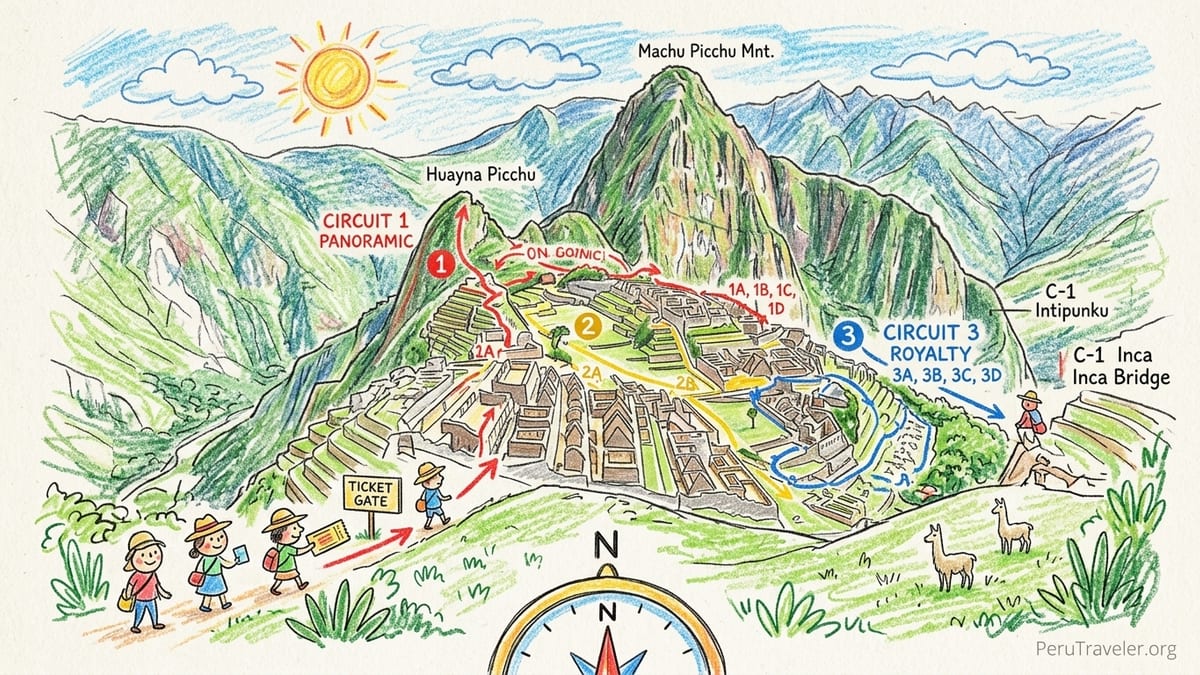
How the New Machu Picchu Circuits Work in 2026
Since mid 2024 the Peruvian Ministry of Culture has reorganized visits to Machu Picchu into three main circuits, divided into ten routes. Every ticket sold for 2026 is tied to one circuit and one route, plus a fixed date and entry time. Once you pass the control gate inside the sanctuary, you must follow the arrows for your circuit and you are not allowed to backtrack or cross into a different route. There is no longer a single “open” ticket that lets you wander everywhere for as long as you like.
Circuit 1 is known as the Panoramic circuit. It focuses on the agricultural terraces and high viewpoints that overlook the site, including the classic postcard view from the upper terraces and access to Machu Picchu Mountain on route 1-A. Circuit 2 is the Classic circuit. It combines a version of the famous panoramic angle with a more complete walk through the central urban ruins, temples and plazas. Circuit 3 is the Royalty circuit, which passes through the lower “royal” sector and gives access to Huayna Picchu, the Great Cavern and Huchuypicchu on specific sub-routes.
The key change that catches many travelers by surprise is that your access to the heart of the ruins is limited by circuit choice. For example, Circuit 1 Panoramic does not automatically include a full walk through the main city streets and temples, and a Huayna Picchu ticket tied to Circuit 3 does not grant you unrestricted freedom to wander back to every viewpoint in Circuits 1 or 2. For a first visit in 2026 or 2027 you should therefore start your planning from the circuit map rather than from train deals or hotel offers.
Daily capacity at Machu Picchu is controlled through these circuits. In recent seasons the Ministry of Culture has authorized around several thousand entries per day, with higher allocations in the high season from roughly June to mid October. Within that total, popular routes such as Circuit 2-A and the Huayna Picchu route 3-A can sell out weeks or months in advance, while less requested options such as 1-B or 3-B may remain available closer to the date. The Tu Boleto system shows remaining spaces for each time slot in real time, so availability is visible as you book.
Circuit 1 Panoramic: Routes 1-A to 1-D
Circuit 1 Panoramic is designed for big views rather than close-up exploration of the stonework. All its routes begin in the agricultural sector and climb to terraces and viewpoints that overlook the entire citadel, with Huayna Picchu rising behind. This is where most travelers take the iconic guardhouse photos that fill guidebooks and social media. Routes on Circuit 1 are labeled 1-A Machu Picchu Mountain, 1-B Upper Terrace, 1-C Intipunku and 1-D Inca Bridge. High season variants open or close depending on conservation needs, but the structure of the circuit remains the same.
Route 1-A includes the demanding hike up Machu Picchu Mountain, which towers above the site on the opposite side from Huayna Picchu. The ascent is steep with many stone steps and can take around three hours round trip at moderate pace, so it is best for fit hikers who are already acclimatized to the altitude. Tickets for 1-A are sold in separate morning time blocks so that hikers finish and exit the mountain trail well before afternoon. This route still focuses on terraces and viewpoints, not the central city streets, so it is ideal for photographers who care more about dramatic wide shots than about seeing every temple interior.
Route 1-B is the simplest way to get the classic balcony-like photograph if you are short on time or not interested in long climbs. From the control gate you follow a rising trail via the upper terraces to the panoramic viewpoints near the guardhouse area, then circle back along a one-way path that descends toward the exit. The walk involves stairs and some moderate inclines, but it is much shorter and easier than the mountain routes. The tradeoff is that you do not descend into the full grid of the urban ruins. Travelers sometimes assume that any Machu Picchu ticket will automatically guide them through the central plaza, but if you only purchase route 1-B you will mainly stay on the upper agricultural side.
Route 1-C to the Sun Gate (Intipunku) and route 1-D to the Inca Bridge add side hikes to the basic panoramic route. The Sun Gate hike is offered primarily in high season between roughly June and mid October and takes you along a section of the original Inca Trail to a lookout above the site. It is a moderately strenuous walk with sustained uphill sections. The Inca Bridge route traverses a narrower trail carved into the cliff with impressive views down to the Urubamba valley. Both routes still begin with the panoramic terraces and both keep your visit mainly in the upper sectors rather than the central city. For travelers with limited mobility, these side hikes are not recommended because of steep drop-offs and uneven steps.
Circuit 2 Classic: The Most Complete First-Time Route
Circuit 2, labeled the Classic circuit by the Ministry of Culture and many tour operators, offers the most balanced experience for a first visit. Its two routes, 2-A and 2-B, both include a climb to an upper viewpoint that provides a version of the iconic Machu Picchu panorama, followed by a structured walk through much of the urban core, including plazas, temples and residential sectors. Many experienced guides and agencies now describe Circuit 2 as the preferred choice for travelers who will only enter Machu Picchu once.
Route 2-A typically begins with a short ascent to terraces that overlook the classic angle, then leads down through the main gate area into the central plaza. From there the path weaves among temples, water channels and staircases. Visitors usually see highlights such as the Temple of the Sun from the outside, the Sacred Plaza with the Principal Temple and the Intihuatana sector, depending on conservation closures in effect that day. While you still must follow a fixed one-way loop, the feeling here is of being immersed in the city rather than viewing it only from above.
Route 2-B, sometimes called the lower terrace route, enters the urban area more quickly and with slightly less climbing to the high terraces. Travelers who compare 2-A and 2-B photos often note that 2-A includes a more elevated version of the postcard view, while 2-B spends more time at eye level in the city streets. In practice, both routes cover similar ground through the central ruins and both are strong choices for a first visit, especially if you are traveling with a family or older relatives who might struggle with very steep panoramic climbs but still want the sense of walking inside an ancient town.
Because Circuit 2 combines both an overview and detailed exploration, its time slots are among the first to sell out in popular months like July and August. For example, a traveler planning to visit during the July school holidays from North America or Europe might find morning entries for 2-A and 2-B fully booked several weeks in advance while late afternoon slots or less in-demand circuits remain. If your whole Machu Picchu dream centers on that iconic view plus walking the city grid, it is wise to secure Circuit 2 as your priority before finalizing trains or hotels.
Circuit 3 Royalty and Huayna Picchu Access
Circuit 3, known as the Royalty circuit, focuses on the lower part of Machu Picchu, including fine masonry sectors traditionally associated with Inca elite use. This circuit is the only one that gives access to Huayna Picchu, the steep peak that appears behind the ruins in most classic photographs, as well as to two smaller side hikes: the Great Cavern (Temple of the Moon) and Huchuypicchu. Routes are labeled 3-A Huayna Picchu, 3-B Designed Route, 3-C Great Cavern and 3-D Huchuypicchu, with some side trails typically operating only in the high season months.
Route 3-A combines a visit through the lower ruins with the ascent of Huayna Picchu. After entering the site and following the lower circuit, you reach a control gate where your Huayna Picchu permit is checked before you begin the climb. The trail is narrow and steep with sections of exposed stone steps, and the full round trip can take around three hours for reasonably fit hikers. Importantly, a Huayna Picchu ticket does not let you wander freely throughout Machu Picchu before or after the hike. Your access is guided by the Circuit 3 pathway, which focuses on the lower and royal sectors rather than the high panoramic terraces and upper city grid of Circuit 2.
Route 3-B offers a designed path through the same lower sectors of the citadel without a major mountain climb. It is often compared to 2-A or 2-B because you still see temples, plazas and fine stonework, but from a slightly different angle and with less access to the highest viewpoints. Some travelers choose 3-B as a second entry after doing Circuit 1 panoramic in the morning or the previous day. It can also be a good option if Circuit 2 is sold out and you still want significant time among the ruins rather than just the terraces.
Routes 3-C to the Great Cavern and 3-D to Huchuypicchu add side hikes that are generally offered only in the high season period, typically from early June to mid October. The Great Cavern route leads down toward a cave-like ceremonial site on the far side of Huayna Picchu and requires a longer, more strenuous walk. Huchuypicchu, by contrast, is a much shorter ascent to a small summit with excellent views that feels more manageable to many visitors than Huayna Picchu itself. Both routes are controlled by limited permits per day and must be selected specifically at purchase, so you cannot decide spontaneously on the mountain once inside Machu Picchu.
Which Circuit for Views, Ruins and Mobility Needs
If your top priority is the famous panoramic photograph of Machu Picchu with Huayna Picchu in the background, both Circuit 1 Panoramic and Circuit 2 Classic can give you that result. Circuit 1-B and 1-C emphasize longer time at the upper terraces and are excellent for photographers who want to experiment with compositions or wait for shifting clouds and light. Circuit 2-A and, to a slightly lesser degree, 2-B provide a similar view but combine it with an immediate descent into the city. In concrete terms, a traveler who dreams of recreating a guidebook cover shot might choose route 1-B for a dedicated “photo morning,” then Circuit 2 the following day for a more complete exploration.
For visitors most interested in walking through the recognizable urban ruins, Circuit 2 is usually the best primary choice. The Classic circuit’s routes pass by the central plaza, religious and residential sectors and many of the iconic spaces that guides focus on in standard explanations of Inca life. Circuit 3-B offers a solid alternative if Circuit 2 is unavailable on your date, though its path is more concentrated in the lower royal sector. By contrast, Circuit 1 is not ideal if you want to feel immersed in the grid of streets and buildings, because its design keeps you mostly on the upper agricultural side.
Huayna Picchu access is tied to Circuit 3 and specifically to routes that include the Huayna Picchu or Great Cavern options. If reaching the summit of Huayna Picchu is important to you, you must select a ticket that explicitly mentions Huayna Picchu or the related mountain routes at the moment of purchase. Purchasing Circuit 2 or Circuit 1 alone will not allow you to add the Huayna Picchu climb once you are at the site. In recent seasons these mountain permits for the most popular time slots have sold out weeks in advance for dates in July, August and late June, so hikers often plan their entire itinerary around the availability of route 3-A.
Travelers with limited mobility or those who are uneasy with steep drop-offs should be cautious when choosing mountain routes and high viewpoints. Circuit 2-B and 3-B are generally more manageable because they involve less extended climbing while still offering meaningful time among the ruins. Circuit 1-B can work for some visitors who are comfortable with moderate stairs to reach the terraces, but the side hikes to Intipunku, the Inca Bridge, Machu Picchu Mountain, Huayna Picchu and the Great Cavern involve narrow paths, many steps and sometimes sections without handrails. In practice, a family traveling with grandparents might choose Circuit 2-B for everyone and reserve a separate mountain circuit only for the younger, fitter members of the group.
Seasonal Routes, Capacity and Booking Windows
Although the basic three-circuit structure remains in place year-round, some individual routes and side hikes operate only during the high season, which the Ministry of Culture has typically defined from 1 June to around 15 October, plus a short period at the end of December. In recent seasons the Sun Gate route 1-C, the Great Cavern route 3-C and the Huchuypicchu route 3-D have been treated as seasonal, opening when weather and conservation conditions allow and closing or reducing capacity outside of peak months. If you are visiting Machu Picchu in November, for example, you might find only a subset of routes visible when you search the official site.
Daily capacity is divided not just by circuit but also by hour. Entry slots are usually organized in one-hour waves from early morning until mid afternoon, and your ticket will show a specific entry time such as 6:00, 7:00 or 13:00. You must present yourself at the control gate within that band and you cannot enter earlier than the printed time. In busy weeks such as late July, the earliest slots for the most sought-after circuits, like 2-A and Huayna Picchu, often disappear first, leaving more availability in mid-morning or early afternoon.
The advance booking window through Tu Boleto has varied while the system stabilizes, but travelers planning for 2026 report that many dates appear progressively during the prior year rather than all at once. For example, people looking for August 2026 entries have seen dates open gradually from late 2025 onwards, sometimes starting with high-season periods. This means that for complex itineraries it is useful to monitor Tu Boleto over several weeks rather than expecting all of 2026 or 2027 to be listed at the same time. Local news from the Ministry of Culture and tourism agencies often signals when new months are added.
Important practical implications follow from these seasonal and capacity rules. If your visit falls in the dry high season and you want Huayna Picchu or the Sun Gate, you should treat the mountain permit as the scarcest resource and book it before trains or hotels. If you are traveling in the rainy shoulder months such as March or November, you might focus on securing a good Circuit 2 slot and accept that some side hikes could be unavailable or more likely to be closed by weather on short notice.
How to Use the Tu Boleto System Step by Step
The official way to buy Machu Picchu tickets for 2026 and beyond is through the Tu Boleto platform operated by the Ministry of Culture. While the interface has evolved and has occasionally experienced heavy traffic, the core steps follow a consistent pattern. First you select the archaeological site, then the circuit and route, date and entry time, and finally you enter personal and passport details before payment.
When you open Tu Boleto, you begin by choosing the site labeled “Llaqta Machupicchu” from the list of cultural destinations. The system then displays available products, which correspond to the different circuits and routes, often including special entries such as “Llaqta Machupicchu – Circuito 3 + Waynapicchu.” You select the product that matches your desired circuit and hike combination, bearing in mind that Huayna Picchu and other mountains are tied to Circuit 3 and Machu Picchu Mountain to Circuit 1. The interface then prompts you to pick a date from the calendar, where you will see which days still have spaces.
After choosing a date, you select an entry time band. The system shows how many spaces remain in each hourly block, for example “50 spaces” at 7:00 or “10 spaces” at 9:00 for a particular route. Once you select your hour, you indicate the number of tickets you want in each category such as adult, student or child. At this stage it is important to double-check that the time bands for any connecting train from Cusco or the Sacred Valley and for the shuttle bus from Aguas Calientes will allow you to be at the Machu Picchu gate at the correct hour.
In the next step Tu Boleto requires personal data for each visitor. You must enter full names, nationality, date of birth and passport or ID numbers. The names and document numbers must match the identification that travelers will show at the entrance gate. If you renew your passport between booking and travel, you should carry both the old and new documents or contact the Ministry or a licensed agency to update the booking details if the system allows modifications at that time. Once all data is entered, you proceed to payment by card. After payment is confirmed, Tu Boleto issues a digital ticket that you should download and save; some travelers print a copy as backup.
On the day of your visit, you must bring your ticket and the original passport or ID used at booking. Entry guards scan the QR code and verify names and document numbers. Because access within Machu Picchu is now strictly tied to the printed circuit and time band, you cannot change circuits or routes once at the gate. If you arrive significantly late for your time slot, admission may be refused or shortened at the discretion of staff, especially on high-demand days.
Current Admission Prices and What Tickets Include
Official admission prices for Machu Picchu are published by the Ministry of Culture in Peruvian soles and may be adjusted periodically. For 2025 and into 2026, foreign adult tickets for the main circuits have generally been in the low to mid hundreds of soles, with separate tariffs for Peruvian nationals and Andean Community citizens at a promotional rate that is significantly lower. Student and child discounts apply with appropriate identification such as an international student card or local school documentation. Since prices can change by government resolution, travelers booking for late 2026 or 2027 should confirm current amounts directly in the Tu Boleto interface at the time of purchase.
Each Machu Picchu ticket includes entrance to the site for a single circuit and one continuous visit, usually lasting around three hours for standard routes and up to five hours when a mountain hike is included. Tickets do not include transportation to Aguas Calientes, train fares on PeruRail or Inca Rail, shuttle buses between town and the site entrance, or the services of a licensed guide. Guided visits can be hired privately or as part of group tours in Cusco, the Sacred Valley or Aguas Calientes, and prices vary depending on language, group size and whether mountain hikes are included.
It is important to separate the different cost components when budgeting. A typical day trip from Cusco in 2026 for a foreign visitor might involve a Machu Picchu entrance ticket purchased on Tu Boleto, a round-trip Expedition or Voyager class train ticket from Ollantaytambo to Aguas Calientes bought directly from the rail operator, shuttle bus tickets purchased either at the bus stop in Aguas Calientes or via the bus company’s channels, and a guided service arranged through a tour agency or independent guide. Each is a separate transaction and being sold out of one component, particularly the circuit ticket, can disrupt the entire day plan.
Mountain permits such as Huayna Picchu and Machu Picchu Mountain carry their own fare bands. When you select a combined product like “Circuit 3 + Huayna Picchu,” the total shown on Tu Boleto integrates both the base circuit entrance and the mountain supplement. Because of limited capacity on the trails, the price per permit can be higher than a standard circuit-only ticket. Families sometimes choose to buy mountain permits only for the adults and older children while younger kids or grandparents use a simpler circuit like 2-B or 3-B at a lower cost.
Rules on Identification, Photography and Ticket Changes
Entry to Machu Picchu in 2026 follows strict identification rules. The name and passport or ID number on each Tu Boleto ticket must match the document the traveler carries at the gate. For foreigners this means the passport they will use to enter Peru. If your passport is renewed after purchase, carrying both the old and new documents is usually the simplest solution. Student and child discounts require valid documentation at the time of entry; if a student card is not presented, staff may require payment of the difference to the adult fare or deny entry at the discounted rate.
Photography inside Machu Picchu is permitted for personal use with handheld cameras and phones. Tripods, drones, large stabilizers, reflectors and professional-looking equipment are either restricted or require a special permit that must be arranged in advance through the Ministry of Culture. Commercial shoots and film productions follow a separate application process with higher fees. In practical terms, most travelers take photographs with smartphones or compact cameras, and security staff may intervene if equipment appears to obstruct pathways or damage the site.
Ticket modifications and cancellations are tightly controlled. In past seasons, limited changes of date or time have sometimes been possible through administrative processes before the day of the visit, often with restrictions and potential penalties, but this is not guaranteed and policies can change. Tu Boleto is primarily designed for nonrefundable, nontransferable tickets tied to a specific person, circuit and date. Because of this, travelers should treat each purchase as final and verify all details before paying. If you miss your entry time by a wide margin, you should not assume that staff will move you to a later slot, particularly on busy days.
Guides remain strongly recommended and in some cases effectively required, especially for first-time visitors. Some travel companies include guiding within a package that also covers train and bus tickets, while others leave entrance purchases to the traveler but coordinate guides to meet at the Machu Picchu gate at a specific hour. When comparing tours, it is worth asking whether the price includes the official circuit ticket or only guiding and transportation. Clear confirmation helps avoid arriving in Aguas Calientes only to discover that you still need to secure a Tu Boleto entry for your chosen date.
Planning Order and Circuit Choices for Different Travelers
When planning a trip to Machu Picchu in 2026 or 2027, the safest booking order is to start with the Machu Picchu circuit ticket itself, then secure train tickets, and finally choose accommodation. This sequence reflects the fact that while there are usually multiple daily trains and many hotels and guesthouses in Aguas Calientes and the Sacred Valley, circuit and mountain allocations on Tu Boleto are strictly limited and cannot be expanded by private operators. For example, a traveler who buys nonrefundable train tickets for a particular morning may later discover that the only remaining Machu Picchu entries that day are in the late afternoon or on a different circuit from the one they wanted.
For a first-time visitor who wants a classic experience without a major hike, Circuit 2-A or 2-B is typically the strongest single choice. These routes deliver a recognizable postcard viewpoint and a thorough walk through the city. A photographer who wants extra time on the terraces for early light might pair 1-B or 1-C at the first morning entry with Circuit 2 in a later slot or on a second day. A hiker focused on summits could plan route 1-A for Machu Picchu Mountain or 3-A for Huayna Picchu and accept that their time in the central ruins will be shaped by those circuits.
Families with younger children often balance attention spans and energy by choosing one circuit that combines views and ruins without very long climbs. Circuit 2-B is a common recommendation in this case because it gives substantial time in the city without demanding the steepest ascents. If older teens are keen on hiking, parents sometimes buy a second set of tickets on a different day for a mountain route like 3-A or 3-D, while younger siblings enjoy a gentler experience with a relative or guide. Repeat visitors may deliberately choose less common routes such as 1-D to the Inca Bridge or 3-C to the Great Cavern to see parts of the sanctuary that most first-timers skip.
To make these decisions more concrete, imagine five travelers with different priorities. A photographer on a short Peru itinerary might fly into Cusco, stay one night in the Sacred Valley and book 1-B at 6:00 for soft morning light on the terraces, then take an afternoon train back. A hiker spending a week in the region might book 3-A Huayna Picchu at 7:00 on the second day after arrival, having already spent one day acclimatizing in Cusco. A family of four from the United States with kids aged 8 and 12 might choose Circuit 2-B at 9:00 to avoid the coldest early morning and save energy. A mobility-conscious traveler recovering from knee surgery might prioritize less stair-heavy sections in Circuit 3-B with a private guide to set a gentle pace. A repeat visitor who has already done Circuit 2 could time a 1-C Sun Gate hike with a clear dry-season sunrise for a new perspective.
FAQ
Q1. Which Machu Picchu circuit is best for a first-time visitor in 2026 or 2027?
For most first-time visitors, Circuit 2 Classic, either route 2-A or 2-B, offers the best balance of the famous panoramic view with an in-depth walk through the central ruins, making it the most complete single choice.
Q2. Does Circuit 1 Panoramic include a full walk through the main Machu Picchu ruins?
No. Circuit 1 Panoramic focuses on terraces and high viewpoints, and even on route 1-B you do not follow the full grid of streets and temples in the urban core, so it should not be your only circuit if you want an immersive city walk.
Q3. How do I get access to Huayna Picchu in 2026?
You must buy a Circuit 3 ticket that specifically includes Huayna Picchu, usually labeled as a combined product such as Circuit 3 with Huayna Picchu on Tu Boleto; other circuits do not grant access to the Huayna Picchu trail.
Q4. Can I change circuits or entry times after buying my ticket on Tu Boleto?
Policies can shift, but tickets are generally treated as nonrefundable and tied to a specific person, circuit, date and time, so you should assume changes are limited or unavailable and check all details before you pay.
Q5. Are student and child discounts available for Machu Picchu tickets?
Yes. The Ministry of Culture offers reduced prices for children and for students with valid documentation, but discounted entries still require correct names and passport or ID numbers that will be checked at the gate.
Q6. How far in advance should I book Machu Picchu tickets for high season?
For visits between roughly June and mid October, especially if you want Circuit 2 or mountain routes like Huayna Picchu, it is wise to start checking Tu Boleto several months in advance and to book as soon as your travel dates are firm.
Q7. Do Machu Picchu tickets include train and shuttle bus costs?
No. Tickets bought on Tu Boleto cover only entrance to the site for a specific circuit and route; trains, buses between Aguas Calientes and the ruins and guiding services are all separate purchases.
Q8. Which circuits are most suitable for visitors with limited mobility?
Circuit 2-B and 3-B are often more manageable because they involve less sustained climbing while still providing meaningful time among the ruins, though any visitor with mobility concerns should discuss options directly with a guide.
Q9. Can I use a tripod or drone to photograph Machu Picchu?
Handheld cameras and phones are allowed for personal use, but tripods, drones and other professional equipment are restricted and typically require special permits that must be arranged in advance.
Q10. In what order should I book Machu Picchu tickets, trains and hotels?
The safest order is to secure your Machu Picchu circuit ticket first on Tu Boleto, then book train tickets that match your entry time, and finally choose accommodation in Aguas Calientes, the Sacred Valley or Cusco around those confirmed times.