


Planning a first trip to Peru can feel overwhelming. Distances are huge, climates swing from coastal desert to high Andes to humid rainforest, and headline attractions like Machu Picchu and the Amazon are expensive. The key is not trying to do everything in one go, but choosing a realistic route that balances time, budget and energy. This guide sets out three bookable itineraries for 7, 10 and 14 days, then walks through real-world transport options, current price ranges and which regions are best left for a second trip.
How To Think About Your First Peru Itinerary
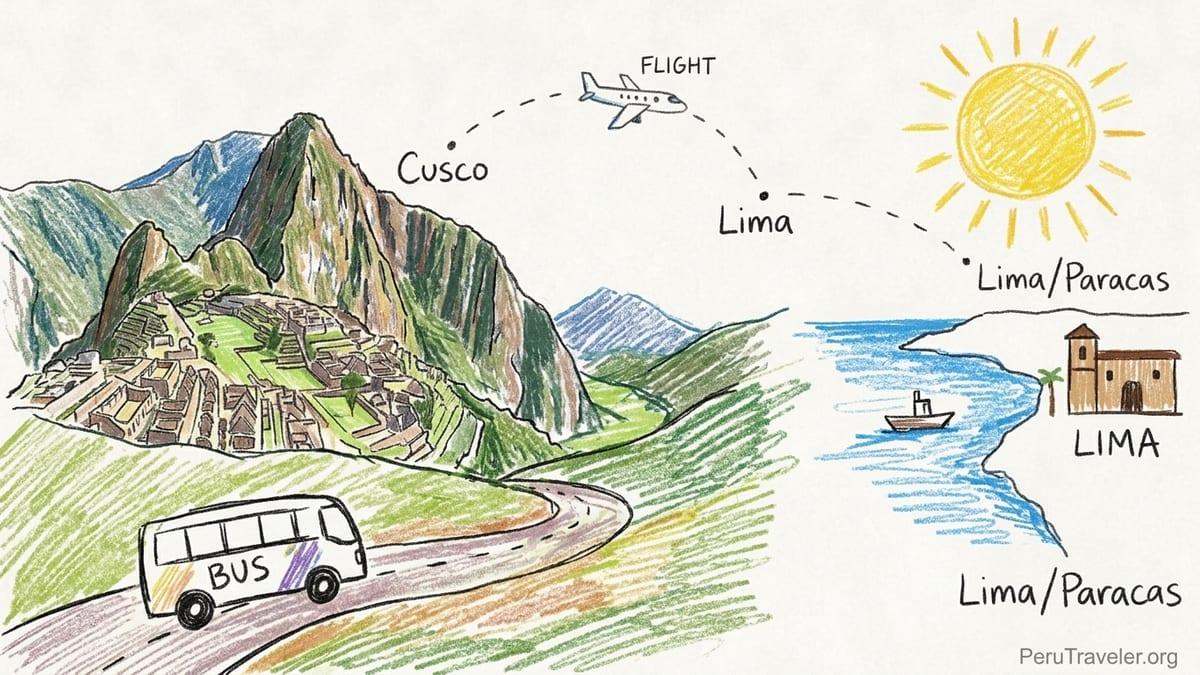
The biggest trap in Peru is trying to cram the entire country into one short holiday. Lima, the Paracas coast, Arequipa and Colca Canyon, Lake Titicaca, Cusco, the Sacred Valley, Machu Picchu and the Amazon each deserve time. Simply moving between them eats into your schedule: Lima to Arequipa by bus takes roughly 17 to 20 hours, Lima to Cusco is a 1 hour 20 minute flight, and even short hops in the Andes can be slow because of winding roads and altitude.
For a first visit of one to two weeks, it makes sense to focus on one coherent region. This usually means a Machu Picchu focused trip combining Lima, Cusco and the Sacred Valley, then deciding whether to add the southern circuit (Arequipa, Colca and Lake Titicaca) or a taster of the Amazon around Puerto Maldonado. You should not expect to see both the entire south and the northern highlights like Huaraz, Trujillo or the Chachapoyas area in two weeks without turning your vacation into a series of night buses.
Costs also rise quickly around the flagship sights. In 2026, a standard foreign adult ticket for a Machu Picchu circuit is in the region of 150 to 165 soles, rising to about 200 soles when a mountain hike such as Huayna Picchu is included. Train services to Machu Picchu Pueblo from Ollantaytambo, operated by companies such as PeruRail and Inca Rail, typically add the equivalent of 80 to 160 US dollars return per person in economy style classes, depending on season and how far in advance you book. When you add shuttle buses, guides and accommodation, a single Machu Picchu day can easily be the most expensive of the trip.
Domestic flights are often the most efficient way to handle Peru’s geography. Airlines such as LATAM, Sky Airline and JetSMART operate multiple daily flights between Lima and Cusco, with several hundred departures a week across carriers. Advance one way fares on these routes are often in the range of 40 to 120 US dollars before luggage, while long distance buses on similar corridors might cost the equivalent of 30 to 60 US dollars but consume 17 to 24 hours of your time. The itineraries below highlight where paying for flights is worth it and where a long bus can make sense if you are on a tighter budget and have extra days.
7 Days: Lima, Cusco, Sacred Valley and Machu Picchu
This one week route focuses entirely on Lima and the Cusco region. It is ideal if you want a concentrated Andean experience built around Machu Picchu without spending half your time in transit. You will still need to accept several early starts but there are no overnight buses.
Day 1 is arrival in Lima. Stay overnight in the Miraflores or Barranco districts for safety, dining options and coastal views. If your international flight lands early, you can explore Lima’s historic center, the Larco Museum or the cliff top parks along the Malecón. The first day is deliberately light to absorb jet lag.
On Day 2 fly from Lima to Cusco. Direct flights run all morning; the flying time is around 1 hour 20 minutes. You have two main choices. The first is to stay that night in Cusco itself, at about 3,400 meters, which gives you immediate access to the city but exposes you straight away to high altitude. The second is to transfer directly from Cusco airport to the Sacred Valley, overnighting in towns like Urubamba or Ollantaytambo at roughly 2,700 to 2,800 meters. Many travelers, especially families and anyone worried about soroche (altitude sickness), choose the Sacred Valley first because the lower elevation and greener surroundings allow a gentler acclimatization.
Days 3 and 4 are for exploring the Sacred Valley and Cusco. If you stay in the Valley on Day 2, you might visit Pisac’s market and hilltop ruins, then the agricultural terraces of Moray and the salt pans of Maras with a local driver or tour. On the following day you can move to Cusco, visiting sites like Sacsayhuamán and Qorikancha. If you stayed in Cusco first, simply invert this order. Expect 1 to 2 hour road transfers between most Sacred Valley sights and Cusco, so each day includes some travel but not full days on the road.
Day 5 is devoted to Machu Picchu. Most travelers take an early morning train from Ollantaytambo to Machu Picchu Pueblo. PeruRail’s Expedition service, for example, has departures around 6 to 7 a.m. that reach the valley town roughly 1.5 hours later, according to 2026 timetables. From there, 25 minute shuttle buses zigzag uphill to the site entrance. You then follow the assigned circuit inside the citadel, often with a guide for around two to three hours. After visiting, you descend back to the town for a late lunch and either stay overnight or return by late afternoon train to Ollantaytambo or Cusco. Trying to commute from Cusco and back in a single day is possible but involves pre-dawn departures and late returns.
Days 6 and 7 bring you back to Lima and home. Many visitors spend one last day enjoying Cusco’s cafes, San Pedro Market or a half day hike, then fly back to Lima on Day 6. Day 7 is a departure day with perhaps a final meal in Lima. The main travel heavy days are Day 2, when you fly to Cusco and transfer by road, and Day 5, which includes train and bus legs to and from Machu Picchu. If you attempt Machu Picchu as a day trip from Cusco, Day 5 becomes almost entirely transit.
10 Days: Adding Arequipa, the Coast or a Short Amazon Stay
With 10 days you can keep the Lima plus Cusco core and add one extra region. Three realistic variants are a southern Andes loop through Arequipa and Colca Canyon, a coastal diversion to Paracas and Huacachina, or a short Amazon experience near Puerto Maldonado. You should choose only one. Attempting to combine all three with Machu Picchu in 10 days will result in a string of pre-dawn departures, altitude jumps and little unstructured time.
The Arequipa option works well for those who like colonial cities and canyon scenery. A common pattern is: Day 1 Lima, Days 2 to 3 Arequipa, Days 4 to 5 Colca Canyon, Days 6 to 9 Cusco, Sacred Valley and Machu Picchu, Day 10 Lima and departure. To keep travel manageable, most travelers fly from Lima to Arequipa on Day 2, a journey of about 1.5 hours, then from Arequipa to Cusco on Day 6. Long distance buses do exist and can cost the equivalent of 30 to 50 US dollars for Lima to Arequipa, but they take in the region of 17 to 20 hours, concentrating an entire day and night into a single transfer. For a 10 day holiday, that is rarely a good trade.
The Paracas and Huacachina coast option suits visitors who want some desert and ocean without the big altitude gains of the Colca Canyon route. A workable itinerary is: Day 1 Lima, Days 2 to 3 Paracas, Day 4 Huacachina, Days 5 to 8 Cusco, Sacred Valley and Machu Picchu, Days 9 to 10 back in Lima or Cusco depending on your departure flight. Travel between Lima and Paracas or Ica is by highway bus or private transfer and usually takes about four hours in each direction. This is a good stretch to use high quality bus companies, as the distance is moderate and top tier operators on the Panamericana Sur include wide reclining seats and onboard refreshments.
The Amazon variant uses Puerto Maldonado as a low commitment rainforest introduction. A common sequence is: Day 1 Lima, Days 2 to 5 Cusco, Sacred Valley and Machu Picchu, Days 6 to 8 Puerto Maldonado, Days 9 to 10 back to Lima via Cusco. Lima to Cusco is flown, then Cusco to Puerto Maldonado takes around 45 minutes by air. From there, lodges use river boats to reach their properties, often 45 to 90 minutes downstream. Many three day lodge packages include meals, guided walks and basic activities such as clay lick visits or canopy towers. This option avoids long buses but adds two extra domestic flights, so costs rise while time remains controlled.
In all three 10 day variants, at least three days are partly consumed by travel. For example, the Arequipa route uses Day 2 and Day 6 as flight and transfer days plus the Machu Picchu transport day. Budget travelers might replace one or both flights with long buses, but those choices must be made knowing that a 17 to 24 hour bus leg can turn a 10 day holiday into just seven functional sightseeing days.
14 Days: A Coherent Southern Circuit With Machu Picchu
Two weeks allows a more substantial route without pretending you can see everywhere. A classic 14 day circuit combines Lima, Arequipa, Colca Canyon, Lake Titicaca around Puno, Cusco, the Sacred Valley and Machu Picchu. You can layer in an Amazon extension if you are willing to trade some city time for additional flights. Trying to add northern Peru or deep jungle lodges on top of all this tends to produce a rushed checklist rather than a satisfying journey.
A realistic pattern begins with Day 1 in Lima, Day 2 flying to Arequipa, and Days 3 to 4 in and around Arequipa itself. The “White City” sits at about 2,300 meters, which is a comfortable stepping stone between sea level Lima and higher altitude destinations. On Day 5 you set out by road toward the Colca Canyon, often overnighting in Chivay or Yanque. The road journey typically takes 4 to 5 hours including a high pass around 4,900 meters, so most of that day is effectively a travel day with scenic stops.
Day 6 is an early start to visit viewpoints such as Cruz del Condor and the villages along the canyon, then continue by road to Puno on the shores of Lake Titicaca. Expect a total of 6 to 8 hours of driving with pauses for lunch and viewpoints, so Days 5 and 6 together form a slow overland transition from Arequipa to Lake Titicaca via Colca. Day 7 is for Lake Titicaca itself, using a full day boat excursion to visit nearby islands. Many tours visit the floating Uros communities and one of the traditional islands like Taquile. You sleep again in Puno.
On Day 8 the route turns toward Cusco. You can travel by tourist bus, a journey of roughly 9 to 10 hours that includes stops at Andahuaylillas, Raqchi and high Andean viewpoints, or by train services operating between Puno and Cusco on select days. Either way, most of the day is transit. Days 9 and 10 are then focused on Cusco, giving you time to adjust to 3,400 meters while exploring the historic center, nearby ruins and local food. That buffer is also important if you have felt any altitude issues around Colca or Puno.
Day 11 moves into the Sacred Valley, often overnighting in Ollantaytambo. You can visit sites such as Pisac or Moray and Maras on the way. Day 12 is the Machu Picchu day, using the same train and shuttle combination from Ollantaytambo to Machu Picchu Pueblo and then to the citadel. Some travelers choose to stay overnight in the valley town and return the following morning for a second entry, particularly if they have secured a mountain hike slot which often carries an earlier entrance time. Day 13 returns you to Cusco or straight to Lima via a Cusco flight, and Day 14 is reserved for departure.
If you want to include a short Amazon visit without turning the trip into a marathon of airports, one option is to trim Arequipa or Puno by a night and insert a three day lodge package from Puerto Maldonado at the end. You would then fly from Cusco to Puerto Maldonado for Days 12 to 13, and from Puerto Maldonado back to Lima on Day 14 with a connection if necessary. What you should not do is add both Puerto Maldonado and more remote Amazon destinations such as Iquitos or Manu inside the same 14 day loop. Those regions require extra flights or long boat journeys and are far better suited to a second trip focused on Amazonia rather than squeezed into an already full southern Andes circuit.
Flights, Buses and Trains: Choosing Your Transport Wisely
Domestic flights in Peru are usually the best way to bridge long distances when time is limited. On Lima to Cusco, the busiest interior route, there are dozens of weekly non-stop flights with airlines like LATAM and Sky Airline. Advance fares can be as low as the equivalent of 40 to 60 US dollars one way in basic economy during sales, rising to around 100 to 150 dollars for more flexible options with luggage included. Flights between Lima and Arequipa, and between Cusco and Puerto Maldonado or Juliaca (for Puno), show a similar pattern, with short flying times and modest price swings compared to the value of a saved day.
Long distance buses remain the budget backbone, especially on the coastal highway and between southern cities. Reputable companies such as Cruz del Sur publish fares and durations on their own route pages. For example, recent schedules for Lima to Arequipa list approximate durations between 17 hours 15 minutes and 20 hours, with lowest fares in the area of 140 Peruvian soles in semi-cama classes. Similar services between Arequipa and Cusco are shorter, usually around 10 hours, and priced accordingly. Choosing these buses can save roughly half the cost of equivalent flights, especially when luggage and peak season markups are considered, but at the expense of one or more entire days of your itinerary.
When itineraries mention “mostly a travel day,” they often refer to these 9 to 20 hour stretches. An overnight bus from Lima to Arequipa, for instance, might leave around 5 to 9 p.m. and arrive late morning the following day. Even with wide reclining seats and meals on board, many travelers find they need part of the arrival day to rest. Over the span of a 14 day trip, stacking multiple overnight buses can mean you functionally lose three or four sightseeing days. This trade-off can make sense for extended backpacking trips but deserves careful consideration on a short holiday.
Trains in Peru play a specialized role, most prominently on the corridor to Machu Picchu. PeruRail’s Expedition and Vistadome trains and Inca Rail’s Voyager and 360 classes connect Cusco or the Sacred Valley to Machu Picchu Pueblo in 1.5 to 3.5 hours depending on the departure station. Timetables for 2026 show early morning departures from Ollantaytambo around 6 to 7 a.m. that reach Machu Picchu Pueblo before 8 a.m., aligning with morning entrance slots inside the citadel. Basic tourist classes are typically priced in the rough range of 40 to 80 US dollars each way, with more panoramic or luxury services costing more. Because there is no regular road into Machu Picchu Pueblo for private vehicles, these trains are not optional if you want to visit the site in comfort.
Budgeting: Economy, Midrange and Premium Scenarios
Peru can be travelled on a wide range of budgets, but major costs usually fall into several categories: domestic flights, long distance buses, trains to Machu Picchu, Machu Picchu entry and guided services, accommodation, tours and activities, meals, local transport and travel insurance. Below are broad 2026 ranges for a one to two week trip, using US dollars for clarity and assuming prices that are widely reported by airlines, train operators, government sources and current traveler accounts.
In the economy bracket, backpacker style travelers using long distance buses where practical and hostels or basic guesthouses can sometimes keep average daily spend excluding international flights around 50 to 80 dollars per person. This might look like 10 to 20 dollars for a dorm bed or simple room, 10 to 15 dollars for street food and menu lunches, another 10 to 20 dollars for local transport and small tours, and then concentrated splurges on items such as Machu Picchu. A bare bones Machu Picchu visit could involve a standard entrance ticket in the region of 45 to 55 dollars equivalent, a return Expedition or Voyager class train at perhaps 80 to 140 dollars, the shuttle bus for roughly 24 to 30 dollars return, and joining a shared guide at the gate for around 10 to 20 dollars. That single day can run 160 to 240 dollars even on an otherwise frugal trip.
Midrange travelers staying in comfortable small hotels and mixing flights with some buses tend to see daily budgets of 120 to 200 dollars per person before international flights. In this scenario, accommodation is often 40 to 90 dollars per night for a double or twin, domestic flights between main cities booked in advance for 60 to 150 dollars each segment including bags, and more frequent paid excursions such as full day Sacred Valley tours, Colca Canyon outings or Lake Titicaca boats that run in the broad zone of 30 to 100 dollars per day trip depending on inclusions. Machu Picchu costs remain similar in structure but travelers in this category might opt for more flexible train times or upgraded classes.
Premium trips, using boutique properties, private guides and a higher proportion of internal flights, can easily reach 300 dollars per person per day and beyond. Deluxe trains to Machu Picchu, such as the luxury services on the route, can cost several hundred dollars per person for the train alone. Multi day small group or private packages advertised by international tour companies for classic routes like a 10 day Lima, Sacred Valley, Machu Picchu and Amazon combination often display per person land prices from approximately 2,500 dollars upward in 2026, excluding international flights, which averages out to 250 dollars per day plus tips and personal spending.
Travel insurance should be treated as a fixed cost rather than an optional extra. Policies that include medical cover at altitude, trip interruption and baggage protection for a one to two week Peru stay often fall somewhere in the 60 to 150 dollar range per person for many travelers based in North America or Europe, depending on age and coverage levels. Given the cost of a missed Machu Picchu day due to weather, strikes or illness, and the expense of emergency evacuation from remote areas, that premium buys important peace of mind.
Independent Travel vs Small Group Tours
Independent travel in Peru is entirely feasible for those comfortable with booking transport and accommodation online and dealing with Spanish in simple situations. Domestic flights, long distance buses and Machu Picchu components can now all be bought through official or well known platforms, though government ticket websites may be temperamental and some foreign cards struggle with payment. Typical independent travelers book their Lima and Cusco hotels, domestic flights and trains in advance, then leave more flexible days in places like Arequipa or Puno to arrange tours on arrival.
The main advantages of independent travel are price control and flexibility. Booking Machu Picchu yourself using the official ticket platform, choosing a standard train and a modest hotel in Ollantaytambo or Machu Picchu Pueblo, and organizing a guide at the entrance usually works out cheaper than all inclusive packages. You can also adjust your route in response to strikes, weather reports or personal energy levels, something that can be vital in a country where occasional protests may block highways or airports for a day or two.
Small group tours, on the other hand, bundle logistics and can be good value when they include costly items. An 8 to 12 day group itinerary that covers Lima, Cusco, the Sacred Valley, Machu Picchu and perhaps either Lake Titicaca or the Amazon might advertise a land price starting around 1,800 to 3,000 dollars per person in twin share accommodation in 2026 with reputable international operators. These prices usually include domestic flights, most transfers, Machu Picchu tickets, train services, some meals and the services of a tour leader and local guides, which removes a lot of planning stress.
The trade-offs with small groups are less freedom and fixed pacing. You may find yourself visiting sites at crowded times or spending time in places that do not match your interests simply because of the group schedule. Solo travelers sometimes appreciate the social side of groups and the reduced single supplement that some companies now offer, whereas families might prefer private arrangements to keep early starts and meal times kid friendly. When comparing costs, it is worth adding up all the separate elements of an independent plan, including airport transfers and guides, and comparing that total to group tour brochures to see which model aligns with your budget and appetite for organization.
Who Each Route Is Best For and What To Save For Next Time
The 7 day Lima, Cusco, Sacred Valley and Machu Picchu itinerary is the most concentrated and works best for first time visitors who have limited holiday time but want the headline Andean experience. It is also often the most suitable for families with school age children, as it keeps travel segments fairly short and allows you to base yourselves in just two or three hotels. Couples on a first South America trip who are wary of too much moving around also tend to appreciate the simplicity of this route.
The 10 day itineraries add a layer of personality to that core. The Arequipa and Colca variant suits travelers who enjoy historic centers, landscape photography and cooler climates, including many couples and older travelers who value a gradual ascent through altitude levels. The Paracas and Huacachina coast option often appeals to younger travelers and families who want wildlife boat trips, dune buggy rides and some warm beach time to break up the city and mountain days. The Puerto Maldonado add-on is the better choice for nature lovers who want a first look at the Amazon but are not ready to structure an entire trip around rainforest lodges.
The 14 day southern circuit is the natural choice for hiking enthusiasts and culture focused travelers with enough vacation time to explore beyond Machu Picchu. The inclusion of Arequipa, Colca, Lake Titicaca and Cusco in one continuous overland loop delivers a strong sense of how southern Peru fits together, provided you accept that several days are largely given over to driving. Independent travelers who are comfortable at altitude and willing to handle bus bookings often get the most out of this route, though well designed small group tours can also follow a similar pattern with the added reassurance of local support.
Some regions are better held for a second trip. Northern Peru’s Cordillera Blanca around Huaraz, archaeological sites such as Kuelap and Chan Chan, the surf towns of the north coast, and the deeper Amazon areas around Iquitos or longer expeditions into Manu National Park all demand their own substantial time windows and extra logistics. Trying to fold them into a 14 day southern Andes circuit will either lead to superficial glimpses or force you to abandon key experiences like sunrise at Machu Picchu and unhurried days in the Sacred Valley. Treat your first itinerary as a foundation and return later to explore the parts of Peru that did not fit this time.
Whichever route you choose, the most important planning decisions happen before you book. Fix your number of nights, decide whether you will prioritize mountains, coast or jungle, and be honest about how many long travel days you are willing to accept. Build Machu Picchu and any Amazon stays around those answers, and you will arrive in Peru with an itinerary that feels ambitious but not exhausting, with enough room left for unplanned markets, plazas and viewpoints along the way.
FAQ
Q1. How far in advance should I book Machu Picchu tickets and trains?
For high season months such as June to August or around public holidays, it is wise to secure Machu Picchu entrance tickets and train seats as soon as your dates are fixed, often several months in advance. Entrance quotas and specific time slots mean that last minute options can sell out, particularly for popular morning circuits and mountain hikes, so early booking greatly reduces stress.
Q2. Is it better to stay in Cusco or the Sacred Valley first?
If you are concerned about altitude, starting in the Sacred Valley is usually gentler because towns like Urubamba and Ollantaytambo sit several hundred meters lower than Cusco. Many travelers fly into Cusco and transfer straight to a hotel in the Valley for the first one or two nights, then move up to Cusco once their bodies have adjusted. If you are already experienced at high altitude, beginning in Cusco can be convenient for city exploration.
Q3. Can I visit Machu Picchu as a day trip from Cusco?
Yes, it is physically possible to visit Machu Picchu as a long day trip from Cusco by taking an early train and returning in the evening, but it makes for a very long day. You will likely leave your hotel before dawn and return after dark, with several hours spent in transit. Many travelers prefer to stay at least one night in the Sacred Valley or in Machu Picchu Pueblo to make the experience more relaxed.
Q4. Are long distance buses in Peru safe and comfortable?
Major companies on popular routes invest in modern coaches with reclining seats, seat belts and on board staff, and they are widely used by both locals and tourists. Safety standards, driving styles and road conditions can vary, so it is worth choosing well regarded operators for overnight or mountain journeys and avoiding unregistered street vendors when buying tickets.
Q5. How much should I budget per day for a trip to Peru?
Economy travelers often manage on around 50 to 80 US dollars per day excluding international flights by using buses, hostels and local eateries, while midrange visitors who prefer private rooms, a mix of flights and some organized tours usually spend around 120 to 200 dollars per day. Premium itineraries with boutique hotels and private guides can climb to 300 dollars per day or more, especially when multiple internal flights and luxury train services are included.
Q6. Do I need a tour guide at Machu Picchu?
Regulations have evolved over time, but having a knowledgeable guide at Machu Picchu greatly enhances the experience and helps you navigate the one way circuits efficiently. You can either pre book a guide through a reputable agency or hire one at the entrance, where shared group services and private guiding are both available, with prices varying according to language and group size.
Q7. Which of the 7, 10 and 14 day routes is best for families?
Families with children often find the 7 day Lima, Cusco, Sacred Valley and Machu Picchu itinerary the most manageable because it minimizes one night stops and long travel days. The 10 day coastal variation with Paracas and Huacachina can also work well for kids who enjoy boat trips and sand dunes, provided you build in rest time between activities and keep altitude changes gradual.
Q8. Is the Amazon in Puerto Maldonado worth it for a short stay?
For travelers short on time who still want a taste of the rainforest, a three day lodge package near Puerto Maldonado can be a good compromise. It adds extra flights and some cost but offers easy access to wildlife watching, river boat rides and jungle walks without the long boat journeys required by more remote reserves, making it practical to tag onto a Machu Picchu focused itinerary.
Q9. Can I see both Lake Titicaca and the Amazon in a 10 day trip?
It is technically possible, but doing both Lake Titicaca and an Amazon lodge in just 10 days usually leads to a rushed schedule with many days consumed by transport. Most travelers get more out of their time by choosing either the southern Andes loop including Titicaca or a Machu Picchu plus Amazon combination, then planning a return visit to cover what they skipped.
Q10. Which regions of Peru are better left for a second trip?
Northern Peru, including the Cordillera Blanca mountains around Huaraz, the archaeological sites of Kuelap and Chan Chan, and the warmer surf beaches, as well as deeper Amazon areas like Iquitos or extended journeys into Manu National Park, generally deserve dedicated itineraries. These destinations require extra travel time and often additional flights or long drives, so they fit best into a separate trip once you have already explored the southern Andes and Machu Picchu.