


After years of writing about trails I had not yet walked, I finally fixed that gap in the most direct way possible: I booked the classic 4‑day Inca Trail to Machu Picchu and, a year later, returned to Peru for the 5‑day Salkantay Trek. I used reputable operators, paid my own way, and took detailed notes on everything from permits and booking stress to toilet conditions at 4,600 meters. This comparison is written from that first‑hand perspective because choosing between these two routes is one of the most important decisions many travelers make about their Machu Picchu trip.
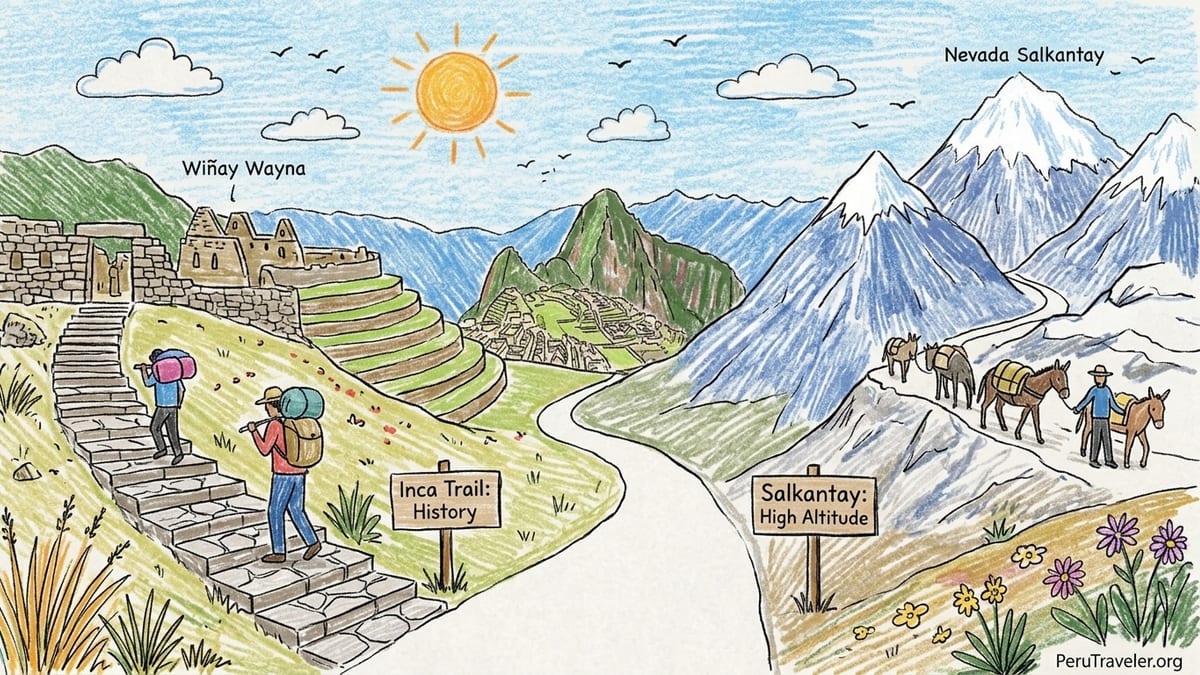
The Core Difference: History vs High Altitude
The Classic Inca Trail and the Salkantay Trek both end in the same place, but they feel like completely different journeys. On the Inca Trail, almost every hour passes along original stone paving, Inca staircases and archaeological sites that only permit holders can access. You climb through three high passes, cross cloud forest and finally reach Machu Picchu through Intipunku, the Sun Gate, or as close as current access rules allow. The focus is cultural immersion and walking quite literally in Inca footsteps.
Salkantay is defined instead by mountain exposure and big, open landscapes. The highest point at Abra Salkantay is around 4,630 meters, roughly 400 meters higher than the Inca Trail’s Dead Woman’s Pass. You begin near the snow‑covered Salkantay massif, pass turquoise Humantay Lake, then drop into coffee and fruit country before following the road or railway corridor via the hydroelectric station to Aguas Calientes. There are far fewer ruins on route; the reward here is towering peaks, glaciers and a stronger sense of wilderness.
If your mental picture of Peru is stone terraces and hidden citadels, the Inca Trail aligns closely with that expectation. If you dream of long days under huge skies and are comfortable at higher altitude, Salkantay delivers more dramatic mountain scenery. Both treks, however, demand several days of continuous hiking, basic camping tolerance and a realistic attitude to toilets, weather and early starts.
From my own experience, the emotional payoff on the Inca Trail came from the feeling of earning a historical arrival. On Salkantay, the big memory is standing at the windy pass with Salkantay’s ice walls above and the Sacred Valley falling away on the far side. They are not interchangeable routes, and that is exactly why the decision matters.
Permits, Booking Stress and How Far Ahead You Must Plan
The Inca Trail has one of the tightest permit systems of any trekking route in the world. Only a fixed number of people are allowed onto the classic four‑day section each day, and permits are controlled by Peru’s Ministry of Culture. You cannot buy them directly as a solo traveler; you must book through a licensed agency or tour operator, and the permit is issued in your name with passport details. Permits for popular months such as June to August can sell out many months ahead, and the entire trail closes every February for maintenance and conservation. If you see a February Inca Trail departure advertised, you should assume it is a different route or a misunderstanding.
For my own Inca Trail hike, I booked with a mid‑range Cusco‑based operator around five months ahead for a departure in early May. Available dates were already limited on their calendar, and the agency double‑checked my passport number twice because any mismatch can invalidate the permit at the checkpoint at Kilometer 82. Current comparisons of Inca Trail tours show typical group four‑day packages in late 2026 priced from roughly 770 to 1,100 US dollars per person for standard service, with premium or private options far above that. Those prices include the permit and basic train ticket back to the Sacred Valley, which are non‑negotiable costs built into every legal Inca Trail tour.
Salkantay is far more flexible. There is no equivalent national permit quota for the trekking section, and various agencies offer 4‑ and 5‑day itineraries with daily or near‑daily departures in peak season. A classic 5‑day Salkantay package that includes Machu Picchu entry, three nights of camping, one night in Aguas Calientes and the return train typically appears around 640 to 700 US dollars at 2026 list prices, with budget promotions lower and high‑comfort “dome” options higher. Because there is no central permit release day, you can often book just a few weeks out or even from Cusco, provided there are still Machu Picchu entry tickets and train seats available for your chosen date.
In practical terms, this meant that my Inca Trail required early commitment, fixed dates and non‑refundable deposits tied to a specific passport number. Salkantay felt more like booking a standard multi‑day tour: I compared several operators in Cusco, checked recent reviews, confirmed the Machu Picchu entry circuit included, then paid a smaller deposit about six weeks before the trip. If you are deciding today, the key point is that the Inca Trail still demands long‑range planning and sells out, while Salkantay remains a flexible option for travelers who cannot confirm vacation dates so far in advance.
Operators, Group Size, Guides and Support Teams
Because of the permit rules, all Inca Trail trekkers must travel with a licensed operator. On my four‑day hike, the agency provided one lead guide and an assistant for a group of 12, plus a crew of porters and a cook. The lead guide held an official Peruvian mountain guide credential, spoke excellent English, and had walked the trail hundreds of times. Porter weight limits are regulated, so the company provided conspicuous weighing scales at the trailhead and issued uniform duffel bags with strict maximums. Porters carried group equipment and up to a set amount of personal gear per hiker, while we each carried our own daypacks.
Salkantay operators are more diverse, ranging from very bare‑bones outfits to companies that market “glamping” domes and heated mountain huts. On my 5‑day Salkantay trek, I chose a mid‑range operator again, but the crew makeup was different. We had one main guide for a group of 14, a smaller team of muleteers instead of porters during the high‑altitude days, and only one cook. Packhorses transported the bulk of the gear up to the pass and down to the first valley campsite, after which we transitioned to road‑accessible camps and, eventually, a night in a simple Aguas Calientes guesthouse. The guide still had formal training and spoke two languages, but the overall structure felt slightly less tightly regulated than on the Inca Trail.
The guiding quality on both routes was excellent in my case, but there were differences in style. On the Inca Trail, our guide gave detailed explanations at archaeological sites, used Quechua terms for plants and place names, and organized short, quiet moments at viewpoints such as Runkurakay and Phuyupatamarca to appreciate the history. On Salkantay, the emphasis shifted toward pacing at altitude, monitoring guests for early signs of soroche, and discussing local farming and coffee production once we reached lower elevations. If you value in‑depth interpretation of Inca history, the Inca Trail guides are often in their element. If you prefer mountain‑guide pragmatism focused on safety and logistics, strong Salkantay operators specialize in that rhythm.
Porter and mule conditions are an important ethical consideration. On the Inca Trail, the permit framework has pushed agencies toward more formal standards around maximum loads and meals for porters, though real enforcement still varies. Check for operators that publish porter welfare policies, weight limits and gear provisions. On Salkantay, pack animals take the place of many human porters, but muleteers still rely heavily on trek income. I found that tipping customs were more informal on Salkantay, whereas the Inca Trail operator provided a suggested range for collective porter and cook tips at the pre‑departure briefing.
Day‑by‑Day: How the Routes Actually Unfold
The classic 4‑day Inca Trail starts at Kilometer 82 on the railway line after a drive from Cusco or the Sacred Valley. Day 1 is a relatively gentle warm‑up, walking along the Urubamba River past the Llactapata ruins before turning into a narrower valley. You camp near small settlements such as Ayapata or Wayllabamba. Day 2 is widely regarded as the hardest: a steady and at times punishing climb up stone steps to Warmiwañusqa, Dead Woman’s Pass, at about 4,215 meters, followed by a long and steep descent of more stone stairs to the second campsite.
Day 3 is the most varied and, for many, the most beautiful. You traverse two smaller passes, visit sites such as Runkurakay, Sayacmarca and Phuyupatamarca, and spend hours on original Inca stone pavement. The trail contours along cloud‑forested slopes, often with orchids, moss‑covered walls and glimpses of the Urubamba far below. The third night is usually spent at Wiñay Wayna or a nearby campsite with toilets, a simple canteen and showers that may or may not have hot water. Day 4 begins in the dark. You line up at the final control gate well before dawn, then walk the last stretch, including a short but very steep staircase sometimes called the “Gringo Killer,” up to Intipunku. Depending on current circuit rules, you either look down on Machu Picchu from there or loop to the main entrance to begin your timed visit inside the citadel.
The 5‑day Salkantay Trek I walked began with an early departure from Cusco to Mollepata and then up to the Soraypampa trailhead. Day 1 included an acclimatization hike to Humantay Lake, a vivid turquoise glacial lagoon framed by peaks, then camping at Soraypampa around 3,900 meters. Day 2 was the high point in every sense: a gradual climb to Abra Salkantay at roughly 4,630 meters, where wind and cold can be intense, followed by a long descent through rocky terrain into a greener valley. That evening we camped near Chaullay or Collpapampa at much lower altitude, where the air felt suddenly thick and mild.
Day 3 continued down into dense vegetation and warmer temperatures, passing small hamlets with coffee and fruit stands before reaching an area near Lucmabamba or Playa Sahuayaco. Some itineraries offer side trips to local hot springs. Day 4 typically climbs again on an old Inca‑era path to the viewpoint and small ruins of Llactapata, which give a distant but clear view across a deep valley to Machu Picchu. From there the route drops to the Hidroeléctrica station, where most groups either walk along the railway alignment or take a short train ride to Aguas Calientes, also known as Machu Picchu Pueblo. Day 5 is dedicated to visiting Machu Picchu itself, then taking the afternoon or evening train back toward Ollantaytambo and onward by road to Cusco.
Crucially, the Inca Trail gives you a sense of continuous, ancient pathway directly into the sanctuary. Salkantay is more of a composite journey: a high‑mountain trek that connects, eventually, to the modern logistic spine of roads, rails and the town at Machu Picchu’s base. Both end with a guided tour of the citadel, but how you arrive shapes how the experience feels.
Altitude, Stairs, Daily Distance and Physical Difficulty
Physically, these treks challenge you in different ways. The Inca Trail’s maximum altitude of about 4,215 meters is lower than Salkantay’s 4,630‑meter pass, but the trail is famous for its relentless stone stairs. Day 2 in particular involves several hours of climbing steps, many uneven and high, followed by several more hours of steep descent. My knees felt far more battered at the end of Day 2 on the Inca Trail than after any single day on Salkantay, despite the lower altitude. Trekking poles were not optional comfort items for me; they were essential, especially on wet stone.
Salkantay’s difficulty is concentrated around altitude. Sleeping at nearly 3,900 meters on the first night and crossing 4,630 meters on the second day puts you in thinner air for longer than on the Inca Trail. The pass itself is not technically difficult; the path is wide and clear, but the combination of cold, wind and limited oxygen means you move more slowly, and even modest inclines can leave you short of breath. The longer descent after the pass, often on loose dirt and stones, can be tough on ankles and knees when you are already tired. Once you drop into the valley, however, the oxygen increase is noticeable, and the remaining days are more about endurance than raw exertion.
Daily distances give another lens. Typical 4‑day Inca Trail itineraries cover roughly 10 to 12 kilometers on Day 1, 7 to 9 on the big climbing day, and 12 to 15 on the long Day 3 traverse and descent, with a short final walk to the Sun Gate. The Salkantay 5‑day route commonly totals around 60 kilometers, with the longest days being the high‑pass day and the walk from Llactapata or Hidroeléctrica to Aguas Calientes if you choose not to take the train. While these numbers sound modest, the combination of altitude, stairs, early starts and repetitive motion adds up.
From a risk perspective, altitude sickness is a real concern on both treks and should never be minimized. I acclimatized for several days in Cusco and the Sacred Valley before each hike and still felt the thin air on Dead Woman’s Pass and even more so approaching Abra Salkantay. Good operators monitor guests, carry oxygen and have protocols to turn back or descend if needed, but ultimate responsibility for listening to your body lies with you. Travelers with known heart, lung or severe anemia issues should consult a medical professional before booking, and everyone should allow extra days in Cusco both for acclimatization and in case weather or strikes disrupt transport.
Food, Water, Weather, Toilets and Campsites
On both treks I ate surprisingly well, but the patterns differed. Inca Trail outfits have refined their field kitchens over decades. Breakfasts included porridge, eggs and bread; lunches and dinners were multi‑course meals with soup, a main dish of rice or quinoa with vegetables and usually some form of meat, and tea. Water was boiled or filtered on site and refilled morning and evening in personal bottles. Because you are far from villages after the first day, almost everything comes with the porter train. Allergies and vegetarian or vegan needs can be accommodated by good operators if flagged in advance.
Salkantay meals felt a little more variable and dependent on operator and route. Our cook produced hearty dishes similar to the Inca Trail on the first couple of nights, but once we reached road‑accessible valleys, lunches sometimes took place in basic roadside restaurants or community dining rooms. Fresh fruit and coffee became more prominent, reflecting the local agriculture. Water was a mix of boiled refills at camp and purchased bottled water at small kiosks, particularly lower down. While I never got sick, I was more careful with hand hygiene and avoided raw salads at lower‑elevation stops.
Weather on both routes is strongly seasonal. The drier months from roughly May to September offer clearer skies and lower rain risk but colder nights, especially at altitude. On my Inca Trail in May, night temperatures near the high passes dropped close to freezing, with heavy condensation on tents. On Salkantay in June, the night at Soraypampa was even colder; frost coated the tent and water bottles were icy at dawn. By contrast, the lower camps near Lucmabamba were almost subtropical at night, with humidity, insects and the sound of the river. Proper layering, including a warm hat, gloves and a genuinely warm sleeping bag, mattered more than any other single gear choice.
Toilets and campsite conditions are an area where expectations must be realistic. The Inca Trail has designated campsites with basic toilet blocks, some with water for bucket flushing and occasionally cold showers. Cleanliness varies by day and crowd levels, and even a well‑maintained block can feel rough compared with hotel standards. Many trekkers prefer to carry small amounts of toilet paper and hand sanitizer. On Salkantay, the first high camps had very basic outhouse‑style toilets and minimal washing facilities. Once we reached lower villages, toilet quality improved slightly, but the final night in Aguas Calientes was the first time in days I could enjoy a proper hot shower. If these details are decisive for you, the shift to guesthouse accommodation on Salkantay’s final night can be a modest advantage.
Money: What I Actually Paid vs Current Cost Ranges
Total cost is one of the biggest differences between these treks when you include everything from rental equipment to tipping. For my 4‑day Inca Trail, the base tour price was in the mid‑range of current offerings, similar to today’s 800 to 900 US dollar standard packages that bundle the permit, guide, porters, tents, meals, Machu Picchu entry and a basic Expedition‑class train back toward Cusco. I then rented a sleeping bag and trekking poles from the operator for a combined fee that brought my pre‑tip total above 900 dollars. Tips for porters, cook and guides added roughly 80 to 120 dollars per person at the levels suggested in the briefing. Factoring in pre‑ and post‑trek hotel nights in Cusco and incidentals, a realistic four‑day Inca Trail budget today often lands somewhere between 1,100 and 1,400 US dollars per person for a mid‑range experience.
My Salkantay 5‑day trek, booked with a similar level of operator, cost less despite being longer. That pattern still holds in 2026. Classic 5‑day Salkantay packages that include Machu Picchu, three camping nights, one Aguas Calientes hotel night and the return train typically sit in the 640 to 700 US dollar range for group departures, with some budget offers lower if you arrange your own gear and accept simpler transport classes. Extras such as sleeping bag and pole rental, hot spring entry and optional train from Hidroeléctrica to Aguas Calientes added around 50 to 80 dollars for me. Tips came in slightly lower than on the Inca Trail because the support team was smaller. Adding Cusco hotel nights and meals in town, a realistic all‑in budget for a 5‑day Salkantay experience today often falls between 900 and 1,200 US dollars per person for a similar comfort level.
It is important to stress that cheaper is not always better. Offers that look dramatically lower than these ranges may exclude the Machu Picchu entry ticket, use overcrowded camps or underpay porters and muleteers. Conversely, luxury packages for both routes can exceed 1,500 to 2,000 US dollars per person by adding high‑end domes, private porters and premium train services. From my perspective, the meaningful comparison is that, at equivalent mid‑range quality, the classic Inca Trail typically costs several hundred dollars more for fewer days of hiking than Salkantay. The extra money is going primarily toward the permit and the right to walk that protected historic corridor.
Short Inca Trail and Other Alternatives
Not everyone has the time, budget or inclination for a four‑day camping trek. The Short Inca Trail offers a compromise that I seriously considered before deciding to commit to the full route. This two‑day option involves a train ride partway toward Machu Picchu, followed by a one‑day hike on the final section of the Inca Trail that passes Wiñay Wayna and arrives at Machu Picchu via Intipunku, with a night in a hotel rather than multiple nights in tents. It still requires a permit, though availability tends to be better than for the full four‑day route, and you avoid the highest passes and the bulk of the stone stairs.
Friends who have taken the Short Inca Trail describe it as a strong option for travelers who mainly want the symbolic arrival via the Sun Gate without committing to three nights of camping and a months‑in‑advance booking race. Prices are generally lower than the full trail but higher than standard Salkantay tours because the permit and train elements remain significant costs. From a pure experience standpoint, you lose the cumulative sense of walking an ancient highway for days, but you still enjoy one full day on original stone pavement, one major archaeological site en route and that iconic approach.
Other alternatives like the Lares Trek and various Sacred Valley lodge‑to‑lodge itineraries also reach Machu Picchu using different approaches. I have not hiked these yet and therefore will not rank them, but if you are particularly sensitive to altitude or value homestay‑style cultural experiences, it is worth comparing them with Salkantay. The key is to verify exactly how each itinerary connects to Machu Picchu itself, which train class is included and which tickets or extras you must buy separately.
My Verdict: Expectations, High Points, Disappointments and Which I Would Repeat
Going into the Inca Trail, I expected a historic pilgrimage with some tough hiking. The reality matched that image closely, especially on Day 3 when we traversed ancient stone paths past terraces and hidden ruins in shifting cloud. My hardest day was undeniably Day 2, when the combination of continuous stairs, thinning air and a long descent left my legs shaking by late afternoon. The most disappointing aspect was how busy certain stretches felt; even with permit limits, some sections near popular viewpoints and campsites created bottlenecks, and arriving at the Sun Gate among several groups reduced the solitude of the moment.
For Salkantay, I expected a cheaper, rougher and more remote alternative. The hardest day again was the high‑point day, but this time because of altitude and weather, not stairs. The climb to Abra Salkantay was steady but the wind and cold at the top made every photo quick and slightly breathless. My disappointment there was less about crowds and more about the final approach. Walking along the railway corridor from Hidroeléctrica to Aguas Calientes lacks the romance of ancient stone paths and feels very much like a practical connection stage rather than part of a grand trek.
In terms of scenery, I would give Salkantay the edge for pure mountain drama. Standing beneath Salkantay’s glaciers, then dropping through multiple climate zones into lush valleys packed with bromeliads and coffee plants, delivered a sense of transecting the Andes that the Inca Trail, mostly on one side of the range, cannot match. Yet for organization, narrative and the feeling that every step matters historically, the Inca Trail still wins. Camps appeared as if by magic each afternoon, the schedule ran to a quiet rhythm honed over years, and the sequence of ruins built a story that culminated at Machu Picchu in a very satisfying way.
On cost, Salkantay offered better value for the number of days and the level of included services. I spent less overall for a longer trek that still included Machu Picchu entry and the train back. However, when I ask myself which I would book again, knowing every step and campsite, my answer tilts toward the Classic Inca Trail. The premium I paid felt justified by the privilege of using that historic corridor and arriving via the Sun Gate after days on Inca stone. If I returned with friends who had never been to Peru and could only choose one multi‑day trek, I would steer them toward the four‑day Inca Trail, with Salkantay as my second recommendation for strong hikers who prioritize mountain scenery and flexibility over archaeology.
The Takeaway: Who Should Choose Which Trek
For experienced hikers who are already comfortable at altitude and crave wild, high‑mountain environments, the 5‑day Salkantay Trek is an outstanding choice. The higher pass, colder first night and longer daily distances offer a satisfying physical challenge, and the route’s relative flexibility means you can often plan the trip around other travel rather than the other way around. If you have completed treks in places like the Alps, the Rockies or Nepal and want a Peruvian counterpart with fewer booking constraints and a smaller price tag than the Inca Trail, Salkantay fits that profile well.
For first‑time multi‑day trekkers whose main reference points are day hikes and city walking, the Classic Inca Trail is surprisingly manageable as long as you respect the stairs, acclimatize properly and choose a reputable operator. The strict permit system, dedicated campsites and polished logistics create a supportive environment for people who have never camped for multiple nights. The biggest hurdle is not technical terrain but committing early enough and budgeting for the higher cost. If in doubt, allow extra nights in Cusco, use trekking poles and accept that Day 2 will be hard for almost everyone, regardless of prior fitness.
Couples often ask whether one route is more romantic or suitable for a shared first visit to Peru. In my view, the Inca Trail offers a more coherent shared story: four days of progressive effort, a joint arrival via the Sun Gate and a sense that you experienced a classic together. Salkantay can be just as bonding, especially in its quieter, high‑mountain camps, but the more utilitarian final approach may feel less special. That said, couples who enjoy boutique‑style glamping and do not mind spending more may find Salkantay dome or hut‑based packages that are actually more comfortable than standard Inca Trail camping.
Budget‑focused travelers, including backpackers stringing together long South American itineraries, usually find Salkantay more compatible with their finances. Cheaper group departures, the possibility of self‑guided versions using simple lodgings, and the lack of a fixed permit quota all lower both costs and stress. The Short Inca Trail can also work for this group if they want a taste of the historic path without committing to the full four‑day price. Finally, for travelers whose main goal is simply reaching Machu Picchu with at most one night of camping or none at all, trains from Cusco or Ollantaytambo plus a day visit or the 2‑day Short Inca Trail remain entirely valid options. The full Inca Trail and Salkantay are fantastic experiences, but they are not the only “real” ways to see Machu Picchu.
FAQ
Q1. Which trek is harder overall, the Classic Inca Trail or the Salkantay Trek?
Salkantay is harder in terms of altitude because it reaches about 4,630 meters at its highest point, while the Inca Trail tops out near 4,215 meters. However, many people find the Inca Trail harder on their legs due to the constant stone stairs, especially on Day 2. If you struggle with altitude, Salkantay may feel more difficult. If you struggle with steep steps and long descents, the Inca Trail may be tougher.
Q2. How far in advance do I need to book each trek?
For the Classic Inca Trail, you should plan several months ahead, especially for departures between May and August, because permits are limited and dates sell out. It is common for popular periods to book up as soon as permits are released. Salkantay usually allows much more flexibility; in many cases you can book a few weeks in advance or even from Cusco, as long as Machu Picchu tickets and trains are still available for your dates.
Q3. What are realistic all‑in costs for each trek, including extras?
For a mid‑range 4‑day Inca Trail package that includes permits, camping, food, guides, Machu Picchu entry and a basic return train, many travelers currently spend around 1,100 to 1,400 US dollars per person once rental gear, tips and hotel nights in Cusco are added. A comparable 5‑day Salkantay Trek often totals roughly 900 to 1,200 US dollars per person for group departures that include Machu Picchu and the train, again counting rentals, tips and hotels.
Q4. Is it safe to hike either trek without a guide?
Walking the Classic Inca Trail without a licensed guide and agency is not allowed; permits are only issued through authorized operators who provide guides and support teams. Salkantay can be done self‑guided by experienced trekkers who speak some Spanish and are comfortable with navigation, arranging their own lodging and managing weather and altitude risks. However, many travelers still prefer guided tours on Salkantay for convenience, logistics and safety, especially at the high pass and river crossings.
Q5. How serious is the altitude risk on these hikes?
Altitude should be treated as a real health factor on both routes. The Inca Trail’s highest point is over 4,000 meters, and Salkantay’s pass exceeds 4,600 meters. Most travelers adapt well with a few acclimatization days in Cusco or the Sacred Valley, but some experience headaches, nausea or worse. Good operators monitor guests, carry oxygen and can arrange descents if needed, but anyone with heart or lung conditions should seek medical advice before booking.
Q6. What kind of camping and toilet facilities should I expect?
On the Inca Trail, you sleep in tents on designated campsites with basic toilet blocks, some cold showers and simple washing areas. Facilities are functional but not luxurious. On Salkantay, the first nights are usually in basic campsites or simple huts with very simple toilets, then you move to lower‑valley camps or small lodges. The final night is normally in a basic Aguas Calientes hotel with private bathrooms and hot showers, which many people appreciate after days on the trail.
Q7. Which trek has better food and water arrangements?
Inca Trail operators have refined on‑trail catering, so you can expect structured meals prepared by a cook and boiled or filtered water provided at camp. On Salkantay, food quality varies more by operator, with a mix of camp cooking and meals in local eateries as you descend. Water comes from boiled sources at camp and from purchased bottles in small settlements. With a reputable agency, both routes can offer safe, satisfying meals, but it is wise to bring favorite energy snacks for long days.
Q8. Does the Inca Trail still close in February every year?
Yes. The Classic Inca Trail normally closes for the entire month of February for maintenance and conservation work. No standard 4‑day Inca Trail departures operate during that period. Travelers visiting in February usually choose Salkantay or other alternative treks, or travel by train directly to Machu Picchu instead.
Q9. Is the Short Inca Trail a good compromise if I do not want four days of camping?
The 2‑day Short Inca Trail is an excellent compromise for many travelers. You hike the final stretch of the Inca Trail, visit the Wiñay Wayna ruins and arrive at Machu Picchu via the Sun Gate, but you stay in a hotel instead of camping multiple nights. It still requires a permit and advance planning but is generally easier to book and physically less demanding than the full 4‑day route.
Q10. If my only goal is to see Machu Picchu once, which trek should I choose?
If your main priority is simply reaching Machu Picchu and you are not especially interested in multi‑day trekking, taking the train from Cusco or the Sacred Valley and spending a full day at the site is perfectly valid. If you want the added satisfaction of arriving on foot, the Classic Inca Trail offers the most historic approach, while Salkantay provides a more flexible, slightly cheaper, mountain‑focused journey. Your decision should balance time, budget, fitness and how much the idea of walking in Inca footsteps matters to you personally.