


I had seen the dramatic photos of Peru’s desert meeting the Pacific and the dune buggies ripping across the sands of Huacachina long before I finally booked the trip. But glossy images rarely show the 4 a.m. hotel pickup, the drowsy bus ride down the Panamericana and the choice every traveler faces: squeeze Paracas and Huacachina into a 16 to 18 hour day from Lima, or slow down and stay overnight. To answer that question properly, I joined a structured full-day tour, then stayed on to experience Paracas and Huacachina on my own schedule.
Leaving Lima Before Dawn: Transport, Timings and Tour Cost
My alarm went off at 3:30 a.m. in Miraflores. By 4:10 a.m., a small van pulled up outside my hotel for the classic Paracas and Huacachina full-day circuit that most agencies in Lima promote. The published timetable from several operators shows pickup between 4:00 and 4:40 a.m., a drive of about 3.5 to 4 hours to Paracas, a mid-morning Ballestas Islands boat tour, then a transfer to Huacachina for a late afternoon dune buggy and sandboarding session before the long drive back to Lima in the evening. Several big-name providers now price this full-day combination between about 89 and 139 US dollars per person, depending on whether Ballestas, a vineyard stop and National Reserve add-ons are included.
On my departure day in October 2026, the vehicle was a modern tourist coach, roughly comparable in comfort to the Cruz del Sur buses that run the Lima to Paracas route with published fares from 60 soles per person and travel times of around 3 to 4 hours 45 minutes. The seats reclined enough to doze, there was air conditioning and overhead storage, and the guide used a microphone to outline the plan. We joined the Panamericana Sur while it was still dark, passing the industrial outskirts of Lima before settling into long straight stretches of highway.
About two hours south of Lima, shortly after 6 a.m., we stopped at a roadside services area near the town of Asia for breakfast and bathrooms. This is standard on most full-day tours. My breakfast of scrambled eggs, bread, coffee and a juice cost roughly 20 soles, not included in the tour price. Some travelers grabbed empanadas or sandwiches to keep costs down. After 30 minutes we were back on the road, and by around 8:15 a.m. we were pulling into Paracas.
The tour operator I chose advertised an all-inclusive price of 129 US dollars per person for the one-day Paracas plus Huacachina itinerary, in line with current published rates for similar products that bundle transport, Ballestas boat, dune buggy, sandboarding and basic entry fees. Meals, drinks, and optional vineyard wine or pisco tastings were extra. I paid a small card fee when booking online in Lima a few days in advance, something most agencies still charge, usually a few dollars per booking.
First Morning in Paracas: Slower Stay Versus Same-Day Rush
Most people on my bus would see Paracas only in passing. The full-day itinerary assigns about three to four hours to the town and harbor, just enough time to board the Ballestas boat, use the bathrooms and buy a coffee or a souvenir magnet. I decided to use the same shared bus to arrive, but I had booked a simple waterfront hotel in Paracas for that night, at about 55 US dollars for a double room with a balcony. This let me compare the experience of rushing through versus settling in.
After we reached Paracas around 8:15 a.m., the guide walked us to the pier area where a string of agencies, all authorized for Ballestas trips, were lining up passengers into groups of about 35 to 45 per speedboat. Normally, one-day tour passengers get back on the bus straight after the boat excursion and continue toward Ica and Huacachina. Instead, I checked into my hotel just off the malecón, left my small backpack and then rejoined the group on the pier.
Staying overnight changed the mood completely. I knew I would have the evening to wander the waterfront restaurants, watch pelicans from the pier and maybe visit the Paracas National Reserve the next morning. That removed the low-level stress that runs under many full-day tours. Around me, several people were already calculating bus hours in their heads: how late they would return to Lima, whether they would be back in time for a restaurant reservation or early morning flight the following day.
Price-wise, adding the hotel night in Paracas nudged the overall cost above the cheapest day trips from Lima. However, by using a regular intercity bus such as Cruz del Sur or Peru Bus for one leg and a local Ballestas tour purchased on the spot for about 35 to 40 soles, as several independent travelers on the pier told me they had done that same week, it is possible to bring the total fairly close to the cost of a packaged full-day tour, with far less fatigue.
Out on the Ballestas Islands: Boarding, Sea Conditions and Wildlife
Boarding for the Ballestas Islands was quick but organized. We were given orange life jackets and assigned to a fiberglass speedboat with rows of bench seating and an outboard motor powerful enough to cover the distance in about 30 minutes. The harbor was calm, with only a light morning swell on the October day I visited. Our guide mentioned that from June to September, stronger winds and rougher seas are more common, and that trips may shorten or cancel at the captain’s discretion if conditions deteriorate.
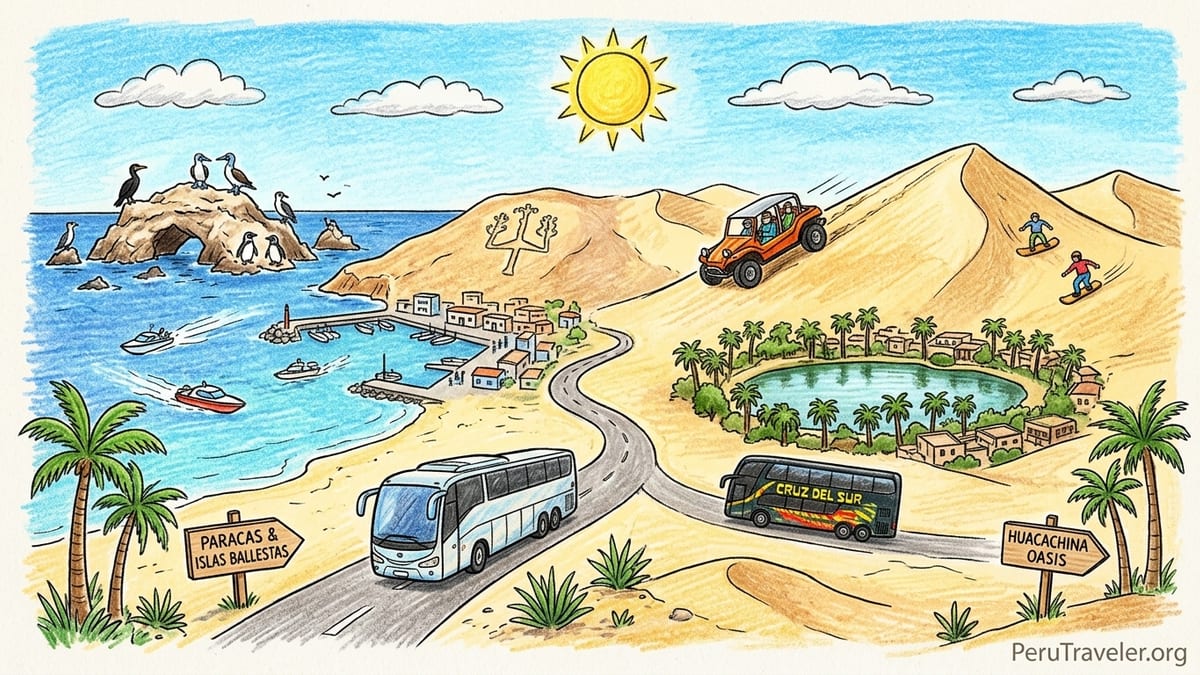
On the way out of the bay, we slowed in front of the Candelabro geoglyph, a giant candelabra-shaped figure etched into the sandy hillside that overlooks the water. The guide gave a short explanation of theories about its origin before the captain turned the boat so both port and starboard passengers could photograph it. This is as close as the boats get; there is no landing here, and the figure is viewed entirely from the water.
About 20 minutes later we reached the first of the Ballestas Islands themselves, which are rocky outcrops teeming with seabirds. Official information describes the typical tour route as a two-hour navigation that circles seabird nesting cliffs and sea lion colonies without landing on the islands. That matched my experience. Our boat stopped at several vantage points while the guide identified Peruvian boobies, cormorants and terns. We saw clusters of sea lions draped over the rocks and, to my delight, a handful of Humboldt penguins shuffling along a ledge close to the waterline.
I paid particular attention to how close we approached the animals. The captain cut the engines as we neared the main sea lion colony and drifted at what looked like 30 to 50 meters from the rocks, close enough for clear views and telephoto photos but far enough that the animals did not show signs of distress. The guide reminded passengers to stay seated and avoid sudden loud noises. No one fed wildlife, and there was no attempt to nudge the boat closer for more dramatic pictures. Our total time on the water was about 1 hour 50 minutes, in line with the two-hour window that most operators advertise. Sea conditions remained mild, although the wind picked up slightly on the return leg, with some spray over the bow that left front-row passengers damp but smiling.
Paracas Between Tours: Food, Free Time and What Felt Commercial
Back on land around 11 a.m., the day-trip participants were given roughly 45 minutes before our bus was due to leave for Huacachina. Several snack stalls just off the pier sold coffees, juices and simple seafood dishes. I paid 30 soles for a plate of fried fish with rice and salad and a cold drink. The guide reminded us that lunch was not included in the tour price and encouraged us to order quickly to avoid delays.
This tight turnaround is where the Paracas portion of the full-day experience began to feel commercial and rushed. Dozens of buses, all following similar schedules, released passengers into the same few streets at once. Souvenir vendors know the timings well and set up directly in the path between the pier and the bus parking area, calling out special offers on magnets, hats and ponchos. I bought a small fridge magnet for 8 soles as a practical memory, but it was difficult to ignore the sense of being funneled efficiently from bus to boat to restaurant and back again.
Because I was staying overnight, I later saw a more relaxed side to Paracas. After the bulk of the day-trip crowds left in the early afternoon, the malecón grew quieter. I sat at a café terrace with a coffee for 10 soles and watched local families and independent travelers stroll the waterfront. If your schedule allows a second morning, you can book a separate Paracas National Reserve tour locally, often for around 60 to 80 soles, to see beaches and cliffs that are not included in the standard Lima day trip. That extra time changed my impression of the town from purely touristic to somewhere that could serve as a gentle coastal base for two nights.
As for the Ballestas excursion itself, my expectations had been high, and the density of wildlife largely met them. The aspect that felt most commercial was the sheer number of boats operating simultaneously, especially when multiple vessels queued at popular viewing spots. It did not feel unsafe, but if you are seeking a solitary, wilderness-style experience, this will not be it.
Onward to Huacachina: First Impressions of the Desert Oasis
Around noon, I rejoined the bus, now bound inland toward Ica and Huacachina. The drive took close to 1 hour 30 minutes, passing vineyards and desert flats before we entered Ica and then approached the oasis itself. Some versions of the tour include a stop at a pisco vineyard or bodegas on the way. Mine did, adding about 1 hour for a quick explanation of how pisco is made and a tasting of several varieties. There was no extra charge for the tasting, although bottles for sale ranged from 35 to 80 soles. Soft drinks and snacks at the vineyard cost another 10 to 15 soles per person.
We reached Huacachina in mid-afternoon. The first glimpse of the lagoon ringed by palm trees and low-slung hostels, with enormous sand dunes rising in every direction, is striking. At ground level, though, Huacachina is compact and busy. The oasis itself is surrounded by a circular road with restaurants, tour kiosks, small hotels and backpacker hostels. Loud music pumped from a couple of bars even in the afternoon, and dune buggies roared past toward the sand entrance, engines echoing against the surrounding slopes.
Because I wanted to experience both formats, I stayed with the tour group for the classic late-afternoon buggy and sandboarding ride, then, on a separate day, booked a slower, smaller-group buggy excursion through my guesthouse, paying privately. Most travelers who come only on a one-day tour will have about three hours total in Huacachina, enough for one buggy excursion and a quick meal before heading back to Lima.
That compressed timescale means you do not see Huacachina in different lights. Staying overnight revealed quiet dawn scenes when the wind is low, the lagoon mirror-like, and a handful of early risers trudging up dunes on foot to watch sunrise, a sharp contrast with the high-energy, almost amusement-park atmosphere around sunset.
Dune Buggies and Sandboarding: Safety, Prices and Techniques
On the day-trip buggy and sandboarding excursion, our guide herded about 25 of us to the edge of the dunes around 4 p.m. We were split into several large tubular buggies, each seating roughly 10 to 12 people, with metal roll cages and basic lap belts. Helmets were offered, although on my vehicle only about half of the passengers chose to wear them. Based on recent local rate surveys in Huacachina, a fair price for a standard shared two-hour buggy plus sandboarding tour in 2026 is around 15 to 25 US dollars per person, plus a municipal desert entrance fee of 3.60 soles paid in cash at the gate. In my case, the buggy ride was included in the overall Lima tour price, but we each paid the desert fee in cash at the checkpoint.
Once through the gate, the driver climbed progressively larger dunes, then dropped steeply down the other side, often at angles that drew screams and laughter. The gradients on some of these descents were intimidating, particularly for travelers with back or neck issues. Our driver did not seem reckless, but he certainly aimed for thrills. The ride intensity felt moderate to high, more like a short rollercoaster than a scenic drive.
Safety practices in Huacachina vary by company. Some operators, especially smaller outfits marketed through local guesthouses, emphasize safety, limit passenger numbers and provide proper helmets and short safety briefings. Others are more minimal, with only basic belts and less visible maintenance. In my group, children as young as eight or nine were present. They seemed to enjoy the ride, but I would hesitate to recommend the most aggressive buggy drivers for very young kids or travelers who are nervous about speed. It is worth asking your tour company in advance about maximum speeds, group size and safety gear, and, if possible, choosing operators that cap numbers and provide well-fitted helmets and goggles.
Sandboarding came in two main styles. The default option offered to everyone was lying down on a board, headfirst, while the driver or guide held the back and gave a push. This is what the majority of people chose. The slopes selected for lying-down runs were long but not vertical, and the guide showed us how to dig feet into the sand as brakes. Speeds still felt high, especially on the third and steepest run, but the body position is low to the ground, which reduces risk of injury from a fall.
Standing sandboarding, closer to snowboarding, was possible on request but not actively promoted on my tour. A few more experienced board riders tried it on moderate slopes using basic strap-in boards. There was no structured lesson, so I would not recommend attempting standing descents on the largest dunes without prior board experience and clear guidance from an instructor. If you are curious about stand-up sandboarding, it is safer to book a dedicated lesson with a specialized operator that focuses on technique and uses gentler practice slopes rather than improvising on a high-speed buggy tour.
Sunset on the Dunes and the Long Ride Back to Lima
The undeniable highlight of the buggy excursion came at the end. Shortly before sunset, the drivers parked their vehicles on a high ridge facing west. Everyone climbed a few meters higher to sit on the crest of the dune. As the sun dropped toward the Pacific, the desert shifted through oranges and pinks, with long shadows accentuating the ripples in the sand. From this vantage point, Huacachina’s lagoon was invisible, and the feeling was one of being surrounded by open desert, even though the oasis and its busy bars were only a few minutes below.
By the time we rolled back into the village, it was just after dark. Fine sand coated our shoes, hair and clothes, and several people coughed from the dust. We were given around 45 minutes to grab dinner around the lagoon. Restaurants offered everything from ceviche and arroz con mariscos to burgers and pizza. Prices for main dishes averaged between 35 and 55 soles. I opted for a plate of lomo saltado and a bottle of water for 48 soles. Drinks, including cocktails, were similar to Lima’s mid-range tourist prices.
At about 7:30 p.m., we boarded the coach for the return to Lima. The bus fell quiet quickly as tired passengers tried to sleep. Traffic heading into the capital was light that night, and we reached Miraflores around 11:30 p.m., nearly 19 hours after my original pickup. Several fellow travelers told me it had been worth it for a single free day in Lima, but everyone agreed that the combination of pre-dawn wake-up, strong sun, wind, sand and two long highway legs made for an exhausting experience.
In contrast, when I arranged my own transport back to Lima a day later, taking an afternoon direct bus from Ica, the journey felt manageable. Spending a night in Huacachina let me shower off the sand, enjoy a slower breakfast, walk around the largely empty lagoon at 8 a.m., and then choose a bus departure that fit my energy levels. The exact same activities felt more memorable when they were not compressed into a single, marathon-style day.
What Surprised Me: Expectations Versus Reality
Going into the trip, I had expected Ballestas to be a gentle warm-up for the more adrenaline-filled Huacachina portion. In practice, the opposite happened. The Ballestas Islands exceeded my expectations thanks to the sheer volume of wildlife packed into a short boat ride. Seeing sea lions, cormorants, boobies and Humboldt penguins in quick succession, with the boat respecting sensible distances and the captain shutting off the engine near sensitive spots, felt like a compact natural experience that still retained a degree of authenticity despite the number of boats on the water.
Huacachina, meanwhile, felt more commercial than I had anticipated. There is no question that the dunes are beautiful, and the sunset views are spectacular, but the village around the lagoon can feel like a desert amusement park. Loud music, aggressive touts selling buggy rides at slightly undercut rates, and the visible wear on some vehicles undercut the sense of remote desert adventure that first drew me there. The buggy ride itself was exhilarating, but the focus on speed and steep drops sometimes overshadowed the landscape.
The activity that most surprised me in a positive way was simply walking up the dunes behind the oasis at first light, without any vehicle. Climbing is hard work in soft sand, and most people stop after a few minutes, but even a modest effort rewards you with panoramic views of the village, the surrounding desert and, in the distance, the agricultural fields around Ica. This quiet, unstructured moment did more to connect me with the desert than the high-octane buggy laps.
The most commercial-feeling element of the entire two-day experience was the clustering of vineyard visits and tastings that slot neatly between Paracas and Huacachina on many itineraries. The stop at a pisco bodega was pleasant enough and did not add a huge amount of time, but it was clearly designed to move groups through in waves, with a set script and a sales pitch at the end. For travelers short on time, that hour might be better spent lingering longer on the dunes or exploring an additional viewpoint in the Paracas National Reserve.
The Takeaway: One-Day Blitz or Overnight Stay?
So, knowing what I know now, would I repeat a one-day Lima to Paracas and Huacachina tour, or would I choose to stay overnight? If I had only a single free day in Lima and wanted to see both the coast and the desert in one sweep, I would still consider the full-day tour, with clear eyes about the long hours and the highly choreographed nature of the experience. It does deliver a lot in a single day: a marine wildlife boat ride, a coastal town, a pisco tasting, a desert oasis, a thrilling buggy session and sunset on the dunes, all without having to manage logistics yourself.
Given any flexibility, however, I would almost always recommend an overnight stop, either in Paracas, Huacachina or both. A popular pattern is to take an early-morning bus from Lima to Paracas, stay a night there, join a Ballestas excursion and a Paracas National Reserve tour over a day and a half, then continue to Huacachina for a night or two. From Huacachina or nearby Ica, you can fit in a buggy and sandboarding session on one evening and use another morning for slower walks or simply enjoying the oasis before heading back to Lima on a daytime bus.
For families, particularly with younger children, the overnight option is kinder. It avoids waking kids before dawn and returning them to Lima close to midnight, and it leaves room to choose a more cautious buggy operator or even skip the most extreme dunes. Paracas, with its calmer waterfront and shorter activities, can be a gentle base for families, with the option of keeping the Ballestas boat ride as the main highlight.
Couples looking for a mix of romance and light adventure may also appreciate the slower pace. An overnight stay allows you to pick a nicer waterfront hotel in Paracas, enjoy sunset drinks overlooking the bay, then move to Huacachina for one or two nights in a small guesthouse where you can time your dune walks for quieter hours. For adventure-focused travelers who enjoy intensity and do not mind fatigue, the one-day blitz does have a certain appeal. It strings together a day of almost continuous activity, and the shared sense of surviving a long, dusty, exhilarating loop from Lima creates quick camaraderie on the bus back.
FAQ
Q1. How long is the full-day Paracas and Huacachina tour from Lima?
The standard full-day tour typically lasts 16 to 18 hours door to door, with hotel pickups starting around 4 a.m. and return to Lima between 10:30 p.m. and midnight, depending on traffic and exact itinerary.
Q2. What is a realistic total price for a one-day tour including Ballestas and dune buggies?
In 2026, reputable operators advertise combined Paracas and Huacachina day trips from roughly 89 to 139 US dollars per person, including transport, the Ballestas Islands boat, dune buggy and sandboarding, and basic entry fees. Food, drinks and optional vineyard purchases are extra.
Q3. Is it cheaper to visit Paracas and Huacachina independently instead of on a tour?
It can be comparable or slightly cheaper to travel independently if you are flexible. One-way bus tickets from Lima to Paracas start from about 60 soles, local Ballestas tours from around 35 to 40 soles, and shared dune buggy excursions from roughly 15 to 25 US dollars, plus small local fees and accommodation if you stay overnight.
Q4. What wildlife can I realistically expect to see on the Ballestas Islands?
On a typical two-hour boat trip you are likely to see large numbers of seabirds, including cormorants and boobies, sea lion colonies on the rocks and, with some luck, several Humboldt penguins. Dolphins are sometimes reported but are less predictable.
Q5. How rough are the sea conditions for the Ballestas Islands boat tour?
In calm weather the crossing is relatively smooth, with only light swells. During the windier months, usually around the southern winter, there can be more chop and occasional spray, and some trips may shorten or cancel if conditions are unsafe.
Q6. Are Huacachina dune buggies safe for children?
Many families do take children on dune buggies, but ride intensity varies by driver and company. If you have younger kids or anyone nervous about speed, ask in advance for a more moderate driver, check that belts and helmets are provided and consider choosing a shorter or gentler tour.
Q7. What is the difference between lying-down and standing sandboarding?
Lying-down sandboarding uses a board as a sled, usually headfirst, with feet used as brakes. It is the default on most group tours and easier for beginners. Standing sandboarding is closer to snowboarding and generally better learned in a dedicated lesson on gentler slopes rather than on the steep dunes used by buggies.
Q8. Do I need to book Ballestas and dune buggy tours in advance?
If you are traveling on a tight schedule or in high season, booking at least a few days ahead is wise, especially for full-day packages from Lima. If you stay overnight in Paracas or Huacachina, you can often arrange tours locally the day before or even the same morning, through hotels or reputable kiosks.
Q9. Is the one-day tour too rushed, or is it manageable?
The one-day tour is manageable for healthy adults who accept a very early start and late return, but it feels rushed. You will see a lot, but with limited free time in each place. Travelers who prefer slower mornings, leisurely meals or more unstructured wandering may find the overnight option more enjoyable.
Q10. Which format is better for families, couples and adventure travelers?
Families and couples often benefit from staying at least one night in Paracas or Huacachina to reduce fatigue and enjoy quieter moments. Adventure travelers who prioritize fitting maximum experiences into minimal days and do not mind long bus hours may appreciate the intensity of the one-day tour directly from Lima.