

The morning I walked down to Puno’s harbor, Lake Titicaca looked almost metallic in the thin Andean light. At more than 3,800 meters above sea level, the air felt dry and sharp in my lungs, and the combination of strong sun and cold breeze was immediately obvious. I had come to see two of Peru’s most talked-about community tourism experiences: the Uros floating islands and the Quechua community of Taquile. What follows is a detailed account of how I arranged the trip, what I paid, what residents themselves shared about their lives, and how it actually feels to spend a day moving between these very different worlds on the highest navigable lake on Earth.
Setting off from Puno: Harbor, Altitude and Lake Conditions
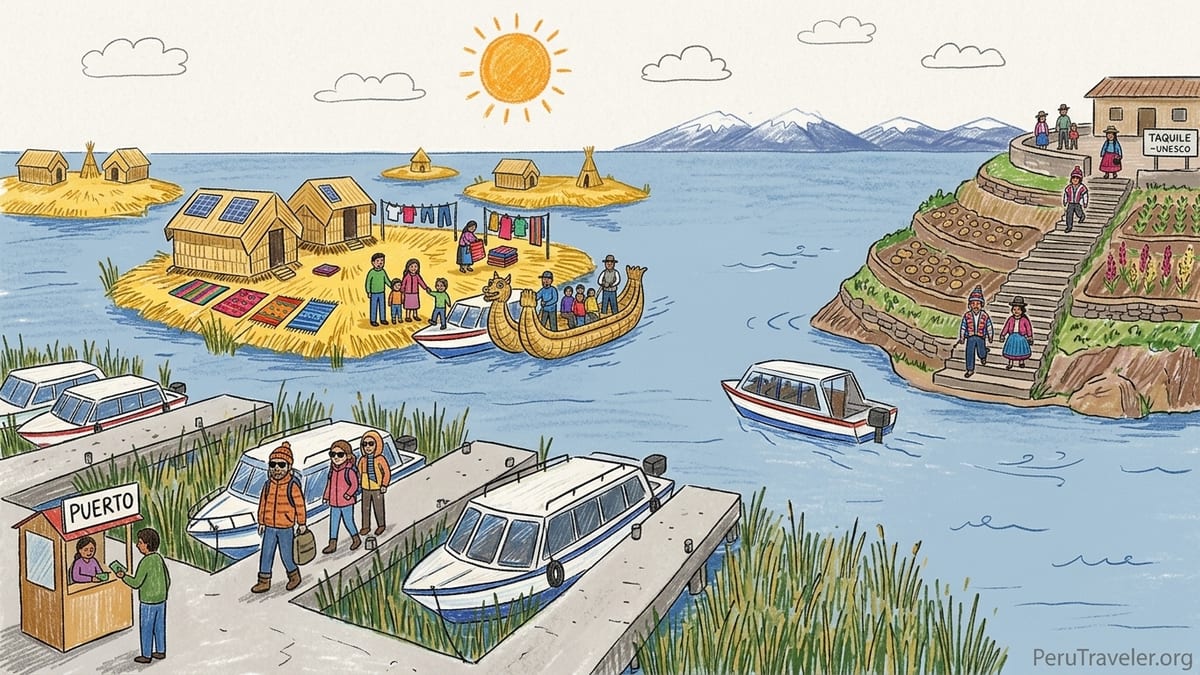
I started the day in central Puno, at about 3,825 meters in elevation, with a short taxi ride down to the main port. Most community and tour boats to the Uros floating islands and Taquile depart from the municipal dock east of the city center, where concrete jetties stretch into the reeds and rows of covered motor launches are tied side by side. Even early, around 7:00 to 7:30 a.m., the sun already felt intense on the skin, yet the air temperature was only in the single digits in Celsius. I was glad to be wearing layered clothing, a warm hat and sunscreen before I even boarded the boat.
For this trip I booked a shared full-day Uros and Taquile excursion in advance with an established operator that works with local communities. In October 2026, standard full-day shared tours from Puno that include Uros and Taquile are typically advertised at around 25 to 45 US dollars per person, depending on whether lunch is included and whether the boat is a regular or faster model. The operator I chose charged the equivalent of about 35 US dollars paid the afternoon before at its office near Puno’s Plaza de Armas, which covered the boat, guide, Uros and Taquile visits and a community-arranged lunch on Taquile. I still needed some soles in cash for port fees, optional reed-boat rides and any textiles or souvenirs.
On arrival at the harbor, the first payment was the obligatory port fee managed by the municipality. In my case, that was paid directly at a small kiosk at the entrance to the dock in Peruvian soles, before reaching the boat. Once aboard, the guide checked names against a printed list and collected the separate Uros entrance contribution in cash, which the operator had clearly marked in its information sheet. Having each cost paid at a specific point in the journey turned out to be useful for tracking where the money was going.
The initial navigation out of Puno’s bay is slow, through channels cut into dense totora reeds that fringe the shoreline. That morning the lake surface was relatively calm, with only small wind ripples. Our boat, a covered motor launch with bench seats, took about 25 to 30 minutes to reach the first inhabited floating island. At this speed the ride was gentle, but I could still feel the altitude in my breathing when I climbed the short stair to the roof deck to watch the city recede behind us and the water open ahead.
Arriving at the Uros Floating Islands
From a distance the Uros archipelago looks like a scatter of low, golden patches on the steel-blue water. As we approached, individual islands emerged: rectangular platforms of thick totora reeds with small reed houses, solar panels, laundry lines and bright textiles laid out in the sun. Our boat tied to a simple wooden post and we stepped from the solid planks of the launch onto the springy, surprisingly soft surface of the island itself.
Several families greeted us in Aymara and Spanish. The guide introduced the island’s president, who explained that this was a living community, not a reconstructed museum site. Around us, children played, a woman stirred a pot over a clay stove, and a man was repairing a section of the reed edge with a bundle of fresh totora. The surface underfoot felt like a firm but slightly moving mat; when several visitors walked together, the whole platform responded with a slow, gentle bounce.
Our guide translated as the island leaders gave a detailed explanation of how the floating islands are built and maintained. The community cuts blocks of totora root, called khili, from the shallow lakebed and anchors them together to form a base that can be up to two meters thick. On top of this they layer fresh, dry totora reeds in crisscross patterns, adding new layers every one to two weeks. If they neglect this maintenance, the surface becomes unstable and wet. Periodically, sections of the island are reinforced or extended, and after many years an island may be retired and a new one constructed. The island we stood on had been in use for more than a decade but had already been thickened several times.
The residents also explained how they balance tourism with everyday life. While part of the island had been arranged to receive visitors, with a semicircle of benches and a demonstration area for handicrafts, they pointed to parts of the platform that were off-limits because they were private living spaces. Solar panels powered lighting and a small television, and several families described rotational schedules, where some days they focus on fishing or reed harvesting and other days on receiving tour groups. Tourism income helps pay for education, fuel and food bought in Puno, but people were clear that they still fish, collect eggs and harvest totora for their own needs.
Tourism, Money and Optional Reed-Boat Rides on Uros
After the introduction, the visit shifted into a more commercial phase, and this is where travelers often have mixed feelings. On our island, women spread out embroidered cushion covers and wall hangings on the reeds while men showed small reed boats and models of traditional houses. The guide was transparent that sales are a key part of the income model. Prices for smaller handicrafts started around 20 to 30 soles, with larger textiles and wall hangings reaching several hundred soles depending on size and detail. I found it helpful that residents were willing to explain which pieces were made on the island and which came from relatives or other communities.
The optional reed-boat ride was offered next. Several residents invited those who wished to take a short trip in a classic totora boat, known locally as a balsa de totora, to another nearby island and back. In October 2026, the standard price cited by our guide and by the islanders themselves was 15 soles per person, paid directly to the boatmen. On my visit participation was genuinely optional: about half the group chose to do it, and those who stayed behind had time to wander a little, ask more questions or simply sit in the sun. I chose to go, partly to see how it felt to move across the water in a reed boat that is now more symbolic than strictly functional.
The ride lasted around 15 to 20 minutes. The boat, with two curved, dragon-like prows, moved slowly under human power. The sensation was different from the motor launch; closer to the water and quieter, with the sound of reeds brushing the hull. For the men piloting the vessel, it was a chance to talk more about how tourism has changed their work. One older boatman described how, in his youth, reed boats were used more for fishing and visiting relatives. Today, fiberglass and wooden boats do most practical transport, and reed boats are often rebuilt every few months primarily for visitors, though knowledge of how to construct them is still considered important cultural heritage.
Back on the island, we had around 20 more minutes of free time. This was both interesting and slightly uncomfortable. The residents were friendly and open to questions, but it was also clear that they hoped to make sales. I bought a small embroidered piece directly from the woman who had been sewing it while we talked about her daughter’s schooling in Puno. Others in the group felt more pressure and left without purchasing anything. The experience was educational in that we heard directly from Uros families about lake ecology and island maintenance, but it did lean heavily toward selling handicrafts.
Crossing to Taquile: Open Water, Time and Walking Conditions
Leaving the reeds behind, our boat set out across open water toward Taquile, about 45 kilometers from Puno. On a standard shared tour with a regular motor boat, this leg often takes roughly two and a half hours from Uros to Taquile’s main pier. Some operators now advertise faster boats that can cut the crossing time down by around 30 to 40 minutes, usually at a higher tour price. My boat was one of the regular models, so the crossing felt long but peaceful, with views of distant snow-capped peaks and the low line of the Bolivian shore on the horizon.
At this altitude the weather can change quickly. Midway across, the sun was very strong, reflecting off the lake’s dark surface and making sunglasses and sunscreen essential. At the same time, a cold wind came through the open sides of the boat and several passengers wrapped themselves in jackets and scarves. Inside the cabin, oxygen felt thinner than in Puno, especially when climbing the small ladder to the roof deck for photos. Anyone sensitive to altitude should factor this into their decision about doing a full-day tour immediately after arriving in Puno, as even mild exertion can feel amplified.
We reached Taquile’s small harbor on the eastern side of the island late in the morning. There are several landing points; our captain chose a pier that requires a steady uphill walk to the main plaza. The guide warned us in advance that the path involved stone steps and sloping paths and that we would gain about 150 meters in elevation, from the lakeshore to the village area, which sits around 3,950 to 4,000 meters. Even though the distance is not huge in terms of kilometers, the combination of altitude, sun and uneven stones makes it a moderate physical challenge for anyone not acclimatized.
The climb took our group 45 minutes at a slow, measured pace with pauses encouraged. Terraced fields stepped away on both sides, planted with potatoes, quinoa and broad beans, and we passed local residents carrying bundles or herding sheep up and down paths that looked steep to us and routine to them. There are no cars on Taquile, so everything moves along these footpaths. By the time we reached the ridge near the plaza, the view back over the lake, with the faint silhouettes of the Cordillera Real in Bolivia, made the effort worth it.
Taquile’s Textile Culture and a Community-Arranged Meal
At the top of the hill, near the main square, we were welcomed by members of the Taquile community wearing garments that were clearly part of everyday life, not costumes brought out only for tourists. Men wore handwoven chullos, the pointed earflap hats that signal marital status through their colors and patterns, and black vests over white shirts. Women wore dark skirts and shawls with vividly embroidered edges. Textiles appeared not just as items for sale, but as clothing in constant use.
Our guide briefly stepped aside as one of the local authorities spoke about the island’s organization of tourism. Taquile has developed a community-based tourism model in which families rotate hosting responsibilities for visiting groups. The community runs simple restaurants and manages homestays, and guides from off the island work in partnership with local hosts. The speaker also mentioned with quiet pride that Taquile’s textile art was recognized by UNESCO in 2005 and later inscribed on the Representative List of the Intangible Cultural Heritage of Humanity, which helped reinforce the value of weaving knowledge across generations.
Rather than being taken straight into a sales setting, our group was first invited to a community-run comedor for lunch. The cost of lunch was included in the tour price already paid in Puno, and the operator settles accounts directly with the community association. We sat at long wooden tables with a view of agricultural terraces sloping toward the lake. The meal was simple, fresh and clearly prepared by the family that ran the kitchen: a quinoa soup, followed by grilled trout from the lake with rice and potatoes, and a coca or muña tea. Dietary needs had been checked on the boat and accommodated with a vegetable-based main dish for those who requested it.
Only after lunch were we invited to a shaded patio where several weavers, both men and women, demonstrated spinning and weaving techniques. They did not perform for the camera in a staged way, but instead worked steadily as the guide explained the symbolism of certain patterns and colors. When we asked questions, they responded in Spanish and Quechua, through the guide when needed. It was clear that textiles here are inseparable from social life. For example, young men are expected to demonstrate skill in knitting their own chullo as part of courtship and marriage negotiations, and women’s belts can encode personal and family narratives.
Textiles for sale were displayed on tables along one wall, but there was no hard sell. Prices were higher than on the Uros islands, reflecting both the UNESCO-recognized status and the amount of work involved. A finely woven men’s scarf could cost the equivalent of 60 to 80 US dollars, and larger pieces such as blankets or complex belts considerably more. The weavers emphasized quality over volume, and several visitors in our group chose to buy nothing, which was respected without visible frustration. I purchased a small belt directly from the man who had described how he taught his son to knit, which felt less like a pressured transaction and more like supporting a craft linked to a specific person and story.
Comparing Day Trips and Overnight Community Stays
From Puno, visitors usually face a choice between a one-day Uros and Taquile excursion and a two-day itinerary that includes a homestay on an island such as Amantaní or one of the Uros communities that host guests. In 2026, full-day shared boat tours covering Uros and Taquile tend to cost around 25 to 45 US dollars per person through established operators. In contrast, a two-day program with one night in a family homestay on Amantaní or another island often ranges from about 45 to 90 US dollars, depending on the boat type and level of organization. In both cases, the price usually includes basic meals on the island, but not personal purchases or tips.
My own experience was limited to the one-day format, which gave a solid overview but felt compressed. We had around one and a half to two hours on the Uros island including the reed-boat option, and about three hours on Taquile split between the uphill walk, lunch and the weaving demonstration. That allowed only a brief wander through the village before it was time to begin the descent via a different path of long stone stairways to another pier. The boat then took about two and a half to three hours to return to Puno, arriving in late afternoon. By the end, many in the group were tired from sun and altitude, and the day had felt full, but not deeply immersive.
Speaking with other travelers and community members, it became clear that an overnight stay changes the dynamic significantly, especially on Amantaní, which many guides and recent visitors highlight as the most rewarding island for a homestay. Guests are assigned to families through the community association and sleep in simple rooms, usually with shared bathrooms and no heating. Evening activities might include music in the communal hall or simply talking around the kitchen table while a host mother cooks with ingredients from local fields. The following morning, there is more time to walk, visit hilltop temples and see daily routines away from the main docks.
Some Uros communities also offer overnight stays in reed or wooden lodges anchored among the islands, at a wide range of prices. These stays can give a different sense of life on the water after most day boats have left, although they also vary in how closely they are integrated into everyday community life. For travelers short on time or concerned about altitude, the one-day Uros and Taquile trip remains the most practical introduction. For those who want more meaningful exchanges and less of a sales focus, adding at least one homestay night on Amantaní or Taquile seems to be the stronger choice, even if that means reducing time in another destination.
What Felt Educational, and Where Sales Pressure Showed
Looking back, the parts of the day that felt most educational were the moments when residents spoke specifically about their own strategies for balancing tradition, livelihood and tourism. On the Uros island, it was hearing exactly how often they must harvest and add totora to keep the islands afloat, and what happens when lake levels fluctuate. Several residents mentioned concerns about water pollution near Puno and the impact of waste from both the city and visitor traffic. Those comments were not part of a rehearsed speech; they came up when someone asked what they worried about for their children’s future on the lake.
On Taquile, education took the form of context. The community representative explained how Taquile’s model of community-based tourism was developed to prevent external agencies from controlling visitor flows and revenues. He talked about how the UNESCO recognition of their textile art had raised the profile of their work but also increased external demand, sometimes pushing designs toward what tourists expect rather than strictly traditional patterns. That tension, and the island’s deliberate response, turned a picturesque stop into a lesson in how communities navigate global attention.
At the same time, there were parts of the day that felt overly sales-focused. On Uros, the transition from cultural explanation to handicraft display was abrupt, and the sense of being a captive audience on a small platform made it difficult for some visitors to decline purchases without awkwardness. The optional reed-boat ride, while clearly described as an extra and reasonably priced, is presented in a way that can make those who skip it feel they are missing an essential part of the experience. On Taquile, sales were much more relaxed, but there was still an implicit expectation that at least a few people in each group would buy textiles to justify the time of the weavers who had come to meet us.
For travelers who want to minimize uncomfortable dynamics, it helps to arrive with a clear sense of what you are willing and able to spend and to communicate respectfully when you choose not to buy. It also helps to remember that communities have chosen tourism as one livelihood strategy among others, and that part of ethical travel is accepting that hosts will try to earn income from visitors. The key, in my view, is whether interactions remain grounded in mutual respect and real conversation, not just transactions.
The Takeaway
Several things surprised me about visiting Lake Titicaca from Puno. The first was how physically demanding a simple day on the lake can feel at roughly 3,810 to 3,815 meters. Climbing modest flights of steps on Taquile left many of us short of breath, and even walking on the springy surface of the Uros island required attention to balance. Strong sun and cold wind combined in a way that made good clothing, sunscreen and steady hydration more important than I had expected for what is often marketed as a gentle boat outing.
The second surprise was how different the social atmosphere felt between the Uros floating islands and Taquile. On Uros, the experience was intense and compact, and the presence of tourism as a primary economic activity was inescapable. Yet even there, listening to residents discuss the technical skill involved in building and maintaining floating land, and hearing their concerns about lake health and education, reminded me that these are complex communities making pragmatic choices. They are not staging a show built from nothing; they are adapting an old way of life in a contemporary context.
On Taquile, the pace was slower and interactions felt less transactional. The most meaningful moment for me was not the formal explanation about UNESCO recognition, but a quieter conversation with a father and teenage son as they sat knitting side by side outside the comedor. The son was working on a half-finished hat, and his father corrected a stitch while explaining how he had learned from his own father. That continuity, unfolding on a bench above terraced fields with Lake Titicaca in the background, made the idea of an intangible heritage feel lived rather than abstract.
Did the full-day trip feel rushed? To a degree, yes. I left with a good overview but also with the sense that I had skimmed the surface of two very different worlds. If I were to return, I would still begin in Puno with a structured visit to Uros and Taquile, but I would then stay on the lake for at least one night, most likely with a family on Amantaní or in a community-run homestay on Taquile. I would build in an extra acclimatization day in Puno before boarding the boat, carry more cash in small denominations earmarked for specific community payments and potential purchases, and approach the trip less as a checklist of islands and more as an opportunity to listen. Lake Titicaca’s communities are not static remnants of the past for visitors to consume; they are partners in a shared, evolving story between people, water and highland sky.
FAQ
Q1. How much does a full-day Uros and Taquile tour from Puno cost in 2026?
The most common range with established operators in 2026 is roughly 25 to 45 US dollars per person for a shared boat, guide, Uros visit, Taquile visit and a simple lunch on Taquile. Cheaper options exist locally at the port, but may use slower boats and offer less community coordination.
Q2. Where and how do you pay for different parts of the Lake Titicaca trip?
In my case, I paid the base tour price in the operator’s office in Puno the day before departure, the municipal port fee at a kiosk at the harbor entrance in soles, the Uros community entrance contribution directly to the guide on the boat, and the optional reed-boat ride fee in cash to the Uros boatmen. Purchases of textiles or souvenirs were paid directly to artisans on Uros and Taquile.
Q3. How difficult is the walking on Taquile Island?
The main challenge is altitude rather than distance. From the pier to the village area you gain about 150 meters on stone steps and sloping paths at around 3,950 to 4,000 meters above sea level. Most reasonably fit visitors manage it with frequent rest stops, but anyone with heart, lung or mobility issues should be cautious and discuss options with their operator.
Q4. What should I wear and bring for a day on Lake Titicaca?
Plan for strong sun and cold wind. A sun hat, sunglasses and high-SPF sunscreen are essential, along with a warm layer, windproof jacket, comfortable walking shoes with good grip for stone steps, and drinking water. Cash in small soles is important for local fees, optional activities and community purchases.
Q5. Are the Uros floating islands authentic or just built for tourists?
The islands are real, inhabited communities that use traditional knowledge to build and maintain floating reed platforms. Tourism has become a major part of their economy, and parts of islands are clearly arranged to receive visitors, but people also fish, harvest totora, send children to school and carry on everyday life around incoming boats.
Q6. Is the optional reed-boat ride on Uros worth it?
If you are interested in feeling how a totora boat moves and in supporting the islanders who maintain this craft, the short ride, usually around 15 soles per person, can be worthwhile. It is not essential to understanding Uros culture, and participation is optional, so those who prefer can stay on the island and talk with residents instead.
Q7. How does a one-day Uros and Taquile trip compare with an overnight homestay?
A one-day tour offers a concise introduction but feels rushed, with only a few hours on each stop. An overnight homestay on Amantaní, Taquile or with an Uros family generally allows slower conversations, shared meals and a better sense of daily routines. Two-day programs from Puno that include a homestay usually cost from about 45 to 90 US dollars per person in 2026.
Q8. How can I make my visit more respectful toward local communities?
Travel with established operators or directly arranged community programs, ask permission before taking close-up photos, listen as much as you speak, and be honest but courteous if you choose not to buy handicrafts. Recognize that tourism is one livelihood strategy among many and that your presence has an economic and cultural impact.
Q9. Do I need to worry about altitude sickness on Lake Titicaca?
At roughly 3,810 to 3,815 meters, some visitors experience headaches, shortness of breath or fatigue, especially if arriving directly from sea level. It is wise to spend at least a day in Puno to acclimatize, stay hydrated, avoid heavy meals and alcohol before the boat trip, and consult a doctor in advance if you have concerns or preexisting conditions.
Q10. Is a Lake Titicaca trip from Puno worth including in a Peru itinerary?
If you are interested in living indigenous cultures, community tourism and high-altitude landscapes, then yes, Lake Titicaca offers experiences you cannot replicate elsewhere in Peru. The Uros floating islands and Taquile’s textile heritage can feel touristy at points, but with the right expectations and respect, they also provide some of the country’s most distinctive cultural encounters.