


Choosing where to stay in Arequipa is more than a matter of views and decor. This is the main jump-off point for Colca Canyon, volcano climbs and Southern Peru’s highlands, and your hotel location can affect 3 a.m. tour pickups, airport transfers, noise levels and how safely you walk back from dinner. This guide focuses on the city’s key neighborhoods and compares real hotels and sample costs so you can pick the right base for one night before Colca, a three-night sightseeing stay or a longer five-night trip with excursions.
Why Location in Arequipa Matters
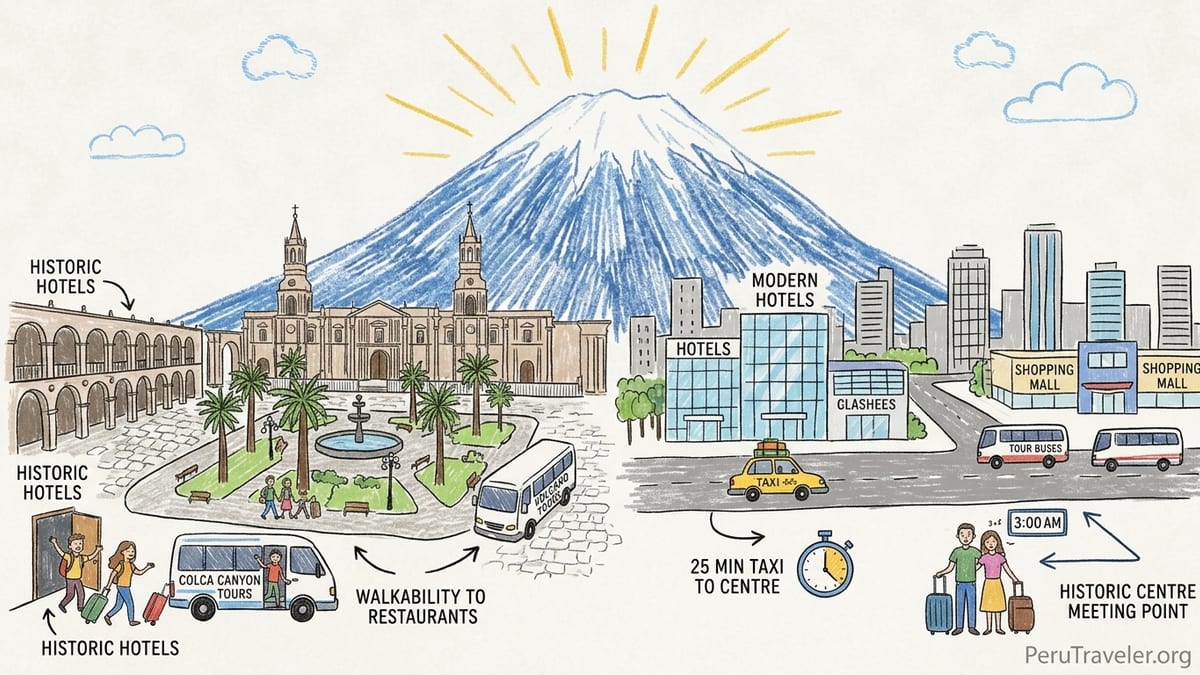
Arequipa’s Historic Centre is compact, but not all hotels are equally practical. Most Colca Canyon and volcano tour operators base their routes around a central pickup zone near the Plaza de Armas, with some extending to streets around Santa Catalina Monastery, San Lázaro and parts of Yanahuara. If your hotel lies outside this radius, operators may either refuse pickup or charge an extra fee, and you might be asked to meet at a designated corner in the centre at 3 a.m. When you are leaving before dawn at 2:45 a.m. for a Colca day trip, walking 20 to 25 minutes across the city or negotiating late night taxis is rarely appealing.
Airport transfers also depend on where you stay. Rodríguez Ballón International Airport sits around 25 to 30 minutes from the Historic Centre in normal traffic. Hotels around the Plaza de Armas, Santa Catalina and San Lázaro fall along standard taxi routes, and you can usually find metered taxis or ride-hailing drivers familiar with these streets. If you choose more residential parts of Cayma or countryside inns near Sachaca, transfer times can increase, especially in rush hour, and some taxi drivers will raise fares for less central drop-offs or late-night rides.
Evening restaurant choices cluster in several walkable pockets. Around Calle San Francisco and Santa Catalina there is a dense strip of restaurants, picanterías and bars. Parts of Yanahuara and Cayma also offer strong dining zones, but walking back to more distant hotels may involve dark, quiet streets. First-time visitors who want to explore on foot into the evening usually find it easier to stay in or near the Historic Centre. Those who value quiet above everything may accept a longer return walk or short taxi ride.
Urban design also plays a role. Arequipa is nicknamed the White City because of its sillar volcanic stone buildings, many of which house restored mansions with thick walls but internal courtyards that carry noise. More modern business hotels in Cayma or parts of Yanahuara may have better sound insulation and heating but lack colonial charm. Your priorities around early departures, heritage atmosphere, room comfort and access to restaurants will guide which neighborhood works best.
Historic Centre & Plaza de Armas: Best for First-Time Visitors
The Historic Centre around Plaza de Armas suits first-time visitors who want to walk almost everywhere. From hotels near the square or Santa Catalina Monastery, you can reach the monastery itself in about 5 minutes on foot, the Plaza de Armas in 5 to 7 minutes, and San Camilo Market in roughly 10 to 12 minutes downhill. This area also contains many agencies selling Colca trips, city tours and volcano climbs, making it easy to compare options in person.
Accommodation here ranges from simple guesthouses to high-end colonial properties. Restored mansions near the monastery and along narrow streets close to the Plaza offer thick stone walls and characterful courtyards. Their charm can come with tradeoffs. Some older rooms may have small windows and limited natural light. Hot water is usually reliable, but water pressure can fluctuate during peak shower times around 6 to 8 a.m. In winter months from May to August, nighttime temperatures drop notably, and not all colonial properties have central heating; instead they may offer portable heaters on request. Sound insulation between courtyard rooms can also be mixed, so light sleepers should ask for upper-floor rooms away from reception and breakfast areas.
Modernized hotels within a few blocks of the Plaza tend to prioritize business travelers. These often have better soundproofing, consistent hot showers and more predictable Wi-Fi. Breakfast is usually served early enough for Colca departures, sometimes from 4 or 4:30 a.m. in the form of simple coffee, bread and fruit, with a fuller buffet from 6 a.m. Storage for luggage is generally straightforward since many Colca tours run as one-night or one-day trips and allow you to leave suitcases at your hotel while you travel with a small overnight bag.
Costs in the Historic Centre cover a broad spectrum. For a midrange example, a couple might find a comfortable double room in a central hotel with private bathroom, heating and breakfast included at a nightly rate that is higher than most San Lázaro guesthouses but offset by reduced taxi use. A family room or interconnected rooms will cost more, but parents often value being able to walk back in minutes from the Plaza after dinner without arranging two taxis. For a one-night pre-Colca stay, central Historic Centre hotels offer the simplest logistics because pickup buses know these streets and operators rarely charge extra.
San Lázaro: Traditional Streets and Boutique Stays
San Lázaro is one of Arequipa’s oldest districts, just north of the Historic Centre. It is characterized by narrow, cobbled lanes, low sillar houses and a more residential feel. Walking from most San Lázaro hotels to Santa Catalina Monastery takes about 10 to 15 minutes, and to the Plaza de Armas about the same. The route is mostly level, though some streets have uneven stone surfaces, so travelers with heavy luggage on wheels might prefer a short taxi ride for arrival and departure days.
The charm of San Lázaro lies in smaller boutique hotels and guesthouses converted from family homes or colonial-era buildings. Rooms here can feel more intimate, with interior patios, rooftop terraces overlooking Misti volcano, and individualized decor. Wi-Fi can vary by property, but many have upgraded to fiber connections to attract remote workers, particularly in the last few years. Hot water tends to be reliable, though in some smaller guesthouses it may take a minute for warm water to reach upper floors. Heating is typically provided by electric heaters rather than built-in radiators, which is important to keep in mind if you visit in the cooler months.
Noise levels in San Lázaro are generally lower than directly around the Plaza. Traffic is lighter, and there are fewer late-night bars. Some properties, however, back onto local streets where dogs bark or neighborhood celebrations run late. Courtyard rooms can carry sound, so guests sensitive to noise should ask in advance for high-floor rooms or those not directly facing common areas. Because the area is residential, early-morning street noise like deliveries or motorbikes heading into town can be more noticeable than in dense commercial streets.
Tour operators usually consider San Lázaro part of their central pickup zone, but you should confirm when booking. In many cases, minibuses will collect guests directly from hotel doors, particularly on routes that pass through the northern side of the centre. For a three-night sightseeing stay, San Lázaro can be an excellent compromise between atmosphere and practicality: you have walkable access to major sights, but sleep in quieter surroundings. Prices are often slightly lower than for a similar room right on or just off the Plaza, which can make a meaningful difference for families or longer stays.
Yanahuara: Quieter Views and a Village Feel
Across the Chili River to the northwest of the Historic Centre, Yanahuara feels like a small town absorbed by the city. Its central mirador plaza offers one of Arequipa’s classic views of Misti volcano framed by stone arches. From many Yanahuara hotels, you can walk to the mirador in 5 to 10 minutes. Walking to the Plaza de Armas usually takes around 20 to 25 minutes, including crossing a traffic bridge. Some routes involve moderate slopes and busy junctions, which may feel challenging at altitude for new arrivals.
Yanahuara appeals to travelers who prioritize calmer streets and views over immediate centrality. Many hotels here are low to mid-rise, with some modern business-style properties and a few small boutique hotels in renovated houses. Room quality tends to be consistent in the more contemporary buildings, with good showers, stronger soundproofing and more widespread use of double glazing. Wi-Fi is often stable enough for video calls. Heating is usually via in-room air conditioning units with heating modes or portable heaters, which can be more effective than small plug-in devices used in some older mansions.
Breakfast options in Yanahuara hotels often start at a standard time around 6 or 6:30 a.m. For Colca Canyon or volcano departures, this can be too late, so it is worth asking if staff can prepare early coffee and bread or a takeaway box. Some tour operators include Yanahuara in their pickup zone or accept it with a small surcharge; others ask guests to meet in the Historic Centre. If your tour requires a central meeting point at 3 a.m., many travel couples and families opt for a short pre-booked taxi from Yanahuara, which adds cost and logistical steps at a tricky hour.
On the positive side, Yanahuara is strong for evening dining without needing to go into the centre every night. Around Avenida Víctor Andrés Belaúnde and nearby streets are restaurants specializing in grilled meats, seafood and traditional Arequipean dishes, along with cafes and dessert spots. Walking around Yanahuara after dark feels more local than touristy, and traffic noise at night tends to be lower than in the Historic Centre. For a five-night stay that mixes sightseeing with remote work or rest days, Yanahuara offers a balanced lifestyle feel, especially for those comfortable using taxis or ride-hailing apps for early departures and late returns.
Cayma: Modern Hotels, Malls and Dining
Cayma lies just north and slightly west of Yanahuara and has grown into one of Arequipa’s modern commercial hubs. Near the main shopping centers you find mid to high-rise hotels that feel more like international business properties, often with elevators, standardized rooms, stronger sound insulation and reliable hot water. For travelers who value consistent facilities over colonial character, Cayma is appealing, especially if staying several nights and working online.
Rooms in Cayma hotels generally offer large beds, desks, blackout curtains and more robust heating or climate control systems. Wi-Fi is typically good, helped by modern infrastructure. Breakfast buffets usually start at predictable times, though early departure options for 3 a.m. Colca tours vary; some hotels provide basic tea, coffee and pastries, while others simply recommend you eat upon arrival in Chivay or at a tour restaurant stop. It is worth clarifying these details prior to booking if you plan demanding excursions.
Walking from central Cayma areas to the Plaza de Armas can take 25 to 30 minutes or more, and sidewalks may pass busy avenues and slopes. Most guests use taxis for sightseeing days, which remain relatively affordable but add up for families. On the other hand, Cayma is superb for access to supermarkets, pharmacies, ATMs and a wide choice of modern restaurants and food courts. For families, having familiar chain options close by can be reassuring. On rest days between excursions, mall cafes and indoor play areas can be more engaging for children than the cobbled lanes of the Historic Centre.
Taxi or ride-hailing services from Cayma to the airport usually take around the same time as from the centre in off-peak hours, although traffic congestion can be heavier around commercial areas at certain times. Some Colca and volcano operators pick up in parts of Cayma, but others categorize the district as outside their central zone and charge extra or ask guests to meet in the Historic Centre. If you plan multiple early starts, you should calculate the cost and stress of pre-dawn transfers against the comfort benefits of a modern room.
Sachaca and Countryside Properties: Space and Quiet
To the southwest of the Historic Centre, Sachaca offers semi-rural pockets of countryside within reach of the city. Here you find hacienda-style inns, small resorts with gardens and some properties oriented toward events and weekend getaways. These are attractive for travelers who want more outdoor space, cleaner air and perhaps a pool, particularly on longer stays that include remote work days or family downtime.
Rooms in Sachaca properties vary widely. Some are in historic haciendas with thick walls, high ceilings and airy verandas. Others are more modern annexes added to event centers. Hot water and heating can be reliable in well-managed properties, but you may encounter occasional temperature fluctuations in older plumbing systems. Wi-Fi may not match city-center speeds, and signal can be weaker in garden rooms set away from the main building. On the upside, noise from traffic is typically lower, replaced by birdsong and occasional agricultural activity, although weddings or parties at event-focused venues can create weekend noise.
The major tradeoff in Sachaca is distance. Driving to the Plaza de Armas can take 15 to 25 minutes depending on the exact location and traffic. Walking is usually impractical except for short stretches, so guests depend on taxis for almost every outing. For 3 a.m. Colca or volcano departures, many operators either charge extra to pick up in Sachaca or request that guests reach the Historic Centre meeting point on their own. This means organizing pre-dawn taxis and building additional buffer time to avoid missing the tour. Families with young children or older travelers may find these transfers tiring.
Sachaca works best for trips of five nights or more that blend excursions with rest, particularly for those who have visited Arequipa before and already know the main sights. Couples who want long afternoons by a garden pool, or remote workers who value landscape views more than instant restaurant access, often accept the tradeoff of higher taxi use. It is less convenient for single-night pre-Colca stays or for travelers planning several very early starts in one week.
Colonial Mansions vs Modern Business Hotels
One of the big decisions in Arequipa is whether to sleep in a restored colonial mansion or a modern business-style hotel. Colonial properties, especially around Santa Catalina, the Historic Centre and San Lázaro, offer stone archways, courtyards, antique furniture and roof terraces with views of Misti and Chachani. They create a strong sense of place and can make even a short stay feel special. However, architectural constraints often mean thinner internal walls than you might expect, uneven floors and limited room for large modern bathrooms.
In terms of comfort, modern hotels in Cayma, Yanahuara and some parts of the centre generally deliver more predictable hot water and sound insulation. Shower fittings and water heaters are newer, and many buildings incorporate double glazing. Business travelers often choose these hotels because they can count on strong Wi-Fi and heating that works like it does at home. Elevators are another practical factor. Some colonial mansions have added lifts, but others still rely on stairs, which can matter for guests carrying heavy bags at altitude.
Heating is a recurring concern in Arequipa. Night temperatures, especially from May to August, can feel cold indoors. Modern hotels often have split-unit air conditioners or central systems that heat rooms evenly. Colonial hotels may provide small portable heaters that work best in smaller rooms with doors and windows well sealed. Before booking, it is worth checking guest feedback about winter stays and asking whether heaters are included in the price or rented for a small supplement.
Noise and early departures tie into this choice. In colonial courtyards, the first clatter of breakfast preparation or rolling suitcases can echo across rooms, which is noticeable if you are not the one leaving at 3 a.m. For hikers and early tour travelers, staying in a property used to handling pre-dawn movements can be helpful, as staff know how to offer simple early breakfast and coordinate with tour operators. Business-style hotels, especially in Cayma and Yanahuara, may handle frequent early checkouts and luggage storage efficiently, though they lack the romance of cloistered corridors and old stone chapels.
Sample Itineraries and Realistic Cost Comparisons
To understand how neighborhood choice affects your budget, it helps to look at sample trip patterns. Consider a couple spending one night in Arequipa before a Colca Canyon tour. If they stay in a central Historic Centre hotel within walking distance of the Plaza de Armas, they can take a taxi from the airport to the hotel on arrival, walk to dinner, sleep, and be collected at the door at around 3 a.m. The same couple staying in a countryside hotel in Sachaca would need a taxi from the airport to the hotel, a taxi into the centre for dinner if they want more choices, another taxi back, and then either pay an extra pickup fee or arrange a pre-dawn taxi into town for the tour.
Extend the scenario to a three-night sightseeing stay for a family of four. In the Historic Centre or San Lázaro, the family can visit Santa Catalina Monastery, the Plaza and San Camilo Market on foot over two days, then use taxis for a city viewpoint circuit if desired. They may only need taxis to and from the airport plus the odd evening ride if tired. In Cayma, even a quick trip to the monastery or market often involves a taxi each way. Over three days, this can add a notable sum. In exchange, the family may get a larger room or adjoining rooms in a modern building with a bigger breakfast selection and access to mall entertainment.
For a five-night stay that includes Colca and perhaps a day tour to local countryside viewpoints, location choices compound. A couple staying in Yanahuara or Cayma might calculate that the cost of additional taxis and any extra pickup fees still keeps the total below that of a top-tier boutique property next to the Plaza, while delivering better Wi-Fi and quieter sleep. Another couple with a stronger focus on atmospheric evenings and minimal logistics might happily pay more for a central colonial hotel, reasoning that the ability to walk home after dinner, drop into museums easily and avoid worrying about night taxis makes the premium worthwhile.
Parking is another often overlooked cost. Travelers arriving by rental car will find some central hotels offer limited on-site or partnered parking, sometimes in nearby garages with daily fees. In Cayma, Yanahuara and Sachaca, parking space is typically easier to find and may be included, especially at countryside inns with large grounds. If you plan several day trips by car, staying outside the tight street grid of the Historic Centre can save time and reduce stress, even if you still drive into town for certain sights.
Best Area by Traveler Type
Budget travelers usually get the best balance in San Lázaro and parts of the Historic Centre a few blocks away from the Plaza. Here you can find simpler guesthouses and hostels with shared kitchens, decent Wi-Fi and basic but clean rooms. Because you can walk to Santa Catalina, the Plaza and San Camilo, you minimize transport costs. Early Colca pickups are commonly available, and even if you need to meet at a central corner, walks of 10 to 15 minutes through familiar streets feel manageable.
Families often prefer either the Historic Centre or Cayma. In the centre, kids can experience the monastery, plazas and markets without long drives, and parents avoid organizing multiple taxis every day. Hotels there may provide family rooms or interconnecting setups, and many have flexible breakfast arrangements to suit early wake-ups. In Cayma, modern infrastructure, malls and chain restaurants simplify meals, and larger, quieter rooms help everyone sleep before long excursions. Parents should weigh the added taxi use and pre-dawn transfers required for tours starting in the Historic Centre.
Couples seeking romance and sense of place are typically happiest in a colonial mansion near Santa Catalina or in a boutique hotel in San Lázaro or Yanahuara. Evening walks through lit sillar streets, drinks on rooftop terraces and short strolls to inventive local restaurants create memorable nights. For those also planning a volcano climb or full-day Colca trip, confirming that their chosen hotel works smoothly with tour pickup logistics is essential, as nothing undermines a romantic escape like confusion over a 2:45 a.m. meeting point.
Hikers and adventure travelers with several very early starts may find modern business-style hotels in the Historic Centre, Yanahuara or Cayma more practical. These properties usually understand early checkouts, can store luggage while you are in Colca or on a volcano overnight, and offer straightforward 24-hour reception for tour vehicles arriving in the small hours. Paying a little more for a hotel firmly within the usual pickup zone can actually reduce total spending when you factor in extra taxi rides, pickup surcharges and time lost navigating unfamiliar streets before dawn.
FAQ
Q1. What is the best area to stay in Arequipa for a first visit? The Historic Centre near the Plaza de Armas and Santa Catalina Monastery suits most first-time visitors because you can walk to major sights, book tours easily and rely on straightforward 3 a.m. pickups for Colca Canyon.
Q2. Is Yanahuara too far from the centre for early Colca Canyon tours? Many travelers stay in Yanahuara without problems, but some tour companies charge a small extra fee or ask you to meet in the Historic Centre, so you should confirm pickup rules before booking.
Q3. How long does it take to walk from San Lázaro to the Plaza de Armas? Most San Lázaro hotels sit about 10 to 15 minutes on foot from the Plaza de Armas and Santa Catalina Monastery, using mostly level streets, which feels manageable for sightseeing days.
Q4. Are colonial hotels colder than modern ones in Arequipa’s winter? Colonial mansions can feel cooler because of stone walls and limited built-in heating, while many modern business hotels use more effective climate control, though portable heaters help in both.
Q5. Is Cayma a good base without a rental car? Cayma works well without a car if you accept using taxis for most outings; you gain modern comforts and malls but sacrifice the ability to walk easily to the main historic sights.
Q6. Do countryside hotels in Sachaca include free transport to the centre? Some Sachaca properties can arrange taxis, but free scheduled shuttles are not guaranteed, so guests usually pay for rides into the Historic Centre and for any early tour meeting points.
Q7. Where should families stay for a three-night visit with kids? Families often choose either a central hotel near Santa Catalina to walk everywhere or a modern Cayma property with larger rooms and mall entertainment, depending on how much taxi use they accept.
Q8. Is Wi-Fi reliable enough in Arequipa for remote work? In modern hotels in the centre, Yanahuara and Cayma, Wi-Fi is usually strong enough for calls, while some small colonial or countryside inns may have slower or patchier connections.
Q9. Can I leave my luggage in the hotel while I go to Colca Canyon? Most city hotels in Arequipa offer free luggage storage during overnight Colca trips, so you can travel with a light bag and collect your suitcases when you return.
Q10. When does it make sense to pay more for a central hotel? Paying more is worthwhile when you have very early tour departures, want to walk to most sights and restaurants, or prefer to avoid late-night taxis and pickup surcharges that can erode savings from cheaper, less central stays.